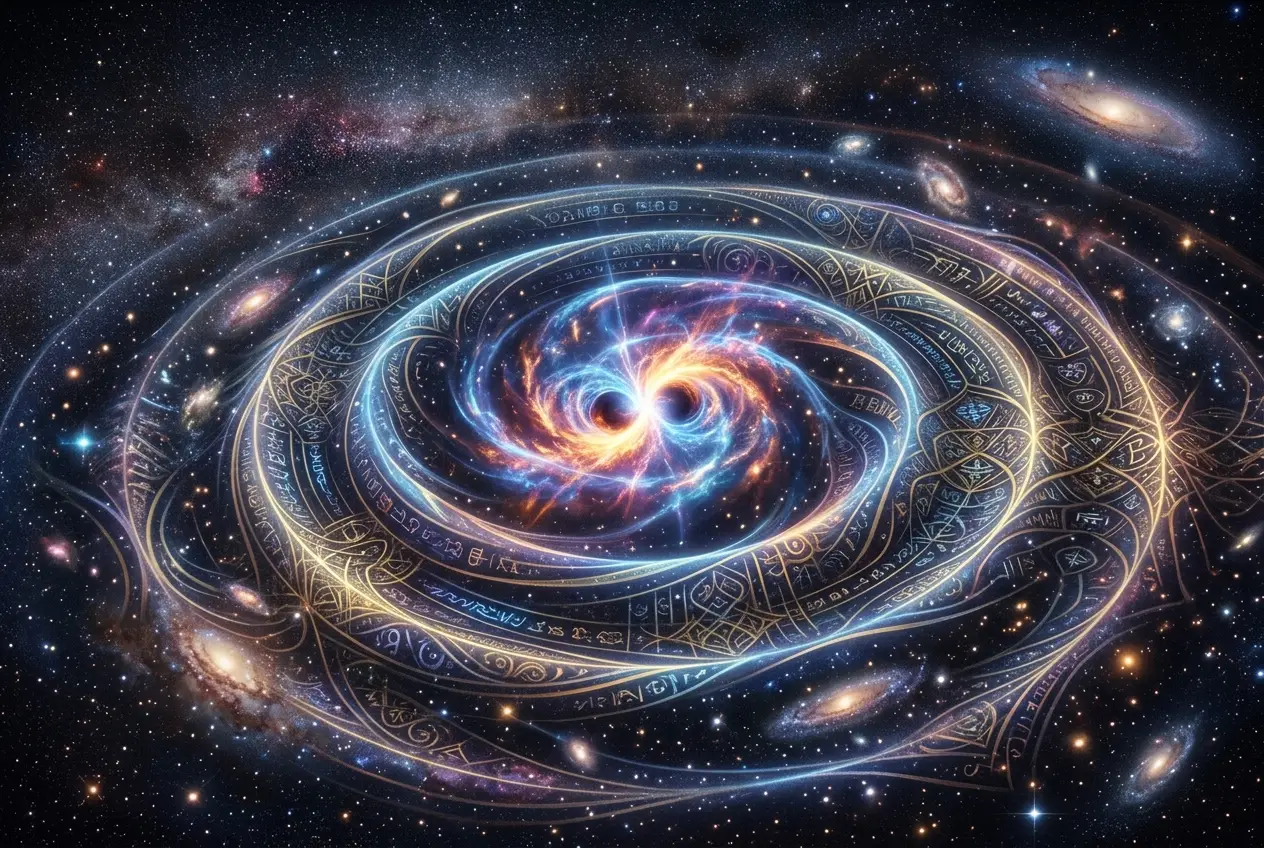
I often find myself gazing at the night sky, not just admiring the stars, but wondering about the whispers they might send across the cosmos. We know light carries stories of distant galaxies, and neutrinos offer glimpses into the hearts of stars. But what about gravitational waves? These ripples in spacetime, born from the universe's most violent events, are already rewriting our understanding of cosmic phenomena. Yet, a deeper, more profound question lingers in the scientific community: **Are gravitational waves carrying unseen information, a hidden cosmic language waiting to be decoded?**
The thought is captivating. Imagine, for a moment, that the universe isn't just a vast, silent expanse, but a dynamic canvas where the very fabric of reality—spacetime itself—is subtly modulated, conveying data far beyond the echoes of black hole mergers or supernova explosions. I believe exploring this possibility isn't just science fiction; it's a frontier of physics that could unlock secrets about the universe's origin, its fundamental laws, and perhaps even forms of communication we can barely conceive.
### The Known Language of Gravitational Waves
Before we dive into the speculative, let’s ground ourselves in what we *do* know. Gravitational waves are disturbances in the curvature of spacetime, generated by accelerating masses. Think of it like dropping a stone into a pond; the ripples spread outwards. In the cosmos, these "stones" are colossal events: colliding black holes, merging neutron stars, or exploding supernovae.
The monumental detection of gravitational waves by the LIGO and Virgo observatories, first announced in 2016, confirmed a century-old prediction by Albert Einstein. These detections provide invaluable information about the masses, spins, and orbital dynamics of the celestial objects involved. They tell us about stellar evolution, the expansion rate of the universe, and even hint at new populations of black holes. You can learn more about this groundbreaking discovery and the science behind it on [Wikipedia's Gravitational Waves page](https://en.wikipedia.org/wiki/Gravitational_wave).
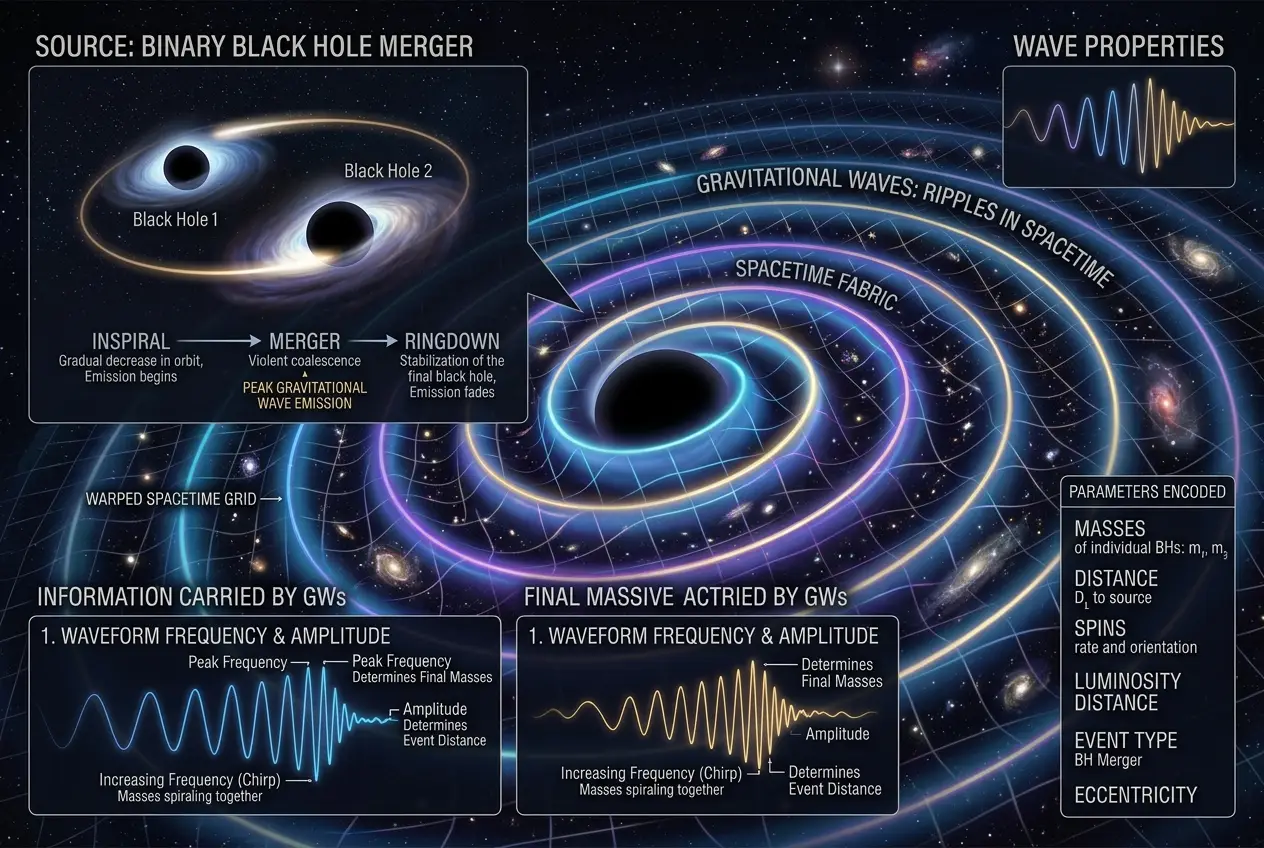
What we observe are the macroscopic effects – the amplitude and frequency changes that stretch and squeeze spacetime as they pass through Earth. This is already a profound amount of information. But could there be more subtle imprints, a deeper layer of data encoded within these cosmic undulations that current detectors are simply not equipped to register, or that our theoretical frameworks haven't yet considered?
### The Whispers Beyond the Roar: Embedding Unseen Data
The hypothesis of "unseen information" carried by gravitational waves is where science meets the speculative edge of our understanding. If other fundamental forces can carry complex data – light transmits images, sound carries voices, electromagnetic waves power our internet – why couldn't gravitational waves, the very fabric of reality, do the same?
One line of thought suggests that information could be embedded in ways that go beyond the simple waveform. Consider these possibilities:
* **Subtle Quantum Modulations:** If spacetime itself has a quantum nature (which quantum gravity theories suggest), then gravitational waves might carry quantum information. This could manifest as extremely faint, high-frequency modulations or even entangled states across vast distances. The idea that quantum phenomena might be intertwined with cosmic information isn't new; we've explored similar concepts in our blog post about whether
black holes store the universe's lost data.
* **Echoes from the Primordial Universe:** The early universe was a chaotic, high-energy environment. Gravitational waves from this era, known as the gravitational wave background, might contain information about phenomena that are inaccessible to light, such as phase transitions or the formation of exotic matter. Could these waves carry remnants of the very first moments of existence, like a cosmic fossil record?
* **Higher-Dimensional Imprints:** Some theoretical models propose extra spatial dimensions beyond the three we perceive. If these dimensions exist, gravitational waves, which are ripples in spacetime, might interact with them or even propagate through them. This could leave subtle imprints on the waves we detect, containing information about these hidden dimensions.
Deciphering such nuanced information would require a complete overhaul of our detection methods and perhaps a unified theory of quantum gravity. As of now, theories like Loop Quantum Gravity and String Theory attempt to reconcile general relativity with quantum mechanics. You can find more about these ambitious efforts on [Wikipedia's Quantum Gravity page](https://en.wikipedia.org/wiki/Quantum_gravity).
### The Challenge of Detection and Decoding
Detecting gravitational waves is already an incredible feat of engineering, involving interferometers so sensitive they can measure changes in distance smaller than one-thousandth the diameter of a proton. Discovering "unseen information" would push these limits even further.
* **Frequency and Amplitude:** Current observatories are optimized for specific frequency ranges, typically those produced by massive astrophysical events. Unseen information might exist at much higher frequencies, or with amplitudes so tiny they are currently indistinguishable from background noise.
* **Quantum Coherence:** If the information is quantum in nature, maintaining its coherence over vast cosmic distances and across interstellar medium presents enormous challenges. Decoherence would quickly scramble any delicate quantum data.
* **Theoretical Framework:** We need robust theoretical models to even hypothesize *what kind* of information might be carried and *how* it would manifest in the gravitational wave signal. Without a clear target, it's like searching for a needle in a haystack without knowing what a needle looks like.
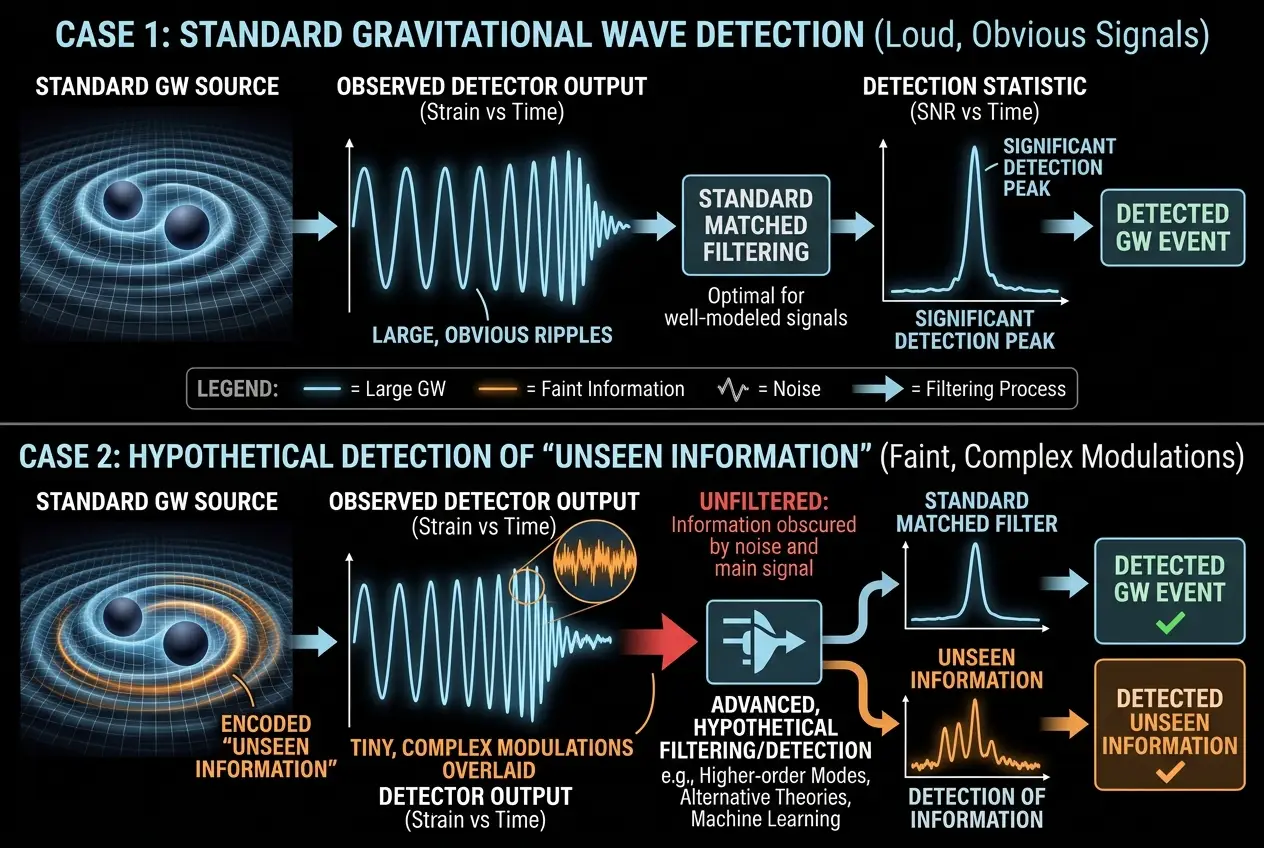
This pursuit echoes our continuous quest to understand universal communication, as explored in articles like
Decoding Cosmic Whispers: Is Light the Universe's Secret Language?.
### What if We Could Decode It?
The implications of decoding hidden information in gravitational waves would be nothing short of revolutionary.
1. **A New Window into Cosmology:** We could gain unprecedented insights into the very earliest moments of the universe, before light could freely travel. This could resolve mysteries about inflation, the nature of dark matter, and even the existence of exotic relics from the Big Bang.
2. **Fundamental Physics Breakthroughs:** Understanding how information is encoded in spacetime could provide crucial clues for developing a unified theory of everything, linking gravity with quantum mechanics and other fundamental forces. It could reveal new aspects of information theory itself, as discussed on [Wikipedia's Information Theory page](https://en.wikipedia.org/wiki/Information_theory).
3. **Beyond Communication:** While direct communication might be highly impractical due to the energy required to generate detectable, modulated gravitational waves, the *information learned* could be far more valuable. It could reveal fundamental constants, physical laws, or even blueprints for advanced technologies from other parts of the universe (though this is venturing into far more speculative territory).
4. **The Universe as a Computer:** The idea that the universe itself might function as a form of cosmic computer has been explored in various contexts, including our article
Is the Universe a Giant Neural Network? If gravitational waves carry intrinsic data, it adds another layer to this fascinating concept.
### The Future of Gravitational Wave Astronomy
The journey to potentially uncover these cosmic secrets is long but promising. Current ground-based detectors like LIGO, Virgo, and Kagra are continuously being upgraded. Next-generation observatories, such as the Cosmic Explorer and Einstein Telescope, will be significantly more sensitive.
Perhaps even more critical are proposals for space-based observatories like LISA (Laser Interferometer Space Antenna). Untouched by terrestrial noise, LISA will be capable of detecting much lower frequency gravitational waves, potentially opening up entirely new windows into the universe's gravitational symphony. These future instruments might just have the sensitivity required to tease out the faint, intricate patterns that signify "unseen information."
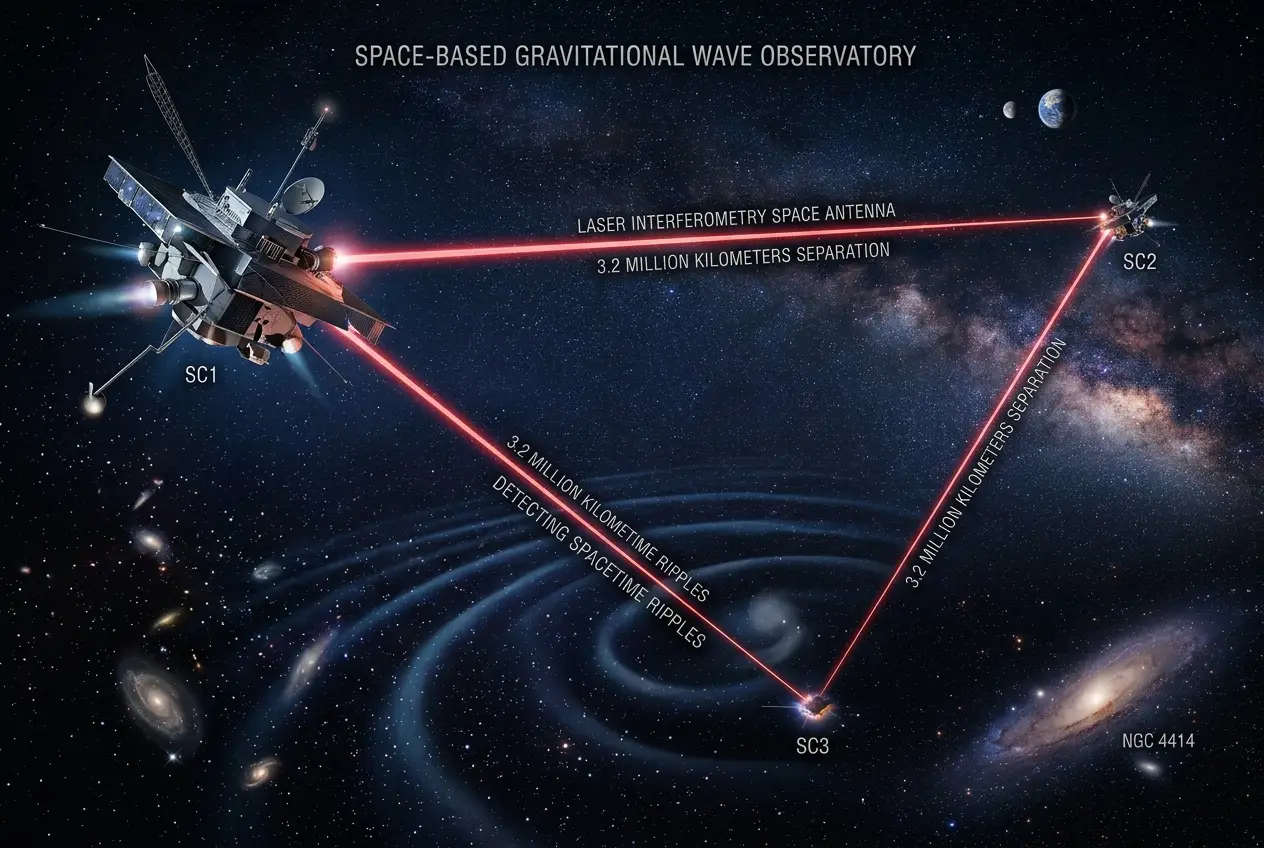
The quest to understand gravitational waves is a testament to humanity's insatiable curiosity. What began as a theoretical prediction has blossomed into a vibrant field of observational astronomy. Whether these waves are simply cosmic messengers of cataclysmic events or profound carriers of hidden universal data remains an open, exhilarating question. As I consider the possibilities, I'm reminded that the universe is far more intricate and information-rich than we can currently grasp, and every ripple in spacetime holds the potential to unveil an entirely new chapter in its story.
 Join Us
 Unknown Author














Leave a Reply
Comments (0)