Recently, I was absolutely captivated by an ancient artifact known as the **Lycurgus Cup**. This seemingly ordinary Roman cage cup from the 4th century CE holds a secret so astonishing, it forces us to reconsider what we thought we knew about ancient technology. When light hits it from the front, it appears a dull jade green. But shine a light *through* it, and it transforms into a fiery, translucent ruby red. This isn't magic; it’s a sophisticated optical phenomenon that scientists only fully understood in the 20th century, involving something we now call **nanoparticles**.
It makes you wonder, doesn't it? Could artisans from nearly two millennia ago have unknowingly, or perhaps even knowingly, manipulated materials at a scale that predates modern nanotechnology by over a thousand years? This question isn't just about a single cup; it’s about a broader re-evaluation of the capabilities of ancient civilizations, particularly the Romans, who were masters of engineering and architecture. I've often thought about how much hidden knowledge might still be locked away in history, waiting for us to catch up.
## The Enigma of the Lycurgus Cup: A Dichroic Marvel
The Lycurgus Cup is the star example of dichroic glass, meaning it appears to be different colors depending on the lighting conditions. This effect isn't just aesthetic; it's a direct result of its unique composition. When scientists finally got a chance to examine fragments of the cup in the 1990s, they discovered something truly groundbreaking: the glass was embedded with tiny particles of **gold and silver**, incredibly uniform in size, measuring just about 50 to 100 nanometers in diameter. For perspective, a human hair is about 80,000 to 100,000 nanometers thick. These particles are so small they interact with light in ways macroscopic materials simply cannot.
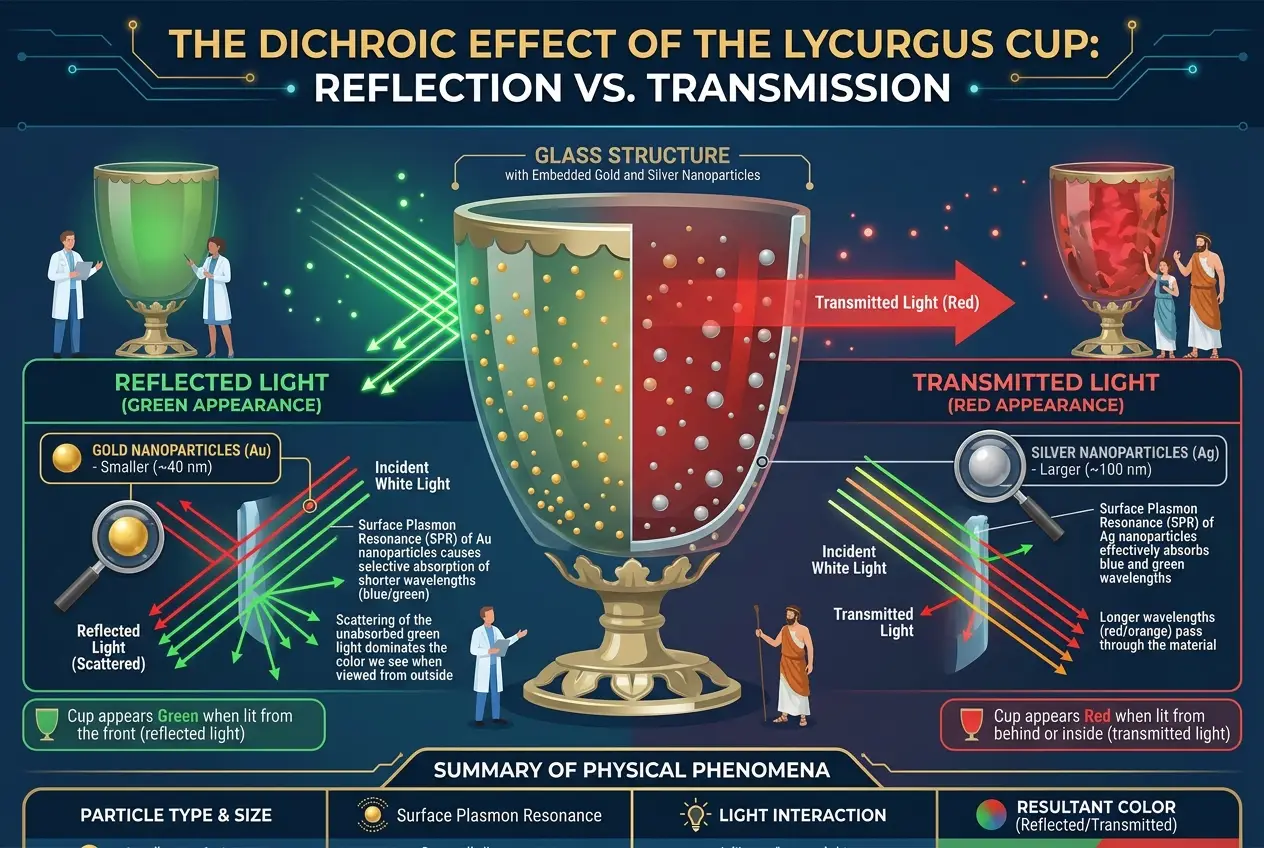
The science behind the cup's color-shifting ability lies in a phenomenon called **surface plasmon resonance**. When light interacts with nanoparticles, especially metals like gold and silver, the free electrons on their surface oscillate collectively. The specific wavelength of light absorbed or scattered depends heavily on the size, shape, and proximity of these nanoparticles. For the Lycurgus Cup, the gold and silver nanoparticles scatter green light and transmit red light, giving it its remarkable dual personality.
The precision of the nanoparticle size is crucial. If the particles were too large or uneven, the effect would be muddled, resulting in an opaque, murky glass rather than the vibrant, color-changing masterpiece we see. This begs the question: how did Roman glassmakers achieve such incredible consistency without electron microscopes or modern chemical analysis tools?
## Ancient Craftsmanship Meets Modern Nanotechnology
The Romans were renowned for their advancements in glassmaking. From transparent window panes to intricate mosaic tesserae and stunning decorative vessels, their glass industry was highly sophisticated. They mastered techniques like glass blowing, molding, and engraving. However, the Lycurgus Cup stands out, suggesting an understanding, or at least an empirical mastery, of material science far beyond what we typically attribute to them.
I often think about the painstaking process. Imagine a Roman glassmaker, perhaps an alchemist in a way, experimenting endlessly with different metallic compounds and firing conditions. They wouldn't have known about "nanoparticles" or "surface plasmon resonance," but they would have observed the *effects*. They would have noticed that adding specific amounts of finely ground gold and silver powders to the molten glass, under controlled heating and cooling, could yield astonishing results. This was likely a trial-and-error process spanning generations, a closely guarded secret passed down through apprenticeships.
> "The Lycurgus Cup is one of the most technologically advanced glass objects known from antiquity, demonstrating a mastery of material science that approaches modern nanotechnology." – The British Museum
This quote from the British Museum, where the cup is housed, underscores the profound significance of this discovery. It’s not merely a beautiful object; it’s a testament to ancient human ingenuity and observational prowess. We tend to view history through the lens of modern progress, often underestimating the scientific intuition and experimental rigor that existed in antiquity.
## Beyond the Lycurgus Cup: Hints of Nanoscale Manipulation?
While the Lycurgus Cup is the most famous example, some researchers suggest that other ancient artifacts might also exhibit characteristics pointing to a rudimentary understanding of nanoscale materials.
For instance, the vibrant, deep red glaze known as **"Samian ware"** (or Terra Sigillata) pottery, widely produced in the Roman Empire, has been found to contain nanoscale iron oxide particles. These tiny particles are responsible for the pottery's distinct color and glossy finish. While perhaps not as dramatic as the Lycurgus Cup, it illustrates how skilled ancient artisans inadvertently (or perhaps through empirical knowledge) worked with materials at a micro- or even nanoscale level to achieve desired properties. This Roman pottery was incredibly widespread and durable; you can still find intact pieces today. To understand more about the longevity of ancient materials, you might be interested in reading about how
Roman Concrete: Did Ancients Engineer Self-Healing Tech?
Another area of interest is **Damascus steel**. Though not Roman, its legendary strength and distinctive wavy pattern (known as *wutze*) have led some modern metallurgists to speculate about the presence of carbon nanotubes or carbide nanoparticles within its structure. While the exact composition remains a subject of debate and scientific replication challenges, the persistent claims and the material's unparalleled qualities suggest that ancient smiths might have, again, empirically stumbled upon ways to manipulate materials at scales we now understand as nanoscale. If you're fascinated by ancient metallurgy, you might want to check out this related article:
Damascus Steel: Did Ancient Smiths Use Nanotech?
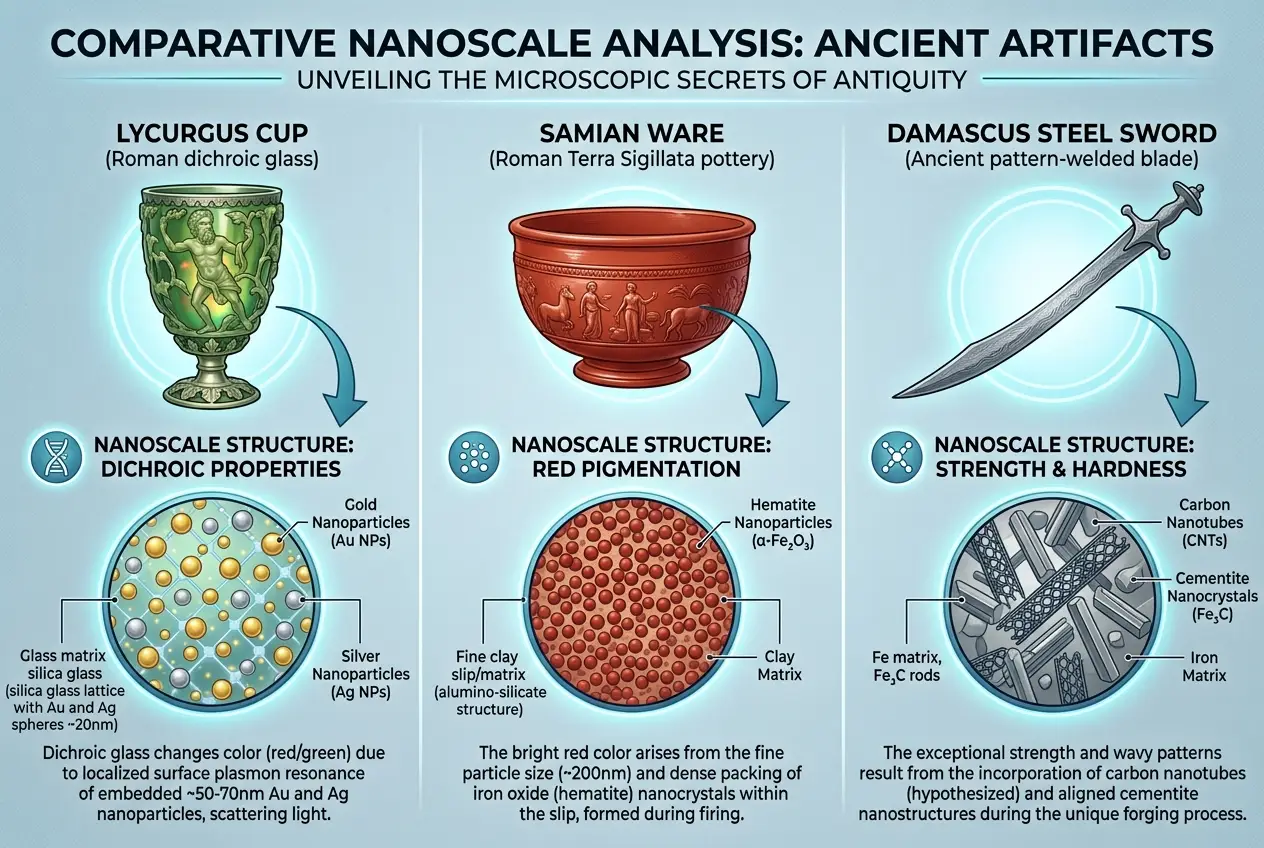
The implications of these discoveries are profound. They challenge the linear narrative of scientific progress, suggesting that advanced material properties achieved through nanoscale manipulation weren't entirely confined to the modern era. Instead, ancient civilizations possessed a profound empirical understanding of materials, honed through centuries of observation, experimentation, and cultural transmission of knowledge.
## The Mechanisms: How Could They Do It?
The precise methods used by Roman glassmakers to create the Lycurgus Cup's glass remain a subject of active research and speculation. However, based on modern understanding of nanoparticle synthesis and ancient metallurgical practices, several theories have emerged:
1. **Controlled Alloying and Precipitation:** The gold and silver could have been introduced as an alloy into the molten glass mixture. Careful control of temperature, cooling rates, and oxygen levels could lead to the precipitation of uniformly sized nanoparticles within the glass matrix.
2. **Reduction-Oxidation Reactions:** Ancient artisans might have used reducing agents (like charcoal or organic matter) or oxidizing agents in specific atmospheric conditions within their kilns. These agents could have facilitated the formation and growth of metallic nanoparticles from dissolved metal salts in the glass. For example, Roman glassmakers were known to use bone ash and other mineral additives that could have played a role in these chemical reactions.
3. **Empirical Knowledge of Pigments:** It's plausible that they observed that certain finely ground metallic powders, when added to glass, produced distinct and sometimes surprising optical effects. Through countless trials, they could have perfected the "recipe" for such dichroic glass, even if they didn't understand the underlying physics.
4. **Specialized Furnaces and Techniques:** The consistency of nanoparticle size suggests highly controlled firing conditions. This would require advanced furnace designs and temperature regulation methods, potentially far more sophisticated than generally assumed for the era. The very act of
Roman glassmaking was a complex industrial process, with specialized workshops producing vast quantities of high-quality glass.
The fact that only a handful of dichroic Roman glass pieces survive suggests that this was either an extremely rare technique, difficult to master, or perhaps reserved for objects of immense value and prestige. The Lycurgus Cup itself is believed to have been a luxury item, possibly used for ceremonial purposes or owned by royalty.
## Replicating the Past, Understanding the Future
Modern scientists have successfully replicated the dichroic effect of the Lycurgus Cup using contemporary nanoparticle synthesis techniques. This replication not only confirms the presence and role of nanoparticles but also offers insights into how such an achievement might have been possible in ancient times. Researchers often draw parallels between ancient craft and modern science. For instance, the discussion around ancient energy generation or mapping technologies often intersects with how we approach similar challenges today. You can read more about such historical tech in our blog on
Did Ancients Map Galaxies? Unpacking Lost Cosmic Charts.
The study of ancient materials like the Lycurgus Cup is more than just historical curiosity. It contributes to our understanding of materials science and nanotechnology. By analyzing how ancient civilizations achieved such impressive feats with limited tools, we can gain new perspectives on material properties and potentially inspire novel approaches in modern engineering. It highlights the power of empirical observation and sustained experimentation, proving that sometimes, simply *doing* and *observing* meticulously can lead to breakthroughs that seem almost prescient.
So, did Roman glassmakers "build" a cosmic computer? No, not in the way we understand it. But did they possess an empirical mastery over materials at a nanoscale level, creating objects that exhibit properties we now associate with cutting-edge science? Absolutely. The Lycurgus Cup is a dazzling reminder that innovation isn't a linear path, and sometimes, the answers to our future tech curiosities might be hidden in plain sight, shining through the glass of our past.
 Join Us




 Unknown Author


































Leave a Reply
Comments (0)