


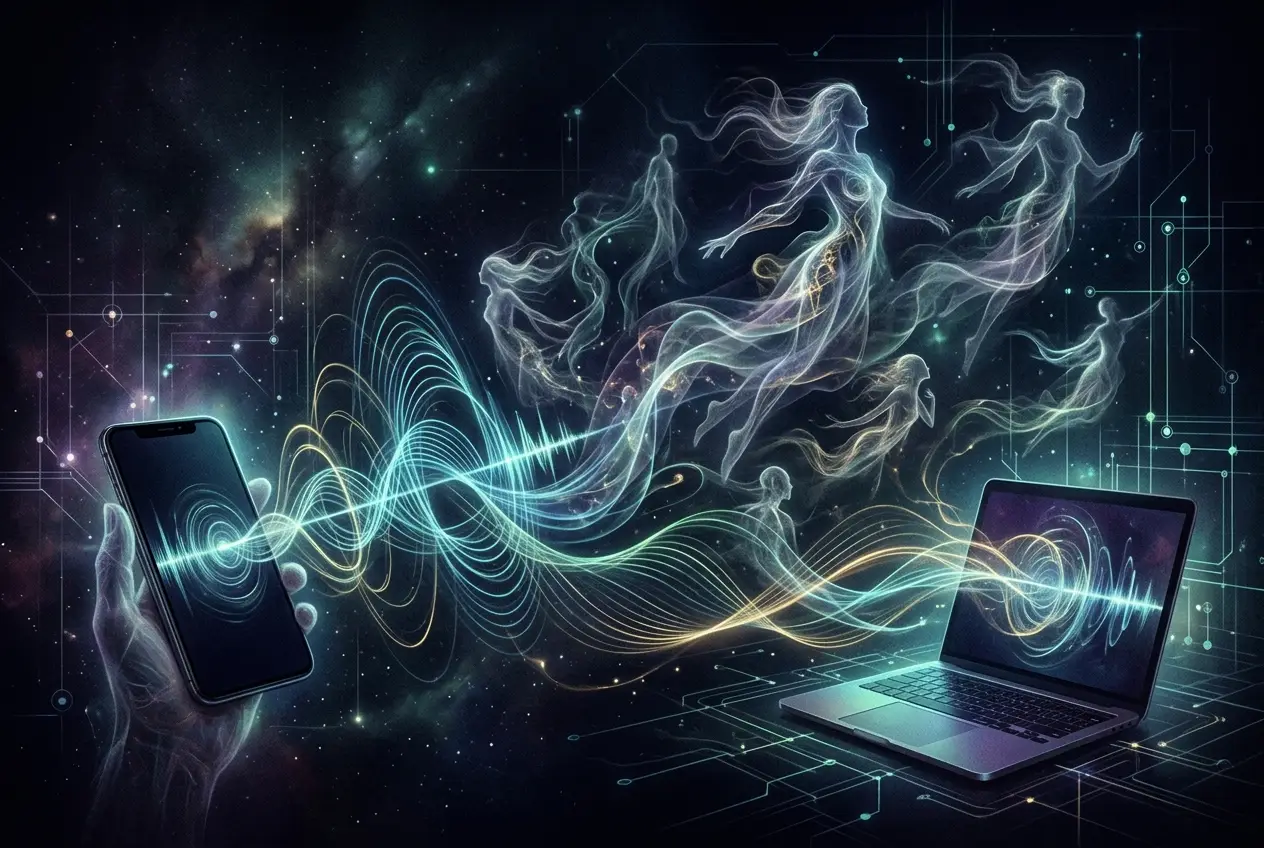
I remember a late night, working on a complex project, when I swore I heard my phone buzz. It wasn't just a faint vibration; it felt distinct, pulling my attention away from the screen. I checked, but the screen remained dark, no new notification, no call. A quick glance at my partner, sound asleep, confirmed I was alone in my silent perception. This wasn’t an isolated incident; it’s a curious phenomenon many of us experience: phantom vibrations or, even stranger, phantom ringing and voices. But what if I told you these aren't just quirks of our perception, but perhaps a glimpse into how our increasingly digital world interacts with our minds, sometimes conjuring sounds that aren't truly there?
The world around us is saturated with digital noise. From the subtle hum of a server farm to the intricate algorithms that shape our audio experiences, technology is constantly processing, compressing, and transmitting sound. It's a symphony of data, largely inaudible, yet it forms the backdrop of our modern existence. This raises a fascinating question: can this digital landscape, combined with our powerful yet fallible brains, inadvertently create "phantom sounds" – auditory illusions that seem to emanate from our devices, or even from the very air around us?
The Science of Sonic Shadows: Auditory Pareidolia
Before we dive into the digital realm, let's understand a fundamental aspect of human perception: auditory pareidolia. This is the tendency for our brains to perceive familiar sounds or patterns (like voices or music) in ambiguous or random noise. Think of hearing a specific melody in the static of a radio, or interpreting wind howling through a chimney as words. Our brains are hardwired pattern-recognition machines, constantly trying to make sense of the sensory input they receive. In the absence of clear signals, they often fill in the gaps, drawing from our experiences and expectations.
When it comes to digital devices, this phenomenon gains a new layer of complexity. Our smartphones, computers, and smart speakers are designed to emit specific sounds – notifications, alerts, voice assistants. We’ve become conditioned to expect these sounds, creating a powerful psychological predisposition. If you've ever heard your phone ring, only to realize it was actually a car alarm outside or a distant siren, you’ve experienced a mild form of this. The brain, anticipating a familiar digital sound, interprets ambiguous noise as such.
Digital Artifacts: When Technology Tricks Our Ears
Beyond psychological predisposition, the very nature of digital audio processing can contribute to phantom sounds. Digital sound is not continuous; it's sampled, compressed, and then decompressed. This process, while incredibly efficient, is not flawless. Think of it this way: when a sound is recorded digitally, it's essentially broken down into thousands of tiny numerical snapshots. These snapshots are then reassembled to reproduce the original sound. Compression algorithms further streamline this by discarding information deemed "less important" to save space. While often imperceptible to the human ear, these processes can introduce digital artifacts. These artifacts are unintended alterations or distortions in the audio signal. They can manifest as faint clicks, hisses, or even subtle, almost subliminal, harmonic content that our brains might try to interpret.
Imagine a highly compressed audio file. The original richness of the sound is stripped down. When played back, particularly through low-quality speakers or headphones, the system tries to "fill in" the missing data, sometimes creating subtle noises that our brain, ever the pattern-seeker, might misinterpret as speech or familiar alerts. This is akin to a blurry image where your brain struggles to identify objects.
Furthermore, electromagnetic interference (EMI) plays a significant role. Our digital devices are miniature radios, constantly sending and receiving electromagnetic waves. These waves can interfere with audio circuits, creating audible static, hums, or even faint "ghost" signals. Have you ever heard a cell phone's distinct interference pattern through an old radio or speaker right before it rings? That’s EMI in action. While devices are designed to minimize this, in certain environments or with sensitive equipment, these interferences can become perceptible, especially to an attuned ear, sometimes even mimicking patterns that sound like faint voices or tones. Learn more about electromagnetic interference on Wikipedia (opens in a new tab).
The Unsettling Case of V2K: Voices in the Head
While most phantom sounds are benign, there's a more unsettling, albeit rare, phenomenon known as "Voice-to-Skull" (V2K) or "Synthetic Telepathy." This concept often appears in unverified claims and conspiracy theories, but the scientific basis for some forms of perceived internal voices might stem from directed energy technologies. The Frey effect, or microwave auditory effect, is a real scientific phenomenon where a human can perceive sounds (clicks, buzzes, speech) induced by pulsed or modulated radiofrequency electromagnetic fields. These sounds are not perceived through the ears, but as if originating from within or immediately behind the head.
While the technology for precisely modulated and directed acoustic or microwave energy exists, its application for "mind control" or widespread V2K is largely speculative and lacks credible scientific evidence in most alleged cases. However, the scientific possibility that certain directed energy could induce auditory perceptions within the skull underscores the delicate interplay between electromagnetic fields, our physiology, and the perception of sound, blurring the lines between external signals and internal experience. For an in-depth understanding of the microwave auditory effect, you can refer to its Wikipedia page (opens in a new tab).
AI and the Future of Sound Perception
As artificial intelligence becomes more sophisticated in processing and generating audio, the concept of "phantom sounds" takes on a new dimension. AI systems are trained on vast datasets of human speech, music, and environmental sounds. They excel at pattern recognition, often surpassing human capabilities. Consider an AI-powered noise cancellation system. Such a system doesn't just block sound; it actively analyzes incoming audio, identifies unwanted noise, and generates "anti-noise" to cancel it out. What happens when these complex algorithms encounter ambiguous background noise? Could an AI, in its attempt to clean up audio or interpret a faint signal, inadvertently "create" or enhance patterns that sound like voices or alerts, even if they aren't truly there?
Furthermore, generative AI can create hyper-realistic voices and sounds from scratch. Imagine an AI designed to mimic human speech. If such an AI were to generate audio in a noisy environment or based on incomplete data, its output could easily be mistaken for a real human voice, especially if our brains are primed to detect such patterns. This leads to interesting questions about the future of digital authentication and the reliability of audio evidence. Can AI truly feel? Some research dives into the emotional processing capabilities of advanced AI, which could influence how they interpret or even project auditory experiences. You can read more about this in our blog post, "Can AI Truly Feel? Decoding Digital Empathy."
The Digital Echoes in Our Minds
Our reliance on technology has fundamentally altered our auditory landscape. We're constantly alert for notifications, conditioned to respond to pings and rings. This heightened state of digital awareness makes us more susceptible to misinterpreting ambient noise as digital signals. It’s a form of hyper-vigilance, an evolutionary trait repurposed for the digital age.
The line between a genuine digital signal and a phantom sound is often blurry, influenced by factors like stress, fatigue, and the sheer volume of sensory input we process daily. Our brains, powerful as they are, are also susceptible to suggestion and error. The digital world doesn't just present us with information; it subtly shapes our perception of reality, including what we hear. These "phantom sounds" are not necessarily a sign of malfunction in our devices or our minds, but rather a fascinating interplay between the two. They highlight how profoundly technology has integrated itself into our very sensory experience. For more on how technology might create unexplained behaviors, explore "Digital Anomalies: Can Computers Show Unexplained Behaviors?."
Conclusion: Listening to the Unseen
So, do phantom sounds truly haunt our digital world? The answer is a nuanced yes. They aren't malicious entities or supernatural occurrences. Instead, they are complex phenomena born from the intersection of our powerful, pattern-seeking brains, the inherent limitations and artifacts of digital audio processing, and the pervasive electromagnetic landscape of our technological environment. These digital echoes serve as a reminder of our intimate, often unconscious, connection with the technology that surrounds us. They invite us to listen more critically, not just to the sounds themselves, but to the fascinating processes by which our minds and machines conspire to create our auditory reality. As technology advances, understanding these phantom sounds will not only enhance our user experience but also deepen our comprehension of human perception in an increasingly digitized world.




Conversation0
No comments yet. Be the first to share a thought — the best questions often become new stories.