Sometimes, I find myself staring up at the night sky, not just admiring its beauty, but pondering the sheer scale of the universe and the unknown forces at play within it. It’s a feeling that often leads me down scientific rabbit holes, exploring the phenomena that challenge our understanding of physics. Recently, my curiosity was piqued by one of the most enigmatic mysteries in modern astrophysics: **Ultra-High Energy Cosmic Rays (UHECRs)**. These aren't your everyday cosmic particles; they are subatomic projectiles, mainly protons and atomic nuclei, that travel through space at velocities incredibly close to the speed of light, carrying energies far exceeding anything we can generate in our most powerful terrestrial accelerators.
Imagine a single particle hitting the Earth's atmosphere with the kinetic energy of a baseball thrown at 100 mph. That's the mind-boggling scale of energy we're talking about with some UHECRs. For years, scientists have detected these cosmic behemoths, but their origins remain shrouded in mystery. Where do they come from? What kind of cosmic engines could possibly accelerate particles to such extreme energies? And, more profoundly, **do these enigmatic rays hint at a new, undiscovered physics** that could fundamentally alter our understanding of the universe?
### The Cosmic Speed Demons: What Are UHECRs?
Cosmic rays are essentially high-energy particles that originate from outer space and bombard Earth. Most cosmic rays are relatively low-energy, originating from our Sun or supernovae within our galaxy. However, UHECRs are in a league of their own. They are defined as cosmic rays with energies exceeding 10^18 electronvolts (eV), or one exa-electronvolt (EeV). The highest energy event ever recorded, known as the "Oh-My-God" particle, registered an astounding 3 x 10^20 eV – that's roughly equivalent to the kinetic energy of a 140-gram baseball travelling at 95 km/h (60 mph)!
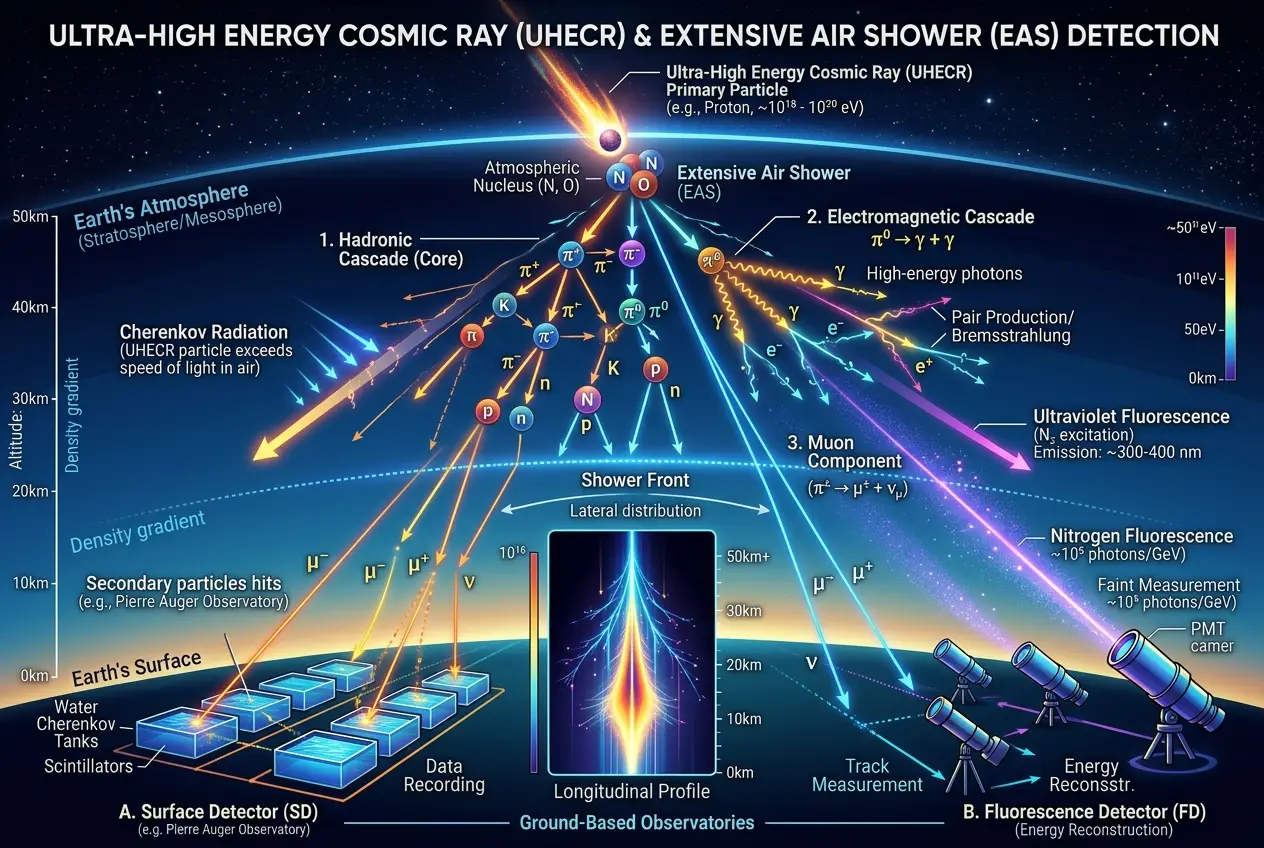
When these particles hit Earth's upper atmosphere, they collide with atomic nuclei, initiating a cascade of secondary particles known as an **extensive air shower**. This shower can span several square kilometers by the time it reaches the ground, leaving a detectable "footprint" that allows scientists to reconstruct the energy and direction of the primary UHECR. This is how observatories like the Pierre Auger Observatory in Argentina and the Telescope Array in Utah detect these elusive visitors.
### The Enigma of the GZK Limit
One of the most perplexing aspects of UHECRs is their seeming violation of a fundamental astrophysical prediction known as the **Greisen–Zatsepin–Kuzmin (GZK) limit**. This theoretical limit, proposed in 1966, states that cosmic rays with energies above approximately 5 x 10^19 eV should interact with the photons of the cosmic microwave background (CMB) radiation. These interactions, specifically the production of pions, would sap the UHECRs' energy, effectively preventing them from traveling more than about 160 million light-years before their energy drops below the limit.
In simpler terms, if UHECRs originate from distant sources, they *shouldn't* reach us with such extreme energies. Yet, they do. This phenomenon has led to what is sometimes called the "GZK paradox." The detection of UHECRs above this limit implies a few possibilities:
1. **Nearby Sources:** The sources of UHECRs are much closer than originally thought, within the GZK interaction distance, allowing them to retain their super-high energies.
2. **Violation of Known Physics:** The particles themselves, or the way they interact with the CMB, might be governed by physics beyond our current Standard Model.
3. **Exotic Particles:** UHECRs might not be ordinary protons or nuclei but something more exotic, such as neutrinos or even hypothetical particles like WIMPs (Weakly Interacting Massive Particles) or super-heavy dark matter.
The GZK limit is a cornerstone of cosmic ray physics, and its apparent challenge by UHECR observations has fueled intense scientific debate and research for decades. As one physicist, Paul Frampton, once noted, "The GZK cutoff means that we should not be able to see particles from far away sources if they are above this energy, because they would be destroyed by collisions with microwave photons." (Source: *The GZK Puzzle*). The fact that we do see them forces us to reconsider.
### Searching for Cosmic Accelerators: Known Candidates and Their Limitations
So, if UHECRs defy the GZK limit or imply nearby sources, what could these cosmic accelerators be?
Scientists have proposed several candidates for these "Extreme Particle Factories":
* **Active Galactic Nuclei (AGN):** These are the incredibly bright centers of some galaxies, powered by supermassive black holes accreting matter. The jets launched from AGNs are highly energetic and could theoretically accelerate particles to UHECR energies. However, observing a direct correlation between known AGNs and UHECR arrival directions has been challenging, partly due to the deflection of charged cosmic rays by interstellar and intergalactic magnetic fields.
* **Gamma-Ray Bursts (GRBs):** These are the most powerful explosions in the universe, believed to originate from the collapse of massive stars or the merger of neutron stars. While GRBs certainly possess the energy, their transient nature and the rapid expansion of their fireballs make it difficult for particles to be trapped and accelerated to UHECR levels.
* **Pulsars and Supernova Remnants:** While excellent accelerators for lower-energy cosmic rays, most theoretical models suggest they lack the power to generate particles above the GZK limit.
The problem is that even the most powerful known astrophysical objects struggle to explain the sheer energy and isotropy (uniformity from all directions) of UHECRs. The "ankle" and "toe" features in the UHECR spectrum hint at different populations or origins, further complicating the picture. You can learn more about the universe's most extreme environments, like those powered by black holes, by exploring our blog post on [Do Black Holes Store Universe's Lost Data?](/blogs/do-black-holes-store-universes-lost-data-5797).
### The "New Physics" Hypothesis: Beyond the Standard Model
This is where the idea of "new physics" truly comes into play. If conventional astrophysical sources can't fully account for UHECRs, then perhaps these particles are harbingers of undiscovered phenomena or fundamental changes in our understanding of space-time and matter.
#### Dark Matter Decays and Exotic Particles
One intriguing hypothesis suggests that UHECRs might originate from the decay of super-heavy **dark matter** particles. If such particles exist and are distributed throughout the universe, their infrequent decays could produce UHECRs isotropically, explaining the lack of definitive point sources. This would also sidestep the GZK limit if the decays occur relatively close to Earth. This ties into broader questions about dark matter, a mysterious substance that makes up about 27% of the universe's mass but remains undetected.
Another possibility is that UHECRs are not standard protons but rather some form of **exotic particle** that interacts less frequently with the CMB, allowing it to travel farther without losing energy. Such particles could be hypothetical WIMPs, axions, or other particles predicted by theories beyond the Standard Model. This would mean that UHECR detectors are, in essence, probing a hidden sector of particle physics.
#### Lorentz Invariance Violation
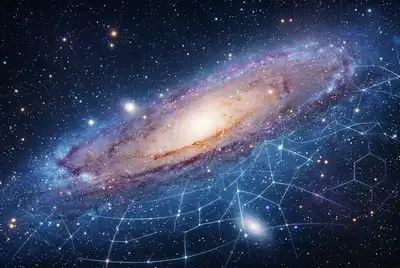
A more radical idea involves the **violation of Lorentz invariance**. Lorentz invariance is a cornerstone of special relativity, stating that the laws of physics are the same for all observers in uniform motion. If Lorentz invariance is slightly violated at extremely high energies, the GZK limit might be circumvented. This is a profound concept, suggesting that the speed of light might not be a constant barrier at all energy scales or that space-time itself has a granular structure that becomes apparent at these extreme energies. The implications of such a discovery would be immense, potentially requiring a complete overhaul of modern physics.
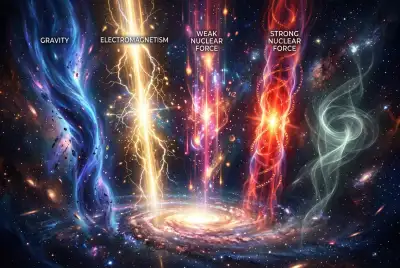
Could there be other fundamental forces at play that we haven't yet discovered, influencing these extreme particles? This question echoes discussions about whether [What If Physics Missed A Fifth Universal Force?](/blogs/what-if-physics-missed-a-fifth-universal-force-2601) The universe is full of subtle clues, and UHECRs might be shouting about one.
### The Future of UHECR Research: Unlocking Cosmic Secrets
The quest to understand UHECRs is far from over. New and upgraded observatories, such as the proposed **Giant Radio Array for Neutrino Detection (GRAND)** and the expansion of existing facilities, aim to dramatically increase the number of detected UHECRs and improve their angular resolution. By combining data from different detection methods (fluorescence telescopes, surface detector arrays), scientists hope to pinpoint sources with greater accuracy and distinguish between different particle types.
One of the key challenges is to better understand the magnetic fields between us and potential sources. These fields act like cosmic deflectors, bending the paths of charged particles and making it difficult to trace them back to their origins. Observing neutral UHECRs, like neutrinos or gamma rays, which are unaffected by magnetic fields, would offer a direct line of sight to these extreme cosmic accelerators.
The implications of finally solving the UHECR mystery extend far beyond astrophysics. If UHECRs indeed point to new physics, it could open doors to understanding:
* **The nature of dark matter:** Confirming the decay of super-heavy dark matter would be a monumental discovery.
* **Quantum gravity:** Violations of Lorentz invariance could provide experimental insights into how gravity behaves at the quantum level, bridging the gap between general relativity and quantum mechanics.
* **Extra dimensions:** Some theories, such as those involving [Deciphering Reality: Does The Universe Hide Extra Dimensions?](/blogs/decoding-reality-does-the-universe-hide-extra-dimensions-5269), propose that the GZK limit could be modified if particles can travel through these hidden dimensions, affecting their energy loss mechanisms. This is a truly mind-bending possibility.
* **The ultimate fate of the universe:** Understanding the most energetic processes could shed light on the universe's most extreme conditions and its evolutionary path.
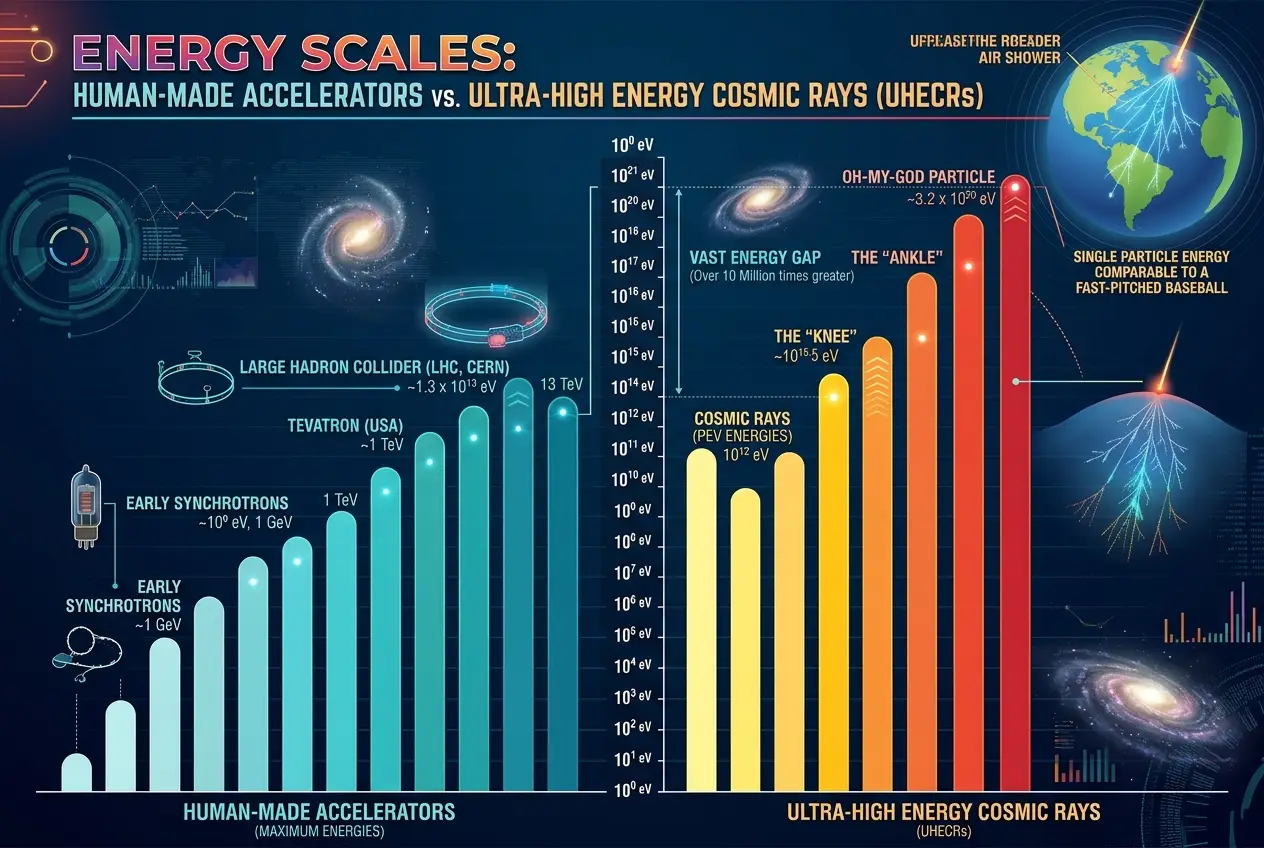
Ultimately, UHECRs are not just interesting cosmic phenomena; they are nature's most powerful particle accelerators, delivering probes of physics at scales we can only dream of replicating on Earth. Whether they reveal nearby, extraordinarily powerful conventional sources or point towards a fundamental breakdown in our known laws of physics, the answer will undoubtedly be revolutionary. I believe that by meticulously studying these cosmic messengers, we might just unlock the next great chapter in the story of the universe.
Frequently Asked Questions
The Greisen–Zatsepin–Kuzmin (GZK) limit is a theoretical maximum energy (around 5 x 10^19 eV) that cosmic rays can retain when traveling over long distances (beyond 160 million light-years). This is because at higher energies, they should interact with cosmic microwave background photons, losing energy. The detection of UHECRs above this limit is puzzling, suggesting either nearby sources or new physics.
While UHECRs carry immense energy, they are not considered a direct danger to humans on Earth. They are incredibly rare, and by the time they reach the ground, they have initiated an extensive air shower, distributing their energy among billions of secondary particles. Our atmosphere acts as an effective shield, protecting us from the primary particle's full impact.
The leading theories include powerful astrophysical objects like Active Galactic Nuclei (AGN), Gamma-Ray Bursts (GRBs), and fast-spinning pulsars. However, none of these fully explain all UHECR observations, particularly the highest energy events, leading to hypotheses involving exotic particles, dark matter decay, or even violations of fundamental physical laws like Lorentz invariance.
Scientists detect UHECRs indirectly by observing the extensive air showers they produce when colliding with Earth's atmosphere. Large ground-based observatories like the Pierre Auger Observatory use networks of detector stations spread over vast areas to measure the secondary particles (muons, electrons, photons) that reach the ground, reconstructing the original UHECR's energy and direction.
If UHECRs genuinely violate the GZK limit without nearby sources, it could imply that our understanding of particle interactions or space-time itself is incomplete. It might suggest the existence of new exotic particles that interact differently with the CMB, or even subtle violations of fundamental principles like Lorentz invariance, which would necessitate a revision of the Standard Model of particle physics and general relativity.
Verified Expert
Alex Rivers
A professional researcher since age twelve, I delve into mysteries and ignite curiosity by presenting an array of compelling possibilities. I will heighten your curiosity, but by the end, you will possess profound knowledge.
Leave a Reply
Comments (0)
No approved comments yet. Be the first to share your thoughts!
 Join Us



 Unknown Author


























Leave a Reply
Comments (0)