


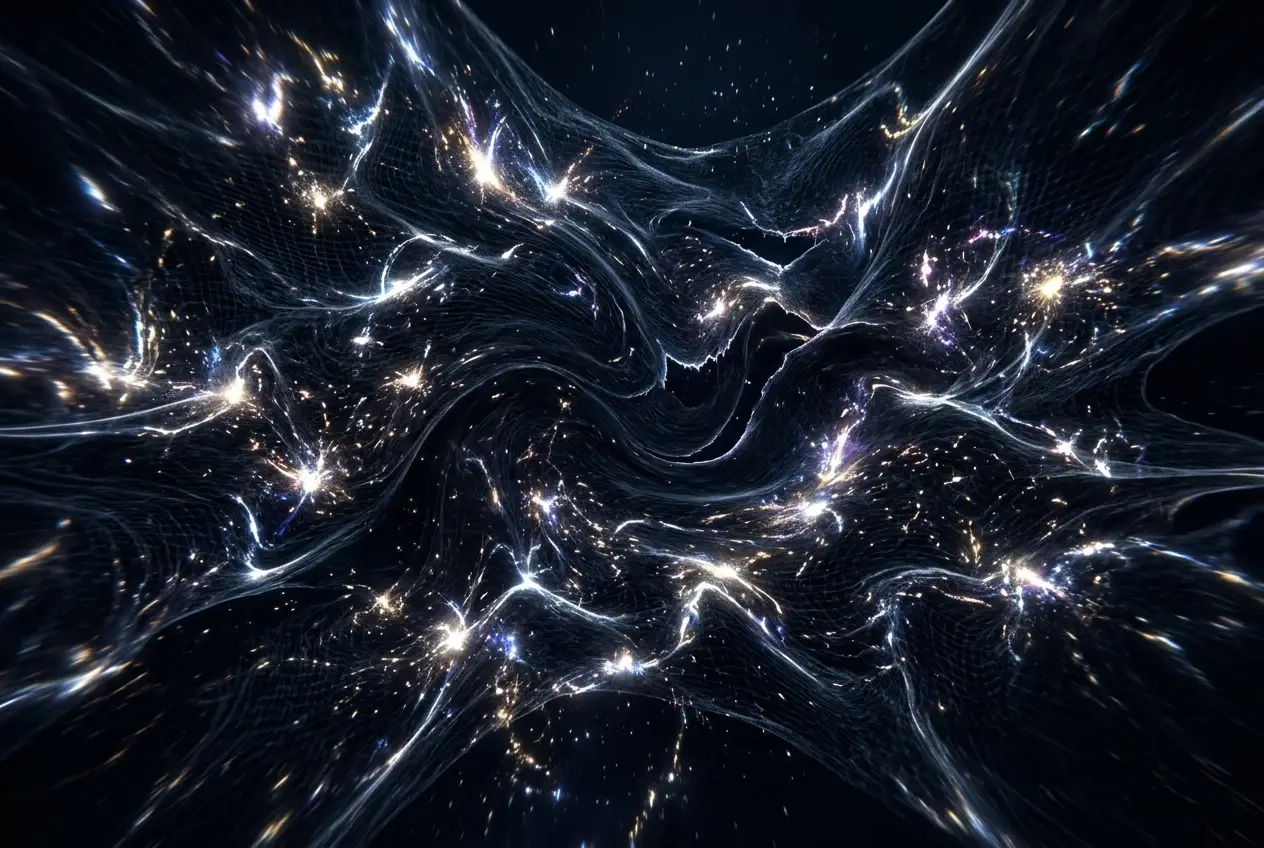
I've always been fascinated by the universe's grand illusion of smoothness. From the perfect curve of a planet's orbit to the seemingly unbroken flow of time, everything appears seamlessly connected. But what if this apparent perfection hides a deeper, more turbulent reality? What if the very fabric of spacetime, the stage upon which all cosmic drama unfolds, is not a continuous, unblemished sheet, but rather a tumultuous, frothing sea of quantum ripples, constantly forming and dissolving, potentially even tearing itself apart at its most fundamental level?
This isn't science fiction; it's the frontier of theoretical physics, where the seemingly disparate worlds of General Relativity (describing the large-scale universe) and Quantum Mechanics (governing the microscopic realm) collide. Understanding this intersection—what we call quantum gravity—is perhaps the greatest challenge facing modern physics. And at its heart lies the intriguing, almost unsettling, concept of spacetime being far more dynamic and less stable than our everyday experience suggests.
The Smooth Illusion: Einstein's Universe
For over a century, Albert Einstein's General Relativity has provided our most accurate description of gravity. It beautifully depicts spacetime not as a rigid, static backdrop, but as a flexible, four-dimensional fabric that can be warped and curved by mass and energy. Planets orbit the sun because the sun's immense mass creates a "dent" in spacetime, and the planets follow the shortest path through this curved geometry. This framework has successfully predicted phenomena from the bending of starlight to the existence of black holes and the expansion of the universe. It’s a theory of elegant continuity, where spacetime is a smooth, differentiable manifold. You can read more about it on Wikipedia's General Relativity page (opens in a new tab).
The Quantum Realm: A World of Jitters and Jumps
However, when we zoom down to incredibly tiny scales – the subatomic world – Einstein’s smooth spacetime breaks down. Here, quantum mechanics takes over, describing a universe that is inherently probabilistic, discrete, and perpetually in flux. Particles don't have definite positions and momenta; they exist as probability waves. Energy isn't continuous; it comes in discrete packets called quanta. This is a jittery, unpredictable realm, where even "empty" space is teeming with virtual particles popping into and out of existence.
The problem arises when we try to reconcile these two incredibly successful but fundamentally different descriptions. How can spacetime be both a smooth, continuous fabric and a discrete, fluctuating quantum field?
Diving into the Quantum Foam: The Fabric Unravels
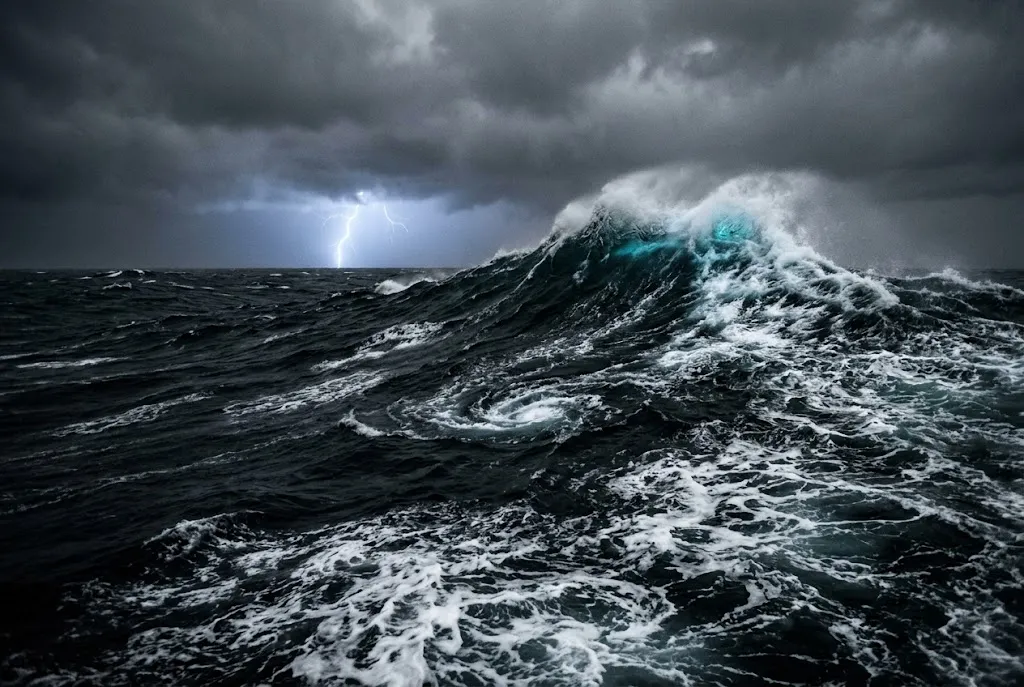
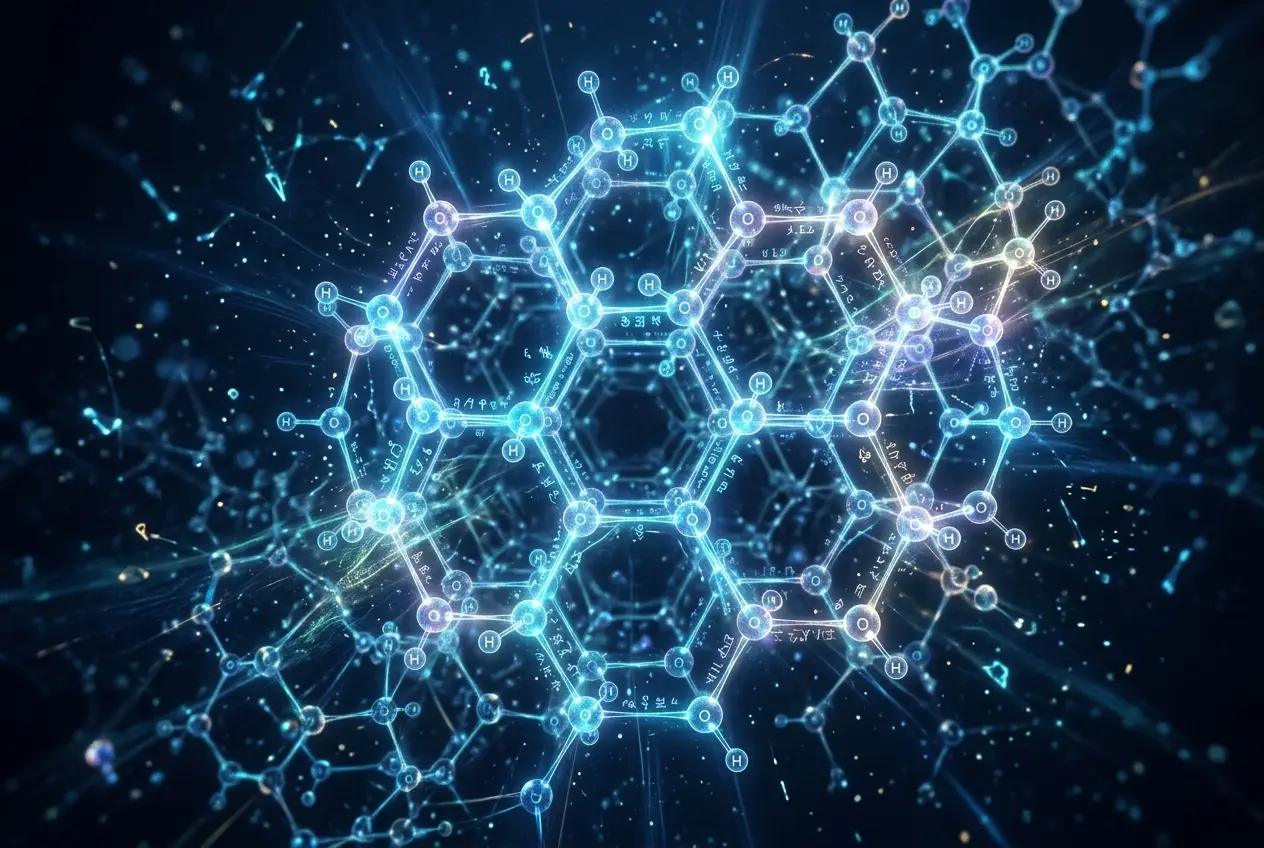
Imagine trying to look at a calm ocean from a high altitude. It appears smooth and uniform. Now, imagine diving into that ocean. You're immediately surrounded by chaotic waves, currents, and splashes. Physicists theorize that spacetime behaves similarly. While it appears smooth at macroscopic scales, at the Planck length (an unimaginably tiny scale of approximately 10^-35 meters), it becomes a chaotic "quantum foam."
At this extreme scale, quantum fluctuations in the gravitational field become so intense that they are theorized to tear spacetime into a constantly changing, bubbling froth of wormholes and virtual black holes. This isn't just a metaphor; it's a consequence of the Heisenberg Uncertainty Principle applied to energy and time. Fluctuations in energy can briefly create pairs of virtual particles and antiparticles, which then annihilate. When applied to gravity, these energy fluctuations can cause spacetime itself to fluctuate wildly, creating transient distortions, or "ripples."
"The idea is that spacetime at the Planck scale isn't like a smooth sheet, but rather a frothing, chaotic sea of quantum fluctuations, often referred to as 'quantum foam'." – Based on insights from Stephen Hawking and John Wheeler's work on quantum gravity.
These ripples aren't just minor disturbances; they represent fundamental instabilities. If spacetime is constantly fluctuating, what prevents these fluctuations from becoming so extreme that they create actual, measurable "tears" or discontinuities?
The Search for Tears: Where Physics Breaks Down
The concept of "tears" in spacetime isn't about giant rips you can fly a spaceship through (at least not yet!). It refers to points where the smooth manifold of spacetime, as described by general relativity, breaks down. Singularities, like those found at the heart of black holes or at the Big Bang, are examples where our current physical laws cease to function. These are effectively "tears" in the classical fabric of spacetime.
However, quantum gravity theories propose that these tears might exist not just in extreme cosmic events, but as an inherent property of reality at its smallest scales. Think of it like this: if you keep dividing a piece of cloth into smaller and smaller pieces, eventually you'll reach the individual threads, and then the atoms, at which point the concept of "cloth" no longer applies. Similarly, at the Planck length, the very notions of space and time might lose their continuous meaning, becoming quantized and discrete.
One prominent theory attempting to unify general relativity and quantum mechanics is Loop Quantum Gravity (LQG). In LQG, spacetime isn't continuous but is made up of discrete "loops" or "quanta" of space. This theory suggests that space and time themselves are granular, like pixels on a screen. If this is true, then spacetime isn't infinitely divisible; there's a smallest unit. At this scale, the idea of a "tear" might simply be a point where these discrete units connect or disconnect in unusual ways, creating a topology far stranger than anything Einstein imagined. For more, check out Wikipedia's article on Loop Quantum Gravity (opens in a new tab).
Cosmic Evidence: Looking for the Cracks
How would we even detect such quantum ripples or tears? The challenge is immense. The Planck length is so small that it's far beyond the reach of any current or foreseeable experimental apparatus. However, physicists are looking for indirect evidence:
- High-Energy Cosmic Rays: Some theories suggest that ultra-high-energy cosmic rays, traveling vast distances, might interact with the quantum foam, leading to slight deviations from expected behavior. These minuscule effects could accumulate over cosmic distances.
- Gamma-Ray Bursts (GRBs): If spacetime has a granular structure, photons of different energies might travel at slightly different speeds, even if only by an infinitesimal amount. Observing distant GRBs could potentially reveal these minute differences, as the effect would be amplified over billions of light-years.
- Gravitational Waves: While gravitational waves are large-scale ripples in spacetime, the extremely precise measurements from detectors like LIGO and Virgo might one day be sensitive enough to detect subtle "quantum noise" or signatures of the Planckian structure of spacetime. We've previously explored how quantum entanglement might defy space-time, touching upon the strange properties of our universe.
- Holographic Principle: The idea that our 3D universe might be a holographic projection from a 2D boundary (a concept we discussed in Is Our Universe a Hologram?) could also imply a fundamental granularity to reality, suggesting that information, and thus spacetime, is not infinitely continuous.
The Implications: A Universe More Alien Than We Thought
If spacetime is indeed a quantum foam, filled with ripples and potential tears, the implications are profound:
- Rethinking Reality: Our understanding of what space and time are would fundamentally change. They wouldn't be fundamental background elements but emergent properties of a deeper, quantized reality.
- Wormholes and Quantum Tunnels: The concept of transient wormholes popping in and out of existence in the quantum foam could provide exotic pathways at the subatomic level, though these would be far too small and fleeting for any macroscopic travel.
- Information Paradox: Understanding the nature of spacetime at the quantum level is crucial for resolving mysteries like the black hole information paradox, where information seems to be lost.
- A New Grand Unified Theory: A successful theory of quantum gravity, one that fully describes these spacetime ripples and potential tears, would be a monumental achievement, unifying all the fundamental forces of nature.
I find it exhilarating to imagine a universe where the very ground beneath our feet (or rather, the spacetime around us) is a maelstrom of activity, hidden from our direct perception. The quest to understand these quantum ripples and potential tears in spacetime pushes the boundaries of human knowledge, forcing us to question the most basic assumptions about our reality. It's a journey into the unknown, promising discoveries that could redefine everything we thought we knew about the cosmos. While we continue to unravel the mysteries of dark matter and unseen universes, as explored in Does Dark Matter Hide an Invisible Universe?, the quantum nature of spacetime remains a captivating, ultimate frontier.
The Ongoing Quest
The journey to reconcile general relativity and quantum mechanics is far from over. Theories like String Theory and Loop Quantum Gravity offer different perspectives on how spacetime might behave at these ultra-small scales. Each grapples with the idea of a universe where the smooth, predictable fabric gives way to something far more fundamental, discrete, and perhaps, occasionally, fractured. The question of whether quantum ripples genuinely "tear" spacetime isn't just academic; it's about the very nature of existence. It’s a challenge that compels physicists to think outside the box, perhaps even to imagine how quantum computers could break gravity's rules in the future, by unlocking new understandings of these fundamental forces.
Ultimately, the quest for quantum gravity is a search for the deepest layer of reality, a quest that could reveal a universe more dynamic, more perplexing, and infinitely more fascinating than we ever dared to imagine.
Conversation0
No comments yet. Be the first to share a thought — the best questions often become new stories.