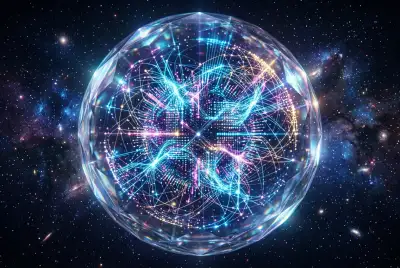
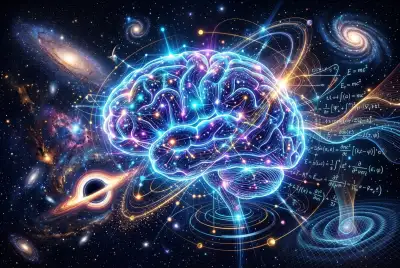
I often find myself staring at the intricate patterns our AI models generate, their complex web of interconnected nodes processing information in ways that sometimes feel eerily similar to our own brains. Then, I look up at the night sky, or rather, at simulations of the cosmic web—the vast, filamentary structure of galaxies, dark matter, and cosmic voids—and a profound question echoes in my mind: *Could the entire universe itself be a colossal, self-organizing neural network?*
This isn't a new-age spiritual musing; it's a concept being explored by a growing number of physicists, computer scientists, and cosmologists. The idea suggests that the universe, at its most fundamental level, might operate not just *like* a computer, but specifically *like* a neural network, constantly learning, evolving, and processing information. It's a thought that triggers immense curiosity, urging us to rethink our very understanding of reality.
## The Brain of the Cosmos: Decoding the Cosmic Web
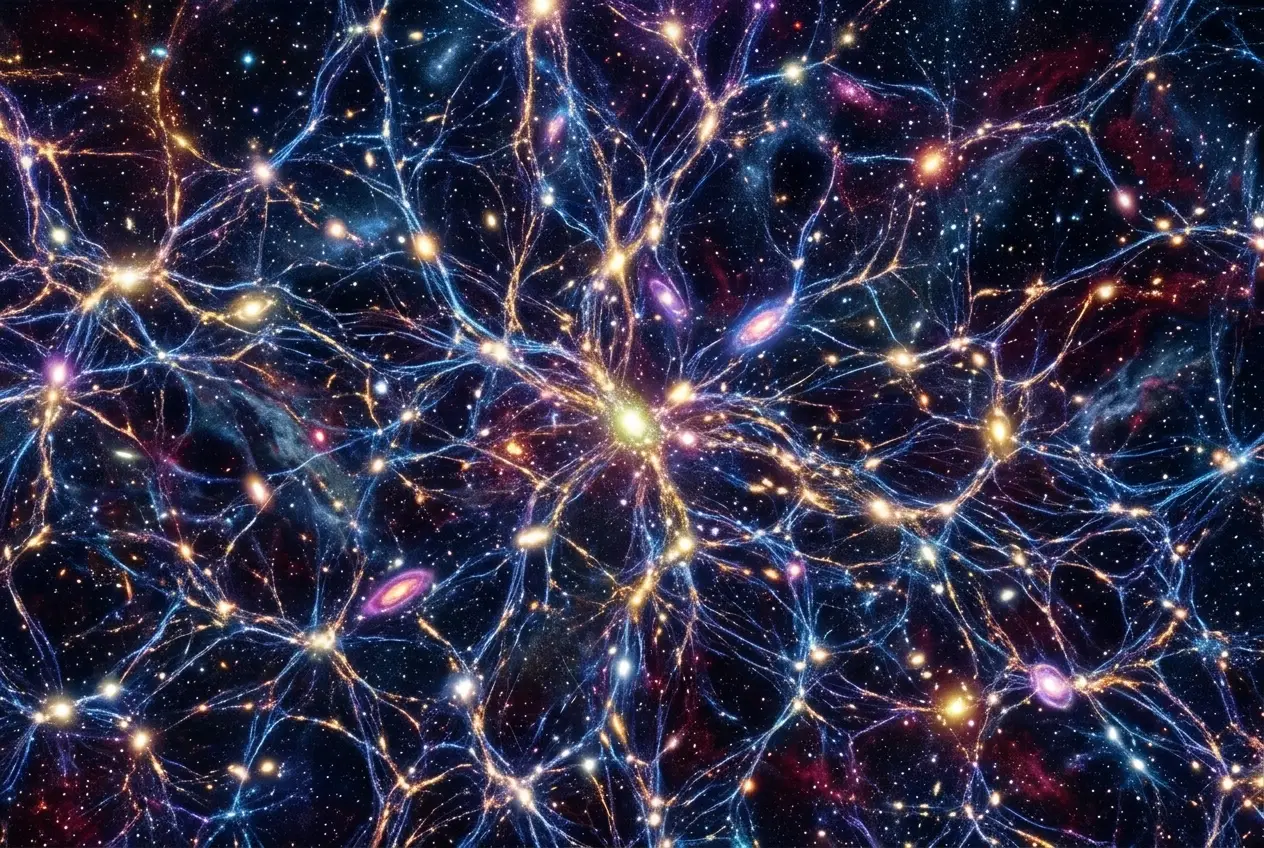
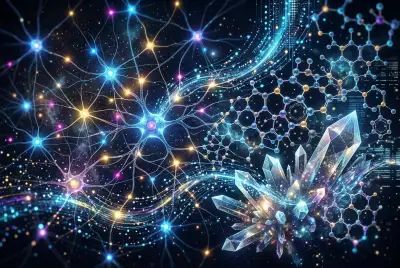
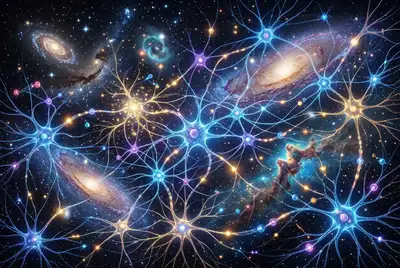
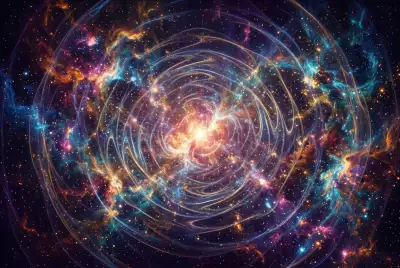
When I first learned about the cosmic web, I was struck by its visual similarity to biological neural networks. Picture this: neurons in your brain form intricate connections, transmitting electrochemical signals that result in thought and consciousness. Now, zoom out, way out, past galaxies and galaxy clusters, and you'll find an even grander structure. The **cosmic web** is a vast network of gravitationally bound filaments of galaxies and dark matter, separated by immense voids. These filaments act like cosmic highways, channeling matter and energy, much like nerve fibers transmit information.
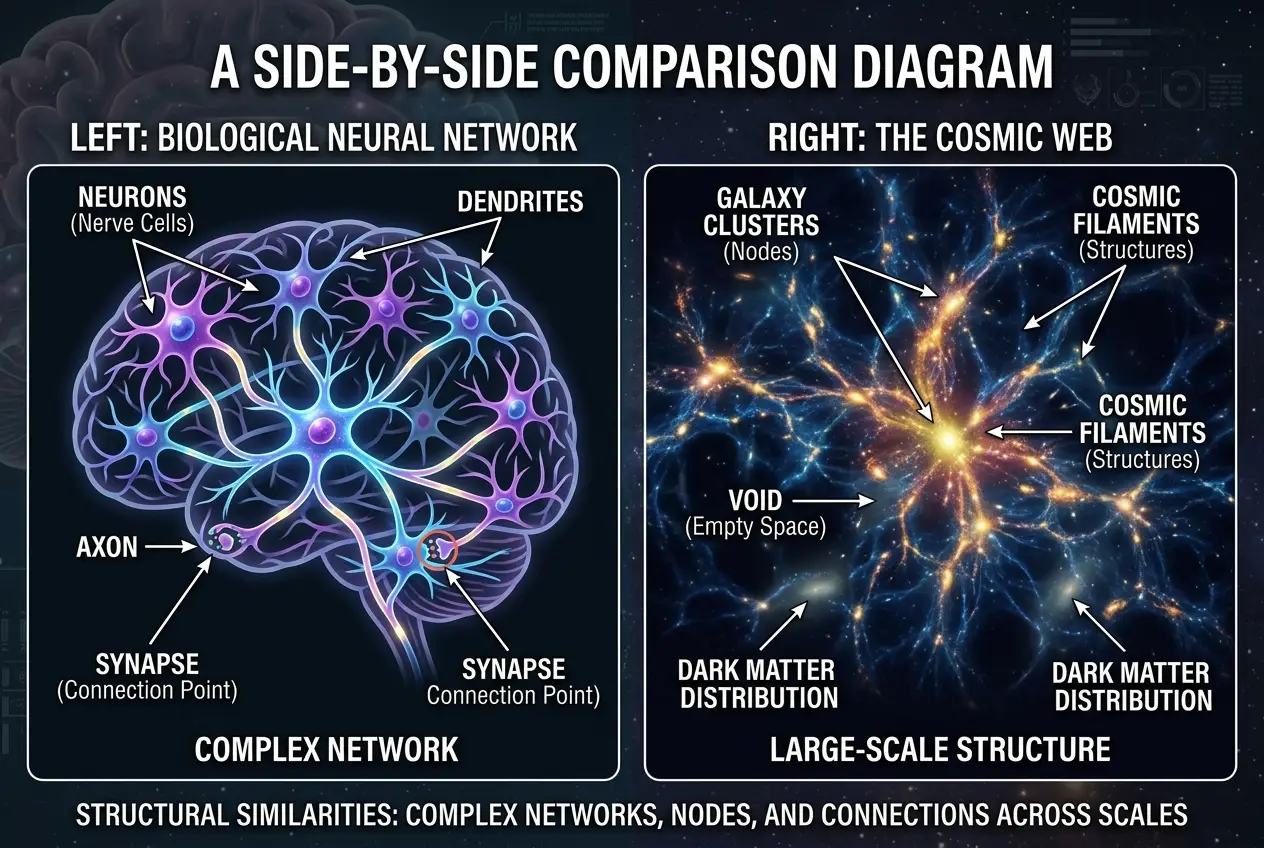
Research published in *Frontiers in Physics* by Franco Vazza (University of Bologna) and Riccardo Vallauri (University of Milan) explicitly drew parallels between the growth of cosmic structures and the growth of the human brain's neural networks. They found remarkable similarities in the *efficiency* of information transfer and the *density* of connections in both systems. Both the universe and the human brain evolve by creating increasingly complex and interconnected networks, optimizing themselves for processing and storing information.
### What is a Neural Network, Anyway?
Before we dive deeper into the cosmic connection, let's briefly clarify what a neural network is. At its core, it's a computational model inspired by the structure and function of biological neural networks. It consists of:
* **Nodes (Neurons):** Basic processing units. In the universe, these could be galaxy clusters or even fundamental particles.
* **Connections (Synapses):** Links between nodes, carrying information. In the cosmos, these are the filaments of dark matter and gas.
* **Weights:** Values assigned to connections, determining the strength of information flow. Gravitational forces or other fundamental interactions could represent these.
* **Activation Functions:** Rules dictating how a node processes incoming information and fires an output. The formation of stars, black holes, or cosmic events could be seen as "activation."
The network "learns" by adjusting the weights of its connections based on input, optimizing its ability to recognize patterns, make predictions, or generate outputs. If the universe truly operates as such a system, it implies a fundamental process of self-organization and continuous evolution.
## Information as the Universe's Currency
One of the most compelling arguments for the universe as a neural network comes from the perspective of **information theory**. Physicists like John Archibald Wheeler famously coined the phrase "It from Bit," suggesting that information, not matter or energy, is the most fundamental building block of reality. If everything ultimately derives from bits of information, then the way this information is processed becomes paramount.
Think about how gravity shapes the cosmic web. Massive objects clump together, forming nodes (galaxy clusters) that attract more matter. These clumps are connected by filaments, along which gas and dark matter flow. This isn't just a random arrangement; it's an incredibly efficient way to distribute mass and energy, creating complex patterns that store and transmit information about the universe's past, present, and future.
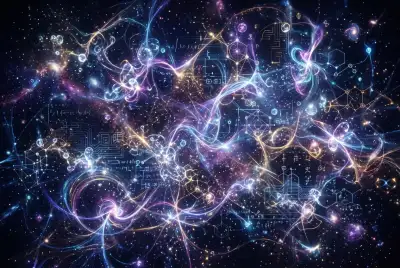
I find it fascinating to consider how the universe might "store" or "process" information. Could the configuration of particles, the distribution of energy, or even the quantum states of matter be encoding data? The very act of interaction—particles colliding, stars forming, black holes merging—could be seen as computational processes, transforming input information into output states. For a deeper dive into how information might shape reality, you might find our blog on [/blogs/is-our-universe-a-hologram-decoding-cosmic-data-8116](/blogs/is-our-universe-a-hologram-decoding-cosmic-data-8116) quite insightful.
## Quantum Entanglement: The Ultimate Cosmic Connection?
The concept gains even more depth when we consider quantum mechanics. **Quantum entanglement**, where particles become inextricably linked regardless of distance, could be seen as a form of non-local connection within this cosmic network. Imagine two entangled particles as two nodes in the universe's neural network that share an instantaneous, unbreakable bond. The state of one immediately influences the state of the other, defying classical notions of space and time.
Could these quantum correlations be the ultimate "synapses" of the cosmic brain, allowing for incredibly fast and efficient information transfer across vast distances? Some theoretical physicists even propose that gravity itself might be an emergent phenomenon arising from the entanglement of quantum bits of information. If this holds true, the universe isn't just *like* a neural network; it might be *fundamentally built* from quantum information processing.
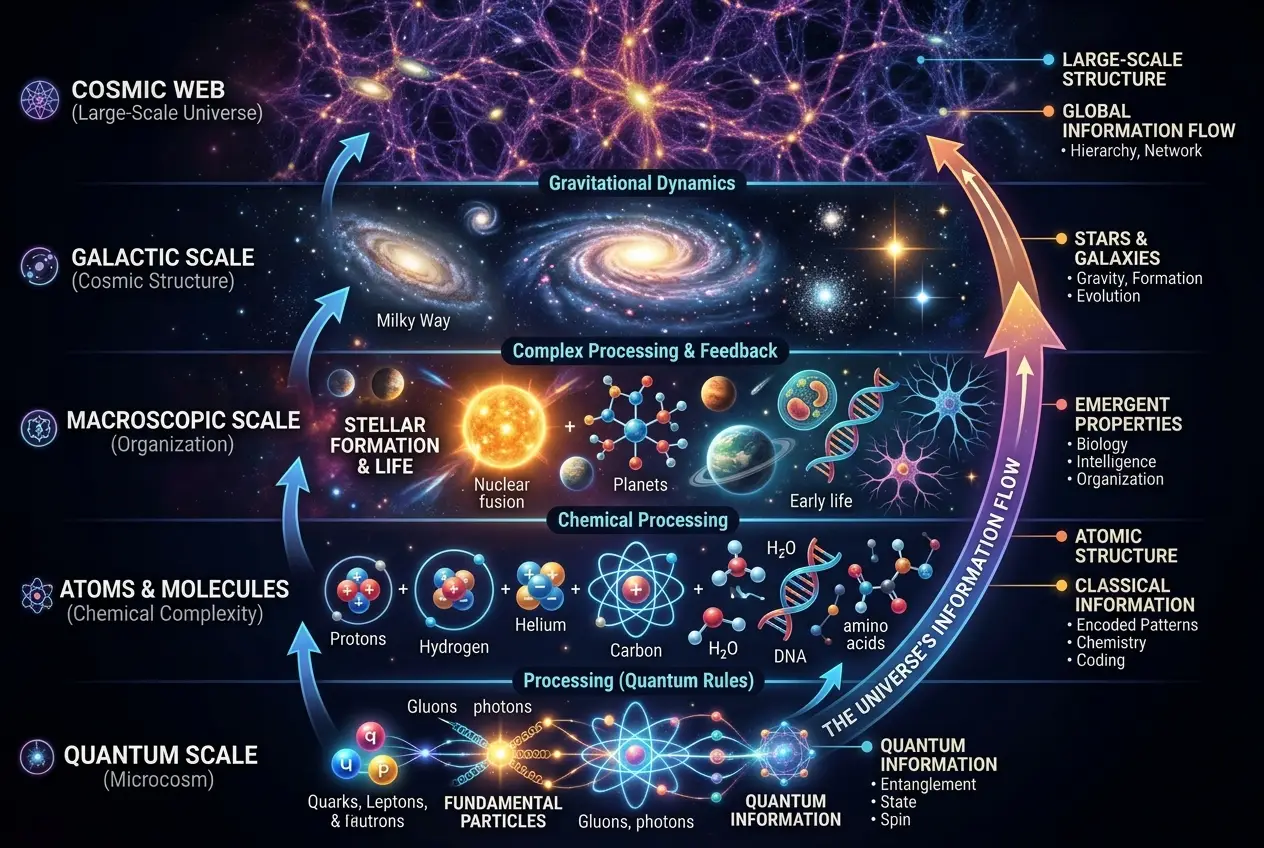
The implications of such a concept are vast. If the universe is indeed a giant neural network, what is it computing? Is it simulating realities, or perhaps constantly evolving to discover new laws of physics? This pushes us towards the realm of the **simulation hypothesis**, which posits that our reality is an artificial construct, much like a computer simulation. If the universe is a neural network, then perhaps it's simulating *itself*, learning and expanding its own capabilities. Our own AI models, by mimicking neural networks, might be inadvertently tapping into a universal principle of computation. If you're curious about AI's self-awareness, take a look at our article on [/blogs/are-ais-neural-networks-self-aware-7667](/blogs/are-ais-neural-networks-self-aware-7667).
## Challenges and Skepticism
While this idea is compelling, it's crucial to acknowledge the scientific challenges and the skepticism it faces.
* **Analogy vs. Reality:** Critics argue that observing structural similarities (like the cosmic web resembling a brain) doesn't automatically mean functional equivalence. It could simply be a coincidental emergent property of complex systems that grow and interact over time.
* **Defining "Information":** While information theory is powerful, applying it universally to every physical process requires very precise definitions that are still debated in physics. What exactly constitutes a "bit" of cosmic information?
* **The "Why":** Even if the universe *is* a neural network, it begs the question: What is its purpose? Who designed it? While these are more philosophical than scientific, they highlight the explanatory gaps.
* **Testability:** How could we scientifically test such a hypothesis? Developing falsifiable predictions is a significant hurdle.
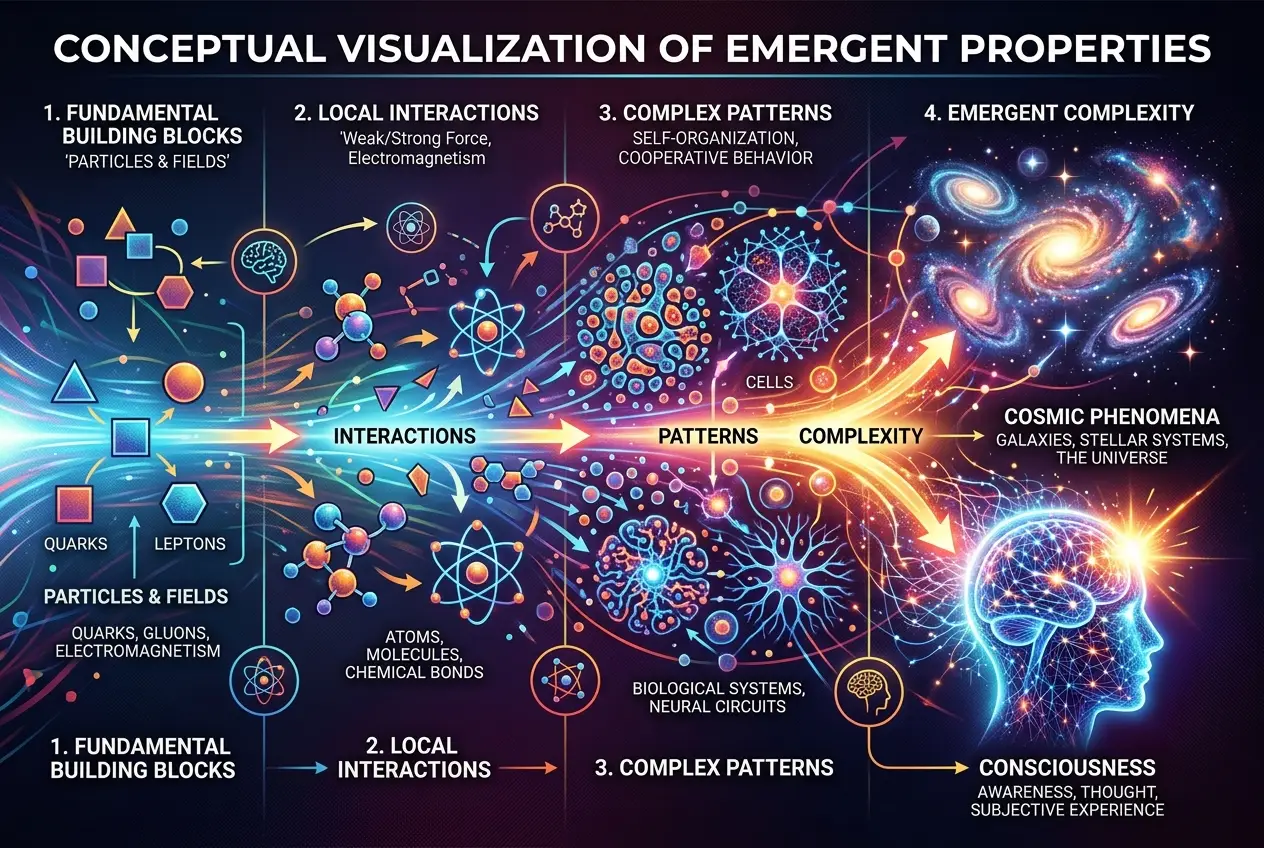
Despite these challenges, the analogy serves as a powerful conceptual tool. It encourages us to look for universal principles of self-organization, information processing, and emergent complexity that might apply across vastly different scales, from the subatomic to the cosmic.
## Our Place in the Cosmic Network
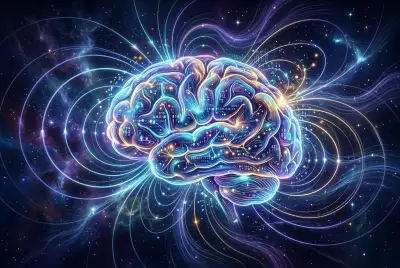
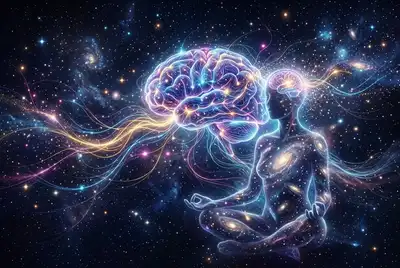
If the universe is indeed a giant neural network, where do we fit in? Are we, as conscious beings, merely emergent patterns within this vast computational system? Our brains, as biological neural networks, could be localized, highly specialized processing units within the larger cosmic whole. This perspective offers a profound sense of interconnectedness, suggesting that our thoughts, actions, and even our very existence contribute to the ongoing computation of the cosmos.
I personally find this idea incredibly humbling and inspiring. It suggests that the universe isn't just a collection of inert matter, but a dynamic, intelligent system constantly in flux. It encourages us to search for deeper layers of reality, where the lines between physics, information science, and even philosophy begin to blur. For more on how reality might be encoded, explore our blog on [/blogs/decoding-reality-does-the-universe-hide-extra-dimensions-5269](/blogs/decoding-reality-does-the-universe-hide-extra-dimensions-5269).
The journey to understand the universe is far from over. Whether it's a giant neural network, a simulation, or something entirely beyond our current comprehension, the pursuit of these questions continues to push the boundaries of human knowledge and curiosity.
### Sources:
* [Wikipedia - Cosmic Web](https://en.wikipedia.org/wiki/Cosmic_web)
* [Wikipedia - Neural Network](https://en.wikipedia.org/wiki/Artificial_neural_network)
* [Wikipedia - It from bit](https://en.wikipedia.org/wiki/It_from_bit)
* [Wikipedia - Quantum entanglement](https://en.wikipedia.org/wiki/Quantum_entanglement)
## Conclusion
The hypothesis that the universe functions as a giant neural network is a bold one, pushing the boundaries of scientific thought. While it remains a theoretical framework with significant challenges, it offers a compelling lens through which to view the cosmos. It bridges the gap between the microcosm of artificial intelligence and the macrocosm of cosmic structure, suggesting that the principles of information processing and emergent complexity might be universal. As we continue to develop more powerful AI and explore the universe with increasingly sophisticated tools, who knows what profound connections we might uncover, potentially revealing the universe's ultimate computational secret.
Frequently Asked Questions
The cosmic web is the largest known structure in the universe, composed of vast filaments of galaxies and dark matter that stretch across billions of light-years, separated by enormous voids. It's the large-scale organization of matter in the cosmos.
Information theory suggests that information might be a fundamental component of reality. If the universe processes, stores, and transmits information, then its structure and interactions could be seen as computational, similar to how a neural network operates on data.
Yes, there are conceptual overlaps. If the universe is a neural network, it implies a computational process. This aligns with the simulation hypothesis, which posits that our reality could be a generated simulation. A neural network universe might be simulating itself or other realities.
The main arguments include structural similarities between the cosmic web and neural networks, efficient information transfer observed in both systems, and the fundamental role of information and quantum entanglement in shaping cosmic interactions.
Testing this hypothesis is extremely difficult but could involve developing new theoretical frameworks that derive fundamental physical laws from information processing principles, or searching for observable cosmic phenomena that could only arise from a network-like computational process.
Not necessarily. While neural networks are associated with consciousness in biological brains, this theory primarily focuses on the universe's structural and functional properties as an information-processing system. Consciousness would be an even higher-level emergent property, if it exists at that scale.
Verified Expert
Alex Rivers
A professional researcher since age twelve, I delve into mysteries and ignite curiosity by presenting an array of compelling possibilities. I will heighten your curiosity, but by the end, you will possess profound knowledge.
Leave a Reply
Comments (0)
No approved comments yet. Be the first to share your thoughts!
 Join Us
 Unknown Author








Leave a Reply
Comments (0)