


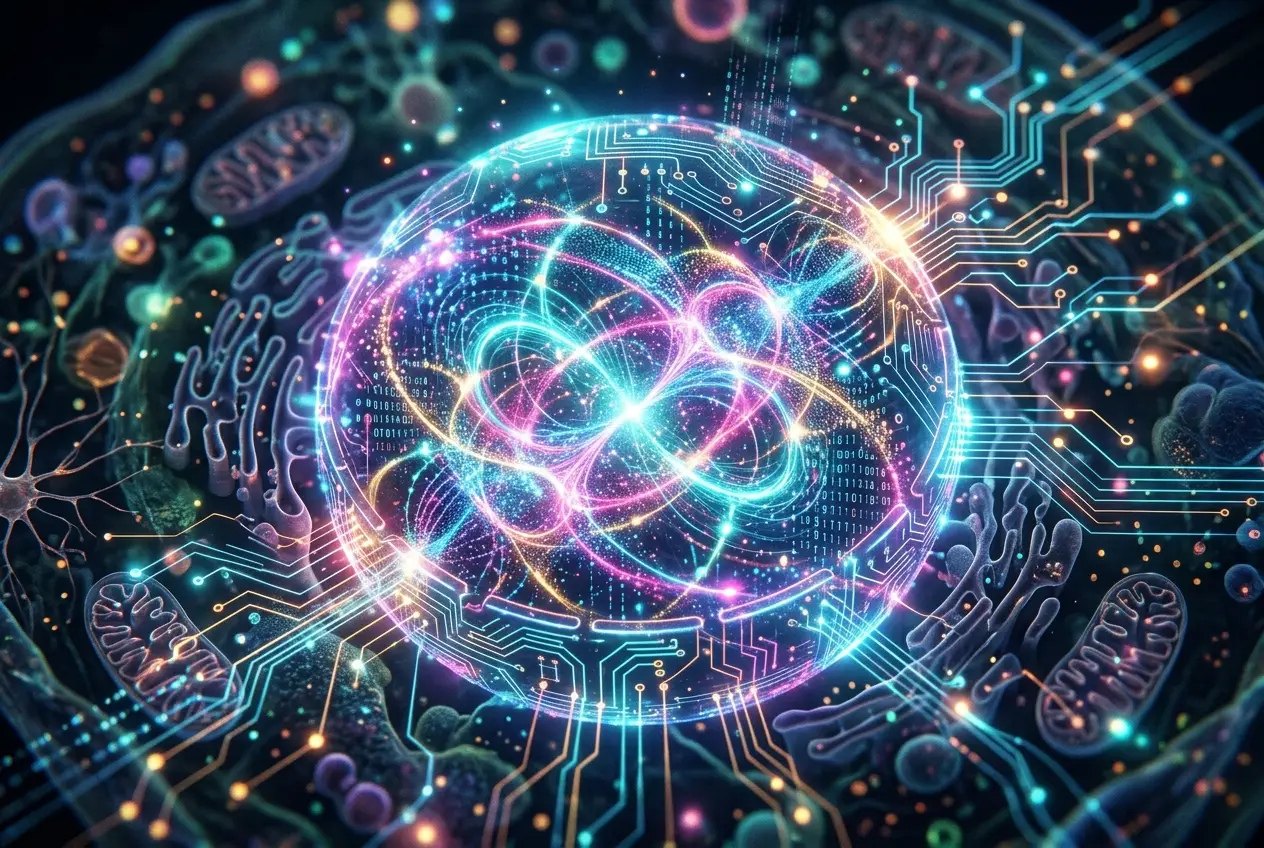
I remember the first time I truly grappled with the idea of data storage. We’ve moved from punch cards and magnetic tapes to solid-state drives no bigger than a thumbnail, holding terabytes of information. Yet, even with these marvels, I find myself asking: are we truly pushing the boundaries of what's possible, or are we overlooking the most incredible storage device already around us? Our very own biological systems.
For years, scientists have looked at DNA as an astounding, naturally occurring hard drive, capable of storing immense amounts of data in incredibly compact spaces. But what if the potential of biology goes even deeper, venturing into the enigmatic realm of quantum mechanics? What if living cells, or even the molecular machinery within them, could be harnessed to store quantum data? This isn’t a sci-fi fantasy; it’s a frontier where biology, quantum physics, and computer science are beginning to converge.
The Unseen World: Quantum Biology's Promise
When I first learned about quantum mechanics, it felt like peering into a secret, invisible layer of reality. Particles can exist in multiple states at once (superposition), become intimately linked regardless of distance (entanglement), and even tunnel through barriers they shouldn’t be able to cross. For the longest time, these phenomena were thought to be confined to the cold, isolated environments of specialized labs. The chaotic, warm, and wet environment of a living cell seemed fundamentally incompatible with the delicate nature of quantum effects.
Yet, a fascinating field known as quantum biology has been challenging this assumption. Researchers are discovering tantalizing hints that quantum mechanics might not just be present in living systems, but actively exploited by them. Think about it: the efficiency of photosynthesis, the unerring precision of avian navigation using Earth's magnetic field, and even the subtle mechanics of enzyme reactions – all exhibit phenomena that classical physics struggles to explain without invoking quantum principles.
"It seems inevitable that quantum mechanics must be playing a role in the function of living things. After all, life is made of atoms, and atoms obey the laws of quantum mechanics." — Dr. Jim Al-Khalili, Professor of Theoretical Physics at the University of Surrey.
These biological processes, honed over billions of years of evolution, might represent nature's own form of quantum computing or, at the very least, quantum data processing. If life itself leverages these bizarre properties, could we intentionally engineer it to store and process information in ways far beyond silicon?
Beyond Bits: The Leap to Qubits in Biology
Traditional computers store information in bits, which are either a 0 or a 1. Quantum computers, however, use qubits. A qubit can be 0, 1, or — thanks to superposition — both 0 and 1 simultaneously. This ability to exist in multiple states dramatically increases the amount of information a single unit can hold and process. Two qubits can represent four states at once, three qubits eight states, and so on, doubling with each additional qubit. This exponential scaling is what gives quantum computing its mind-boggling potential.
Now, imagine if we could find natural qubits within living cells. What could these be? One leading candidate is the spin of electrons within molecules. Electrons have an intrinsic angular momentum, or "spin," which can be thought of as pointing "up" or "down." In a quantum context, it can point both ways at once. Proteins and other biomolecules contain numerous electrons whose spins could potentially act as qubits.
Another area of interest is nuclear spins within atoms like phosphorus, which are abundant in DNA. The nucleus of an atom also has a spin, and these nuclear spins are remarkably isolated from their environment, making them excellent candidates for stable qubits. If we could manipulate and read these spins within, say, the phosphate backbone of DNA or specific proteins, we might unlock an entirely new paradigm for biological data storage.
DNA as a Quantum Tape Drive?
We already know DNA is an incredible storage medium. A single gram of DNA can theoretically store all the data on the internet, and it can remain stable for millennia. This is why many scientists are looking at DNA as a potential archival solution for our ever-growing digital footprint. You can learn more about its astounding capacity in our previous post, Can DNA Store The World's Digital Data?.
But what if DNA could store not just classical bits, but quantum bits? Imagine encoding quantum information directly into the molecular structure or the quantum states of the atoms that make up the DNA strand. Researchers are exploring how the quantum states of molecules could be manipulated to encode information. For instance, the exact spatial arrangement of atoms, or even the vibrational energy levels within molecules, could potentially carry quantum data.
One specific approach involves leveraging the concept of "quantum dots" – tiny semiconductor nanocrystals that exhibit quantum mechanical properties. While not biological in origin, the idea is to integrate similar quantum phenomena into biological structures. Imagine bio-engineered proteins or even specialized organelles designed to house these quantum dots, or to mimic their behavior, creating a cellular quantum memory. The stability of DNA, combined with the power of quantum mechanics, could lead to storage devices of unprecedented density and complexity.
Challenges and Ethical Considerations
The road to biological quantum data storage is, admittedly, fraught with immense challenges.
- Maintaining Quantum Coherence: Qubits are incredibly fragile. Their superposition and entanglement states quickly collapse due to interactions with the environment, a process called decoherence. A warm, noisy cellular environment is the worst place to keep quantum states coherent. Researchers are working on strategies to protect qubits, such as using specific molecular cages or leveraging natural "decoherence-free" subspaces within molecules.
- Read/Write Operations: Even if we can encode quantum data, reading and writing it efficiently and non-destructively within a biological system is another monumental hurdle. We would need highly precise biological tools, perhaps even modified enzymes or specialized nanoparticles, that can interact with specific quantum states without disturbing them.
- Scalability: Building a few biological qubits is one thing; scaling it up to a functional quantum hard drive with thousands or millions of qubits is an entirely different beast.
- Ethical Implications: The idea of manipulating living cells for advanced computing raises significant ethical questions. What are the long-term biological impacts? Could such technology be misused? These are crucial discussions that need to happen alongside scientific advancement.
Nature's Quantum Processors: A Glimpse into the Future
Despite the hurdles, the potential rewards are immense. If we could tap into the quantum capabilities of living cells, we might not just store data but also gain insights into how nature itself performs complex computations. Could biological systems hold the key to solving problems currently intractable for even the most powerful supercomputers? This could lead to breakthroughs in medicine, materials science, and even artificial intelligence. For a deeper dive into how quantum principles might be at play in life, check out Could Quantum Biology Unlock Life's Deepest Secrets?
Some even speculate that the very fabric of existence, including empty space itself, might harbor quantum computing capabilities. This fascinating notion is explored in Is Empty Space A Quantum Computer? and Black Holes: Are They Nature's Ultimate Quantum Computers?. These topics highlight a broader shift in scientific thought: the universe might be inherently computational, and life could be a sophisticated expression of that computation.
The notion that our cells might one day serve as quantum hard drives feels like science fiction, yet the seeds of this future are being sown today in labs worldwide. As our understanding of both quantum mechanics and biological systems deepens, I believe we are on the cusp of discovering truly revolutionary ways to harness life's intrinsic capabilities for technological advancement. It's a journey that promises to redefine the very meaning of "information storage" and "computation."



Conversation0
No comments yet. Be the first to share a thought — the best questions often become new stories.