


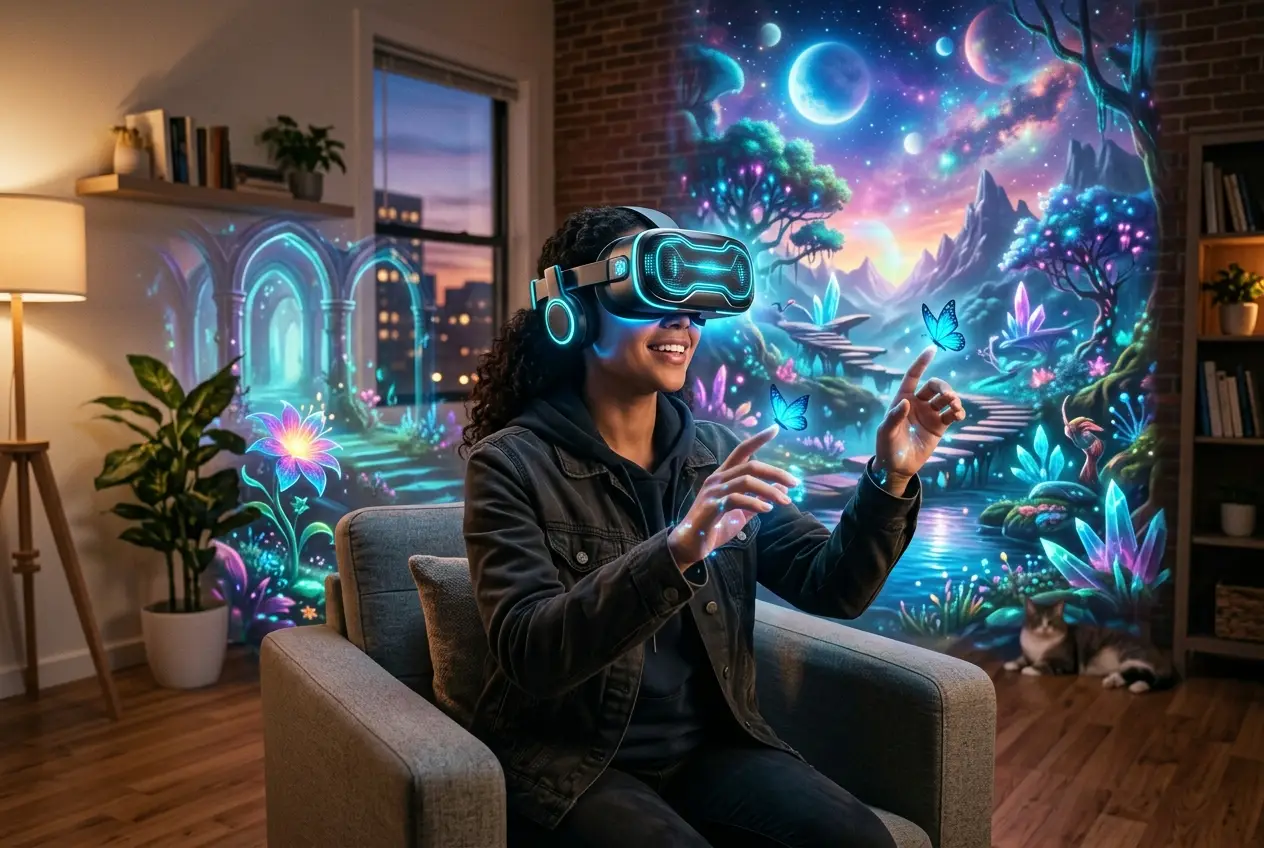
I remember the first time I truly felt transported by virtual reality. It wasn’t just looking at a screen strapped to my face; it was an undeniable sense of being there. The gentle sway of a virtual spaceship, the immense scale of a digital mountain range, the surprising weight of a digital object in my hand – it all conspired to convince my brain, for a fleeting moment, that what I was experiencing was real. This wasn't merely advanced graphics; it was a profound illusion, a carefully orchestrated symphony of technology designed to hijack my senses and redefine my perception of reality.
But how does it work? How do these devices, essentially sophisticated goggles and controllers, manage to so convincingly trick one of the most complex biological machines known – the human brain – into believing it’s somewhere else entirely? It’s a question that delves into the fascinating intersection of neuroscience, display technology, and ingenious engineering.
The Foundation of the Illusion: Vision and Immersion
At the heart of any virtual reality experience is the visual display. Unlike a TV screen across the room, a VR headset places screens mere centimeters from your eyes, blocking out the real world entirely. This immediate proximity and complete occlusion are the first steps in creating immersion. But it's far more nuanced than just sticking a screen up close.
High-Resolution, Wide Field of View: To prevent the "screen door effect" (seeing individual pixels), modern VR headsets boast incredibly high pixel densities. Combined with specialized lenses, these displays offer a wide field of view (FOV), often matching or exceeding human peripheral vision. When your entire visual field is filled with a virtual world, your brain has fewer external cues to remind it of your physical surroundings, making the illusion stronger.
Stereoscopic Vision: The Depth Deception: One of the primary ways VR creates a sense of depth is through stereoscopic vision. Just like our eyes naturally see slightly different images of the world, which our brain then combines to create a 3D perception, VR headsets display two slightly different images – one for each eye. This difference, or parallax, is crucial. My brain interprets these two distinct images as depth, giving the virtual world volume and realism. Without it, the world would feel flat, like looking at a photograph.
The Brain's Role: A Master Manipulator of Perception
Our brains are incredibly adept at making sense of the world, often filling in gaps or interpreting incomplete information to create a coherent reality. VR leverages this inherent ability. The goal is to provide just enough sensory information to activate the brain's natural perception mechanisms, then let the brain do the heavy lifting of constructing the immersive experience.
The Vestibular System: Fooling Your Balance: Beyond sight, our sense of balance and motion is critical. This is governed by the vestibular system, located in our inner ear. When you move your head in the real world, your vestibular system sends signals to your brain, which correlates with what your eyes are seeing. In VR, motion tracking sensors (accelerometers, gyroscopes, magnetometers) precisely follow every tilt and turn of your head. This information is instantly fed to the VR software, which updates the virtual scene to match your head's movement.
This synchronization is paramount. If the visual input (what you see) doesn't perfectly match the vestibular input (what your body feels), my brain flags it as a mismatch, leading to a phenomenon known as VR sickness or motion sickness. It's the same reason some people get seasick: my eyes see motion, but my body feels stable, creating a sensory conflict. This discomfort is often linked to the vestibular system, as detailed on Wikipedia (opens in a new tab).
Proprioception and Haptic Feedback: Our body's sense of its own position and movement (proprioception) also plays a role. When I reach out in VR and "grab" a virtual object, the absence of tactile feedback can break immersion. This is where haptic technology comes in. Controllers that vibrate, pressure sensors, or even full haptic suits aim to provide physical sensations that align with the virtual experience. While still evolving, these haptic cues help convince my brain that I'm interacting with something tangible, further blurring the lines between real and virtual. The subtle art of touch, or haptic feedback, is a fascinating field you can learn more about on Wikipedia (opens in a new tab).
The Technical Backbone: Tracking, Latency, and Processing
The seamless illusion of VR relies on a sophisticated interplay of hardware and software.
Precision Tracking Systems: Modern VR relies on highly accurate tracking systems. These can be inside-out (cameras on the headset tracking the environment) or outside-in (external sensors tracking the headset and controllers). These systems monitor the position and orientation of the user's head and hands in 3D space, translating real-world movements into virtual actions. Without this real-time, millimeter-precise tracking, the virtual world would feel disconnected, like it's not responding to my presence.
Minimizing Latency: Perhaps the most critical technical challenge in VR is latency. This refers to the delay between when I move my head or hand and when that movement is reflected in the virtual world. Even a few tens of milliseconds of delay can cause significant motion sickness and break immersion. VR systems are engineered to achieve incredibly low latency, often aiming for under 20ms, to ensure that the virtual world reacts almost instantaneously to my physical actions. Latency, the delay between action and reaction, is a critical factor, as explained on Wikipedia (opens in a new tab).
Processing Power: Rendering a fully immersive, high-resolution 3D world twice (once for each eye) at a high refresh rate (e.g., 90-120 frames per second) requires immense processing power. This is why high-end VR often demands powerful PCs or dedicated consoles. The smoother and more detailed the graphics, the more my brain accepts the virtual world as plausible.
The Future of the Illusion: Beyond the Headset
The current generation of VR is just the beginning. The quest for ultimate immersion continues, pushing the boundaries of what our brains can accept as reality.
Advanced Haptics and Olfactory Integration: Imagine not just feeling vibrations but textures, temperatures, and even the subtle resistance of virtual objects. Full-body haptic suits are in development, promising to immerse every inch of our skin in the virtual world. And what about smell? Olfactory sensors and dispensers could introduce scents, making a virtual forest smell like pine or a digital kitchen like freshly baked bread.
Brain-Computer Interfaces (BCIs): The ultimate frontier lies in directly interfacing with the brain. While still largely theoretical for consumer VR, the ability to control virtual environments with thought alone, or even to directly stimulate sensory cortices, could create an indistinguishable reality. This kind of technology, which seeks to bridge the gap between human thought and digital action, reminds me of the fascinating discussions we've had about Can Brain-Computer Interfaces Read Your Dreams?.
Extended Reality (XR) and the Blurring of Worlds: VR is just one part of the broader concept of Extended Reality (XR), which includes Augmented Reality (AR) and Mixed Reality (MR). These technologies seek to blend digital information with the real world, rather than fully replacing it. As these fields mature, the line between what is "real" and what is "virtual" will continue to blur, much like the "Holodeck Dreams" we once explored, where simulated environments become indistinguishable from reality in Holodeck Dreams: Can Science Recreate Virtual Reality?. The ability to seamlessly overlay digital elements onto our physical space, or even create entire digital universes, perhaps even with digital life forms within them, will change how we interact with information and each other.
Conclusion: A New Frontier of Perception
Virtual reality is far more than just a technological gimmick; it's a profound exploration into the nature of human perception and consciousness. By meticulously manipulating our visual, auditory, and vestibular systems, and minimizing the technological lag that betrays the illusion, VR headsets can transport us to places that exist only in code. They challenge our brains to differentiate between what's real and what's rendered, opening up new possibilities for entertainment, education, training, and even social interaction.
As the technology continues to evolve, becoming lighter, more powerful, and more integrated with our natural senses, the illusion will only deepen. We are on the cusp of a new era where our definition of "being there" expands beyond the confines of our physical reality, guided by the ingenious ways technology learns to trick the most complex computer of all: the human brain.




Conversation0
No comments yet. Be the first to share a thought — the best questions often become new stories.