Imagine a world where power flows without resistance, where devices run endlessly without heat loss, and where levitating trains zip across continents, consuming minimal energy. I’ve often caught myself lost in this vision, a future whispered about in scientific circles for decades. It's a world built upon the promise of **room-temperature superconductivity**, a phenomenon so profound it could rewrite the rules of modern technology and energy. For generations, it has been the ultimate prize in materials science, a scientific "holy grail" tantalizingly close, yet perpetually just out of reach.
Recently, the scientific community buzzed with unprecedented excitement—and skepticism—when a team claimed to have achieved this very feat. The discussions were furious, the implications staggering. It made me wonder: what exactly is superconductivity, why is "room temperature" such a big deal, and are we truly on the cusp of a revolution, or is this just another fleeting dream?
### The Marvel of Superconductivity: A Glimpse into Quantum Perfection
To understand the quest for room-temperature superconductivity, we first need to grasp what superconductivity itself entails. Simply put, **superconductors** are materials that conduct electricity with **zero electrical resistance** and expel magnetic fields (a phenomenon known as the Meissner effect) when cooled below a certain critical temperature.
Think about the wires in your home or the power lines crisscrossing the landscape. They all lose energy as heat because of resistance. It's an unavoidable part of current electricity transmission. Now, imagine a wire that loses absolutely no energy as heat. None. That's a superconductor. This isn't just about efficiency; it's about fundamentally changing how we interact with energy.
The phenomenon was first discovered in 1911 by Dutch physicist Heike Kamerlingh Onnes, who observed that mercury lost all electrical resistance when cooled to 4.2 Kelvin (K), just above absolute zero (-273.15°C). While a groundbreaking discovery, the need for extreme cooling (often using expensive liquid helium) made early superconductors impractical for widespread use.
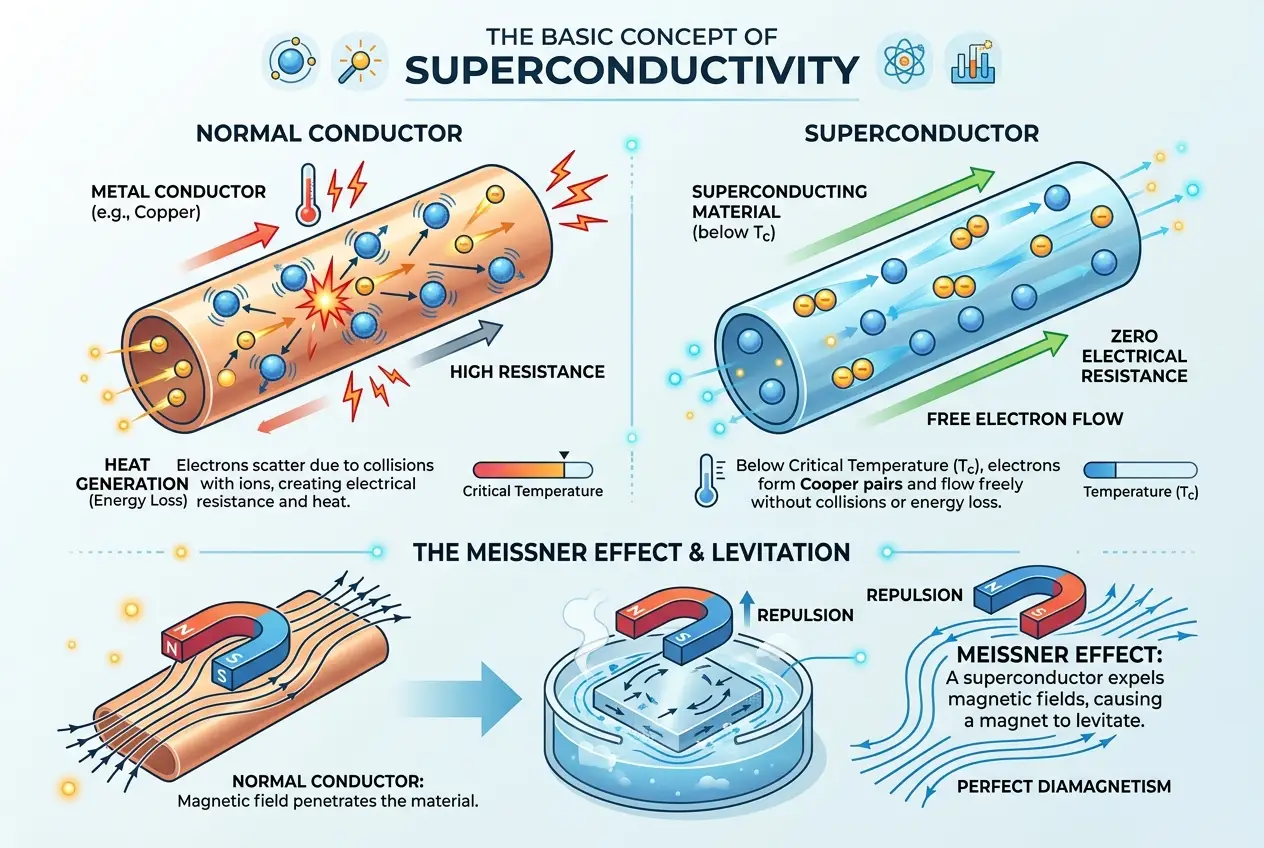
Over the decades, scientists discovered new superconducting materials, pushing the critical temperature higher and higher. "High-temperature" superconductors, discovered in the 1980s, could operate at temperatures above the boiling point of liquid nitrogen (77 K, or -196°C), making them more accessible and cheaper to cool. Even so, -196°C is still incredibly cold, requiring specialized infrastructure.
The dream, the true holy grail, has always been a material that exhibits superconductivity at or near **room temperature** (around 20-25°C or 293-298 K) and ambient pressure.
### The Pursuit of a Holy Grail: Why Room Temperature Matters
The implications of room-temperature superconductivity are nothing short of monumental. It's not hyperbole to say it would spark a technological revolution comparable to the invention of the transistor or electricity itself.
1. **Energy Efficiency & Transmission:** We lose a staggering amount of energy during transmission through conventional power grids. Superconducting power lines could eliminate this loss, delivering electricity with 100% efficiency. This would drastically reduce energy consumption, lower costs, and reshape global energy policy. Imagine a world where renewable energy sources, no matter how remote, could power entire cities without significant loss.
2. **Advanced Computing:** Superconducting circuits could lead to incredibly fast, powerful, and energy-efficient computers. Quantum computers, which currently require extreme cooling, could potentially operate at higher temperatures, accelerating their development and deployment. This could open doors to solving problems currently beyond the reach of even the most powerful supercomputers. You might recall our discussions on whether /blogs/is-empty-space-a-quantum-computer-9021 or the potential of /blogs/can-quantum-computers-break-every-encryption-1438 – room-temp superconductors could amplify these possibilities.
3. **Transportation:** Magnetic levitation (maglev) trains, already operational in some parts of the world, could become commonplace. With superconducting magnets, these trains could levitate and propel themselves at incredible speeds with virtually no friction, making long-distance travel faster, quieter, and greener.
4. **Medical Breakthroughs:** MRI machines, which currently use superconducting magnets cooled by liquid helium, could become cheaper, smaller, and more accessible, revolutionizing medical diagnostics. New medical technologies, from advanced imaging to targeted drug delivery systems, could emerge.
5. **New Technologies:** From frictionless motors and generators to ultra-sensitive sensors and new forms of energy storage, the applications are almost limitless. The future could involve everything from /blogs/can-diamond-batteries-power-our-future-3308 to /blogs/programmable-matter-will-anything-be-solid-in-the-future-8475, all accelerated by this breakthrough.
### The Scientific Gauntlet: Hype, Hope, and Healthy Skepticism
The path to room-temperature superconductivity has been riddled with both genuine progress and spectacular false alarms. The scientific community, by its very nature, maintains a healthy dose of skepticism, demanding rigorous proof and independent replication for claims of such magnitude.
For decades, the highest known superconducting temperatures were achieved under immense pressure. Materials like hydrogen sulfide and lanthanum hydride have shown superconductivity at relatively "high" temperatures (e.g., 203 K or -70°C for H2S, and 287 K or 14°C for LaH10) but only when squeezed between diamonds at pressures millions of times greater than Earth's atmosphere. While a remarkable scientific achievement, practical applications under such extreme conditions are, understandably, non-existent.
This brings us to the recent whirlwind of **LK-99**. In mid-2023, a team of South Korean researchers published pre-print papers claiming to have synthesized a material, dubbed LK-99, that exhibited superconductivity at ambient pressure and above room temperature. The news spread like wildfire, igniting excitement globally. People around the world, myself included, watched with bated breath as laboratories rushed to replicate the findings.
The claims were extraordinary: the material, a modified lead-apatite compound, showed a sharp drop in resistance to near zero and partial levitation (the Meissner effect) at temperatures up to 400 K (127°C). If true, this was it – the moment we had all been waiting for.
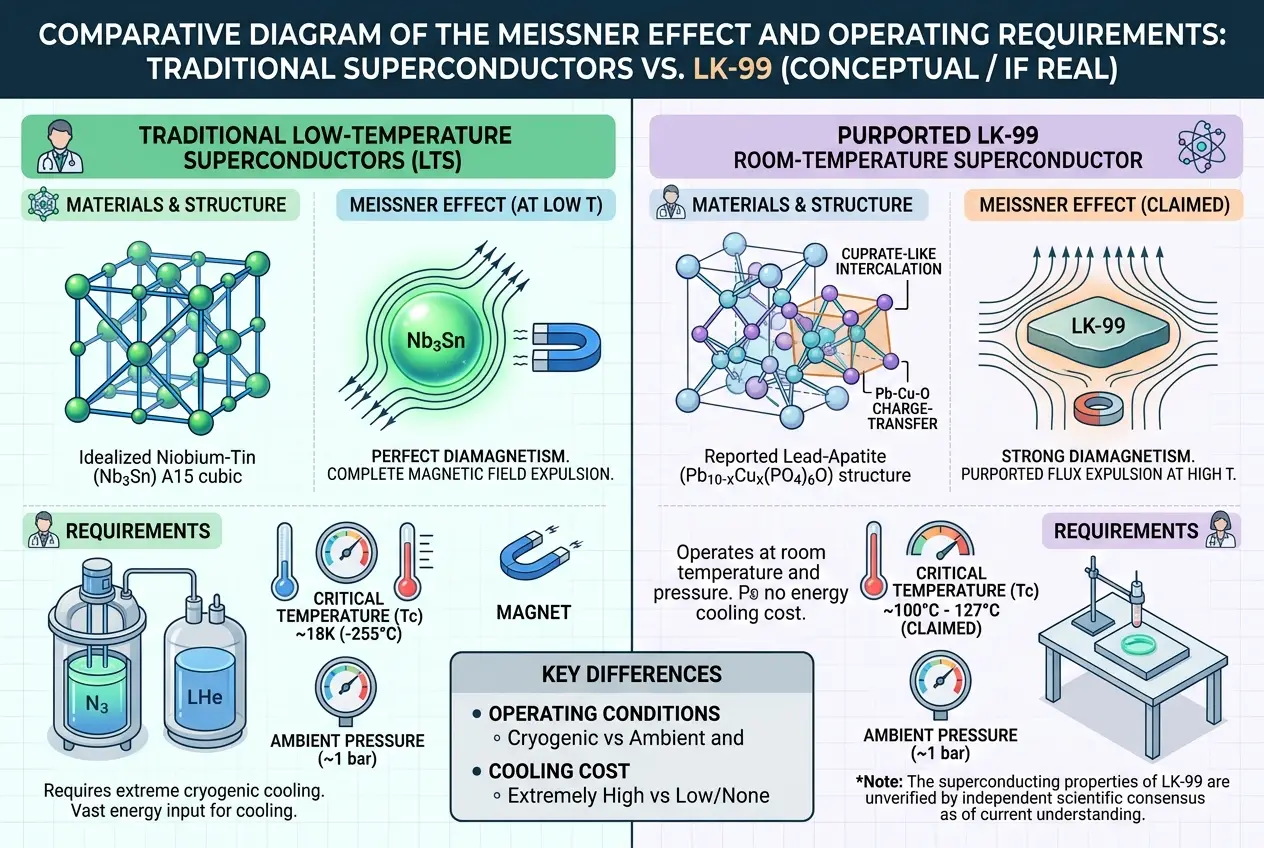
However, the scientific process is one of rigorous verification. Initial attempts at replication yielded mixed results. Some groups observed slight diamagnetism or resistance drops, but none conclusively demonstrated the full signature of superconductivity (zero resistance *and* strong Meissner effect) at room temperature and ambient pressure. Many studies pointed to impurities in the synthesized material as the cause of observed anomalies, or found that the resistance drop was not truly zero.
As of early 2024, the general consensus in the scientific community is that LK-99 is **not a room-temperature ambient-pressure superconductor**. While the initial excitement was palpable, the inability of independent teams to replicate the full superconducting properties has led to widespread debunking of the claim. This episode, though ultimately inconclusive for LK-99, serves as a powerful reminder of how science works: bold claims must be met with stringent scrutiny and repeatable evidence. You can read more about the scientific method and replication in fields like physics on [Wikipedia's page on the scientific method](https://en.wikipedia.org/wiki/Scientific_method).
### The Road Ahead: Persistence in the Face of Adversity
While the LK-99 saga may have concluded without a definitive breakthrough, it doesn't diminish the ongoing quest. The scientific community continues to explore new materials and theoretical frameworks. Researchers are delving into:
* **Hydride Superconductors:** Pushing the boundaries of high-pressure superconductivity to understand the mechanisms at play, hoping to find pathways to lower pressures.
* **Quantum Materials:** Investigating novel quantum materials with exotic electronic properties that might host superconductivity under less extreme conditions. This touches on complex quantum phenomena, similar to those explored in discussions about /blogs/do-quantum-sensors-reshape-our-reality-perception-2502.
* **Artificial Intelligence and Machine Learning:** Using AI to predict and design new materials with desired properties, accelerating the discovery process. AI can analyze vast datasets of material characteristics and properties, potentially identifying patterns that human researchers might miss. This exciting intersection of AI and material science hints at how /blogs/can-ai-predict-sciences-next-big-leap-9069.
The journey is challenging, fraught with experimental difficulties and theoretical complexities. Understanding the precise mechanisms of high-temperature superconductivity itself is an ongoing challenge, with no single, universally accepted theory explaining all observations. The Bardeen-Cooper-Schrieffer (BCS) theory successfully explains conventional superconductivity, but newer "unconventional" superconductors often defy this model, leading to fascinating new avenues of research. You can explore more about BCS theory on [Wikipedia's page on Superconductivity](https://en.wikipedia.org/wiki/Superconductivity).
### Conclusion: A Future Still Within Our Grasp
The dream of room-temperature superconductivity remains alive, albeit tempered by the realities of scientific rigor. While LK-99 didn't deliver the paradigm shift we hoped for, the intense global focus it generated underscored the profound impact such a discovery would have.
I believe it's not a question of *if* we will achieve this technological holy grail, but *when*. The drive for efficiency, innovation, and a deeper understanding of the universe's fundamental laws ensures that this quest will continue. Each attempt, each hypothesis, each replication—successful or not—pushes the boundaries of our knowledge, refining our methods and bringing us closer to a future where energy is limitless, technology boundless, and the seemingly impossible becomes our everyday reality. The future of science and technology is often a story of persistence, even in the face of temporary setbacks, a testament to humanity's unyielding curiosity.
Frequently Asked Questions
Conventional superconductors typically require cooling to extremely low temperatures (near absolute zero) using liquid helium, and their behavior is well-explained by BCS theory. High-temperature superconductors operate at slightly higher, but still very cold, temperatures (above liquid nitrogen's boiling point) and their mechanisms are less understood, often involving complex quantum phenomena.
The biggest immediate impact would likely be on energy transmission and storage. Eliminating energy loss in power grids would revolutionize global energy efficiency, making renewable sources more viable and affordable on a massive scale.
Ambient pressure is crucial for practical applications. While some materials exhibit superconductivity at high temperatures, they often require immense pressures (millions of atmospheres) to do so. This makes them impossible to use outside specialized lab environments. Achieving room-temperature superconductivity at ambient pressure means the material can be easily manufactured and integrated into everyday technology.
The Meissner effect is a key characteristic of superconductivity where a superconductor expels all magnetic fields from its interior when cooled below its critical temperature. This phenomenon is responsible for magnetic levitation and is a strong indicator of a material's superconducting state, alongside zero electrical resistance.
AI and machine learning are increasingly used to accelerate material discovery by predicting new compounds with desired properties, analyzing vast datasets of experimental results, and simulating material behaviors at atomic levels. This can significantly reduce the trial-and-error often involved in traditional materials science research.
Verified Expert
Alex Rivers
A professional researcher since age twelve, I delve into mysteries and ignite curiosity by presenting an array of compelling possibilities. I will heighten your curiosity, but by the end, you will possess profound knowledge.
Leave a Reply
Comments (0)
No approved comments yet. Be the first to share your thoughts!
 Join Us



 Unknown Author
































Leave a Reply
Comments (0)