


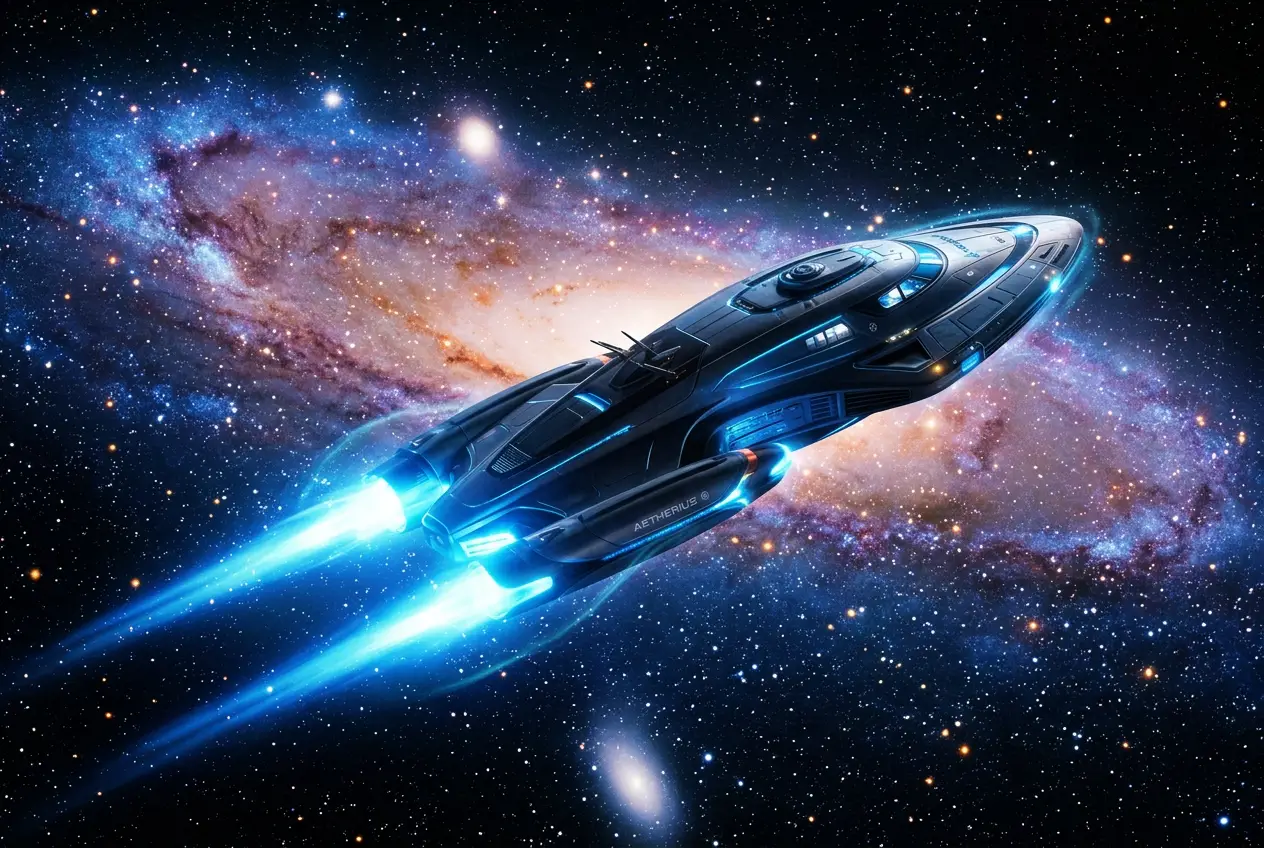
I remember gazing up at the night sky as a child, lost in visions of starships zipping between galaxies, effortlessly defying the constraints of fuel and gravity. The idea of interstellar travel has always been the ultimate dream, but the sheer physics of it—the monumental amount of propellant needed, the crushing limitations of Newton's laws—often brings us crashing back to Earth. Yet, what if there was an engine that promised to bypass these very laws? An "impossible engine" that could propel a spacecraft without any propellant, simply by bouncing microwaves around a closed cavity? This is the fascinating and deeply controversial story of the EmDrive, a concept that has sent ripples through the scientific community, forcing us to question the very foundations of physics.
Recently, I’ve been diving deep into fringe science and technological anomalies, and the EmDrive consistently pops up as one of the most perplexing modern mysteries. It’s a device that, if proven to work as claimed, could redefine space travel and perhaps even our understanding of the universe.
The Maverick Concept: What Exactly is the EmDrive?
At its core, the EmDrive (Electromagnetic Drive) is deceptively simple. Envision a truncated cone-shaped metal cavity, sealed off, with microwaves continuously bounced inside it. According to British aerospace engineer Roger Shawyer, who first proposed the concept in 1999, the varying group velocities of the electromagnetic waves within the asymmetrical cavity would generate a net thrust. This thrust, crucially, would occur without expelling any propellant.
Think about that for a moment. Every rocket we’ve ever launched, from the V-2 to the Saturn V, operates on the principle of Newton’s Third Law of Motion: for every action, there is an equal and opposite reaction. Rockets push exhaust gases downward, and the reaction pushes the rocket upward. The EmDrive, however, purports to generate thrust from within a closed system, seemingly defying this fundamental law of physics—specifically, the conservation of momentum. This is precisely why it’s earned the moniker “the impossible engine.”
Shawyer's initial theory suggested that the differing radiation pressures on the end plates of the cavity would lead to a net force. Later, other theoretical explanations emerged, often invoking the quantum vacuum and virtual particles, proposing that the EmDrive might be "pushing" against the fluctuations of space-time itself. It's a grand claim, bordering on science fiction, but it's a claim that has been pursued with surprising persistence by various research groups.
A Brief History of a Scientific Maverick
The journey of the EmDrive is a testament to scientific curiosity—and stubbornness. Roger Shawyer first detailed his concept and experimental results in the early 2000s, claiming measurable thrusts. His initial findings were met with widespread skepticism, largely because they appeared to violate a cornerstone of physics that has been robustly tested for centuries.
Despite the initial cold reception, the idea refused to die. Over the years, several independent researchers and groups tried to replicate Shawyer's experiments. These included:
- Dr. Yang Juan from Northwestern Polytechnical University (NPU) in China: Her team reported positive thrust measurements in the mid-2000s, fueling renewed interest.
- Guido Fetta and his Cannae Drive: A similar concept, also claiming propellantless thrust, emerged, adding another layer to the enigma.
- NASA's Eagleworks Laboratory: This is where the EmDrive truly gained mainstream attention. In 2014, a team at NASA Eagleworks, led by Dr. Harold White, began experimenting with their own EmDrive prototypes. Their initial, peer-reviewed paper in 2016 claimed to have measured a small but consistent thrust from their device in a vacuum, after accounting for several potential sources of error, such as thermal expansion. This publication, in the Journal of Propulsion and Power, sparked an explosion of debate and media coverage. You can read more about the initial Eagleworks findings on Wikipedia's EmDrive page (opens in a new tab).
I remember the excitement and confusion among the tech and science communities when the NASA results came out. Could it be true? Had we just stumbled upon a breakthrough that would change everything, or was it simply an elaborate error?
The Core of the Controversy: Breaking Physics?
The reason the EmDrive is so contentious boils down to one thing: the conservation of momentum. This fundamental law states that in a closed system, the total momentum remains constant. If the EmDrive generates thrust without expelling mass, where does the momentum come from? It's like pulling yourself up by your bootstraps in space—it just shouldn't work.
Skeptics argue that if the EmDrive truly works, it would imply a revolutionary re-evaluation of our understanding of physics, potentially challenging even Einstein’s theory of relativity. For a blog that often explores topics like "Unseen Energy: Is Zero-Point Reality?" or "Does Quantum Entanglement Connect Parallel Universes?", the EmDrive presents another fascinating frontier where known physics might be pushed to its limits, or even broken.
However, many theoretical physicists argue that such a fundamental violation is highly unlikely and that any observed thrust must be attributed to experimental error or misinterpretations of quantum mechanics. As physicist Sean Carroll eloquently put it, "The EmDrive is just not the kind of idea that we should be spending a lot of time on in a physics department." This sentiment reflects the strong bias against ideas that so flagrantly contradict established science, especially when a clear, coherent theoretical framework is lacking.
The Evidence: Elusive Thrust and Persistent Doubts
The history of EmDrive experimentation is a mixed bag of tantalizing positive results and frustrating null findings.
The "Positive" Experiments:
- NASA Eagleworks (2016): Reported thrust in the micronewton range in a hard vacuum. Their tests were meticulously designed to eliminate external factors, though critics still found potential flaws.
- Other independent researchers: A few smaller labs have also claimed to detect thrust, though often with less rigorous experimental setups or less significant results.
The "Negative" or Ambiguous Experiments:
- Dr. Martin Tajmar's Group at Dresden University of Technology: This group conducted very precise measurements and initially reported no thrust from their EmDrive setup, but later found small thrusts that they largely attributed to thermal effects causing internal deformations within the cavity, rather than a true EmDrive effect. This highlights the extreme difficulty in precisely measuring such minuscule forces and distinguishing them from experimental artifacts.
- Numerous academic analyses: Many physicists have published papers detailing why the EmDrive is physically impossible and explaining how apparent thrusts could arise from mundane factors like thermal expansion, measurement device biases, or electromagnetic interactions with test equipment.
One of the persistent challenges is the incredibly small amount of thrust being measured—often in the micronewton range, which is roughly the weight of a tiny insect. Detecting such a minute force in a laboratory environment, while shielding it from all possible confounding factors, is extraordinarily difficult. This is why some researchers, like those exploring the potential of "Why is Quantum Computer 1 Million Times Faster Than SuperComputers?", understand the immense challenges in pushing the boundaries of measurement and verification.
What if it’s Real? The Sci-Fi Future Awaits
If, against all odds, the EmDrive were definitively proven to work, the implications would be nothing short of revolutionary:
- Propellantless Space Travel: Imagine spacecraft that never run out of fuel. Deep-space missions to the outer planets or even nearby stars would become far more feasible, cutting travel times dramatically.
- Cheaper Launches: Without the need to lift massive amounts of propellant into orbit, launch costs would plummet.
- Faster Interstellar Journeys: While not warp drive, continuous, low-level acceleration could eventually build up to incredible speeds, shortening trips to other star systems from millennia to decades or centuries. This would open up new possibilities for humanity's expansion beyond Earth.
- Onboard Power Generation: Some theories even suggest the EmDrive could be adapted for power generation, though this remains highly speculative.
The potential is so immense that it's understandable why people cling to the possibility, despite the scientific hurdles. It taps into that primal human desire to explore, to overcome limits, and to reach for the stars.
The Path Forward: Rigor and Open Minds
The EmDrive remains an unsolved puzzle. For every claim of a detected thrust, there's an equally compelling argument for an experimental error. The scientific process, however, demands rigor, repeatability, and a clear theoretical explanation. Until consistent, unambiguous results are obtained from multiple independent labs, and a widely accepted theoretical framework is developed that explains how it works without violating known physics, the EmDrive will likely remain in the realm of intriguing anomalies.
I believe this ongoing debate perfectly illustrates the dynamic nature of science. While fundamental laws are robust, genuine anomalies—if they truly exist—force us to re-examine our assumptions and expand our understanding. Whether the EmDrive eventually proves to be a triumph of physics or simply a fascinating scientific dead end, its journey reminds us to keep asking audacious questions and to continually push the boundaries of what we believe is possible, much like the questions posed in discussions around topics like "Unseen Energy: Is Zero-Point Reality?"
For now, the EmDrive stands as a testament to humanity's relentless quest for discovery, a modern-day scientific mystery that continues to inspire both fervent belief and profound skepticism. Perhaps one day, we will uncover its true nature, and I, for one, will be eagerly watching.
Conversation0
No comments yet. Be the first to share a thought — the best questions often become new stories.