


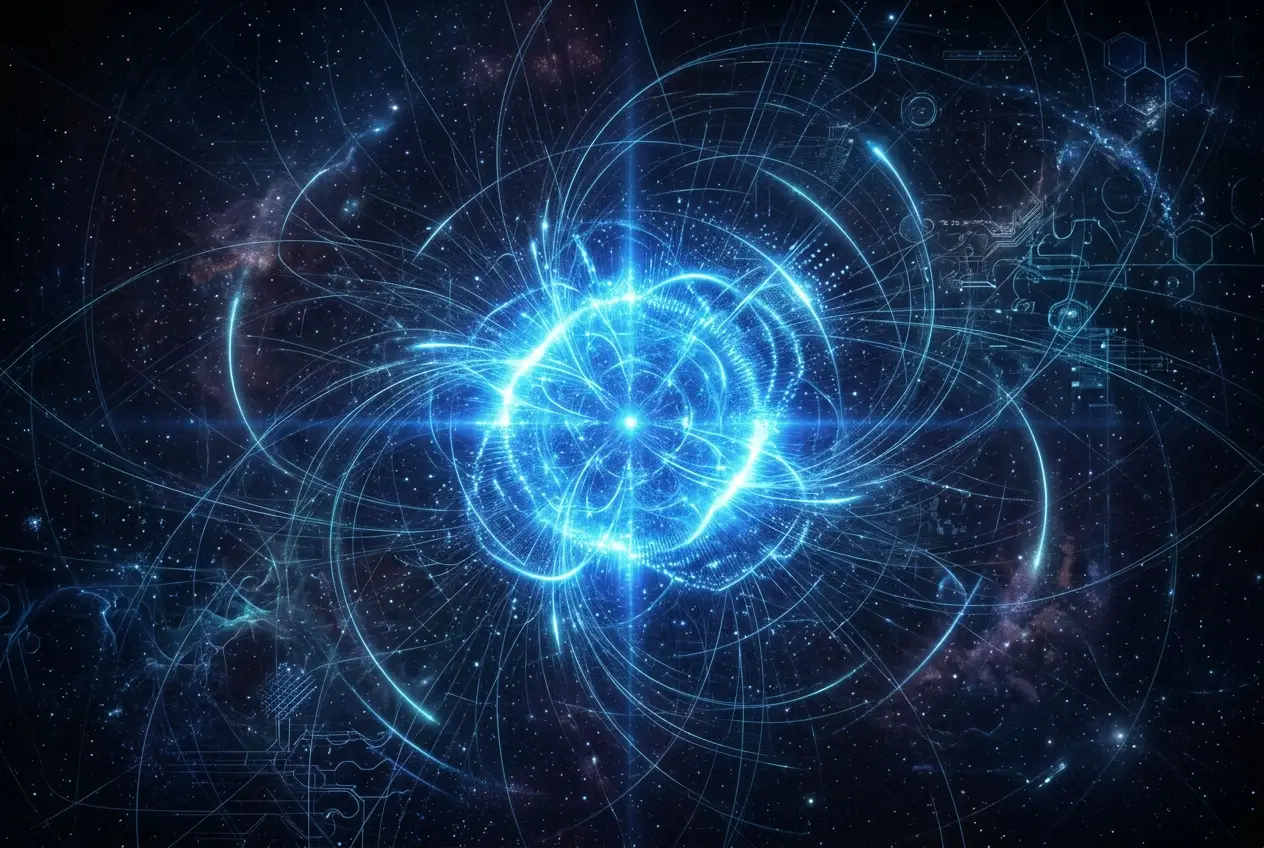
The deep blue glow is unmistakable, almost otherworldly. It's the kind of ethereal light you might expect to see in a sci-fi movie, signaling a warp drive engaging or an alien artifact powering up. Yet, this phenomenon isn't confined to fiction. It's a very real, captivating display of physics in action, often witnessed in nuclear reactors: Cherenkov radiation. I've always been fascinated by how the universe reveals its secrets in such unexpected ways, and Cherenkov light is a prime example of a curious phenomenon that pushes the boundaries of our understanding, hinting at possibilities that once seemed purely speculative.
When I first learned about it, my mind immediately jumped to the idea of "faster-than-light" travel. After all, the descriptions often involve particles exceeding the speed of light. But is it truly faster-than-light, and could this peculiar glow be a key to unlocking advanced technologies, perhaps even revolutionizing communication or energy generation? Let's dive deep into the science behind Cherenkov radiation and explore its potential, moving beyond the sensational headlines to the grounded realities and intriguing implications for our future.
What is Cherenkov Radiation? The Sonic Boom of Light
Imagine a supersonic jet streaking across the sky. As it breaks the sound barrier, it creates a powerful shockwave that we hear as a sonic boom. This isn't the jet actually moving faster than sound itself, but faster than the speed of sound in the air around it. The sound waves pile up, forming a cone of compressed air that creates the characteristic boom.
Cherenkov radiation is essentially the electromagnetic equivalent of this sonic boom. It occurs when a charged particle – typically an electron – travels through a dielectric medium (like water or glass) at a speed greater than the phase velocity of light in that same medium. It's crucial to understand that this is not faster than the universal speed of light in a vacuum (c, approximately 299,792,458 meters per second), which Einstein's theory of special relativity states is the absolute cosmic speed limit. Instead, it's faster than light's speed within that specific material.
Light slows down when it passes through a medium. For instance, light travels about 25% slower in water than it does in a vacuum. If a high-energy electron, perhaps produced by a cosmic ray or nuclear decay, enters water at a speed greater than light's speed in that water, it emits Cherenkov radiation. The electron literally outruns the light waves it generates, creating an electromagnetic shockwave that manifests as that distinctive blue glow.
The name comes from Soviet physicist Pavel Alekseyevich Cherenkov, who first observed this phenomenon in 1934 and later shared the Nobel Prize in Physics for his discovery. He noticed the faint blue light emitted from bottles of water exposed to radiation, a phenomenon initially perplexing to scientists. It took the theoretical work of Igor Tamm and Ilya Frank to fully explain the mechanism behind it. For more detailed history and physics, you can explore the Cherenkov radiation Wikipedia page (opens in a new tab).
The Blue Light of Detection: Current Applications
Beyond its aesthetic appeal, Cherenkov radiation is far from a mere curiosity. It has become an invaluable tool in various scientific and technological fields, primarily in particle physics and astrophysics.
-
Neutrino Detection: Neutrinos are elusive subatomic particles, often called "ghost particles," that interact very weakly with matter. When a high-energy neutrino interacts with an atom in a detector (often a massive tank of ultra-pure water or ice), it can produce a charged lepton (like an electron or muon). If this lepton travels faster than light in the medium, it emits Cherenkov radiation. Giant detectors like Super-Kamiokande in Japan or IceCube in Antarctica use thousands of photomultiplier tubes to detect these faint flashes, allowing scientists to pinpoint the direction and energy of incoming neutrinos. This helps us study everything from solar processes to distant supernovae and even potential dark matter interactions, as discussed in our previous blog about whether neutrinos carry hidden cosmic messages.
-
Nuclear Reactor Monitoring: The iconic blue glow in the core of a functioning nuclear reactor is Cherenkov radiation. It's produced by high-energy electrons (beta particles) emitted during the radioactive decay of fission products in the water cooling the reactor fuel. This glow isn't just visually striking; it's a practical indicator of reactor activity and helps monitor the presence and intensity of radiation.
-
Medical Imaging and Radiation Therapy: In medical physics, researchers are exploring ways to use Cherenkov radiation to monitor radiation doses during cancer therapy. When high-energy radiation beams (like those from a linear accelerator) pass through tissue, they can generate Cherenkov light. Detecting this light can provide real-time information about where the radiation is going and how much dose is being delivered, allowing for more precise and safer treatments.
-
Security and Non-proliferation: Cherenkov radiation can also be used to detect and characterize spent nuclear fuel, which emits this light due to the decay products within it. This helps international agencies monitor nuclear materials and prevent their diversion, playing a role in global security efforts.
Faster-Than-Light Communication? The Speculative Leap
Now, for the really exciting part: could Cherenkov light provide a pathway to faster-than-light (FTL) communication or even something akin to FTL travel? The short answer, based on current understanding of physics, is no, not directly.
The key distinction, as I mentioned, is that the particle is exceeding the speed of light in a medium, not the absolute speed of light in a vacuum. This means information cannot be transmitted faster than 'c'. Any signal or information piggybacking on Cherenkov radiation would still be bound by the universal cosmic speed limit. You can't use Cherenkov light to send a message from Earth to a distant star faster than a regular light pulse could travel in a vacuum. The particles emitting the Cherenkov radiation are still subject to the laws of special relativity, and they themselves travel slower than 'c'.
However, the concept of "breaking" a local speed limit still ignites the imagination and encourages thinking about exotic physics. What if there were a way to manipulate the fabric of spacetime, or harness dimensions beyond our perception, to enable true FTL? Some theoretical concepts, like wormholes or warp drives (inspired by concepts like Alcubierre drives, which locally distort spacetime to allow apparent FTL travel without actually violating 'c'), touch upon these ideas. While these are currently highly speculative, they highlight our persistent desire to overcome cosmic distances.
The idea of FTL phenomena, even if locally constrained, compels us to consider other fundamental questions. What if there are hidden dimensions influencing our reality, or if we could somehow manipulate the fundamental forces that govern the universe? Our curiosity about such possibilities leads us to explore concepts like whether what if physics missed a fifth universal force or if quantum tunneling can break reality's rules, constantly pushing the boundaries of known physics.
Future Tech and Cherenkov's Unseen Potential
While direct FTL communication through Cherenkov light is a non-starter, its underlying principles might inspire future technologies in less obvious ways.
-
Advanced Sensors and Imaging: Imagine highly sensitive Cherenkov detectors optimized for different mediums. Could we develop new forms of imaging for deeper penetration into materials, or even biological tissues, leveraging the precise angle and spectrum of Cherenkov light? This could lead to revolutionary non-invasive diagnostic tools or security scanners.
-
Energy Harvesting: The energy from charged particles that create Cherenkov radiation is typically lost. Could we devise ultra-efficient ways to "harvest" this light, perhaps converting it into electrical energy, especially in high-radiation environments? This is a highly theoretical concept but intriguing nonetheless.
-
Exotic Propulsion (Very Speculative): If we could ever create or control mediums with extremely low phase velocities for light, or develop new ways to accelerate particles to ultra-high energies in compact systems, could there be a distant, indirect application in manipulating localized electromagnetic fields for propulsion? This remains firmly in the realm of science fiction but shows how foundational phenomena can spark grander visions.
-
Quantum Communication & Entanglement: While not directly Cherenkov-related, the pursuit of fast information transfer often leads to quantum mechanics. Cherenkov radiation helps us observe high-energy particles that are crucial for understanding quantum phenomena. As we explore advanced quantum communication techniques, perhaps even those leveraging concepts like quantum entanglement for interstellar comms, the tools and insights gained from Cherenkov detection might indirectly contribute.
The "blue light" of Cherenkov radiation is a powerful testament to the complexity and beauty of our physical universe. It serves as a constant reminder that even within the strictures of known physical laws, there are phenomena that still manage to feel extraordinary and hint at technological futures that are yet to be fully imagined. While it might not be the direct key to interstellar communication at warp speed, it continues to illuminate pathways for scientific discovery and the development of cutting-edge technologies that are reshaping our understanding of reality, one blue flash at a time. The continuous pursuit of understanding such natural phenomena is what drives human innovation and fuels our perpetual curiosity about the cosmos.



Conversation0
No comments yet. Be the first to share a thought — the best questions often become new stories.