


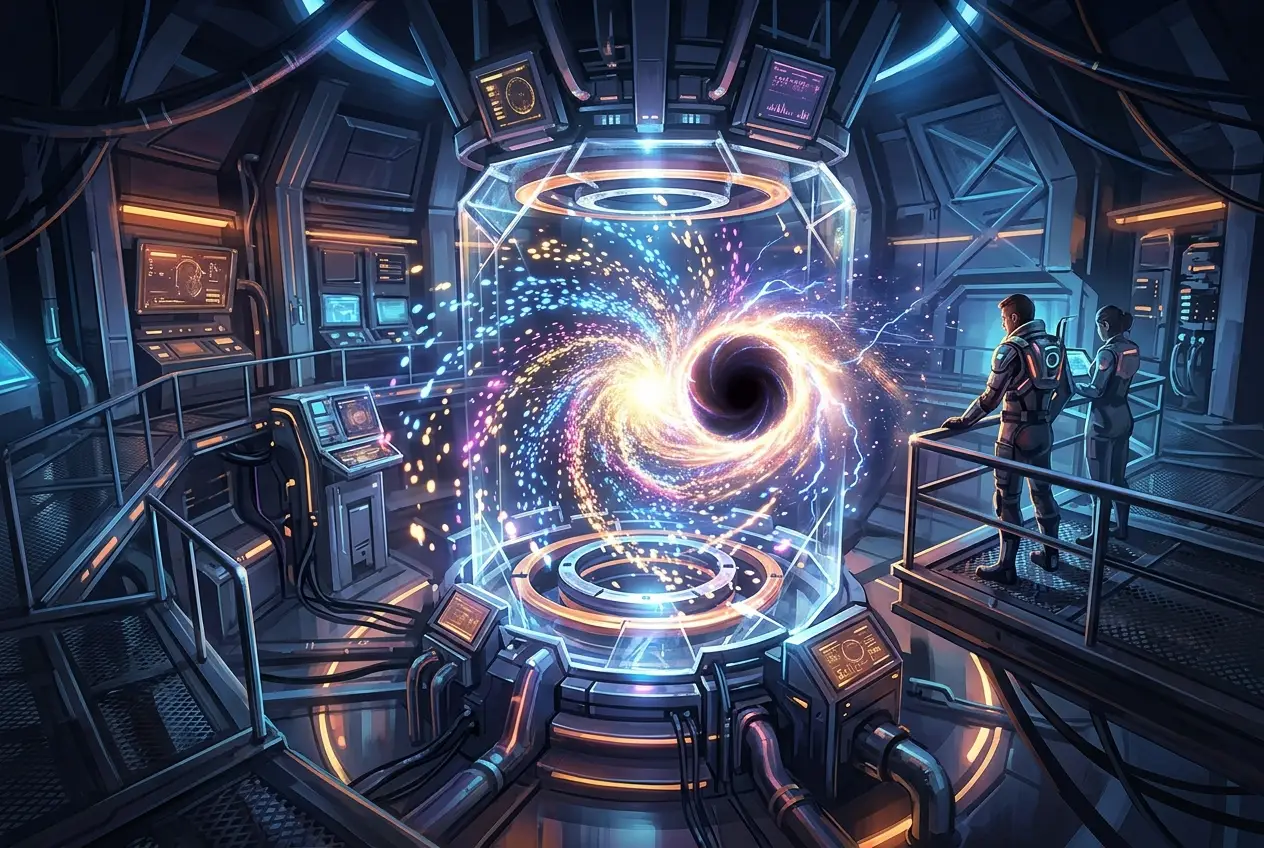
I was recently captivated by a thought experiment that truly sent shivers down my spine: What if we could create black holes here on Earth? Not the gargantuan cosmic monsters that devour stars, but tiny, subatomic versions. The idea sounds like something ripped straight from a sci-fi blockbuster, right? Yet, within the hallowed halls of theoretical physics, the concept of micro black holes isn't just a fantasy; it's a tantalizing possibility with profound implications for our technological future.
For most of us, black holes are these terrifying, enigmatic voids lurking in the vastness of space, regions where gravity is so intense that nothing, not even light, can escape. But what if I told you that the very principles governing these cosmic behemoths might one day be harnessed in a laboratory, potentially unlocking energy sources and computing power beyond our wildest dreams? This isn’t a simple leap of faith; it’s a journey into the bleeding edge of physics, where the macro meets the quantum, and where the impossible often becomes merely the currently unachievable.
The Science Behind Micro Black Holes: A Quantum Quandary
The concept of a micro black hole stems largely from the work of Stephen Hawking, who famously theorized that black holes aren't entirely black. They emit Hawking radiation, a theoretical thermal radiation that causes them to slowly lose mass and eventually evaporate. This process is more efficient for smaller black holes. A black hole the size of a mountain would evaporate almost instantaneously, but a micro black hole, if stable enough, could theoretically emit energy.
But how could something so small even form? Traditional black holes are born from the gravitational collapse of massive stars. To create a micro black hole, you'd need to compress a tiny amount of mass into an extraordinarily small space, reaching densities far beyond anything naturally occurring on Earth. The energies required for this are immense, usually associated with the very early universe or cosmic phenomena.
However, certain theoretical models, particularly those involving extra spatial dimensions, suggest that the gravitational force could become much stronger at very small scales. If these extra dimensions exist and are "large" (in the sub-millimeter range, for example), then the fundamental Planck scale—the energy threshold at which gravity becomes as strong as other forces—could be much lower than currently thought. In such scenarios, particles colliding at energies attainable in particle accelerators like the Large Hadron Collider (LHC) could theoretically create micro black holes.
The idea is that if gravity "leaks" into extra dimensions, it appears weaker in our observable four dimensions. But at distances smaller than these extra dimensions, gravity would regain its full strength, potentially allowing for the formation of mini black holes at lower energy thresholds. This is a fascinating aspect of brane cosmology and string theory, which propose that our universe is a "brane" floating in a higher-dimensional space. To learn more about how fundamental physics ties into computing, you might enjoy reading our article on Black Holes: Are They Nature's Ultimate Quantum Computers?.
The LHC and the Hunt for Mini Black Holes
When the LHC first fired up, there was a flurry of public concern, fueled by dramatic headlines suggesting that the collider might create Earth-swallowing black holes. Scientists, of course, swiftly dismissed these fears. The consensus was, and remains, that even if micro black holes were created, they would be incredibly short-lived, evaporating almost instantly via Hawking radiation, posing no threat. Any such micro black hole would be much smaller than an atom, radiating its energy away faster than it could interact with its surroundings.
"The possibility of creating micro black holes at colliders has been a fascinating theoretical prediction of certain models of quantum gravity with extra dimensions," explains a summary on CERN's official website. These are not the astrophysical monsters, but rather transient quantum phenomena. The LHC primarily looks for specific decay signatures, much like a cosmic detective sifting through forensic evidence. If these tiny black holes were created, their rapid decay would produce a unique shower of particles that physicists could detect. So far, no definitive evidence of micro black holes has been found, but the search continues, pushing the boundaries of our understanding of gravity and particle physics.
The implications of even a fleeting detection would be monumental. It would not only validate theories about extra dimensions but also open up entirely new avenues for exploring the very fabric of spacetime at its most fundamental level.
Powering Our Future: Energy Beyond Fossil Fuels
If we could somehow create stable micro black holes—a monumental "if"—the potential energy applications are staggering. According to Hawking's theory, smaller black holes radiate more intensely. Imagine a micro black hole that weighs, say, a billion kilograms (the mass of a small asteroid) but is only the size of an atom. Its Hawking radiation output would be immense, potentially providing a clean, incredibly dense energy source.
This isn't just about efficiency; it's about density. A controlled micro black hole could convert mass into energy with an efficiency approaching 100%, far surpassing nuclear fission or fusion. The challenge lies in two main areas:
- Creation: The energy required to create such a black hole is currently beyond our capabilities, even with the LHC.
- Containment: Once created, how do you contain something whose gravitational pull is so extreme? Any material placed near it would be instantly torn apart. Theorists have pondered exotic solutions, such as using magnetic fields to trap charged black holes (if they could be charged) or even leveraging the quantum nature of spacetime itself.
This leads us to a fundamental question: Is there an energy source hidden within the vacuum of space itself? While not directly a micro black hole, the concept of extracting energy from fundamental physics echoes ideas like Zero-Point Energy: Can the Vacuum Power Our Future?, which explores similar frontiers. The idea of harnessing the quantum vacuum or exotic states of matter for energy is a recurring theme in advanced physics.
Computing Beyond Silicon: The Ultimate Information Processors
Beyond energy, micro black holes could revolutionize computing. As we touched upon in a previous blog, black holes are theorized to be ultimate information processors. If we could create and manipulate micro black holes, their potential to store and process information could be unparalleled.
Consider the implications for quantum computing. Black holes already exhibit quantum properties, and their event horizons are thought to encode information. A controlled micro black hole might act as a hyper-dense, hyper-efficient quantum computer. The challenge here shifts from pure energy to control and information extraction. How do you input data into a black hole? How do you read it back without it being lost beyond the event horizon?
Theoretical physicist John Archibald Wheeler famously coined the phrase "It from Bit," suggesting that information is fundamental to the universe. Black holes, with their intricate relationship to entropy and information, embody this idea. If a micro black hole could be controlled, it might represent the ultimate "bit" of information storage, perhaps even interacting with our concepts of time and causality, as explored in Can Quantum Computers Break Time's Rules?.
The ability to create and precisely manipulate such exotic objects would fundamentally reshape our understanding of computation and the limits of what a machine can achieve.
The Ethical and Existential Questions
The pursuit of micro black hole technology, while promising, is fraught with ethical and existential questions. The idea of creating miniature versions of the universe's most destructive entities, even if theoretically safe, raises natural concerns. What if our containment systems fail? What are the unforeseen side effects of manipulating spacetime at such a fundamental level?
It's a testament to human curiosity and ambition that we even consider such possibilities. As we push the boundaries of scientific discovery, we must also mature in our capacity for responsible innovation, ensuring that the pursuit of knowledge doesn't inadvertently unleash forces beyond our comprehension. The journey into the realm of micro black holes is a potent reminder that the universe, even in its smallest manifestations, holds secrets that could either empower or overwhelm us.
The Road Ahead: From Theory to Reality (Maybe)
The creation and harnessing of micro black holes remain firmly in the realm of theoretical physics and distant future speculation. The energy scales involved are immense, the technological challenges formidable, and the scientific hurdles numerous. However, the history of science is replete with examples of seemingly impossible feats becoming reality. From splitting the atom to gene editing, humanity has repeatedly demonstrated its capacity to transform abstract theories into tangible technologies.
The ongoing search for micro black holes at particle accelerators, the continuous refinement of quantum gravity theories, and the relentless human drive to understand the universe continue to lay the groundwork for what might one day be possible. For now, the micro black hole remains a shimmering beacon on the horizon of human ingenuity, a cosmic paradox that promises to reshape our future if we can ever learn to tame its wild, fundamental nature.
&meta_title; Micro Black Holes: Can Lab Creations Power Future Tech? &meta_title; &meta_description; Explore the astonishing possibility of creating micro black holes in laboratories and how these exotic entities could revolutionize energy, computing, and our understanding of the universe. Dive into the science and the incredible potential. &meta_description;
&faqs;{"faqs":[{"id":1,"question":"Are micro black holes dangerous if created in a lab?","answer":"The current scientific consensus is that if micro black holes were created in particle accelerators like the LHC, they would be extremely short-lived. They would evaporate almost instantaneously via Hawking radiation, posing no threat to Earth or experiments. They are vastly different from the much larger, stable astrophysical black holes."},{"id":2,"question":"How would creating micro black holes confirm theories about extra dimensions?","answer":"In certain theoretical models, like those involving extra spatial dimensions, gravity becomes much stronger at very small scales. If these extra dimensions exist, the energy required to create a micro black hole could be much lower than in our standard four-dimensional understanding. Detecting micro black holes at current accelerator energies would provide strong evidence for these extra dimensions."},{"id":3,"question":"What is Hawking radiation, and why is it important for micro black holes?","answer":"Hawking radiation is a theoretical thermal radiation emitted by black holes, causing them to slowly lose mass and energy over time. For micro black holes, this process is much faster, leading to their rapid evaporation. Understanding Hawking radiation is crucial for assessing the stability and potential energy output of any artificial micro black hole."},{"id":4,"question":"Could a micro black hole be used as an energy source?","answer":"Theoretically, a stable and controlled micro black hole could be an incredibly dense and efficient energy source, converting mass into energy through Hawking radiation with near 100% efficiency. However, the challenges of creating a stable one and then safely containing it are currently far beyond our technological capabilities."},{"id":5,"question":"What are the challenges of using micro black holes for computing?","answer":"The primary challenges involve how to reliably input and extract information from a micro black hole. While black holes are thought to be ultimate information processors, developing a mechanism to interface with their quantum information storage without losing data beyond the event horizon is a profound technological and theoretical hurdle."}]}&faqs;



Conversation0
No comments yet. Be the first to share a thought — the best questions often become new stories.