


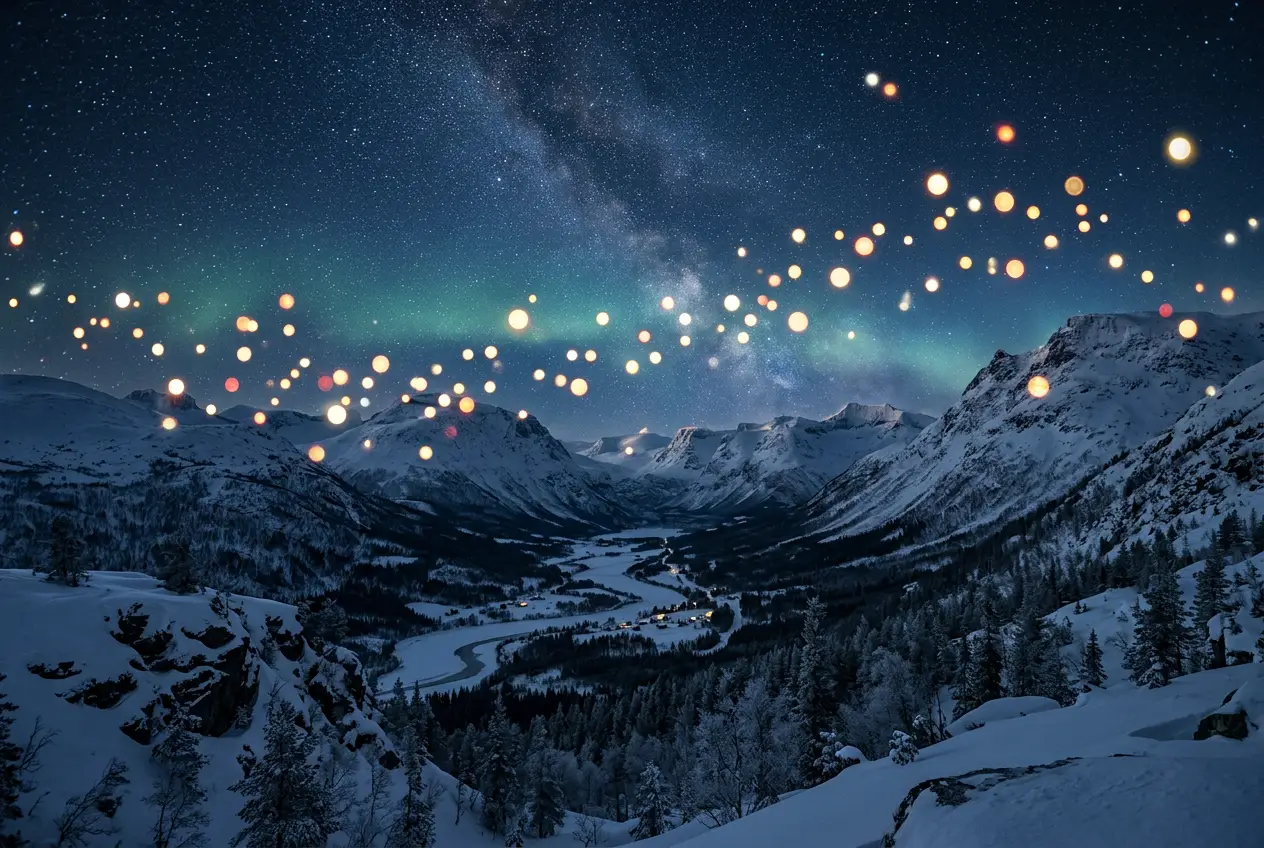
I remember stumbling upon a documentary late one night, years ago, that painted a picture so bizarre and compelling, it stuck with me. It wasn't about aliens or ancient pyramids, but something far more localized and persistent: unexplained lights dancing in a remote Norwegian valley. For over 40 years, the Hessdalen Valley has been a stage for a natural spectacle that defies conventional explanation, attracting scientists and curious minds alike. What are these lights? Are they a strange geological phenomenon, an exotic form of atmospheric plasma, or perhaps even a hint at unknown energy sources that could reshape our understanding of technology?
The mystery of the Hessdalen lights isn't just a local folklore tale; it's a genuine scientific enigma that has birthed dedicated research projects and continuous monitoring. As someone deeply fascinated by the intersection of science, technology, and unexplained phenomena, I find the Hessdalen lights to be one of Earth's most tantalizing "tech mysteries," hinting at natural processes that could mimic or even inspire advanced technology.
The Phenomenon: Lights in the Nordic Night
Imagine standing in a secluded valley, surrounded by mountains and sparse settlements, as twilight deepens. Suddenly, across the valley or hovering above the treetops, a light appears. It might be white, yellow, or even red, sometimes pulsing, sometimes moving slowly, sometimes darting at incredible speeds. These are the Hessdalen lights, observed consistently since the early 1980s, though local reports stretch back much further.
Eyewitness accounts describe a wide variety of behaviors:
- Stationary lights: Appearing in one spot and fading away.
- Moving lights: Drifting slowly, sometimes appearing to follow the valley’s contours.
- High-speed objects: Blips of light moving at velocities that defy conventional aerial vehicles.
- Changing colors and shapes: From small glowing spheres to larger, amorphous forms.
- Objects passing through solid matter: Reports of lights passing through cabin walls, though these are rarer and harder to verify scientifically.
What makes these lights so captivating is their sheer unpredictability and the lack of a single, consistent explanation. Unlike brief, isolated sightings, the Hessdalen lights are a recurring, observable phenomenon, allowing scientists to set up monitoring stations and collect data, albeit with significant challenges due to their elusive nature. You can read more about the ongoing research efforts and observations on the Wikipedia page for Hessdalen lights (opens in a new tab).
The Quest for Answers: Project Hessdalen and Beyond
The intensity of sightings peaked between 1981 and 1984, triggering significant media attention and prompting scientific investigation. In 1983, a group of researchers from Østfold University College and the Norwegian UFO Project launched Project Hessdalen. This initiative established a field station in the valley, equipped with various instruments—radars, magnetometers, seismographs, and cameras—to capture and analyze the elusive phenomena.
Initial findings confirmed the lights' existence and their unusual characteristics, ruling out many conventional explanations like cars, airplanes, or celestial objects. The lights often exhibited electromagnetic properties, with some instruments detecting radiation and magnetic field fluctuations correlating with sightings. This hinted at a non-trivial, potentially energetic source behind the spectacle.
"The Hessdalen phenomenon is one of the most enigmatic natural phenomena we know of," states Dr. Bjørn Gitle Hauge, a leading researcher with Project Hessdalen. "It challenges our understanding of physics and chemistry."
Leading Theories: From Combustion to Plasma
Over the decades, several theories have been proposed to explain the Hessdalen lights.
1. The Combustion Theory (Less Favored)
Early theories suggested the lights might be a result of the combustion of gases released from the decay of organic matter in the bogs, similar to methane or phosphine. However, the observed characteristics of the lights – their erratic movement, high speeds, and electromagnetic signatures – don't align well with slow-burning marsh gases.
2. The "Geological Battery" or Piezoelectric Theory
One intriguing hypothesis suggests that the lights are a form of tectonic stress light. The Hessdalen Valley sits on a geological fault line. Rocks under extreme stress, particularly those containing quartz (which is abundant in the area), can generate an electric charge through a phenomenon called the piezoelectric effect (opens in a new tab). This charge could ionize the air or gas pockets, leading to luminous displays.
Researchers have found that the rocks in Hessdalen are rich in iron and copper, acting as potential anodes and cathodes, with the river water serving as an electrolyte. This setup could create a "geological battery" capable of generating significant electrical potential. This aligns somewhat with discussions about Earth's internal energies, perhaps even resonating with ideas explored in posts like Giant Electrical Discharges: Earth's Hidden Power Grid?.
3. The Plasma Hypothesis: Nature's Unknown Tech?
This is where the mystery truly intertwines with our concept of advanced technology. Many researchers now lean towards the idea that the Hessdalen lights are a form of plasma. Plasma, often called the fourth state of matter, is an ionized gas where electrons are stripped from atoms, creating a soup of charged particles. Lightning is a natural example of plasma. Plasma is also the fundamental state of matter in stars and is crucial for many modern technologies, from neon signs to fusion reactors. You can delve deeper into the nature of plasma in physics on Wikipedia (opens in a new tab).
The specific type of plasma suggested for Hessdalen is dusty plasma. This involves microscopic dust particles suspended in an ionized gas. These dust particles can accumulate charges, allowing them to self-organize and even levitate within an electromagnetic field. The valley air contains titanium and scandium dust particles, which could become charged and form structures in an ionized atmosphere, creating the observed lights.
If this is true, Hessdalen could be a natural laboratory for studying a unique form of atmospheric plasma that generates light and exhibits complex movements without external propulsion. This brings to mind other mysterious atmospheric lights, such as the Will-o'-the-Wisps: Could Swamp Lights Be Plasma Tech?, which share similar characteristics.
Could Hessdalen Be a Glimpse of Unseen Technology?
The phrase "unknown plasma tech" in the title isn't necessarily suggesting an alien craft or a secret government project, though these remain popular speculative theories for any unexplained aerial phenomenon (UAP). Instead, it prompts us to consider: if these lights are indeed a natural plasma phenomenon, what can they teach us about energy generation, propulsion, or material science that we don't yet understand?
- Self-organizing energy: If nature can create self-sustaining, mobile plasma bodies, what are the principles at play? Could we replicate this to develop novel energy storage or propulsion systems that require no fuel input?
- Electromagnetic manipulation: The lights often interact with electromagnetic fields. Understanding how these natural plasmas respond to or generate such fields could inform new methods of electromagnetic manipulation, perhaps even influencing phenomena like those discussed in Cosmic Rays: Do They Spark Earth's Tech Anomalies?.
- Atmospheric sensing: The ability of these lights to persist and move within the atmosphere suggests an unknown level of interaction with atmospheric conditions. Could we develop sensors or technologies inspired by this natural "intelligence"?
The implications are profound. If the Hessdalen lights are a manifestation of highly efficient natural energy processes, it opens up new avenues for research into what I like to think of as "precursor tech"—natural phenomena that hint at technologies beyond our current grasp. It’s akin to how bio-luminescence in fireflies inspires LED research, or how echolocation in bats led to sonar. Could Hessdalen be showing us a glimpse of truly efficient, self-contained energy?
Modern Research and the Future
Today, Project Hessdalen continues its work, often with international collaboration. The automated monitoring station, EMBLA, continuously records data, waiting for the next elusive display. The focus is on gathering more quantitative data—spectroscopic analysis to determine the elemental composition of the lights, precise movement tracking, and further electromagnetic measurements.
The challenge lies in the lights' erratic behavior. They don't appear on demand, and when they do, they might be far away or obscured by weather. This makes systematic study incredibly difficult. However, the persistence of researchers underscores the profound scientific curiosity surrounding this phenomenon. The quest to understand the Hessdalen lights is a reminder that our world still holds deep mysteries, and some of them could be showing us the path to revolutionary breakthroughs. It’s a testament to the power of observation and the human drive to decipher the unknown, much like the pursuit of understanding unexplained computer behaviors we discuss in Digital Anomalies: Can Computers Show Unexplained Behaviors?.
Conclusion
The Hessdalen lights stand as one of the most compelling unsolved mysteries of our time. Whether they are the result of a complex geological battery, an exotic form of dusty plasma, or something else entirely, their continued existence challenges our scientific models and pushes the boundaries of our understanding. As we continue to explore the edges of our scientific knowledge, phenomena like the Hessdalen lights serve as powerful reminders that nature holds secrets that could revolutionize our technology, if only we can learn to listen and observe. Perhaps, in that remote Norwegian valley, nature is already running an experiment in plasma tech that we are just beginning to comprehend.

Conversation0
No comments yet. Be the first to share a thought — the best questions often become new stories.