


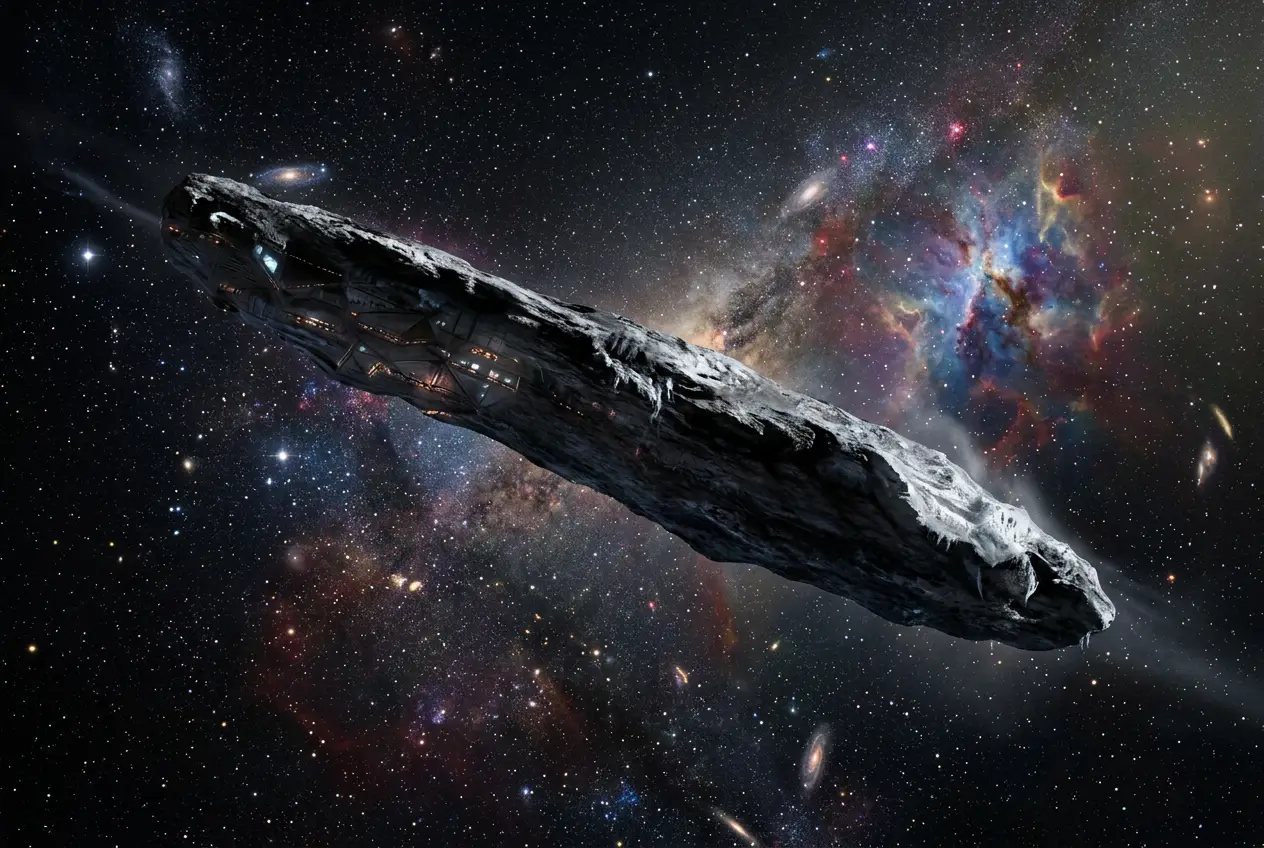
The year was 2017. I remember seeing the headlines flash across my screen, each one more sensational than the last: "Mysterious Interstellar Object Detected!" and "First Visitor from Another Star System!" It was a thrilling moment for astronomy, marking humanity's first confirmed encounter with an object originating from beyond our solar system. This cosmic wanderer was named ‘Oumuamua (pronounced oh-MOO-ah-MOO-ah), Hawaiian for "a messenger from afar arriving first."
But what started as a scientific marvel quickly spiraled into one of the most intriguing debates in modern astrophysics. Was Oumuamua merely a peculiar rock, a cosmic iceberg ejected from a distant stellar nursery? Or, as some prominent scientists dared to suggest, could it be something far more extraordinary – a piece of advanced alien technology, an interstellar probe sent by an unknown civilization?
The Unexpected Visitor: A First Glimpse
On October 19, 2017, the Pan-STARRS 1 telescope in Hawaii spotted a faint, fast-moving speck of light. Its trajectory was unlike anything we had seen before. Unlike comets or asteroids that orbit our Sun, Oumuamua was on an open, hyperbolic path, meaning it was just passing through, never to return. This confirmed its interstellar origin. It zipped past the Sun at an incredible speed, accelerated by our star's gravity, and was soon heading back into the vastness of space.
What made Oumuamua truly baffling wasn't just its origin, but its characteristics. For one, its shape was highly unusual. Observations suggested it was significantly elongated, perhaps ten times longer than it was wide, like a cosmic cigar or a flat pancake. This was unlike any asteroid or comet we had observed in our own solar system.
Furthermore, as it departed our solar system, scientists detected a non-gravitational acceleration. This meant something other than the Sun's gravity was subtly nudging it. For comets, this is common: as they approach the Sun, ice sublimes (turns directly into gas), creating jets that act like tiny thrusters. This process is called outgassing, and it forms the comet's characteristic tail. However, Oumuamua showed no signs of a cometary tail, no dust, no gas, no obvious outgassing. The lack of a visible coma or tail was a significant puzzle. You can read more about how scientists search for unusual signals in space, like those from potential alien tech, in our blog on strange radio bursts.
The Natural Explanations: A Cosmic Enigma
For the scientific community, the primary goal was to find a natural explanation. If it wasn't a comet with visible outgassing, what could cause its acceleration?
1. The Hydrogen Iceberg Theory: One theory proposed that Oumuamua was largely composed of molecular hydrogen ice. Hydrogen ice is volatile, even at the cold temperatures of deep space. If it outgassed, it would do so invisibly, producing no dust or visible light, thus explaining the lack of a tail. However, for hydrogen ice to survive the journey through interstellar space and then past our Sun without completely sublimating, it would need to be remarkably large, and its formation mechanisms are still speculative. A paper detailing this hypothesis was published in The Astrophysical Journal Letters [1].
2. The Nitrogen Iceberg Theory: Another intriguing hypothesis, put forth by researchers including Alan Jackson and Steven Desch, suggested Oumuamua was a fragment of a nitrogen iceberg, similar to the surface material of Pluto or Triton. They proposed that it broke off from an "exo-Pluto" in another star system. The reflectivity and estimated density of Oumuamua could potentially align with this idea, and nitrogen ice sublimes invisibly, explaining the non-gravitational acceleration without a visible coma [2]. This theory suggests a surprisingly common process might be at play across the galaxy, producing interstellar rogue objects, a concept explored in our blog about rogue planets.
3. Fragment from a Tidal Disruption Event: Some astronomers also considered that Oumuamua might be a fragment from a planetary body that was torn apart by its star's tidal forces. Such events could produce highly elongated, unusual shapes. However, connecting this specific type of event to Oumuamua's other observed properties remains challenging.
Despite these efforts, each natural explanation struggled to fully account for all of Oumuamua's peculiar characteristics simultaneously. The perfect combination of shape, acceleration, and lack of visible outgassing made it a truly unique object.
The Controversial Hypothesis: An Alien Artifact?
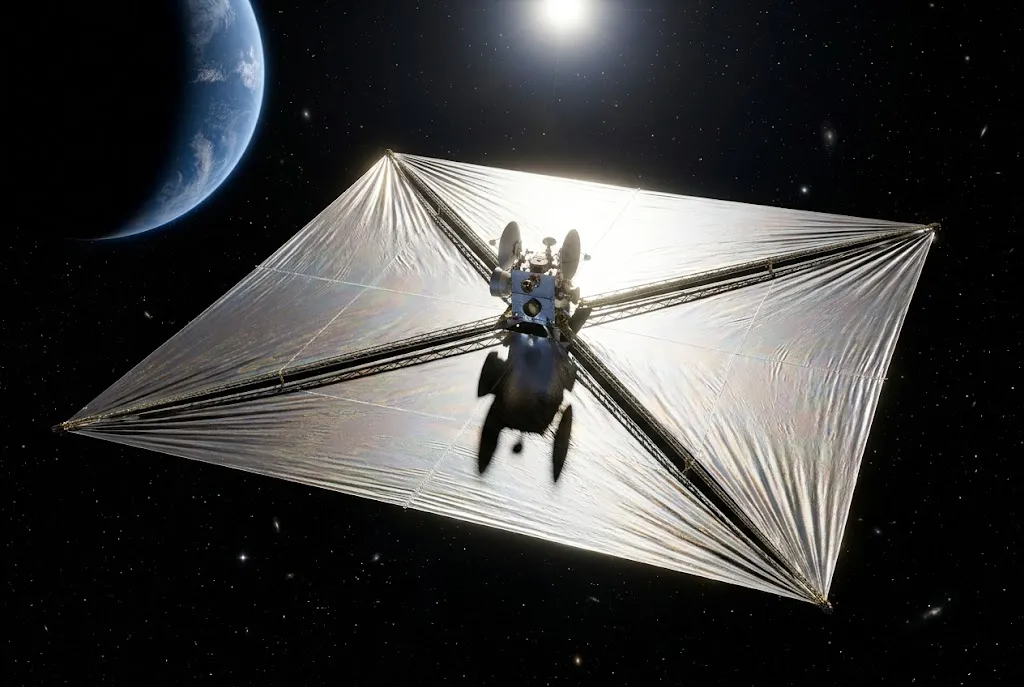
Enter Avi Loeb, a Harvard University astrophysicist. Loeb, a respected figure in theoretical astrophysics, posited a radical alternative: Oumuamua might not be a natural object at all, but rather artificial in origin. He and his collaborator, Shmuel Bialy, suggested that Oumuamua could be a "light sail" or a "solar sail"—a type of spacecraft designed to be propelled by radiation pressure from stars, similar to proposed future human spacecraft concepts.
Why would he suggest this?
- The "Pancake" Shape: A flat, thin shape (like a light sail) would be very efficient at using radiation pressure for propulsion. This could explain the observed non-gravitational acceleration without outgassing. The object's estimated thinness, if it were disc-shaped, aligns with this.
- The Lack of Tumble: Observations indicated that Oumuamua wasn't tumbling chaotically as most irregularly shaped asteroids do. Instead, its rotation was relatively stable, which could suggest some form of controlled orientation or an extremely rigid structure.
- The Speed and Trajectory: While its speed was not exceptional for an interstellar object, its arrival from a specific direction (the 'solar apex') has also been noted as potentially significant, although this remains debated.
Loeb’s proposal ignited a firestorm of controversy within the scientific community. While many dismissed it as pure speculation, Loeb argued that scientists should remain open to extraordinary explanations when natural ones fall short. He argues against "astro-chauvinism," the tendency to assume that we are alone or that alien technology would necessarily conform to our current understanding of physics. His book, "Extraterrestrial: The First Sign of Intelligent Life Beyond Earth," further details his arguments.
"The most profound discovery for humanity," Loeb has stated, "would be to find evidence for intelligent life beyond Earth. If we find such evidence, it would fundamentally change our perspective on our place in the universe and inspire us to aspire for a better future." [3]
This idea, while speculative, forces us to confront our assumptions about what might be out there. It makes me think about other grand mysteries, like the famous Wow! Signal, where a fleeting anomaly spurred decades of debate.
The Search Continues: What Have We Learned?
Unfortunately, Oumuamua was only observable for a few weeks before it sped too far away for our telescopes to track. We couldn't send a probe to intercept it, nor could we get higher-resolution images. It remains a tantalizing "what if."
However, Oumuamua’s visit has irrevocably changed our approach to interstellar objects.
- New Surveys: Projects like Pan-STARRS and the upcoming Vera C. Rubin Observatory are now specifically designed to detect and characterize transient astronomical events, including future interstellar visitors, with greater speed and detail.
- Interstellar Object Databases: We are actively building catalogs and models to better understand the population of interstellar objects passing through our solar system. Scientists estimate that at any given time, there might be several such objects within the inner solar system, unseen.
- Technosignatures vs. Biosignatures: The debate around Oumuamua has invigorated the search for "technosignatures" – evidence of technology – as opposed to just "biosignatures" – evidence of life. This expands the scope of SETI (Search for Extraterrestrial Intelligence) in exciting new directions. For instance, the Breakthrough Listen project, a major SETI initiative, did perform observations of Oumuamua, though no artificial signals were detected.
The fact that the first confirmed interstellar object we observed was so unusual, defying easy natural classification, is itself remarkable. It forces us to ask: Is Oumuamua an outlier, a rare cosmic quirk? Or is it perhaps representative of a much larger, more diverse population of interstellar objects, some of which might indeed be technological?
While the jury is still out, the Oumuamua phenomenon serves as a powerful reminder of the vast, unexplored wonders of the cosmos. It pushes the boundaries of our scientific imagination and encourages us to keep looking, questioning, and daring to dream of what lies beyond the familiar. Perhaps the next messenger from afar will stay long enough for us to truly understand its message.
Further Reading:
- Seligman, Darryl, and Malena Rice. "Could ‘Oumuamua Have Been a Hydrogen Iceberg?" The Astrophysical Journal Letters, vol. 876, no. 1, 2019, L22. https://iopscience.iop.org/article/10.3847/2041-8213/ab19c8 (opens in a new tab)
- Jackson, Alan P., and Steven J. Desch. "1I/‘Oumuamua as a nitrogen iceberg." Journal of Geophysical Research: Planets, vol. 126, no. 11, 2021, e2021JE006880. https://agupubs.onlinelibrary.wiley.com/doi/full/10.1029/2021JE006880 (opens in a new tab)
- Loeb, Avi. Extraterrestrial: The First Sign of Intelligent Life Beyond Earth. Houghton Mifflin Harcourt, 2021.
- Wikipedia: 'Oumuamua. https://en.wikipedia.org/wiki/%CA%BBOumuamua (opens in a new tab)
- Wikipedia: Solar Sail. https://en.wikipedia.org/wiki/Solar_sail (opens in a new tab)
Conversation0
No comments yet. Be the first to share a thought — the best questions often become new stories.