


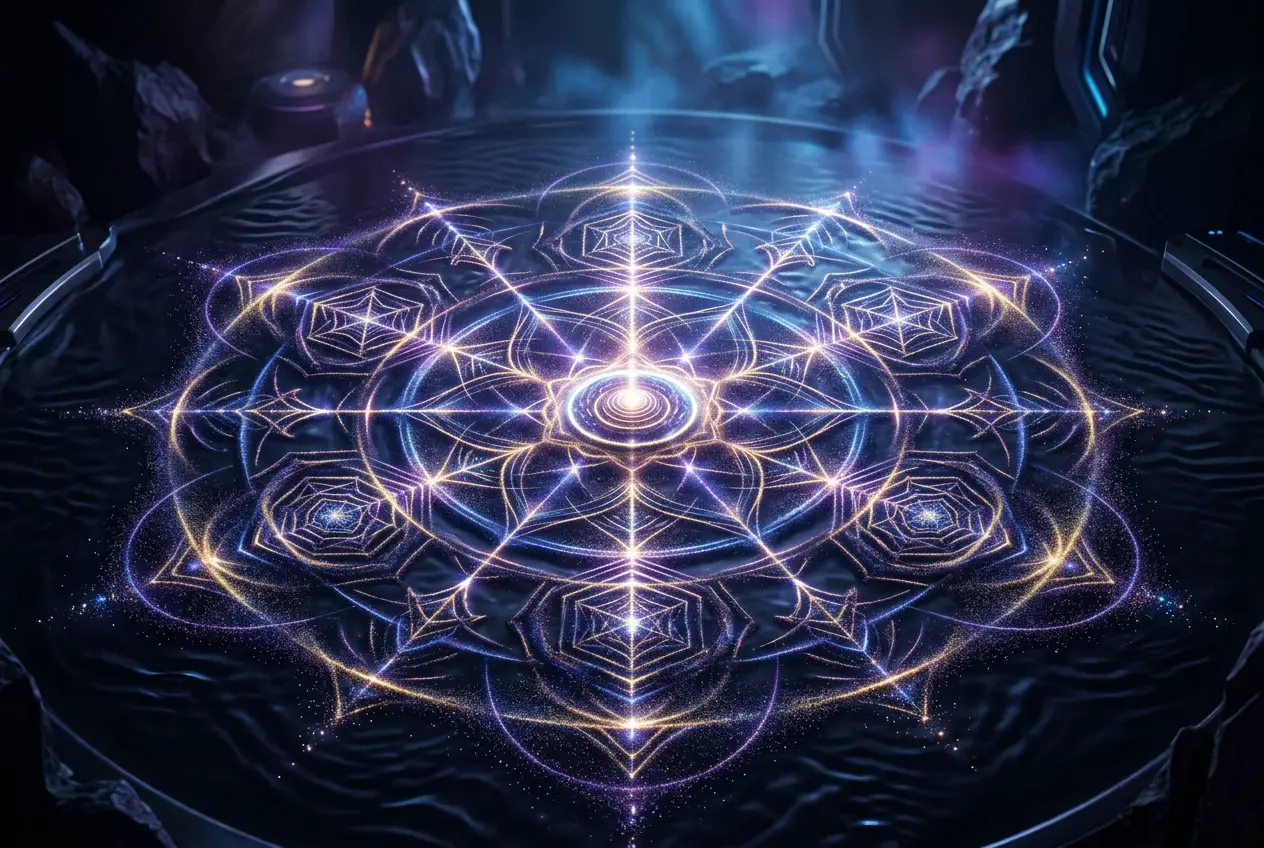
I remember a moment that completely shifted my perception of reality. I was watching a documentary, and on screen, a speaker vibrated a plate covered in fine sand. As the frequency changed, the sand danced, not chaotically, but forming exquisite, symmetrical patterns — stars, mandalas, intricate geometric shapes that seemed to appear out of thin air. It wasn't just interesting; it was profoundly unsettling, in the best possible way. Could something as ethereal as sound truly possess the power to sculpt the physical world into such precise forms? This phenomenon, known as Cymatics, isn't just a parlor trick; it's a fascinating bridge between the invisible world of vibration and the tangible realm of form, hinting at secrets the universe might be whispering to us.
The Invisible Architect: What is Cymatics?
At its heart, Cymatics is the study of visible sound and vibration. It demonstrates how different frequencies create distinct, often complex, geometric patterns in a medium like sand, water, or even air. Think of it as giving form to frequency. The patterns aren't random; they are a direct consequence of the sound waves' amplitude and frequency, revealing the underlying structure of vibration.
For me, understanding Cymatics was like finding a hidden instruction manual for the universe. It suggests that form isn't just a static property of matter, but a dynamic expression of underlying vibrational energy. This isn't some fringe idea; it's a verifiable scientific principle that has intrigued scientists and mystics alike for centuries.
A Symphony of Discovery: From Chladni to Jenny
The story of Cymatics isn't new; its roots stretch back centuries. I find it fascinating how different minds, separated by time and space, converged on this same curious phenomenon.
One of the earliest pioneers was the German physicist and musician Ernst Chladni in the late 18th century. He discovered that by drawing a violin bow across the edge of a metal plate covered with sand, he could produce intricate geometric patterns. These "Chladni figures," as they came to be known, were a revelation, demonstrating that sound could organize matter. His work laid the fundamental groundwork for understanding nodal lines — areas where there is no displacement, causing particles to settle. You can read more about his groundbreaking work on Wikipedia (opens in a new tab).
Fast forward to the 20th century, and the field found its modern champion in Swiss physician and natural scientist Hans Jenny. Beginning in the 1960s, Jenny dedicated years to systematically observing and documenting these phenomena. Using what he called a "Tonoscope," he experimented with a wide range of frequencies, media (liquids, pastes, powders), and materials. His extensive work, compiled in his book "Cymatics: A Study of Wave Phenomena and Vibration," truly brought the subject into scientific focus.
Jenny didn't just reproduce Chladni's experiments; he expanded upon them, showing how human speech, when spoken into the Tonoscope, would create patterns specific to the vowels and consonants. He observed that when a sound was generated, a form would appear in the physical medium, and when the sound stopped, the form disappeared. For me, Jenny's work highlighted the transient, yet powerful, nature of vibrational influence. It wasn't about creation ex nihilo, but rather the unfolding of inherent order.
The Science Unveiled: How Sound Sculptures Matter
So, how exactly does an invisible wave of sound create such intricate visible forms? It all comes down to resonance and vibrational physics.
When a sound wave travels through a medium, it causes the particles within that medium to vibrate. However, not all parts of the medium vibrate equally. Certain areas, called nodes, remain relatively still, while other areas, antinodes, experience maximum displacement.
Imagine a drumhead. When you hit it, the entire surface vibrates, but there are specific points (nodes) where the vibration is minimal. In Cymatics, when fine particles like sand are placed on a vibrating surface (like a Chladni plate), they are effectively "shaken off" the vibrating antinodes and accumulate in the quieter nodal areas. The frequency and amplitude of the sound wave dictate the arrangement and complexity of these nodal lines, thus forming the distinct patterns we observe.
Different frequencies produce different patterns because they excite different modes of vibration within the medium. Higher frequencies tend to produce more complex and intricate patterns, with more nodal lines. It’s like a hidden language where each frequency speaks a unique design. This principle applies across various forms of vibration, from seismic waves shaping geological formations to the subtle vibrations within biological systems.
Nature's Own Cymatics: Echoes in the Cosmos
As I delved deeper, I couldn't help but wonder: if sound shapes matter in these controlled experiments, what role does vibration play in the grander tapestry of the universe?
Many theorists propose that Cymatics offers a glimpse into how form arises in nature. From the spiral patterns of galaxies to the branching of trees, from the hexagonal cells of a honeycomb to the intricate designs of snowflakes, we see patterns everywhere. Could these be the universe's own Chladni figures, formed by underlying vibrational frequencies?
This idea resonates with ancient philosophical and spiritual traditions that speak of "the Word" or "Om" as the primordial sound from which all creation emerges. While modern science wouldn't frame it in mystical terms, the concept of a universal vibration organizing matter has profound implications. Could the very fabric of spacetime be resonating, creating the structures we observe? For more on the concept of sound and creation in various cultures, you might explore topics like sacred geometry or ancient cosmology.
Consider the intricate arrangements of molecules in crystals, or the way cells organize themselves into complex biological structures. Could there be a "cymatic effect" at a microscopic level, where the specific vibrational frequencies of molecules influence their arrangement and function? This isn't confirmed science, but a fascinating area of speculation that Cymatics encourages.
The Whisper of Ancient Wisdom and Future Tech
The implications of Cymatics extend beyond theoretical physics and natural patterns. I find myself contemplating how this understanding might have influenced ancient civilizations and how it could shape our future.
Could ancient builders, like those who constructed megalithic structures, have intuitively understood the power of sound? Some theories suggest that certain ancient sites were designed to resonate at specific frequencies, potentially influencing materials or even human consciousness. While highly speculative, it adds a layer of mystery to how structures like those discussed in our blog on unseen-forces-did-sound-energy-build-ancient-megaliths might have been created. Perhaps they didn't have "tech" as we understand it, but a deep knowledge of vibrational mechanics.
In the realm of modern technology, Cymatics offers exciting possibilities:
- Materials Science: Imagine designing materials with specific vibrational properties that allow them to self-assemble or change their structure on demand. Researchers are already exploring how sound waves can manipulate particles to create intricate 3D structures, a concept that could revolutionize fields like manufacturing and nanotechnology.
- Healing and Therapy: Sound healing is an ancient practice gaining modern scientific interest. If specific frequencies can organize matter, could they also influence biological systems? Therapies using targeted sound waves are being explored for pain relief, tissue regeneration, and even cancer treatment. While the exact mechanisms are still under investigation, the principle of resonance influencing cellular structures is a fascinating avenue.
- Acoustic Levitation: This is already a reality! Scientists can use precisely tuned sound waves to suspend objects in mid-air, defying gravity. While currently used for delicate handling in laboratories, the potential for zero-G manufacturing or even transportation is immense.
I believe Cymatics also offers a unique perspective on the emerging field of bio-inspired computing and even living crystals, as explored in our article on living-crystals-computings-next-frontier. If life itself is a complex interplay of vibrations and energy, then understanding how these vibrations create and sustain form could be key to unlocking new frontiers in AI and biotechnology.
The Challenges and the Call to Curiosity
Despite its wonders, Cymatics is not without its detractors and misconceptions. Some claim that the patterns are merely artifacts of the experimental setup, while others push speculative theories without sufficient scientific rigor. It's crucial, as I always emphasize, to approach these phenomena with a balance of open curiosity and critical thinking. The patterns are real, the physics behind them is sound (pun intended!), but the broader implications are still very much a field of active exploration.
What Cymatics undeniably shows us is that the universe is far more dynamic and interconnected than our everyday senses perceive. The seemingly empty space between particles, the silent hum of existence – these are not voids, but arenas of vibrant, creative energy. This echoes the concept of a hidden layer of reality, prompting us to ask if could-our-reality-be-a-simulation, where fundamental rules, like those governing vibration, dictate everything we experience.
Conclusion: The Universe Sings its Form
Cymatics stands as a powerful testament to the hidden order within the universe. It's a reminder that even the most fleeting and invisible phenomena, like sound, carry immense power to shape and define the physical world. For me, it transforms our understanding of reality from a static, solid entity into a pulsating, vibrating symphony where every note contributes to the grand design.
As we continue to explore the frontiers of science and technology, the insights from Cymatics could prove invaluable, leading to breakthroughs in fields we can barely imagine today. It beckons us to listen more closely, to observe more keenly, and to never stop asking what unseen forces are at play, orchestrating the magnificent drama of existence. The universe, it seems, isn't just a place; it's a song, and its vibrations are constantly giving birth to its form.






Conversation0
No comments yet. Be the first to share a thought — the best questions often become new stories.