


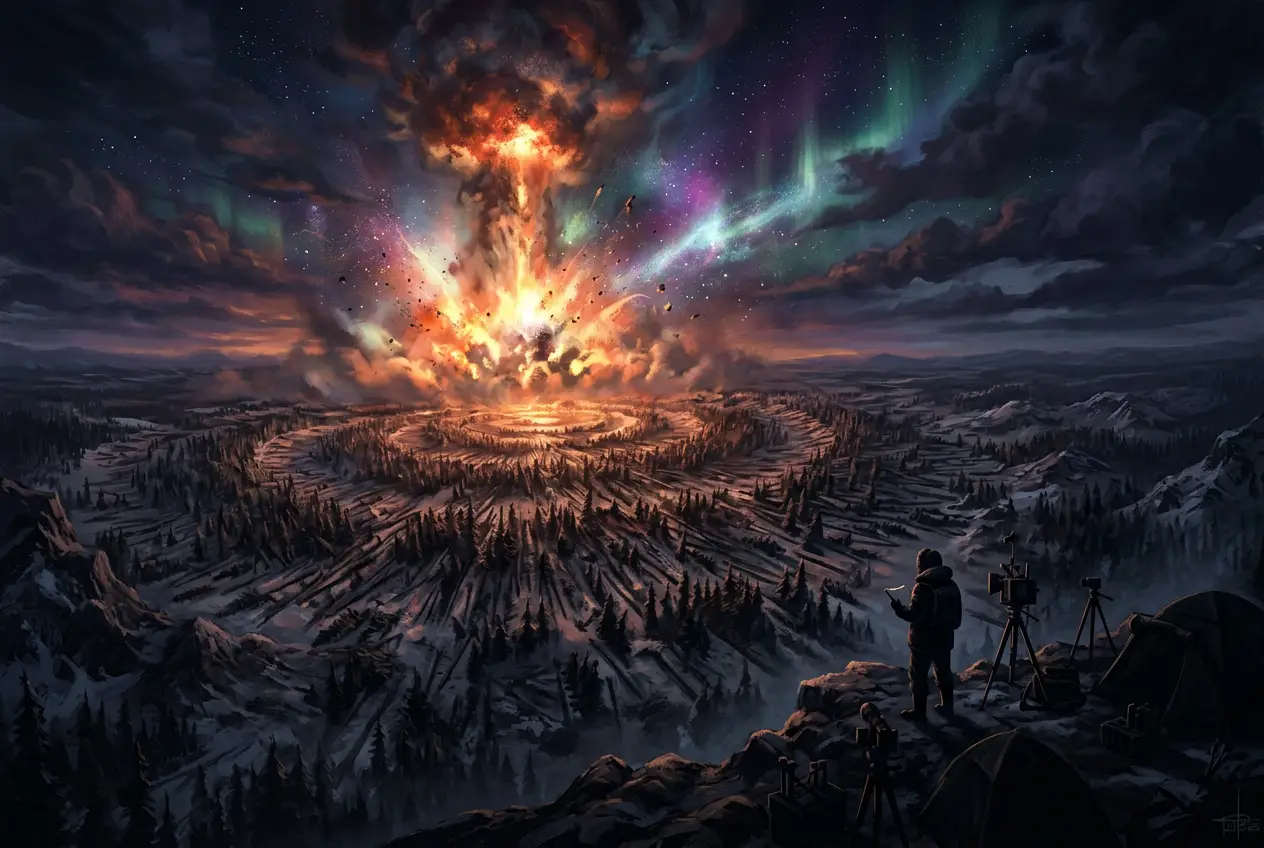
Imagine a typical morning on June 30, 1908. In the vast, remote wilderness of Siberia, life went on as it always had. Then, without warning, the sky erupted. A blinding flash, a heat so intense it charred trees miles away, followed by an earth-shattering roar that echoed for hundreds of miles. The ground trembled, windows shattered in distant towns, and atmospheric shockwaves circled the globe twice. Roughly 80 million trees across 2,150 square kilometers (830 square miles) were flattened, yet incredibly, no impact crater was ever found. This wasn't just another natural event; it was the Tunguska Event, and I find it one of the most compelling and perplexing mysteries in scientific history.
For over a century, scientists, historians, and enthusiasts have grappled with the same question: What exactly happened that day? Was it a massive cosmic intruder? A rare natural phenomenon? Or, as some have dared to speculate, something far more anomalous, perhaps even an unknown technology operating on a scale we can barely comprehend?
The Day the Sky Fell: What Really Occurred?
The Tunguska Event occurred at approximately 7:17 AM local time. Eyewitness accounts, though scarce due to the remote location, paint a vivid picture of cosmic terror. Indigenous Evenk people living nearby reported seeing a brilliant, bluish light streaking across the sky, followed by an explosion so powerful it knocked them off their feet. Many thought the end of the world had come. Livestock were incinerated, structures were destroyed, and some individuals suffered severe burns and shock.
One remarkable account, from a local farmer named S. B. Semenov, details the immediate aftermath: "The sky split in two, and high above the forest, the whole northern part of the sky appeared covered with fire... At that moment there was a loud bang and a mighty crash... The crash was followed by a noise like stones falling from the sky, or guns firing. The earth trembled..." These firsthand reports underscore the sheer magnitude of the event, which many scientists now estimate was equivalent to a 10–15 megaton TNT explosion – a force comparable to a large thermonuclear weapon.
The Long Road to Discovery: Why the Delay?
Despite its immense power, the Tunguska Event remained largely uninvestigated for nearly two decades. The vastness and inaccessibility of the Siberian taiga, coupled with the political turmoil of early 20th-century Russia, meant that the first scientific expedition didn't reach the site until 1927. Led by Russian mineralogist Leonid Kulik, these early researchers faced incredible challenges. What they found was both astonishing and baffling: a massive area of flattened trees, all pointing away from a central point, yet no discernible impact crater, no fragments of a meteorite, and no clear explanation for the event.
Kulik initially theorized a meteor impact, expecting to find fragments. However, repeated searches yielded nothing conclusive. This absence of typical impact evidence became a cornerstone of the Tunguska mystery, pushing conventional explanations to their limits and opening the door to more unconventional theories.
Scientific Scrutiny: Leading Theories Explored
Over the decades, numerous scientific theories have been put forward to explain the Tunguska Event.
1. The Cosmic Culprit: Asteroid or Comet?
The most widely accepted scientific explanation is that the explosion was caused by the airburst of a large meteoroid or comet fragment. A stony asteroid or an icy comet, estimated to be 50–100 meters in diameter, would have entered Earth's atmosphere at high speed. The immense pressure and heat generated by its entry would have caused it to disintegrate and explode several kilometers above the surface, rather than hitting the ground directly.
This "airburst" hypothesis elegantly explains the lack of a crater and the radial pattern of felled trees. The shockwave would have radiated downwards, flattening everything in its path. Studies by NASA and other institutions have simulated such events, showing how an object of that size and composition could produce the observed destruction without leaving a traditional impact scar. The scarcity of meteoritic fragments is also consistent with a cometary body, largely composed of ice and dust, which would have vaporized completely in the atmosphere. You can learn more about comets and their composition on Wikipedia (opens in a new tab).
2. The Micro Black Hole Theory: A Cosmic Pinprick?
This theory, proposed in the 1970s by physicists Albert A. Jackson and Michael P. Ryan, suggests that the Tunguska Event was caused by a tiny primordial black hole passing through Earth. While highly speculative and largely discredited by further research, it highlights the extent to which scientists were willing to go to explain the unusual characteristics of the event. A micro black hole, with its immense gravitational pull, could theoretically pass through Earth, leaving no large-scale debris but causing a localized energy release and seismic shockwaves as it entered and exited the atmosphere. However, such an object would likely cause two distinct entry and exit points, neither of which has been found, and its existence itself is purely theoretical.
It's fascinating how cosmic phenomena can spark such wild ideas, much like discussions around /blogs/black-holes-natures-ultimate-quantum-computers-4410.
3. Geophysical Explanations: Earth's Own Fury?
Some researchers, particularly in the early days, explored terrestrial explanations. One theory suggested a massive release of natural gas from the Earth's crust, perhaps ignited by lightning. However, the scale and characteristics of the Tunguska explosion, particularly the atmospheric shockwaves and widespread destruction, make this explanation highly improbable. The energy required simply isn't consistent with known geophysical phenomena of that type.
The Anomaly Angle: Was it "Unknown Tech"?
This is where the intrigue truly deepens, touching on the idea of historical tech or anomalies. While mainstream science leans heavily towards a natural cosmic airburst, the lingering questions—the absence of definitive fragments, the strange light phenomena reported for days after, and the sheer uniqueness of the event—have led some to ponder more exotic possibilities.
Could it have been a form of unknown, advanced technology? Not necessarily alien in the conventional sense, but perhaps an experimental energy discharge, a deliberate atmospheric manipulation, or even an accidental occurrence of something beyond our current understanding of physics. I’ve often wondered if the echoes of such a powerful, yet crater-less, blast could hint at forces unknown.
The key here is not to promote unsubstantiated conspiracy theories, but to acknowledge that the lack of absolute, undeniable proof in the early days fueled, and to some extent still fuels, this kind of speculation. When traditional explanations fall short, the human mind naturally seeks alternatives. The unusual magnetic anomalies detected in the soil, albeit minor, have sometimes been interpreted as remnants of an advanced energy field. Similarly, the unique light effects seen globally for days – a sky so bright that one could read newspapers at midnight in London – sparked curiosity about strange atmospheric interactions that transcended a simple explosion. This calls to mind other unexplained cosmic phenomena, such as those discussed in /blogs/cosmic-rays-do-they-spark-earths-tech-anomalies-8855, which explore the boundary between known science and unexplained events.
It’s crucial to distinguish between scientific hypothesis and mere speculation. The "unknown tech" angle largely falls into the latter category, driven by the desire to fill knowledge gaps with captivating possibilities. However, it's these very possibilities that make the Tunguska Event such a staple in discussions of curious phenomena and tech mysteries.
Lingering Questions and Modern Research
Even with the robust meteoroid airburst model, the Tunguska Event still holds secrets. For instance, the precise composition of the object remains debated—was it a stony asteroid or a fragile comet? Modern analysis techniques, including studying the microscopic silicate and magnetite spherules found in the peat layers of the Tunguska region, are continually trying to piece together the puzzle. These particles, believed to be extraterrestrial in origin, offer tangible clues, but their limited distribution makes a definitive identification challenging.
Researchers also continue to explore the "Lake Cheko" theory, which suggests a small lake near the blast epicenter might be an impact crater left by a fragment of the Tunguska object. Geophysical surveys of the lakebed have shown some anomalies, but conclusive evidence is still sought. You can read more about ongoing research and theories on the Tunguska event Wikipedia page (opens in a new tab).
The event also serves as a stark reminder of our planet's vulnerability to cosmic impacts. It wasn't a world-ending catastrophe, but it was powerful enough to wipe out a major city if it had occurred over one. This realization has spurred significant advancements in planetary defense, focusing on detecting and tracking Near-Earth Objects (NEOs). This foresight, born from understanding such impactful anomalies, is vital for our future. It even makes one wonder about other potential cosmic visitors, like the mysterious object Oumuamua, explored in /blogs/oumuamua-alien-probe-or-cosmic-iceberg-8256.
Conclusion: A Century of Cosmic Curiosity
The Tunguska Event remains an extraordinary chapter in Earth's history, a stark reminder of the dynamic interplay between our planet and the cosmos. While the scientific community largely agrees on a cosmic airburst, the details continue to inspire debate and research. It's a testament to human curiosity that we tirelessly seek answers to such profound mysteries. Whether it was a fragile comet, a dense asteroid, or something far stranger, Tunguska continues to fascinate, reminding us that sometimes, the most astonishing events leave the fewest traces, forcing us to look beyond the obvious for the truth.




Conversation0
No comments yet. Be the first to share a thought — the best questions often become new stories.