


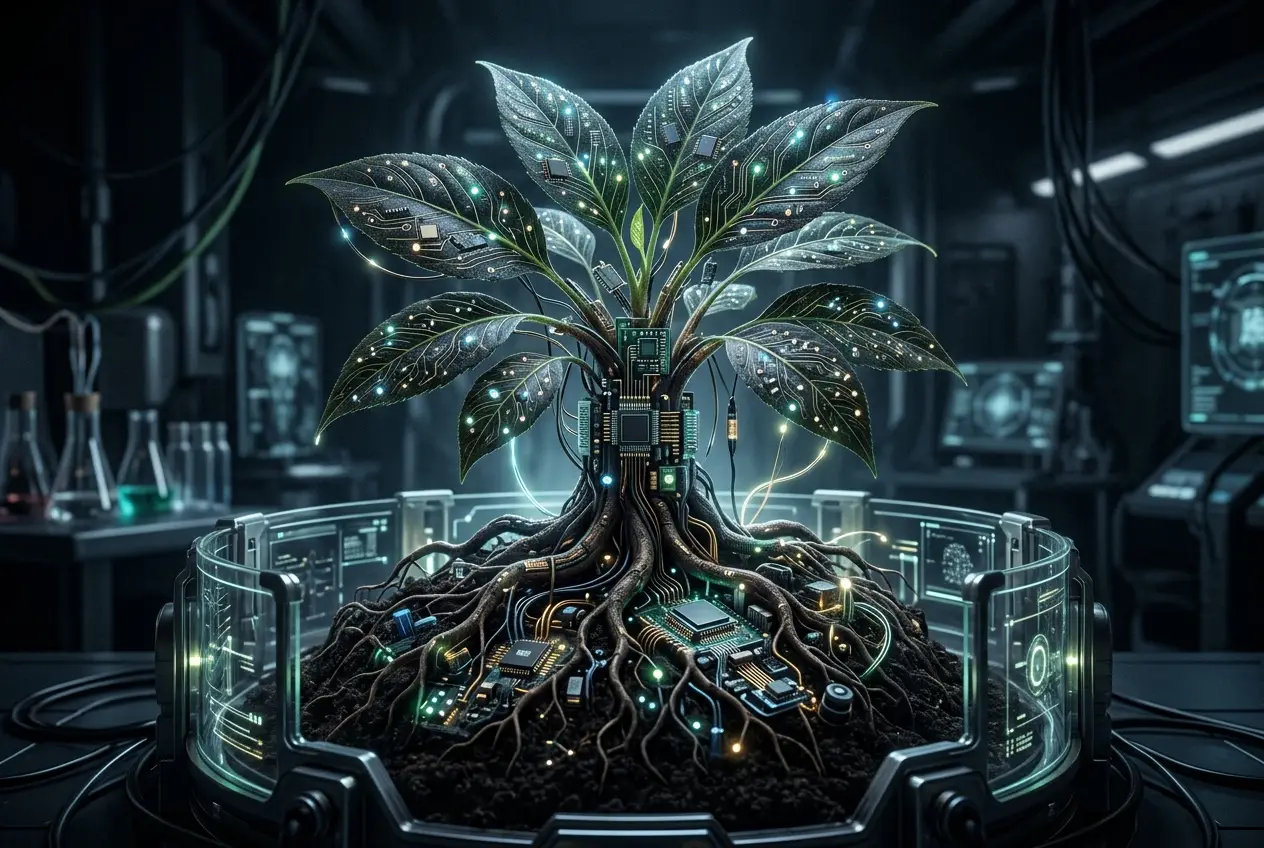
I recently stumbled upon a concept so wild, so utterly futuristic, yet so grounded in biological reality, that it completely reshaped my understanding of technology's potential. Imagine a world where the very devices that power our digital lives—our smartphones, computers, even advanced AI systems—aren't forged in sterile factories but cultivated in verdant greenhouses. I'm talking about bio-integrated electronics, specifically, the mind-bending idea that plants could grow our next microchips.
It sounds like something straight out of a sci-fi novel, a blend of organic life and cutting-edge silicon. But what if the intricate, self-organizing systems perfected by nature over billions of years hold the key to overcoming the limitations of conventional electronics? What if the future of computing isn't just about shrinking transistors, but about merging them with the unparalleled efficiency and sustainability of the plant kingdom? I believe this isn't just a whimsical thought; it's a burgeoning field of research that promises a revolution.
The Problem with Traditional Microchip Manufacturing
Before we dive into the green revolution, let’s consider the status quo. The production of modern microchips is an incredibly complex, energy-intensive, and often environmentally taxing process. It relies on massive fabrication plants, vast amounts of pure water, and a cocktail of hazardous chemicals. As our demand for computational power continues to skyrocket, the ecological footprint of this industry becomes increasingly concerning.
We're hitting fundamental limits in miniaturization with silicon-based chips. Moore's Law, while remarkably resilient, is beginning to show its age. The physical constraints of silicon and the immense heat generated by increasingly dense circuits are pushing engineers to their breaking points. This has led many to question: is there another way? Could nature offer a more elegant, sustainable, and perhaps even more powerful path forward?
Bio-Integrated Electronics: A Seed of an Idea
The core concept behind "plants growing microchips" isn't about literal plants spontaneously sprouting fully formed CPUs. Instead, it explores the potential of using biological systems – particularly plants – as dynamic templates, self-assembling platforms, or sustainable power sources for electronic components. It's about harnessing the plant's inherent ability to synthesize complex molecules, transport nutrients, and respond to stimuli in incredibly efficient ways.
Researchers have already made significant strides in the broader field of bio-integrated electronics. We've seen projects where electronics are woven into fabrics for wearables, or even directly integrated with human tissue for medical applications. The leap to plants isn't as far-fetched as it seems when you consider the sophisticated biological machinery already at work within a leaf or a root system.
How Could Plants Contribute to Microchip Growth?
There are several fascinating avenues being explored:
1. Biomineralization and Nanoparticle Synthesis
Plants are natural chemists. They absorb minerals from the soil and can process them into various forms. Imagine genetically engineering plants to absorb specific metallic ions (like gold, silver, or copper) and then precipitate them as nanoparticles within their cellular structures or vascular systems. These nanoparticles could then serve as building blocks for nanoscale conductive pathways.
"The natural ability of plants to absorb and process inorganic materials offers a unique and sustainable route for synthesizing complex nanomaterials that are crucial for next-generation electronics," says Professor Liqiang Mai of Wuhan University of Technology, a leading researcher in nanomaterial synthesis. This process, known as biomineralization, is already observed in nature, such as in the formation of silica structures in diatoms. Scientists are actively trying to control and direct this process for technological applications. You can read more about biomineralization on Wikipedia (opens in a new tab).
2. Self-Assembling Circuits and Templates
Nature excels at self-assembly. Proteins fold into precise 3D structures, and cells arrange themselves into complex tissues and organs. What if we could design plants to act as living templates for electronic circuits? Picture a plant's vascular system, the xylem and phloem, providing a natural network of channels. We could potentially introduce conductive polymers or nanoparticles that self-assemble along these predetermined biological pathways, creating rudimentary circuits.
The structural integrity and self-repairing capabilities of plants are also a huge advantage. A "plant chip" could potentially heal minor damage, extending its lifespan and reducing waste. Furthermore, the inherent parallelism and branching structures found in plants could inspire novel computational architectures, moving beyond the traditional linear logic gates.
3. Bio-Power and Energy Harvesting
One of the biggest challenges in electronics is power. Plants are masters of solar energy harvesting through photosynthesis. If we could integrate electronic components directly into a plant, the plant itself could become a self-sustaining power source, drawing energy from sunlight. Research into "plant-microbial fuel cells" already demonstrates the feasibility of generating electricity from plant root systems interacting with soil microbes, providing small but continuous power outputs. Learn more about plant microbial fuel cells on Wikipedia (opens in a new tab).
This wouldn't just be for the chips within the plant. Imagine a network of such plants powering a vast network of sensors, or even contributing to the grid in a decentralized manner. The implications for sustainable energy are immense.
4. Bio-Logic Gates and Sensors
Beyond passive components, could plants perform computational tasks? While a full CPU is a distant dream, scientists are exploring how plants react to electrical and chemical signals. Plants demonstrate complex signaling networks within their own bodies, responding to light, touch, and chemical cues. Could these biological responses be harnessed as a form of "bio-logic gate"?
For instance, certain plants can be engineered to change color or emit signals in the presence of specific pollutants. This principle could be extended to create highly sensitive, self-replicating biosensors directly within living organisms. The possibilities for environmental monitoring, agriculture, and even medical diagnostics are profound. We already have examples of how plants communicate internally, which you can find insights into on Wikipedia (opens in a new tab).
Current Research and Future Outlook
While a plant-grown iPhone might be decades away, the foundational research is already underway. Scientists are experimenting with:
- Growing nanowires in plants: Researchers at Linköping University, for instance, have pioneered ways to grow conductive polymers inside the vascular bundles of roses, turning them into "cyborg plants" with electronic circuits.
- Integrating electronic sensors into plant leaves: These sensors can monitor a plant's health, water stress, or detect pathogens, essentially giving plants a "digital voice."
- Using plant-derived cellulose as a substrate: Cellulose, a primary component of plant cell walls, is a sustainable and flexible material that can be used to create biodegradable electronic components.
This field draws inspiration from various disciplines, including synthetic biology, materials science, and bio-engineering. It's a testament to humanity's ongoing quest to push the boundaries of what's possible, seeking solutions not just in labs, but in the boundless creativity of nature itself. For another fascinating look at nature-inspired tech, check out our blog on Could Bioluminescent Plants Light Up Our Cities?.
The Challenges and Ethical Considerations
Of course, this path is not without its hurdles.
- Scalability: How do we mass-produce complex electronic components using biological systems?
- Precision: Achieving the exact nanometer-scale precision required for modern microchips through biological growth is an immense challenge.
- Stability and Durability: Living systems are dynamic and susceptible to environmental changes. How do we ensure the longevity and stability of bio-integrated electronics?
- Ethical Concerns: Genetically modifying plants for technological purposes raises ethical questions about biodiversity, environmental impact, and the very definition of "life" and "machine."
These are critical questions that must be addressed as the field progresses. Yet, the potential benefits – reduced environmental impact, self-sustaining systems, and entirely new forms of computing – are too significant to ignore.
A Greener Future for Tech?
The idea of plants growing our next microchips is more than just a scientific novelty; it represents a fundamental shift in our approach to technology. It forces us to reconsider the artificial boundaries we've placed between the natural and the manufactured. As I reflect on this, I realize that nature, in its infinite wisdom, has often held the blueprints for our most advanced innovations. From the aerodynamic design of birds inspiring aircraft to the intricate neural networks of the brain guiding AI, the natural world continues to be our greatest teacher.
Perhaps, one day, the humming server farms of today will be replaced by rustling silicon forests, quietly growing the intelligence that powers our world. It's a vision of a truly sustainable, interconnected future where technology doesn't just coexist with nature but emerges directly from it. And that, I think, is a future worth cultivating. For more on nature's secrets and technology, explore our post on Can Trees Talk? Decoding Earth's Hidden Network or even Did Ancient Plants Fuel Tomorrow's Cities?.






Conversation0
No comments yet. Be the first to share a thought — the best questions often become new stories.