


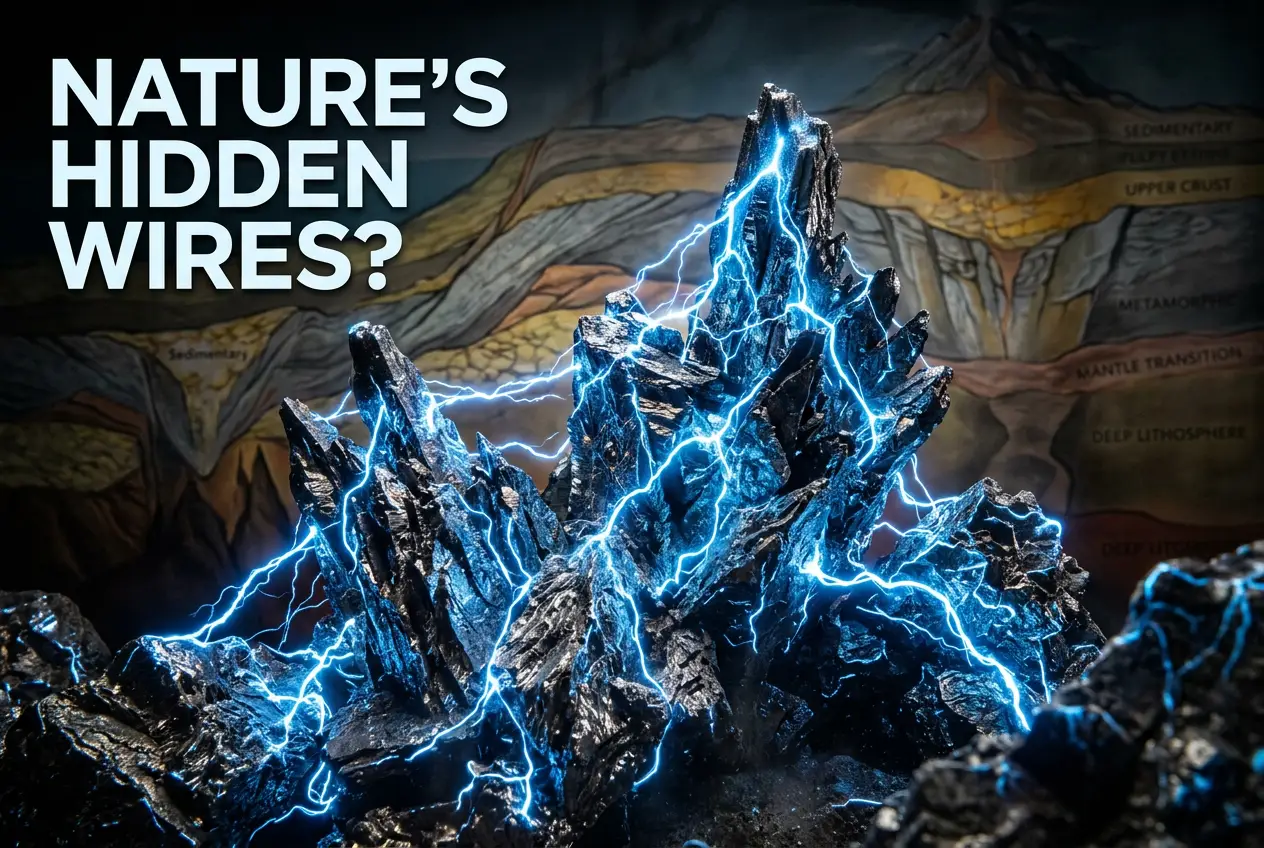
I was recently sifting through an old geology textbook, and a thought struck me — a truly wild one that made me pause. We spend so much time marveling at the advancements in material science, chasing the dream of room-temperature superconductors that could revolutionize everything from power grids to quantum computing. But what if nature had already cracked that code, long before we even knew what superconductivity was? What if, buried deep within Earth’s crust, there exist naturally occurring materials that defy conventional electrical resistance?
It sounds like something out of a science fiction novel, perhaps a forgotten plot point from a Jules Verne adventure. Yet, the more I delved into the fringe theories and the sheer unpredictability of geological processes, the less far-fetched it seemed. The idea that Earth's crust might harbor natural superconductors isn't just a whimsical thought; it opens up a fascinating intersection of geology, physics, and profound technological implications.
The Spark of an Idea: What is Superconductivity?
Before we dive into Earth's hidden potential, let's briefly recap what superconductivity actually is. Imagine an electrical wire that conducts current with absolutely no resistance. No energy loss, no heat generated. That's superconductivity in a nutshell. Once an electrical current starts flowing in a superconductor, it can theoretically flow forever, unimpeded. This phenomenon usually occurs at incredibly low temperatures, close to absolute zero (-273.15°C or 0 Kelvin), but scientists are constantly discovering "high-temperature" superconductors that operate at less extreme, though still very cold, conditions. You can read more about the fascinating world of superconductivity on its Wikipedia page (opens in a new tab).
The implications of widespread, accessible superconductivity are colossal. Think about it:
- Lossless Power Grids: Electricity transmitted without any waste.
- Levitating Trains (Maglev): No friction, incredibly fast and efficient travel.
- Ultra-Powerful Magnets: Revolutionizing medical imaging (MRI) and scientific research (particle accelerators).
- Faster, More Efficient Electronics: Imagine computers with zero resistance in their circuits.
Nature's Lab: Extreme Conditions and Exotic Materials
Earth's crust and mantle are, in many ways, the ultimate natural laboratory. They operate under conditions that we struggle to replicate in even our most advanced facilities:
- Immense Pressure: Depths of hundreds of kilometers mean pressures that can alter the atomic structure and electron behavior of minerals in ways we're only beginning to understand.
- Extreme Temperatures: While the surface is cool, the interior is scorching, creating unique chemical reactions and mineral phases.
- Rich Chemical Soup: A vast array of elements interacting, forming compounds that might not be stable or easily synthesized on the surface.
It's these extreme conditions that could potentially forge materials with exotic properties, including, perhaps, superconductivity. Many superconductors we know are complex oxides or intermetallic compounds. The Earth's crust is teeming with these types of materials, especially around hydrothermal vents, volcanic activity, and deep subduction zones.
Consider iron hydride, for instance. Under immense pressures found deep within Earth, iron hydride is predicted to become a superconductor at relatively high temperatures. While this is primarily theoretical and applies to the core/mantle rather than the crust, it highlights that the raw ingredients and conditions for unusual electrical properties exist naturally.
The Case for Natural Superconductors: A Deep Dive
The idea isn't entirely new or unresearched, though concrete evidence remains elusive. Researchers have long speculated about the possibility of naturally occurring superconductors for a few reasons:
- High-Pressure Environments: In laboratories, extreme pressure is a common way to induce superconductivity in materials that aren't typically superconducting at ambient conditions. Minerals deep within Earth's crust and mantle experience pressures far exceeding anything we can sustain for long periods in a lab. These pressures can compress atomic lattices, forcing electrons into configurations that favor superconductivity.
- Unusual Mineral Formations: Earth's geological history is a story of constant change, with minerals forming under highly specific, transient conditions. Some of these unique formations might possess atomic structures conducive to superconductivity. Think about how unexpected materials like "time crystals" were eventually discovered, hinting at the vastness of unexplored material science, as we discussed in our blog post on Do Time Crystals Exist? (opens in a new tab).
- Hydrothermal Systems: Areas with active hydrothermal vents, particularly deep-sea vents, are known for their extreme temperatures, pressures, and rich chemical environments. These "black smokers" churn out a diverse array of sulfide minerals and exotic compounds, some of which might theoretically exhibit unusual electrical properties if cooled rapidly or subjected to specific conditions.
I find it fascinating to consider how such a discovery might alter our understanding of not just geology, but also the very fabric of our planet's energy dynamics. Could these hidden conductors play an unknown role in geothermal processes or even the Earth's magnetic field?
Evidence, Anomalies, and the Search
So, if natural superconductors exist, why haven't we found them? The challenges are immense:
- Accessibility: Most promising locations are deep underground or beneath the oceans, making direct sampling difficult and expensive.
- Stability: Many exotic materials formed under extreme conditions might not retain their superconducting properties once brought to the surface and exposed to normal temperatures and pressures. They might revert to a non-superconducting state.
- Detection: How would we even detect a pocket of superconducting material meters or kilometers beneath us? Conventional geological surveys aren't designed for this.
However, there have been intriguing anomalies and observations that keep the idea alive:
- Unusual Electrical Conductivity in Rocks: Geologists have occasionally reported areas of unexpectedly high electrical conductivity in certain rock formations. While usually attributed to highly conductive minerals (like graphite or certain metal sulfides) or saline fluids, the possibility of other, more exotic explanations remains open.
- Magnetic Field Anomalies: Superconductors exhibit the Meissner effect, expelling magnetic fields. Large, stable superconducting pockets could theoretically create localized magnetic anomalies. While Earth's magnetic field is complex, specific, unexplainable variations could theoretically hint at such phenomena.
- Hypothetical Geological Superconductors: Some theoretical models have explored the conditions under which certain silicates or metallic hydrides could become superconducting within the Earth. One notable example is high-pressure metallic hydrogen, a theoretical substance that could exist in the cores of gas giants and is predicted to be a high-temperature superconductor. While not in the crust, it shows the potential for natural superconductivity under extreme conditions.
The Future of the Search: New Technologies, New Discoveries
The search for natural superconductors is incredibly challenging, but advances in remote sensing and deep-drilling technologies could pave the way for future discoveries.
- Advanced Geophysical Surveys: Using new techniques that can map electrical conductivity and magnetic fields with greater precision could reveal subtle signatures of superconducting materials.
- Deep-Sea Exploration: Robots and submersibles capable of operating in extreme environments could sample materials from deep-sea hydrothermal vents, bringing back potential candidates for laboratory analysis.
- High-Pressure Synthesis and Prediction: Continued research into high-pressure materials science helps us predict which minerals might become superconducting under geological conditions, guiding the search.
I believe these explorations are more than just a scientific pursuit; they’re a testament to our enduring curiosity about the hidden workings of our own planet. Just as ancient civilizations crafted materials with seemingly impossible properties, a topic we touched upon in our article about Did Ancient Metals Have Self-Healing Powers? (opens in a new tab), Earth itself might hold secrets that defy our current understanding of technology and physics.
Conclusion: A World of Hidden Potential
The question, "Did Earth's Crust Hold Natural Superconductors?" remains largely unanswered. There's no definitive proof yet, but the geological conditions are ripe for the formation of exotic materials with unexpected properties. The ongoing quest for room-temperature superconductors in our labs mirrors a potential reality hidden beneath our feet.
If such materials were ever discovered and harnessed, the impact would be revolutionary. It would not only transform our technological landscape but also fundamentally deepen our appreciation for the planet we inhabit – a planet that continues to surprise us with its boundless mysteries and hidden potential. Our journey through the wonders of science often leads us to question our assumptions, much like considering whether Our Reality Could Be a Simulation (opens in a new tab). Perhaps, the greatest innovations are not always invented, but sometimes, merely discovered in nature's grand design.




Conversation0
No comments yet. Be the first to share a thought — the best questions often become new stories.