


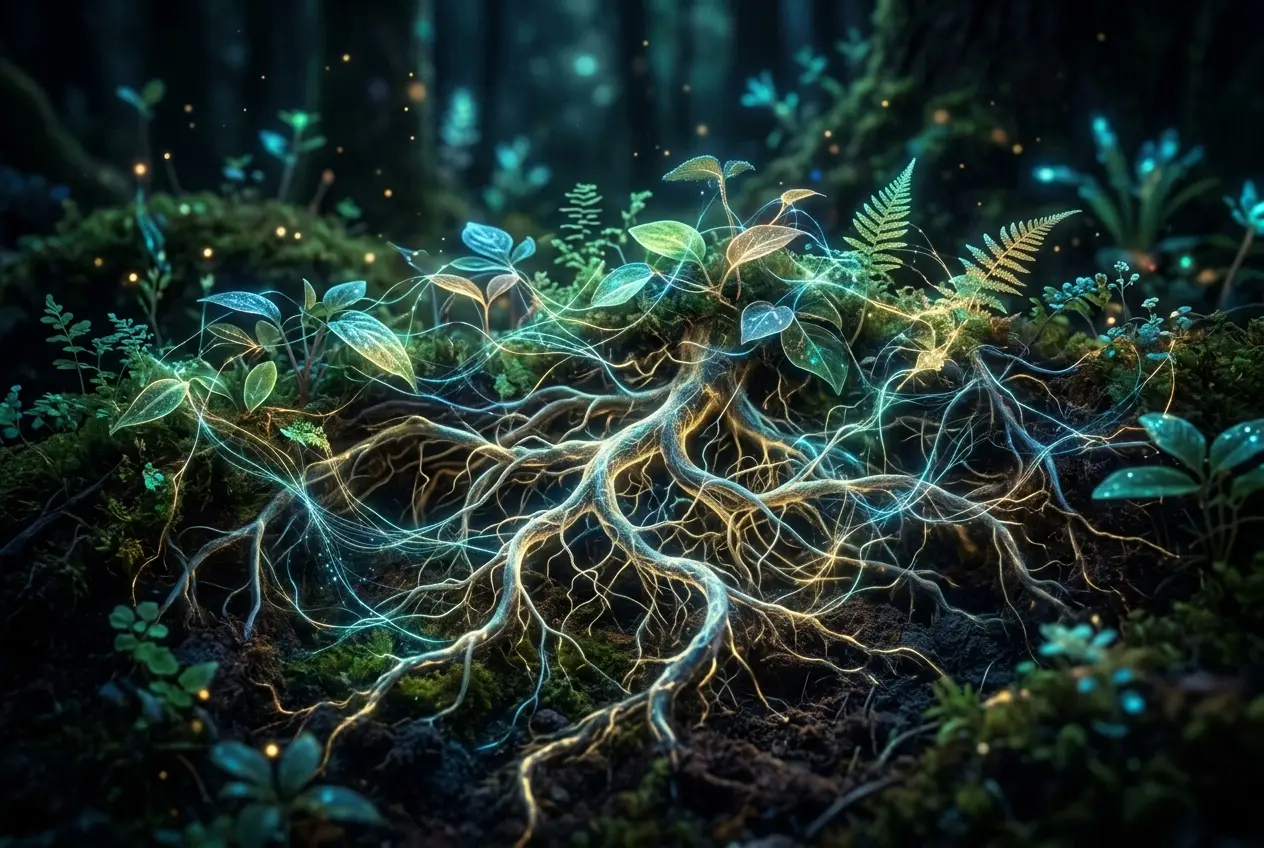
I remember walking through a quiet forest once, and being struck by the sheer interconnectedness of it all. The way trees seemed to "know" when to share nutrients, or how certain plants react to the presence of others. For years, scientists explained these phenomena through chemical signals, root networks, and environmental cues. But recently, a more mind-bending idea has taken root in the scientific community: could plants be using quantum entanglement to communicate? It sounds like something straight out of science fiction, an invisible, instantaneous conversation happening at the subatomic level, but the emerging field of quantum biology suggests it might not be so far-fetched.
The very notion challenges our classical understanding of biological processes. We're accustomed to thinking of life operating on macro-scales, governed by physics we can see and measure. Yet, the deeper we probe into the machinery of life, especially at the molecular level, the more we encounter phenomena that seem to defy conventional explanations. This journey into the microscopic world reveals a universe far stranger and more connected than we ever imagined, pushing the boundaries of what we consider "natural" communication.
The Spooky Action Behind the Leaves: What is Quantum Entanglement?
Before we dive into the verdant world of plants, let's briefly touch on the concept that makes this entire discussion so captivating: quantum entanglement. Famously dubbed "spooky action at a distance" by Albert Einstein, it’s a phenomenon where two or more particles become linked in such a way that they share the same fate, no matter how far apart they are. If you measure a property of one entangled particle, you instantly know the corresponding property of the other, even if it's light-years away. This isn't about sending information faster than light – that's a common misconception – but rather about a pre-existing, shared state that is revealed upon measurement.
Imagine two coins. If they are entangled, and you flip one and it lands heads, you instantly know the other, wherever it is, has landed tails. This correlation is not due to any secret, hidden variables, but rather an inherent, non-local connection described by quantum mechanics. You can learn more about this fascinating concept on Wikipedia's Quantum Entanglement page (opens in a new tab).
Quantum Biology: Where Physics Meets Photosynthesis
The idea that quantum mechanics plays a significant role in biological systems might seem radical, but it's the core tenet of quantum biology. This interdisciplinary field investigates whether quantum phenomena like superposition, tunneling, and entanglement are not just confined to the cold, isolated labs of physicists but are actually essential to the fundamental processes of life itself. From bird navigation to enzyme catalysis, scientists are finding hints of quantum effects influencing biological efficiency.
One of the most compelling examples, and perhaps the most relevant to plants, lies in photosynthesis. This is the process by which plants convert sunlight into chemical energy. It's incredibly efficient, far more so than any human-made solar panel. For decades, scientists struggled to fully explain how plants could capture light energy and transfer it to reaction centers with such minimal loss. The energy, in the form of excitons, needs to navigate a complex molecular landscape to reach its destination.
Recent research suggests that quantum coherence—a state where particles behave like waves, exploring multiple paths simultaneously—might be the key. This allows the energy to essentially "test" all possible pathways to the reaction center at once, choosing the most efficient one almost instantaneously. Some researchers even propose that a form of "vibronic entanglement" could be at play, linking the electronic states of molecules with their vibrational states, further optimizing energy transfer. This isn't direct communication in the way we usually think of it, but it's a form of ultra-efficient, quantum-assisted internal signaling. To delve deeper into this, check out the Quantum Biology Wikipedia page (opens in a new tab).
Beyond Photosynthesis: The Leap to "Communication"
While quantum coherence in photosynthesis is becoming increasingly accepted, the jump to "quantum entanglement for plant communication" is a much bolder claim, and one that remains largely theoretical and highly debated. However, some scientists are beginning to explore how these subtle quantum effects could underpin more complex biological interactions.
Consider the intricate mycorrhizal networks—the underground fungal networks that connect trees and plants, allowing them to share nutrients, water, and even alarm signals. Could the instantaneous nature of entanglement provide a mechanism for faster, more efficient signaling across these networks than classical chemical diffusion alone? While chemical signals are undoubtedly primary, some speculate that quantum channels might subtly optimize or accelerate aspects of this biological internet. "The idea that biological systems might exploit quantum mechanics for communication is not just exciting; it fundamentally alters our view of life's capabilities," notes Dr. Elizabeth A. R. Gill, a theoretical physicist at the University of Bristol.
The challenge lies in detecting and proving such entanglement in a warm, wet, and noisy biological environment. Quantum states are notoriously fragile and easily disrupted by interaction with their surroundings—a phenomenon called decoherence. Keeping entanglement stable long enough for meaningful biological "communication" is a monumental hurdle. This is why many quantum biologists focus on very short-lived quantum phenomena, like those in photosynthesis, rather than sustained, long-distance entanglement. However, some theories suggest that biological systems might have evolved ways to protect these delicate quantum states. For instance, the structure of certain proteins or cellular architectures could act as natural "quantum shields."
The "How" and "Why" of Quantum Plant Talk
If plants were to communicate using quantum entanglement, what would it look like, and why would they need it?
- Ultra-Fast Signaling: In moments of stress, such as pest attacks or drought, a plant needs to rapidly communicate across its own tissues or with neighboring plants. While chemical signals travel relatively slowly, an entangled system could theoretically provide an instantaneous alert.
- Resource Allocation: Imagine a forest where the entire ecosystem needs to optimize resource sharing based on real-time needs. Entanglement could facilitate a collective, distributed "computation" of optimal resource distribution, beyond what classical chemical gradients allow. This might even be related to the concept of the Cosmic Web computing our universe's fate (opens in a new tab).
- Information Density: Quantum states can carry far more information than classical bits. If plants could encode biological data in entangled particles, their communication could be incredibly rich and complex, perhaps explaining how they manage to coordinate growth, defense, and reproduction so effectively. This could be a new form of digital life forms hidden in networks (opens in a new tab).
Challenges, Skepticism, and the Path Forward
It's crucial to acknowledge that evidence for quantum entanglement-based communication in plants is still largely speculative. The scientific community remains cautious, and rightly so. Reproducing and observing quantum phenomena in biological systems is incredibly difficult. Most experiments proving quantum effects in biology rely on ultrafast spectroscopy or low-temperature environments, far removed from a living plant in a sunny field.
However, the field is rapidly advancing. New experimental techniques are allowing scientists to probe biological processes with unprecedented precision. Theoretical models are also becoming more sophisticated, exploring how life might leverage quantum mechanics. The very existence of quantum biology suggests that nature might have discovered quantum technologies long before humanity did. For those interested in the broader implications of quantum mechanics in life, our past blog on could quantum biology unlock life's deepest secrets (opens in a new tab) offers a fascinating perspective.
The possibility, however remote it may seem now, invites us to reconsider the fundamental nature of life. Are we missing a crucial layer of interaction? Is there a hidden quantum language spoken in the silent rustle of leaves and the slow growth of roots?
Conclusion: A Quantum Leap in Understanding Life?
The question "Do plants use quantum entanglement to talk?" remains open, teetering on the edge of established science and groundbreaking theory. What is certain is that the exploration of quantum biology is revealing that the living world is far more complex and perhaps more "quantum" than we ever imagined. From the astounding efficiency of photosynthesis, which harnesses quantum coherence, to the tantalizing hints of deeper, entanglement-driven processes, plants continue to surprise us.
Whether it's truly communication or simply ultra-efficient molecular machinery, the ongoing research promises to redefine our understanding of life itself. As technology advances, allowing us to peer deeper into the subatomic dance within every cell, we might just uncover secrets that change how we view every green leaf, every budding flower, and the very fabric of existence. The implications for agriculture, biotechnology, and even our philosophical understanding of consciousness are immense. Perhaps the "silent language" of plants is, in fact, a whisper from the quantum realm.



Conversation0
No comments yet. Be the first to share a thought — the best questions often become new stories.