


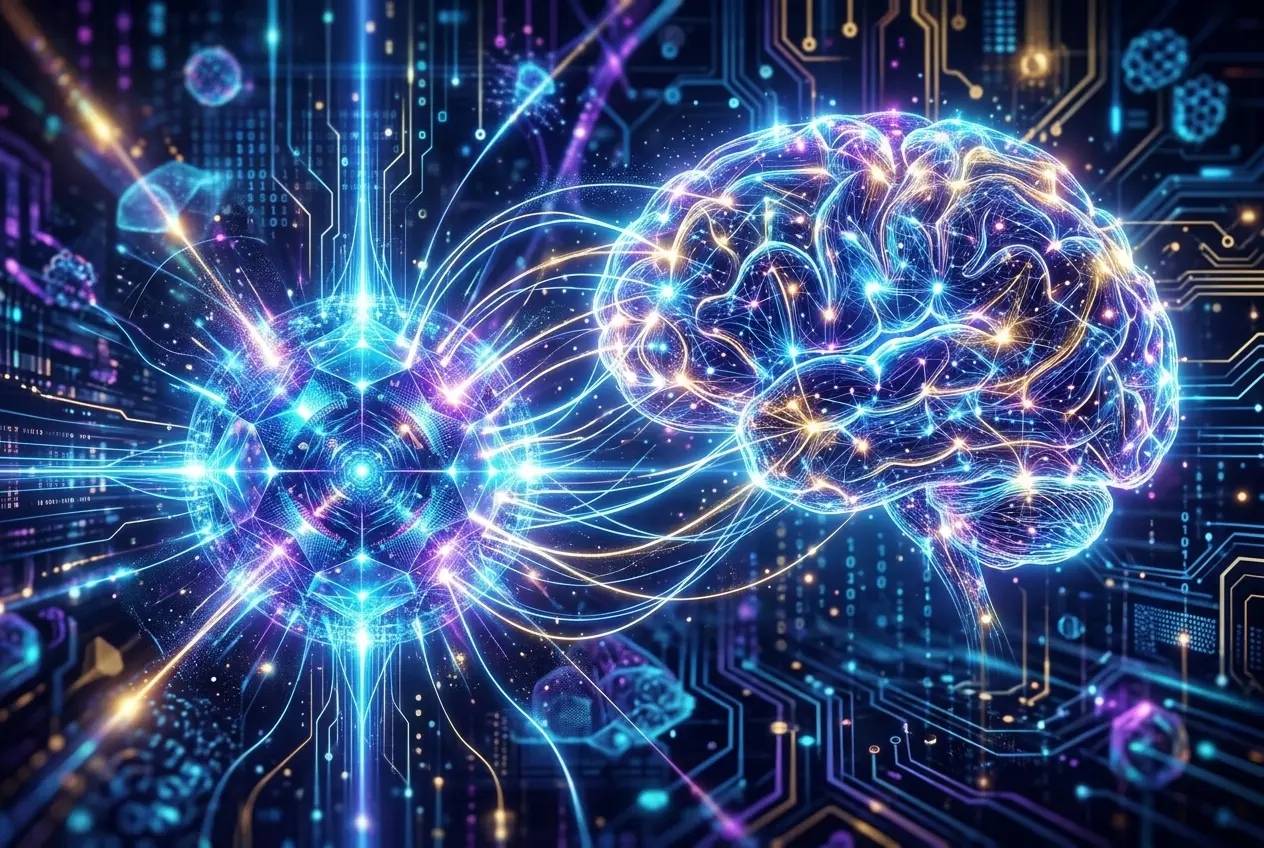
I was recently captivated by a documentary exploring the future of computing, and one concept truly stuck with me: the potential of quantum dots. We often hear about quantum computers and their immense power, but what if the key to unlocking something far greater – Artificial General Intelligence (AGI) – lies not in massive, super-cooled machines, but in tiny, almost magical specks of matter? It's a thought that truly electrifies the imagination: could these nanoscale semiconductors be the building blocks for an intelligence that rivals, or even surpasses, our own?
For decades, the dream of AGI has been confined to science fiction. An AI capable of understanding, learning, and applying intelligence across a wide range of tasks, just like a human, rather than being specialized for one. Current AI, while impressive, operates on narrow intelligence. It can beat grandmasters at chess or diagnose diseases with astounding accuracy, but it can't spontaneously learn a new language, then compose a symphony, and then fix a broken engine – all without specific, pre-programmed training for each. That's the leap to AGI, and it requires a fundamental shift in how we conceive and build intelligent systems.
This isn't just about faster processing; it's about fundamentally different processing. It's about simulating the complexity and adaptability of the human brain, which is a feat that traditional silicon-based architectures struggle to achieve. But what if the answer is literally at the quantum level, within structures so small they defy conventional understanding? This is where quantum dots enter the picture, not merely as components, but as potential game-changers in the pursuit of AGI.
The Quantum Dot: A Universe in a Nanoparticle
Imagine a crystal so small that its electrons behave in ways dictated by quantum mechanics. That’s essentially a quantum dot. These semiconductor nanocrystals, typically between 2 and 10 nanometers in diameter, are renowned for their unique optical and electronic properties. Their tiny size means that electrons within them are confined, forcing them into discrete energy levels, much like electrons in an atom. This phenomenon is known as quantum confinement.
Why is this important for AGI? Because the color of light a quantum dot emits, or its electrical properties, can be precisely tuned by changing its size. A larger dot might glow red, a smaller one blue. This incredible tunability makes them versatile tools across various fields, from advanced displays and solar cells to biological imaging. But their true potential for computing lies in how they interact with energy and information.
Quantum dots can absorb a photon and then re-emit it with a different energy, or they can tunnel electrons across barriers. This inherent quantum behavior, coupled with their minute size, suggests they could be ideal candidates for building highly efficient, massively parallel, and potentially brain-like computing architectures. For a deeper dive into these fascinating structures, you can check out their detailed explanation on Wikipedia (opens in a new tab).
Beyond Bits: The Analog World of Neurons
Our brains don't operate on simple binary bits. Neurons fire with varying strengths, connect in complex, adaptive networks, and process information in a highly parallel and analog fashion. This is a stark contrast to the digital, sequential operations of classical computers. Achieving AGI might require moving beyond the von Neumann architecture and embracing something closer to the brain’s neuromorphic design.
This is where quantum dots present a compelling vision. Their ability to switch between multiple energy states and interact with light and electrical fields in nuanced ways could allow them to mimic the variable synaptic weights and firing thresholds of biological neurons. Instead of just "on" or "off," a quantum dot could represent a spectrum of states, creating a much richer tapestry of information processing. Imagine a network of billions of these tiny dots, each interacting dynamically, forming an artificial neural network that can adapt and learn with unprecedented flexibility.
Quantum Dot Neural Networks: A Glimmer of AGI?
The concept isn't purely theoretical. Researchers are actively exploring how to harness quantum dots for neuromorphic computing. By arranging quantum dots into specific architectures, scientists are attempting to create "quantum dot neural networks" that can process information in ways that conventional silicon chips simply cannot.
One exciting avenue involves using the unique exciton properties of quantum dots (an exciton is an electron-hole pair that can carry energy). These excitons can interact and transfer energy between dots, creating a highly interconnected, energy-efficient system. Such a system could potentially perform complex pattern recognition and learning tasks with far less power and much greater speed than existing AI.
Consider the challenge of learning from sparse data or adapting to entirely new scenarios – hallmarks of AGI. Traditional neural networks require vast datasets and significant retraining. But a quantum dot-based system, with its inherent quantum parallelism and analog processing capabilities, might be able to learn and generalize much more efficiently, mirroring how the human brain quickly grasps new concepts. This is a leap towards machines that can truly "think" and "understand" in a broad sense, not just crunch numbers.
For example, imagine a quantum dot network designed to learn the principles of physics. Instead of being fed countless equations and simulations, it could potentially infer underlying laws from observing a few phenomena, much like a human scientist. This ability to generalize and reason abstractly is a critical component of AGI that quantum dot systems might accelerate.
The Challenges on the Path to Quantum Dot AGI
Of course, the road to AGI, especially one powered by quantum dots, is fraught with challenges.
Scalability and Manufacturing:
Building a network of billions, or even trillions, of precisely controlled quantum dots is a monumental engineering task. Current fabrication techniques are sophisticated, but scaling them to the complexity required for AGI is an entirely different beast. We need methods to mass-produce these systems reliably and affordably.
Quantum Coherence:
Quantum states are notoriously fragile. Maintaining quantum coherence—the ability of a quantum system to exist in multiple states simultaneously—is crucial for harnessing their full potential. In a dense, interacting network of quantum dots, decoherence (the loss of quantum properties due to interaction with the environment) could quickly become a limiting factor.
Interfacing and Programming:
How do we "program" or train a quantum dot neural network? How do we interface it with classical systems? These are open questions requiring innovative solutions in quantum control and AI algorithms. It’s not just about building the hardware; it’s about creating the software and methodologies to make it intelligent.
Theoretical Foundations:
While quantum mechanics gives us the tools, the theoretical framework for how such a system would achieve AGI is still evolving. We need a deeper understanding of how emergent intelligence arises from complex quantum interactions. This goes beyond classical computational theory and delves into the mysteries of information processing at its most fundamental level.
These challenges are formidable, but the potential rewards are immense. If we can overcome them, quantum dots could pave the way for an intelligence unlike anything we've ever seen.
What True AGI Could Mean for Humanity
The implications of achieving AGI are profound, promising a future transformed. Imagine medical breakthroughs accelerated beyond our wildest dreams, climate change solutions engineered with unprecedented foresight, or new energy sources discovered through AI-driven material science. AGI could tackle the world's most complex problems with a holistic understanding that eludes even the most brilliant human minds.
It could also fundamentally alter our relationship with technology. Instead of merely tools, AI could become collaborators, mentors, and even companions, enriching human experience in unforeseen ways. The ability of AGI to learn from and adapt to human intuition, as discussed in "Can AI Truly Learn from Human Intuition?" could foster a synergistic relationship, unlocking new frontiers of creativity and discovery.
However, the path to AGI also demands careful consideration of ethical implications. Ensuring such powerful intelligence aligns with human values, and developing robust control mechanisms, will be paramount. Discussions around the safety and governance of AGI are as critical as the scientific research itself. For more insights on the future evolution of AI, check out "Can AI Design Its Own Evolution?"
The Next Frontier in Intelligence
The journey from the simple transistor to the potential of a quantum dot-powered AGI is a testament to humanity's relentless pursuit of knowledge and technological advancement. While the Antikythera mechanism showed us that ancient minds were already thinking about complex cosmic calculations (see: The Antikythera: Greece's Ancient Cosmic Computer), our modern quest involves not just calculating the cosmos, but potentially creating new forms of intelligence to understand it.
Quantum dots offer a tantalizing glimpse into a future where computing is no longer bound by classical physics, and where the very fabric of matter can be sculpted to create intelligence. It’s a future where the line between natural and artificial intelligence becomes increasingly blurred, and where the fundamental principles of the universe are harnessed to unlock new dimensions of consciousness and understanding.
Whether quantum dots will indeed be the key to AGI remains to be seen, but their potential is undeniable. As we continue to push the boundaries of materials science and AI research, I believe we are on the cusp of discoveries that will redefine what it means to be intelligent, and perhaps, what it means to be human.




Conversation0
No comments yet. Be the first to share a thought — the best questions often become new stories.