The cosmos is a tapestry woven with mysteries, and few are as tantalizing as the idea that the seemingly empty vacuum of space might be teeming with an inexhaustible supply of energy. I often find myself pondering the silent, vast expanse between stars and galaxies, not as a void, but as a vibrant, hidden reservoir. It’s a concept that sounds like science fiction, a dream of limitless power, but modern physics suggests it might be a profound, fundamental truth. Could the very fabric of reality hold the key to an energy source that dwarfs all our current technologies?
### The Emptiness That Isn't Empty: Quantum Fluctuations
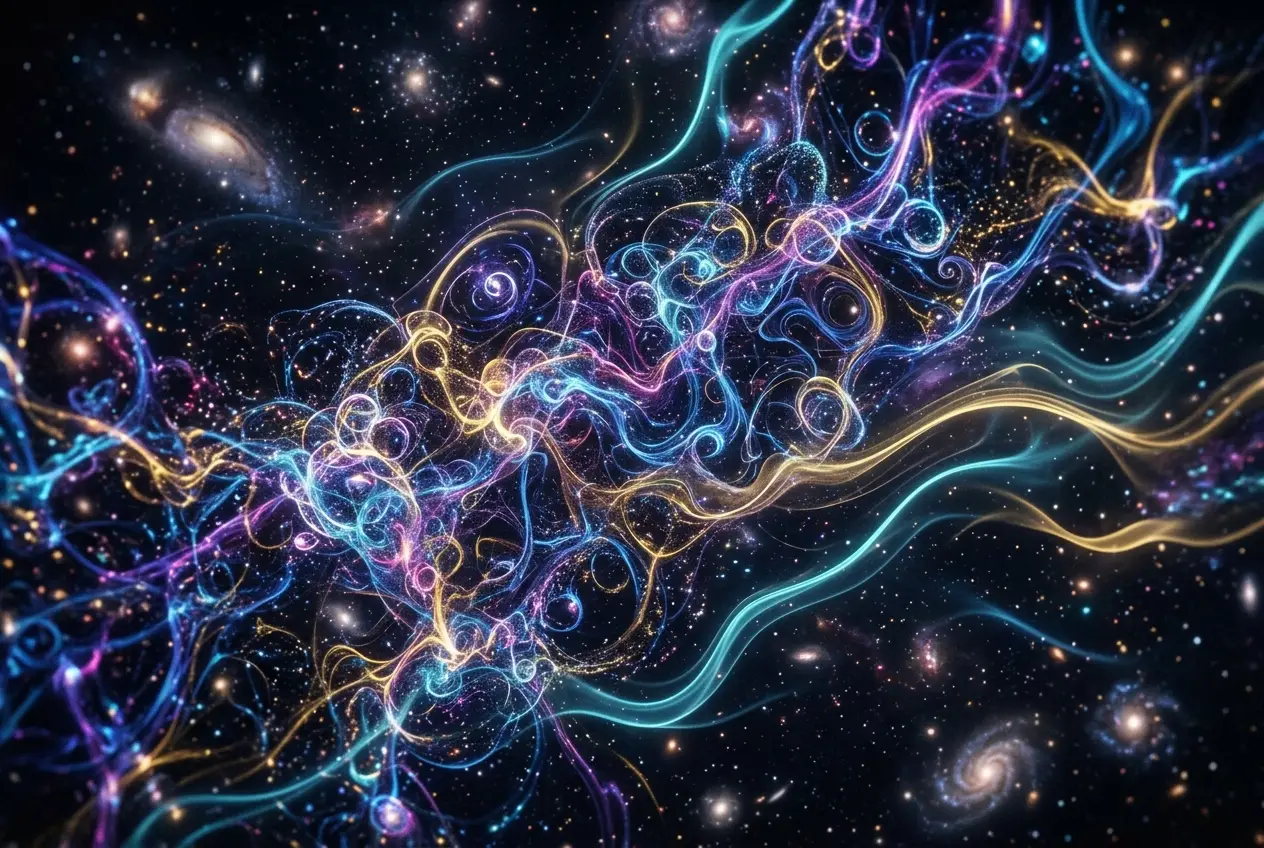
When we picture a vacuum, we typically imagine nothingness – a perfect void devoid of matter, light, or forces. However, quantum mechanics, the branch of physics that governs the incredibly small, shatters this classical notion. At the quantum level, even the emptiest space is a hive of activity. **Particles and antiparticles are constantly popping into existence and annihilating each other** in fleeting moments, borrowing energy from the vacuum itself, only to return it almost immediately. These are known as quantum fluctuations.
I remember first learning about this concept and being completely awestruck. It wasn't just theoretical; these fluctuations have observable effects. One of the most famous is the **Casimir effect**. In the 1940s, Dutch physicist Hendrik Casimir predicted that if two uncharged, parallel metal plates are placed extremely close together in a vacuum, they would experience a small attractive force. Why? Because the quantum fluctuations between the plates are restricted to certain wavelengths, while outside the plates, all wavelengths are possible. This creates an imbalance, pushing the plates together. It’s like a subtle, cosmic pressure from an invisible ocean of energy. You can read more about the Casimir effect on [Wikipedia](https://en.wikipedia.org/wiki/Casimir_effect).
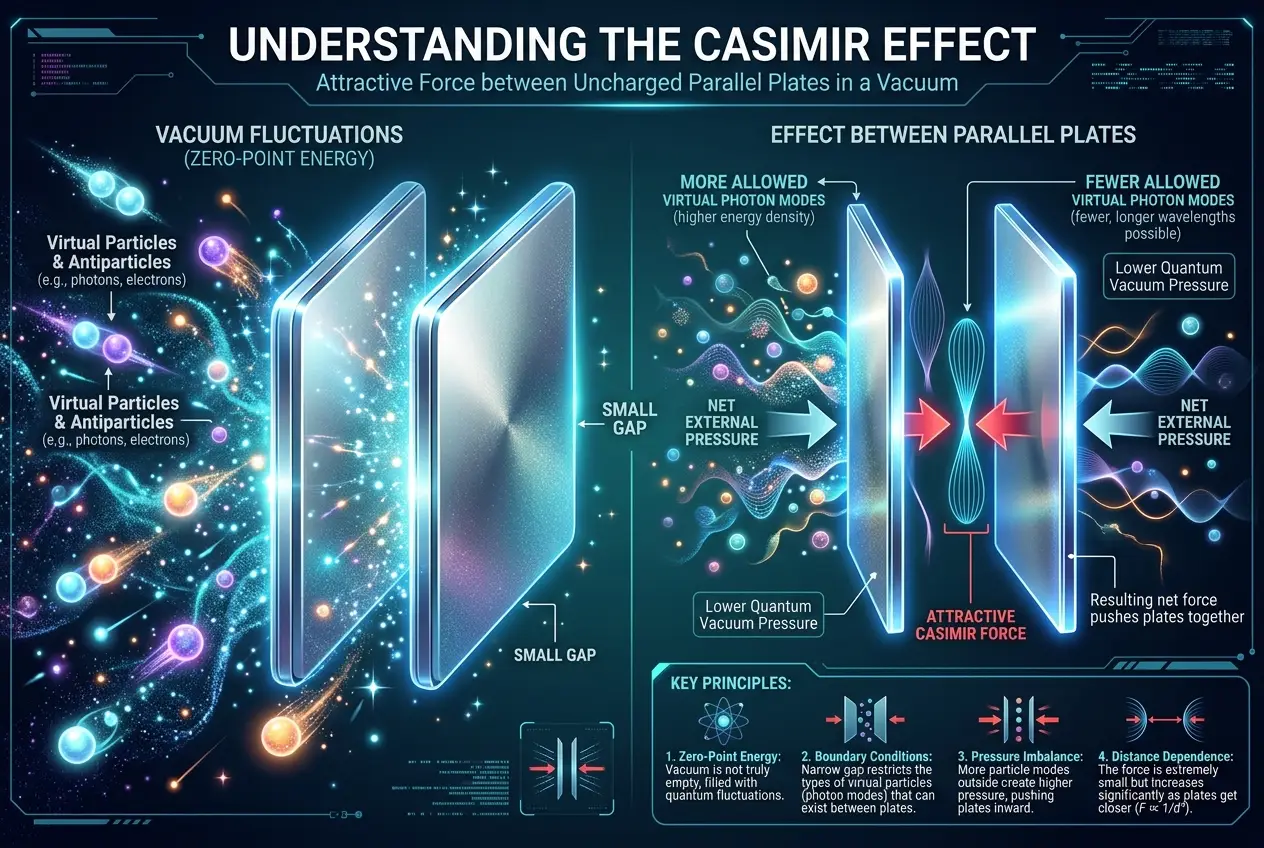
This isn't some abstract theoretical quirk; the Casimir effect has been experimentally verified multiple times, demonstrating that **empty space truly has an inherent energy**. This energy is often referred to as **vacuum energy** or **zero-point energy**, because even at absolute zero temperature (where all classical motion stops), these quantum jitters persist.
### The Problem of Infinite Energy
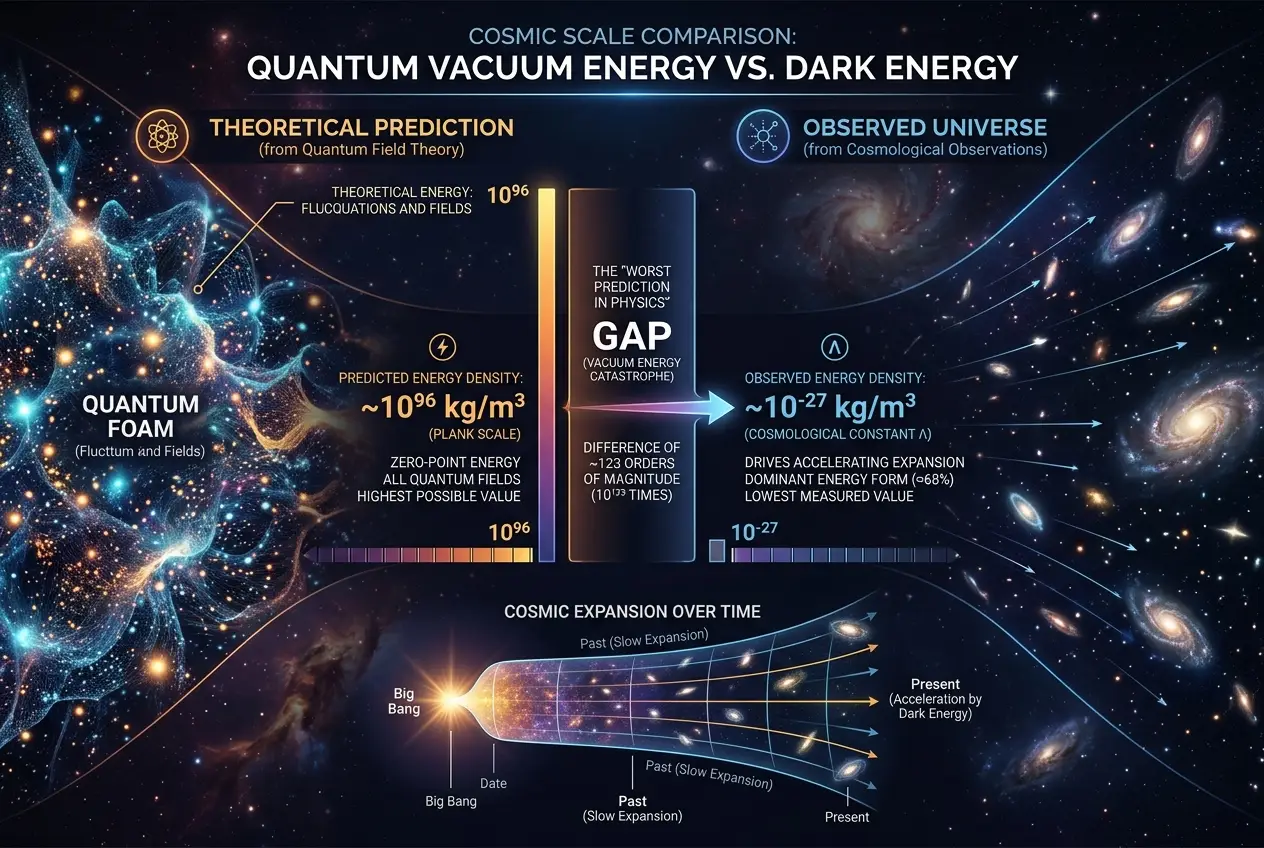
While the existence of vacuum energy is accepted, its actual magnitude presents a colossal problem. When physicists try to calculate the total energy density of the vacuum, the numbers are astronomically large – so large, in fact, they tend towards infinity! This discrepancy, known as the **"cosmological constant problem,"** is one of the biggest unsolved puzzles in physics.
If the vacuum truly contained such immense energy, the universe would be an incredibly violent, unstable place, constantly expanding at an unimaginable rate, ripping itself apart almost instantaneously. Yet, we observe a universe that is vast, relatively calm, and expanding at a more modest pace, albeit an accelerating one. This acceleration is attributed to **dark energy**, which shares some characteristics with vacuum energy but is far, far weaker than theoretical predictions. The observed dark energy density is about 120 orders of magnitude smaller than the predicted quantum vacuum energy – a staggering difference that physicists are still struggling to reconcile. Some argue that this difference points to new physics, perhaps even hidden dimensions or symmetries that cancel out most of the vacuum energy.
### Can We Tap Into It? The Allure of Free Energy
The idea of harnessing this boundless energy has captivated inventors and scientists for decades. If the vacuum truly contains such immense power, could we somehow extract it? This is where the concept of "free energy" devices often emerges, promising to draw power from the very fabric of space-time.
However, extracting usable energy from vacuum fluctuations faces immense theoretical and practical challenges. The energy of these virtual particles is "borrowed" and quickly repaid; it's a dynamic equilibrium. Extracting net energy without violating fundamental laws of thermodynamics (like the conservation of energy) is generally considered impossible with current understanding. Many proposed "free energy" devices have failed to provide repeatable, verifiable results, often due to misinterpretations of physics or clever hoaxes.
Despite the hurdles, the allure remains. If we could find a way, even theoretically, to create a sustained imbalance or "rectify" these quantum fluctuations, it would revolutionize everything. Imagine power sources that never run out, silent propulsion systems for interstellar travel, or even the ability to manipulate space-time itself. This kind of advanced technology is often a staple in science fiction, but the quantum vacuum hints that it might not be entirely fantastical.
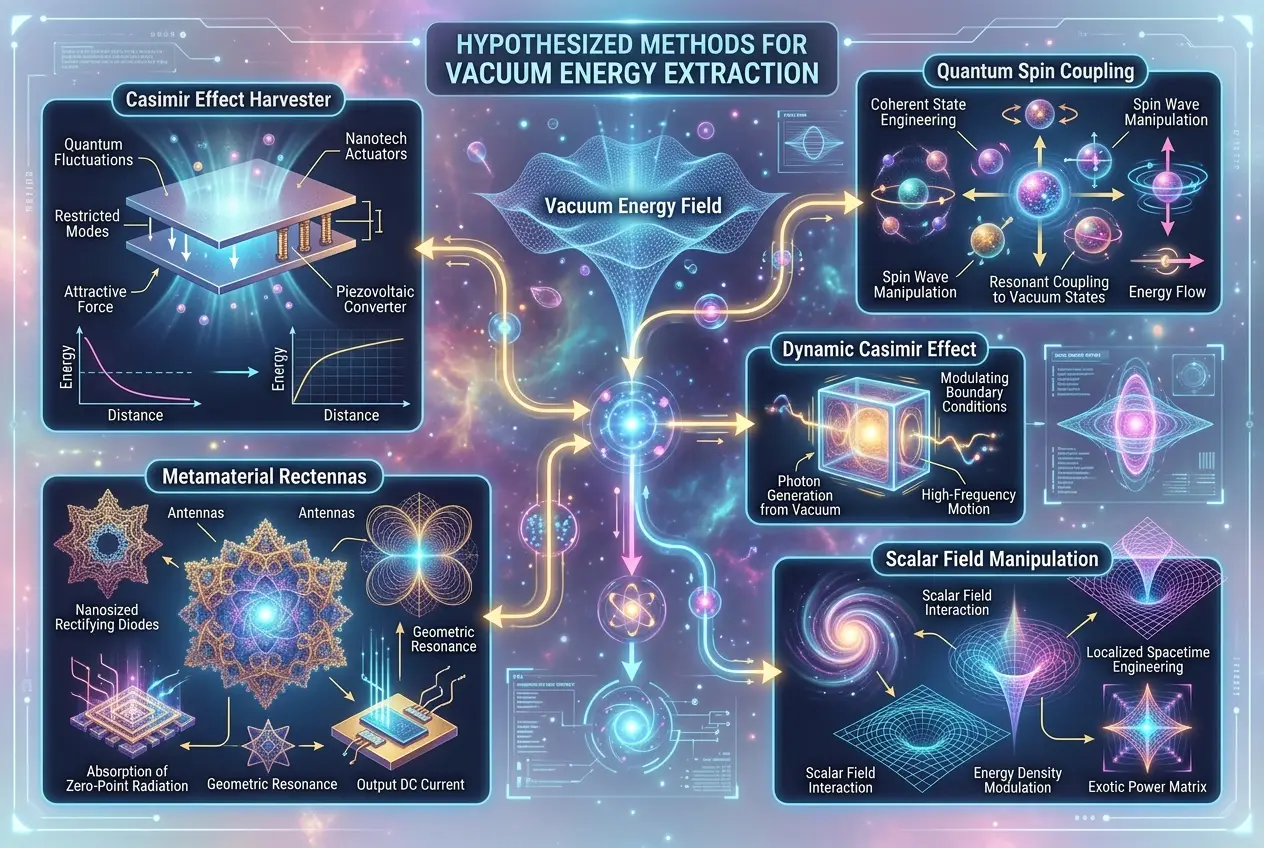
Some researchers explore exotic states of matter or quantum metamaterials that might interact with vacuum energy in novel ways. The hope is that manipulating the boundary conditions, similar to the Casimir effect, could somehow lead to a net energy transfer. However, for now, these remain highly speculative areas of research, far from practical application. For more on the concept of zero-point energy and its implications, you might find this [Wikipedia page](https://en.wikipedia.org/wiki/Zero-point_energy) insightful.
### Vacuum Energy and Cosmology: The Accelerating Universe
Beyond the dream of free energy, vacuum energy plays a crucial role in our understanding of the universe on the largest scales. As mentioned, the universe's accelerating expansion is attributed to **dark energy**, a mysterious force acting like a cosmic anti-gravity. While not the infinite vacuum energy predicted by quantum field theory, dark energy is consistent with a form of vacuum energy – albeit one with a remarkably small, positive energy density.
This small, positive value means that as the universe expands, more "empty" space is created, and this new space also possesses this intrinsic energy. This, in turn, drives further expansion, creating a self-reinforcing cycle. Understanding the nature of dark energy, and its connection (or lack thereof) to the quantum vacuum, is one of the most significant challenges in modern cosmology. Scientists are using advanced telescopes and missions to map the universe's expansion with unprecedented precision, hoping to shed light on this elusive cosmic component. You can learn more about dark energy and its role in the universe's expansion on [Wikipedia](https://en.wikipedia.org/wiki/Dark_energy).
The implications of vacuum energy extend even to the origin of the universe. Inflationary cosmology, a leading theory for the universe's rapid expansion in its earliest moments, also posits a scalar field with a high energy density, somewhat akin to an early, powerful form of vacuum energy, that drove the universe to inflate dramatically. As I think about this, it reinforces the idea that what we perceive as "empty" is anything but.
### The Future: What if We Could?
Let's allow ourselves a moment of pure speculation, grounded in the possibilities hinted at by physics. What if, one day, humanity *does* unlock a way to tap into the quantum vacuum?
* **Limitless Clean Energy:** The energy crisis would be a relic of the past. Homes, cities, and industries could be powered sustainably without relying on finite resources or harmful emissions.
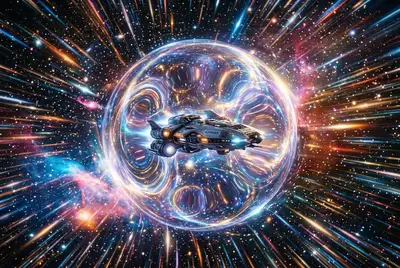
* **Interstellar Travel:** With an energy source that doesn't require fuel, propulsion systems could be revolutionary. Starships might achieve speeds currently unimaginable, potentially even bending space-time to travel across vast cosmic distances, perhaps as explored in our blog on [Can Black Holes Warp Time to Unlock Future Tech?](/blogs/can-black-holes-warp-time-to-unlock-future-tech-6807).
* **Matter Manipulation:** If we can control the vacuum, could we influence the very properties of matter? This opens doors to creating new materials with extraordinary properties or even advanced forms of manufacturing, a theme also touched upon in [Could Pressure Forge Unseen Materials for Future Tech?](/blogs/could-pressure-forge-unseen-materials-for-future-tech-7524).
* **Redefining "Space":** Our understanding of space would fundamentally shift. It would no longer be a passive backdrop but an active, energetic participant in all physical processes, perhaps even holding hidden information, as discussed in [Could Empty Space Hold the Universe's Lost Data?](/blogs/could-empty-space-hold-the-universes-lost-data-7037).
The journey to understand and potentially harness vacuum energy is one of humanity's grandest scientific quests. It challenges our perceptions of reality, pushes the boundaries of theoretical physics, and holds the promise of a future vastly different from our present. While practical applications are still firmly in the realm of dreams, the very existence of this hidden energy in the vacuum reminds us that the universe is far more mysterious and magnificent than we can often imagine. The answers lie in continued curiosity, relentless research, and an open mind to the profound secrets nestled within the "nothingness" all around us.
Verified Expert
Alex Rivers
A professional researcher since age twelve, I delve into mysteries and ignite curiosity by presenting an array of compelling possibilities. I will heighten your curiosity, but by the end, you will possess profound knowledge.
Leave a Reply
Comments (0)
No approved comments yet. Be the first to share your thoughts!
 Join Us
 Unknown Author


















Leave a Reply
Comments (0)