


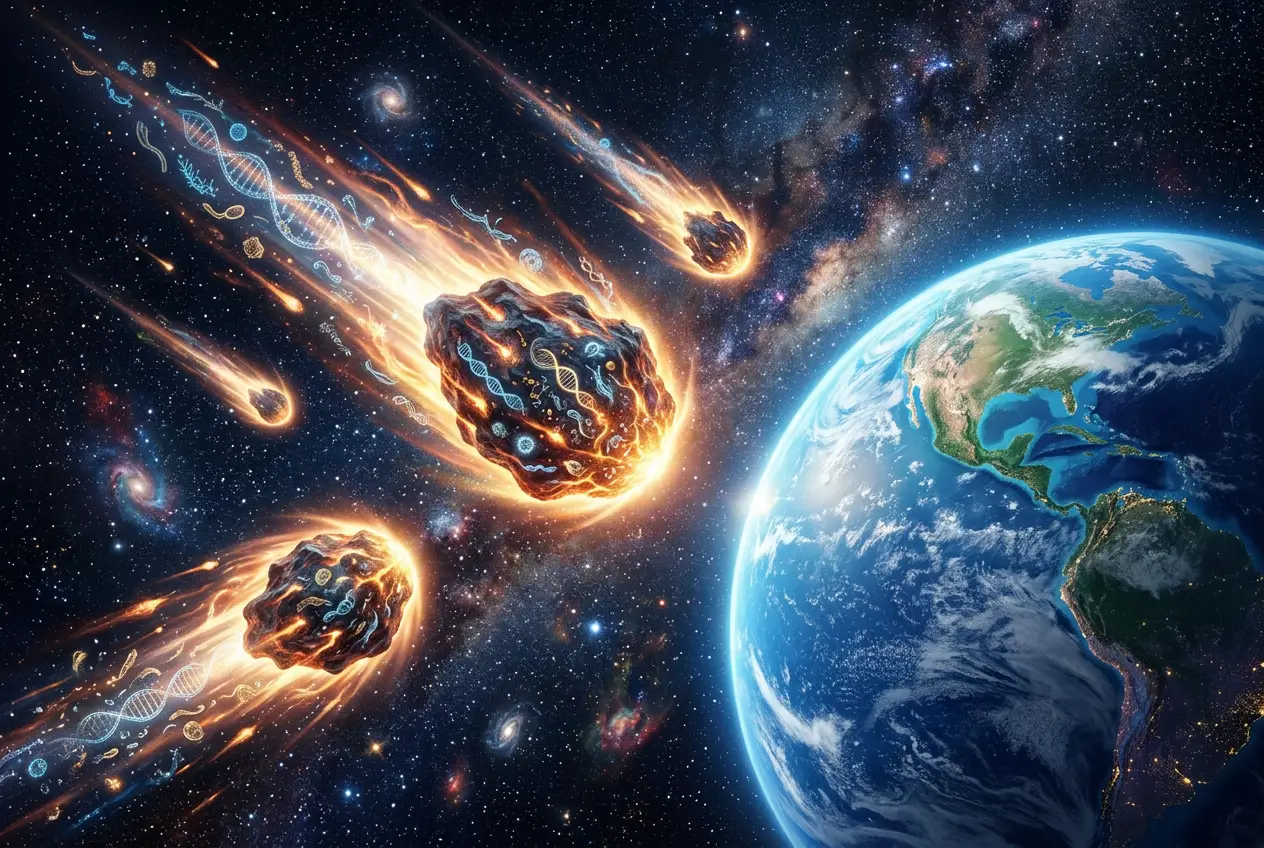
I recently found myself staring up at the night sky, a familiar sense of wonder washing over me as I traced the faint trails of distant meteors. It wasn't just the fleeting beauty that captivated me; it was the profound thought that each speck of cosmic dust, each fiery descent, might carry a secret far older and more significant than we often imagine. What if these celestial wanderers aren't just cosmic debris, but ancient voyagers, quietly delivering the very building blocks of life—or even life itself—across the vast, silent ocean of space? This idea, known as Panspermia, is one of the most intriguing and audacious hypotheses in astrobiology, suggesting that life on Earth might not be entirely "homegrown" but could have arrived from beyond.
It’s a concept that challenges our anthropocentric view of life's origins, shifting the focus from a purely terrestrial genesis to a universal one. While often debated, the scientific underpinnings of Panspermia are surprisingly robust, drawing on evidence from astrophysics, geology, and microbiology. I believe it's a notion that deserves a closer look, especially as we continue to discover the incredible resilience of life and the abundance of organic molecules throughout the cosmos.
The Cosmic Mail Service: What is Panspermia?
At its core, Panspermia (from Greek, meaning "seeds everywhere") is the hypothesis that life exists throughout the universe, distributed by meteoroids, asteroids, planetoids, comets, or cosmic dust. It posits that microscopic life forms, such as bacteria, or their precursors, can survive the harsh conditions of space and be transported from one star system or planet to another, potentially seeding new worlds.
This isn't a modern invention. The idea has ancient roots, with proponents like Anaxagoras in ancient Greece. However, it gained scientific traction in the 19th century through figures like Lord Kelvin, Hermann von Helmholtz, and Svante Arrhenius. They argued that if life could spontaneously arise on Earth, it could do so elsewhere and then travel.
There are several flavors of Panspermia, each with its own proposed mechanism of transport:
- Lithopanspermia: This is arguably the most discussed and studied form. It suggests that life travels embedded within rocks, like meteorites or asteroids, ejected from one planet by impacts (e.g., a massive impact on Mars sending Martian rocks to Earth) and later landing on another. The rock acts as a shield against radiation and the vacuum of space.
- Ballistic Panspermia: A subset of Lithopanspermia, specifically focusing on the short-range transfer of materials between planets within the same solar system. For example, rocks blasted off Mars reaching Earth.
- Directed Panspermia: A more speculative (and perhaps dramatic) version, proposed by Francis Crick and Leslie Orgel, where life is intentionally transported by advanced extraterrestrial civilizations. I find this one fascinating, though it moves further into the realm of science fiction than testable science.
- Soft Panspermia (or Molecular Panspermia): This variant suggests that not entire living organisms, but the complex organic molecules necessary for life (amino acids, nucleobases, sugars) are transported through space and then facilitate abiogenesis (the origin of life from non-living matter) on a suitable planet. This is perhaps the most scientifically accepted aspect, as we have abundant evidence of these molecules in space.
The Evidence from Beyond: Space as a Nursery
For Panspermia to be viable, several conditions must be met: life (or its building blocks) must originate elsewhere, survive the violent ejection from a planet, endure the vacuum and radiation of space, survive re-entry into a new atmosphere, and finally, be able to proliferate in a new environment. While challenging, scientific discoveries over the past decades have lent surprising support to these possibilities.
1. The Cosmic Presence of Organic Molecules: One of the strongest pieces of evidence for "Soft Panspermia" is the sheer abundance of complex organic molecules found in space. Radio telescopes have detected a vast array of compounds—including amino acids, sugars, and even nucleobases (the components of DNA and RNA)—in interstellar clouds, comets, and asteroids. The Murchison meteorite, which fell in Australia in 1969, contained over 90 different amino acids, many of which are not found on Earth. This suggests that the universe is teeming with the raw ingredients for life. For more on how space environments facilitate chemical complexity, you can explore the Wikipedia page on Astrobiology.
2. The Martian Connection: Perhaps the most compelling argument for Lithopanspermia comes from Mars. We know that impacts on Mars have ejected rocks into space, some of which have landed on Earth. The most famous example is ALH84001, a meteorite found in Antarctica that originated from Mars. While its purported evidence of fossilized Martian bacteria remains highly controversial, the fact that Martian rock can travel to Earth is undisputed. I often ponder what other secrets these cosmic messengers might hold. This direct exchange of material opens a clear pathway for potential biological transfer. If life arose on Mars when conditions were more favorable, could it have hitchhiked to early Earth? This intriguing question is explored further in discussions about the possibility of past life on Mars.
3. Extremophiles: Life's Unyielding Spirit: Life on Earth has shown an astonishing capacity to survive in environments once thought impossible. These "extremophiles"—microbes found thriving in boiling hot springs, super-acidic lakes, deep-sea hydrothermal vents, or even within solid rock hundreds of meters underground—demonstrate incredible resilience. Some bacteria can withstand extreme radiation, freezing temperatures, and even the vacuum of space for extended periods in dormant states (spores).
Experiments conducted in Earth orbit, such as the EXPOSE program on the International Space Station, have shown that certain bacteria and lichens can survive exposure to unfiltered solar UV radiation and the vacuum of space for months, even years. While these studies don't prove interstellar travel is easy, they certainly show that life is far tougher than we initially imagined. I've always been amazed by the tenacity of life, and these discoveries only amplify that wonder.
Challenges and Counterarguments: A Skeptic's View
Despite the compelling evidence, Panspermia is far from a universally accepted theory. Significant hurdles remain:
- Survival of Ejection: The force of a planetary impact that ejects rock into space is immense. The acceleration and shock could vaporize or destroy any embedded life.
- The Journey Through Space: While extremophiles are tough, the time scales for interstellar travel are vast—millions to billions of years. Cosmic radiation (X-rays, gamma rays, heavy ions) can severely damage DNA and other biomolecules over long periods, even within a rock.
- Atmospheric Re-entry: The fiery re-entry through a new planet's atmosphere is another brutal test. The outer layers of a meteorite are ablated by extreme heat, though the interior can remain cool.
- The "Where Did Life Originate?" Problem: Panspermia doesn't solve the problem of abiogenesis; it merely shifts it elsewhere. If life came from Mars, how did it start on Mars? This is a fundamental criticism that I often consider. It pushes the origin of life question out of Earth's local context, but doesn't provide a mechanism for its initial spark.
It's also important to remember the distinction between Soft Panspermia and Lithopanspermia. While the cosmic delivery of organic molecules is largely accepted and observed, the transfer of living, viable organisms remains a more speculative and debated aspect.
The Bigger Picture: Implications for Our Cosmic Search
Whether life originated solely on Earth or was seeded from elsewhere, the Panspermia hypothesis profoundly impacts our search for extraterrestrial life. If Panspermia is true, it suggests that life might be more common in the universe than previously thought. If the universe is constantly exchanging biological material, then the chances of finding life on other planets or moons within our solar system, like Europa or Enceladus, increase significantly.
The idea also intertwines with the "Great Filter" concept, which I've pondered before in topics like our blog on Is The Great Filter Real? Tech’s Biggest Cosmic Test?. If life easily seeds across planets, then perhaps the "filter" isn't in abiogenesis itself, but in a later stage, such as the development of complex, intelligent life or the ability to escape planetary self-destruction.
I find it particularly thought-provoking when considering objects like Oumuamua, which we discussed in Oumuamua: Alien Probe or Cosmic Iceberg?. While Oumuamua was unlikely to be a life-seeding vehicle, the very existence of interstellar objects passing through our solar system highlights the dynamic nature of cosmic material exchange. These are the same mechanisms that could, in theory, transport life.
Looking to the Future: Where Do We Go From Here?
The debate around Panspermia continues to fuel research in multiple scientific fields. Future missions to Mars, Europa, and Enceladus will meticulously search for signs of past or present life, and the discovery of any independent origin of life would be a monumental finding, helping us understand if Earth's biology is unique or part of a universal pattern.
Further studies on extremophiles, space exposure experiments, and advanced analyses of meteorites will continue to refine our understanding of life's cosmic limits. The development of better models for planetary ejection and re-entry, coupled with improvements in detecting biomolecules in space, will also be crucial.
For me, the Panspermia hypothesis serves as a powerful reminder of our cosmic interconnectedness. It hints that we might be part of a much larger, sprawling biological tapestry woven across galaxies, rather than an isolated bloom in a barren universe. It expands our definition of "home" to include the stars themselves, making us all, in a sense, children of the cosmos. As we continue to gaze at the stars and explore our solar system, the question isn't just if life exists elsewhere, but where it came from and how it journeyed to our pale blue dot.
Sources:



Conversation0
No comments yet. Be the first to share a thought — the best questions often become new stories.