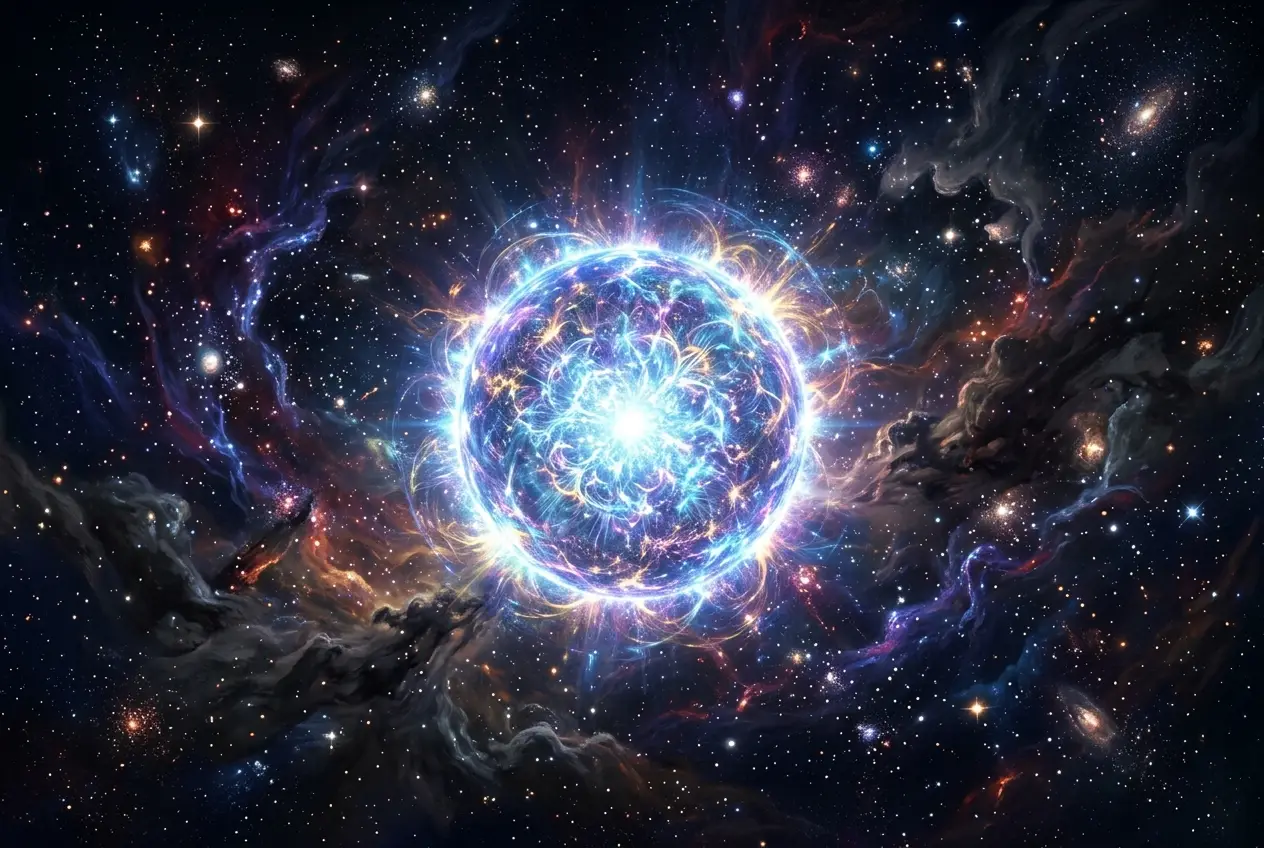
The night sky, a canvas of familiar constellations and twinkling pinpricks of light, often leads me to ponder the universe's deeper, stranger secrets. We learn about main-sequence stars like our Sun, and then the dramatic end-states: white dwarfs, neutron stars, and black holes. But what if there’s an even more exotic class of celestial objects lurking out there, pushing the boundaries of physics as we know it? I’m talking about **quark stars**, theoretical celestial bodies so dense and so utterly alien that they might redefine our understanding of matter itself.
It’s a concept that sounds straight out of science fiction, yet it’s a serious area of research in astrophysics. Imagine peering into the core of a star, not to find hydrogen fusion or a neutron superfluid, but a sea of deconfined quarks – the fundamental particles that make up protons and neutrons. Could such "strange stars" be hidden among the familiar, broadcasting silent riddles across the cosmos? This question has fascinated me, and I've spent some time delving into the mind-bending physics that suggests they might exist.
Beyond Neutron Stars: A Cosmic Compression Chamber
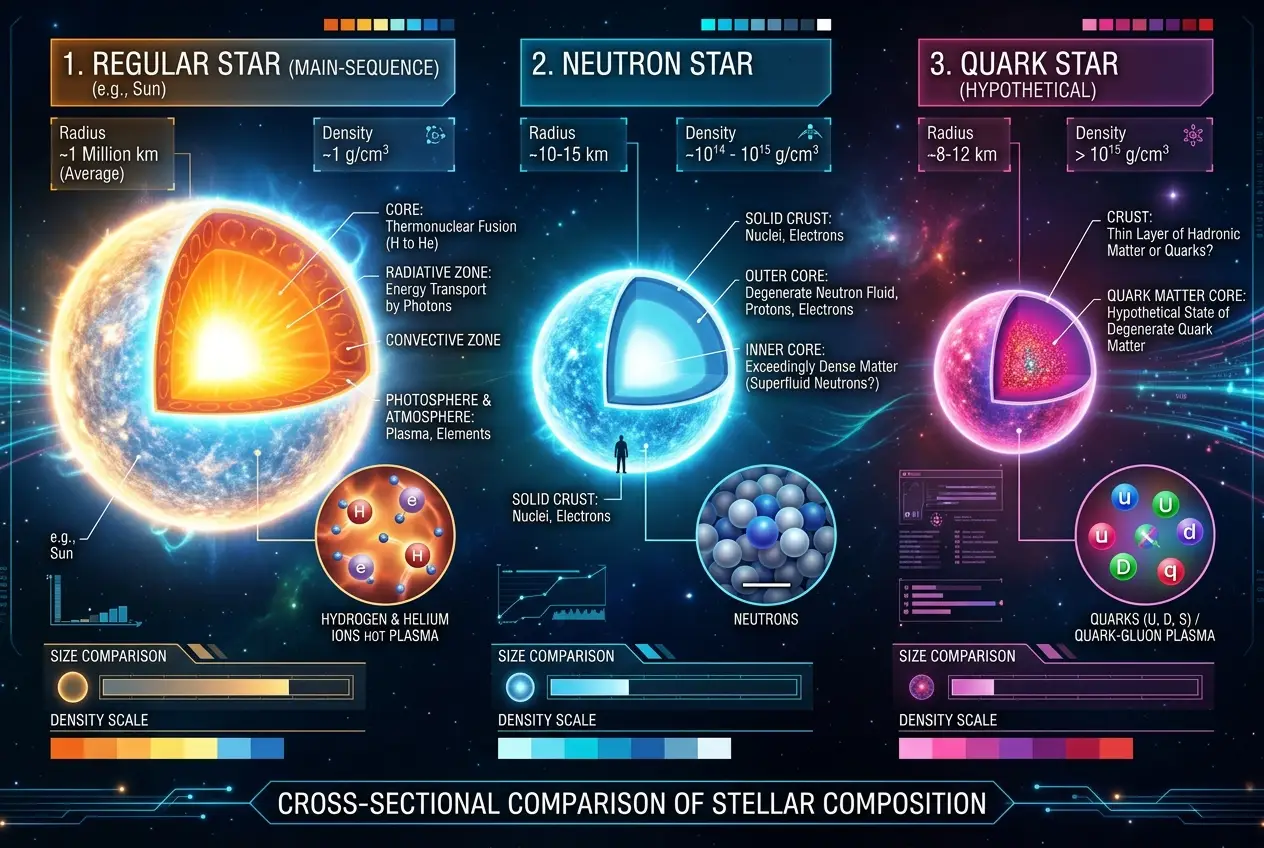
To truly appreciate the weirdness of a quark star, we first need to understand its slightly less strange, but still incredibly exotic, cousin: the **neutron star**. These stellar remnants are formed after massive stars, far larger than our Sun, exhaust their nuclear fuel and undergo a spectacular supernova explosion. The core implodes under immense gravity, crushing protons and electrons together to form neutrons. What results is an object with a mass greater than our Sun, crammed into a sphere only about 20 kilometers (12 miles) in diameter. If you could somehow take a teaspoon of neutron star material, it would weigh billions of tons.
This incredible density creates a gravitational field so powerful that even light struggles to escape. For a long time, physicists believed neutron stars represented the ultimate endpoint of stellar compression before collapsing into a black hole. Their cores are thought to contain a super-dense soup of neutrons, along with a sprinkling of other particles, forming a kind of exotic superfluid or superconductor. However, the exact composition of the innermost core of neutron stars remains a profound mystery, a cosmic unknown that hints at even stranger possibilities. For more on the extreme conditions inside neutron stars, you might want to read about the properties of
neutron-star matter on Wikipedia.
The Quark Conundrum: Unpacking Fundamental Particles
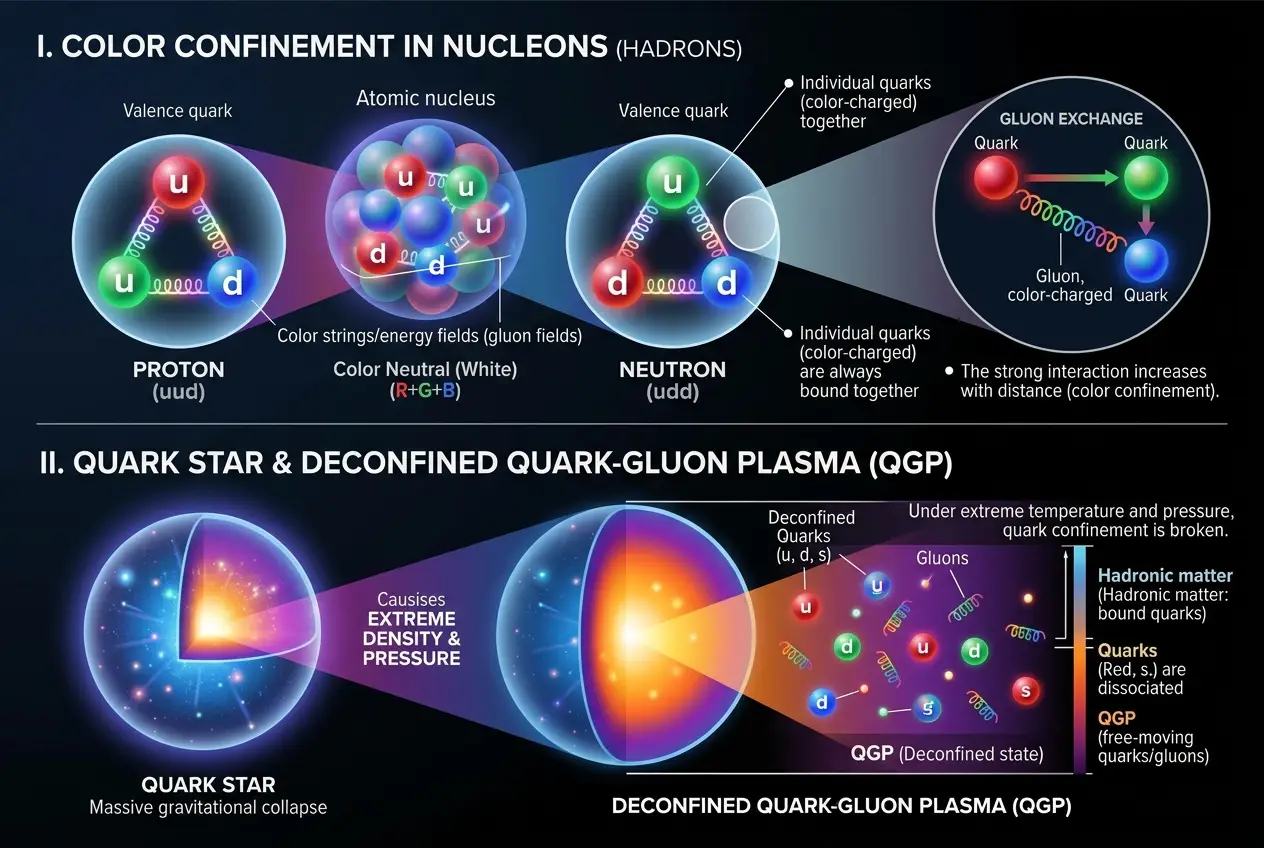
Before we plunge deeper into the realm of quark stars, let's briefly touch upon the fundamental building blocks of matter. Protons and neutrons, which make up the nuclei of atoms, are not elementary particles. Instead, they are composed of even smaller particles called **quarks**. There are six "flavors" of quarks: up, down, charm, strange, top, and bottom. Protons are made of two up quarks and one down quark (uud), while neutrons consist of one up quark and two down quarks (udd). These quarks are held together by the strong nuclear force, mediated by particles called **gluons**.
An astonishing property of quarks is **confinement**: under normal conditions, they are never observed in isolation. They are always bound together within composite particles like protons and neutrons. Trying to pull them apart is like stretching a rubber band – the force gets stronger the further you pull, eventually creating new quark-antiquark pairs rather than releasing a single quark. This confinement is a cornerstone of a theory known as **Quantum Chromodynamics (QCD)**. But what if the pressure, the sheer crushing force of gravity, becomes so immense that this confinement breaks down?
The Birth of a Strange Star: Deconfined Quarks
This is where the concept of a quark star emerges. If a dying star is even more massive than one that forms a typical neutron star, or if a neutron star accumulates enough mass, the gravitational pressure at its core could exceed the threshold where even neutrons can withstand the compression. The individual neutrons would then break down, liberating their constituent quarks. These quarks, no longer confined within protons and neutrons, would form a new, exotic state of matter: **quark matter**, or more specifically, **strange quark matter**.
The term "strange" comes from the "strange quark," which is heavier than the up and down quarks found in normal matter. Theoretical models suggest that strange quark matter, composed of roughly equal numbers of up, down, and strange quarks, might actually be more stable than ordinary nuclear matter at extremely high densities. This hypothetical stability is the cornerstone of the "strange matter hypothesis," which posits that strange quark matter could be the true ground state of matter at very high densities. If this hypothesis is true, then quark stars, sometimes referred to as "strange stars," could exist.
How Do We Find What We Can’t See Directly?
The challenge, of course, is that these objects are theoretical. We can’t simply observe a quark star and confirm its internal composition. So, how do scientists attempt to detect them? The answer lies in their **unique properties** and **signatures**.
1. **Mass and Radius:** Quark stars are predicted to have slightly different mass-radius relationships compared to neutron stars. Precise measurements of stellar remnants in binary systems, or through advanced gravitational wave observatories, could potentially differentiate between the two. Recent observations of massive neutron stars have pushed the limits of neutron star models, making the existence of quark matter cores a tantalizing possibility. Some high-mass compact objects might already be hinting at a quark-matter core. For deeper insights into neutron star physics and potential quark matter, you can explore the
Neutron Star page on Wikipedia.
2. **Cooling Rates:** Quark stars are expected to cool down more rapidly than neutron stars due to different internal processes. Observing the temperature evolution of young, hot compact objects could provide clues.
3. **Gravitational Waves:** The detection of gravitational waves from merging compact objects, such as those observed by LIGO and Virgo, offers a powerful new tool. The "chirp" signal emitted during the final moments of a merger carries information about the internal structure of the colliding objects. If a merger involves quark stars, the gravitational wave signature could be distinctly different from that of merging neutron stars. The ongoing research in this area is a fascinating blend of astronomy and fundamental physics.
4. **Strangelets and Quark Nuggets:** If strange quark matter is truly stable, it's theoretically possible that tiny chunks of it, dubbed "strangelets" or "quark nuggets," could be produced in high-energy cosmic events or even exist as dark matter candidates. Detecting these particles, though incredibly difficult, would be a game-changer.
5. **Unusual Bursts:** Some cosmic phenomena, like certain types of gamma-ray bursts or fast radio bursts, could potentially originate from phase transitions within the core of super-dense stars, perhaps indicating the conversion of a neutron star into a quark star. However, these links are still speculative. Speaking of unusual cosmic signals, have you ever wondered about the mysteries behind
Fast Radio Bursts?
The Implications of a Cosmic Computer-Like State
If quark stars indeed exist, their implications ripple across several fields of science.
* **Fundamental Physics:** The discovery of quark stars would provide direct evidence for the existence of stable strange quark matter, validating aspects of Quantum Chromodynamics under extreme conditions. It would also refine our understanding of the strong nuclear force and how matter behaves when pushed to its absolute limits.
* **Astrophysics:** It would add a new class of objects to our cosmic menagerie, affecting models of stellar evolution, supernova explosions, and the cosmic distribution of heavy elements. It might also help explain some of the more puzzling observations of compact objects that don't quite fit existing neutron star models. For instance, the discussion around
black holes and stored cosmic data is another example of how extreme cosmic objects challenge our perception of information.
* **Cosmology:** The strange matter hypothesis has implications for the early universe and could even relate to the nature of dark matter. If strangelets are stable, they could have formed in the early universe and contribute to the mysterious dark matter component.
Comparing Stellar Remnants: A Glimpse into Density
| Feature |
White Dwarf |
Neutron Star |
Quark Star (Hypothetical) |
| Precursor Star Mass |
Up to ~8 Solar Masses |
~8-20 Solar Masses |
>20 Solar Masses or Accretion |
| Primary Composition |
Degenerate Electrons, Carbon/Oxygen Nuclei |
Degenerate Neutrons |
Deconfined Up, Down, and Strange Quarks |
| Typical Radius |
~10,000 km (Earth-sized) |
~10-20 km (City-sized) |
~8-12 km (Slightly smaller than NS) |
| Typical Density |
~10^9 kg/m^3 |
~10^17-10^18 kg/m^3 |
>10^18 kg/m^3 |
| Stability Mechanism |
Electron Degeneracy Pressure |
Neutron Degeneracy Pressure |
Quark Degeneracy Pressure / Strong Force Interactions |
The quest to find definitive proof of quark stars is one of the most exciting frontiers in modern astrophysics. It’s a journey that takes us from the death throes of giant stars to the fundamental particles that compose our universe, revealing that even the most extreme environments can hold secrets about the very fabric of reality. Just like the hunt for
digital life forms in our networks, this cosmic search pushes the boundaries of what we previously thought possible.
As I look up at the night sky, my imagination now includes these incredible, silent behemoths – cosmic computers of sorts, processing matter at densities we can barely conceive. Whether they truly exist or remain a fascinating theoretical possibility, the mere thought of them reminds me of the universe's infinite capacity for wonder and the endless mysteries still waiting to be unraveled. And perhaps, it echoes the ancient human fascination with complex cosmic patterns, a curiosity that stretches back to early astronomical endeavors, much like the questions around
ancient sites processing cosmic data. The universe continues to surprise us, challenging our established paradigms and inviting us to always ask: "What else is out there?"
 Join Us
 Unknown Author











Leave a Reply
Comments (0)