


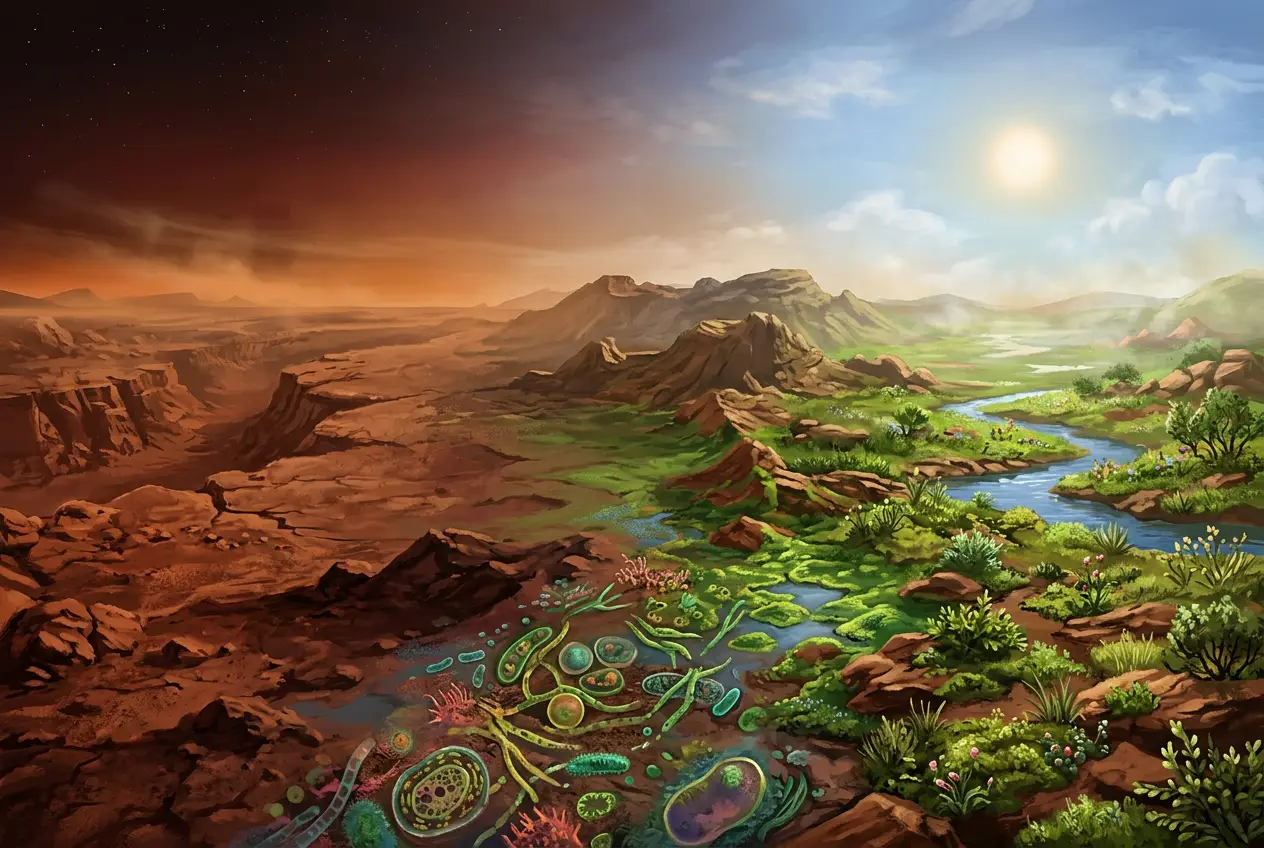
I remember gazing at images of Mars, a desolate red sphere, and wondering if humanity could ever truly make it home. It's a question that has captivated scientists, engineers, and dreamers for decades: Can we transform Mars into a habitable world? The challenge is monumental. Mars is a frigid desert with a thin, toxic atmosphere, relentless radiation, and no liquid water on its surface. Yet, a revolutionary concept is gaining traction, one that doesn't involve giant mirrors or colossal atmospheric processors, but something far smaller, far more ancient, and infinitely resilient: microbes.
The idea of "terraforming" Mars, reshaping its environment to resemble Earth's, sounds like science fiction. But what if the key to unlocking a Martian spring lies not in advanced mega-engineering projects, but in the most fundamental building blocks of life itself? This isn't just a whimsical thought; it's a frontier of astrobiology and synthetic biology, exploring how engineered microorganisms could be humanity's smallest, yet most powerful, planetary engineers.
The Red Planet's Harsh Realities: Why Mars is So Uninviting
Before we delve into the microbial solution, let’s briefly understand the monumental task at hand. Mars, as we know it, is a hostile place for Earth life. Its atmosphere is incredibly thin, about 1% the density of Earth's, and composed primarily of carbon dioxide (CO2). This thin veil offers little protection from harmful solar and cosmic radiation, which sterilizes the surface. Surface temperatures average around -63 degrees Celsius (-81 Fahrenheit), plummeting far lower at the poles. Crucially, liquid water cannot persist on the surface due to the low atmospheric pressure and extreme cold; it either freezes or sublimates directly into gas.
The Martian soil, or regolith, also presents challenges. It's rich in perchlorates, toxic salts that are harmful to most terrestrial life. Furthermore, essential atmospheric components like nitrogen, vital for plant growth, are scarce. Transforming this barren world requires significant changes: thickening the atmosphere, warming the planet, generating a protective ozone layer, and creating a stable water cycle. These are the objectives of terraforming, a concept with various approaches, from injecting greenhouse gases to orbiting solar reflectors. For a comprehensive overview of these grand proposals, Wikipedia offers an excellent resource on the terraforming of Mars (opens in a new tab).
Enter the Extremophiles: Nature's Ultimate Survivors
On Earth, life thrives in the most unlikely places. From volcanic vents to Antarctic ice, organisms called extremophiles have adapted to survive conditions that would instantly kill most other species. These are the unsung heroes of Earth's biodiversity, and they hold immense promise for Mars. I find their resilience truly inspiring. Imagine bacteria that feast on radiation, archaea that flourish in intensely acidic environments, or cyanobacteria that thrive in extreme cold and low light while producing oxygen. This incredible adaptability makes them prime candidates for kickstarting life on Mars. You can learn more about these incredible survivors on Wikipedia's extremophile page (opens in a new tab).
The Microbial Dream: How Tiny Organisms Could Reshape a Planet
The core idea is to introduce specially selected or genetically engineered microbes to Mars that can slowly, but surely, alter its environment. Here's a breakdown of the key roles they could play:
1. Warming the Planet and Thickening the Atmosphere
Mars's thin CO2 atmosphere is a starting point, but it's not enough to trap significant heat. The challenge is to release more greenhouse gases or increase the CO2 concentration to kickstart a runaway greenhouse effect.
- Methane Producers: Certain methanogens (methane-producing archaea) could convert existing Martian resources into methane, a potent greenhouse gas. While methane is naturally short-lived in a radiation-rich environment, a continuous supply could contribute to warming.
- CO2 Fixers and Nitrogen Recyclers: Genetically modified microbes could be designed to fix atmospheric CO2 and nitrogen from the Martian atmosphere, locking carbon into biomass or soil, and making nitrogen available for future plant life. While this doesn't directly warm the planet, it lays the groundwork for more complex ecosystems.
2. Generating Oxygen and Building an Ozone Layer
This is arguably the most crucial step for human habitability. Earth’s early atmosphere, nearly 4 billion years ago, was very similar to Mars's current one, devoid of significant oxygen. It was cyanobacteria, often called blue-green algae, that slowly transformed our planet through photosynthesis, releasing oxygen as a byproduct. These pioneering organisms, which you can read about on Wikipedia's cyanobacteria page (opens in a new tab), literally changed the world.
- Engineered Cyanobacteria: Scientists envision sending genetically enhanced cyanobacteria to Mars. These microbes could be engineered to be highly resilient to Martian radiation, low temperatures, and high perchlorate levels. Once established, perhaps in protected subsurface habitats or temporary pressurized domes, they would slowly begin to photosynthesize, releasing oxygen into the atmosphere. This process would be incredibly slow, spanning millennia, but it offers a natural, scalable solution.
- Ozone Precursors: As oxygen accumulates, it can react with solar radiation to form ozone (O3), which would eventually create a protective layer, shielding the surface from harmful UV radiation. This would be a game-changer, allowing more complex life forms, including plants, to survive directly on the surface.
3. Detoxifying the Soil and Creating Fertile Ground
Martian regolith is toxic due to perchlorates. Microbes could be engineered to neutralize these compounds.
- Perchlorate-Reducing Bacteria: Some terrestrial bacteria can break down perchlorates. Introducing or engineering such strains could render the Martian soil less toxic, making it suitable for future plant growth.
- Bio-weathering: Other microbes could accelerate the breakdown of Martian rocks, releasing essential nutrients and creating more Earth-like soil structures, essentially kickstarting soil formation.
4. Unlocking Subsurface Water
While liquid water is unstable on the surface, vast amounts of ice are locked in Mars's polar caps and subsurface permafrost. Microbes could play an indirect role in its release.
- Greenhouse Effect Enhancement: By thickening the atmosphere and increasing temperatures, microbial activity would contribute to the overall warming trend, which in turn could lead to the melting of subsurface ice and the eventual formation of stable liquid water bodies.
The Challenges and Ethical Considerations
The microbial terraforming dream, while compelling, faces immense hurdles:
- Slow Pace: This process would unfold over thousands, if not tens of thousands, of years. It requires an incredible long-term commitment.
- Radiation: Even extremophiles would struggle with the intense radiation on Mars. Initial deployment would likely require shielded habitats or deep subsurface deployment.
- Energy and Resources: Establishing and sustaining microbial colonies would require energy (e.g., solar power for initial growth) and nutrient delivery, especially in the early stages.
- Planetary Protection: Introducing Earth life to Mars carries the risk of contamination, potentially destroying any indigenous Martian life that might exist. Strict planetary protection (opens in a new tab) protocols would be crucial to avoid this. This is a vital discussion point, as we’ve seen with concerns about potential life on places like Europa, as explored in articles like Is Europa's Ocean Hiding Alien Life?.
- Irreversibility: Once terraforming begins, it's an irreversible process, permanently altering a planetary body. The ethical implications of "owning" or "changing" another planet are profound and necessitate global consensus.
The Future is Microscopic
Despite the challenges, the concept of microbial terraforming remains a powerful vision for humanity's future among the stars. It offers a potentially more sustainable and "natural" pathway to planetary engineering than purely industrial approaches. As we continue to push the boundaries of synthetic biology and astrobiology, our understanding of how life adapts and transforms environments will only deepen. Perhaps the greatest journey humanity ever undertakes won't be in a spaceship, but through the microscopic efforts of billions of tiny organisms working in unison.
The dream of a green Mars is a testament to our ingenuity and our enduring desire to expand our horizons. It resonates with the grand narratives of future human existence, often discussed in speculative futures like those explored in our article, Earth 2099: Will Humanity Live in Utopia or Tech Dystopia?. While the path to "greenifying" Mars is long and fraught with difficulties, the idea that a handful of resilient, engineered cells could fundamentally alter an entire planet for future generations is nothing short of breathtaking. This tiny revolution could be the key to our cosmic future, one small step for a microbe, one giant leap for humankind.
What do you think? Are microbes our best bet for turning Mars into Earth 2.0? The conversation about our future in space, and how we might achieve interstellar goals, often touches upon revolutionary technologies, much like the discussions around Can Cryosleep Unlock Interstellar Travel?. The microbial approach offers another fascinating avenue.




Conversation0
No comments yet. Be the first to share a thought — the best questions often become new stories.