


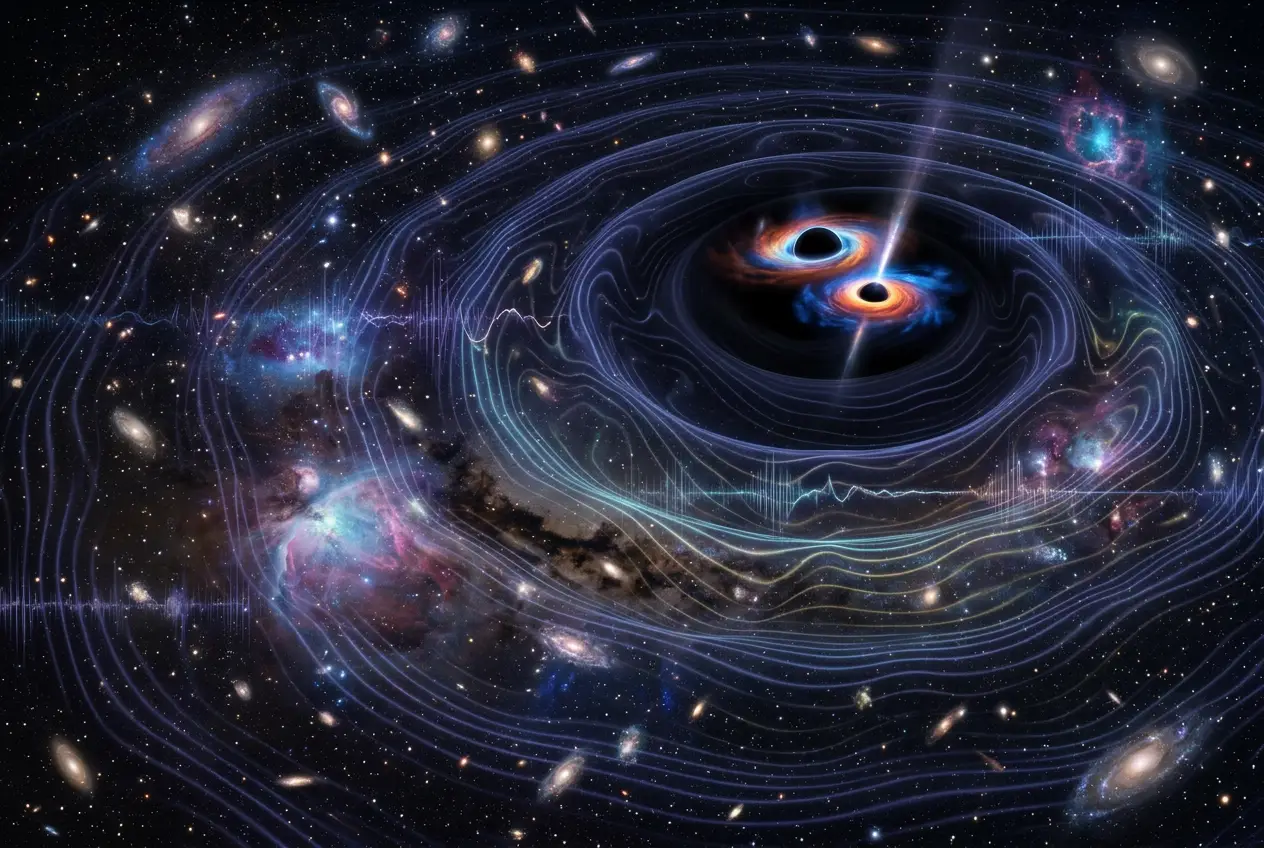
Sometimes, I find myself staring up at the night sky, a vast canvas of glittering stars, and I can't help but feel a profound sense of awe. We see light from distant galaxies, but what if there's an entire universe of information we're only just beginning to perceive, not with our eyes, but with a different sense altogether? Imagine being able to hear the universe, not as sound waves traveling through space, but as ripples in the very fabric of reality. For centuries, our understanding of the cosmos was limited to the light it emitted—visible, X-ray, radio, and gamma rays. This electromagnetic spectrum has revealed breathtaking nebulae, energetic quasars, and the echoes of the Big Bang itself. But what if the most dramatic events in the universe—the collisions of black holes, the merger of neutron stars—were screaming out their stories in a different medium? This isn't science fiction; it’s the astonishing reality of gravitational waves, a cosmic symphony that has opened an entirely new window to the universe.
I remember when the news broke in 2016: the first direct detection of gravitational waves. It was a monumental achievement, confirming a prediction Albert Einstein made a century ago in his theory of general relativity. For me, it wasn't just a scientific milestone; it felt like humanity had just developed a sixth sense, expanding our perception of the cosmos in a way we could barely imagine.
Einstein's Ripples: A Century-Old Prophecy Fulfilled
Albert Einstein, in his groundbreaking theory of General Relativity published in 1915, revolutionized our understanding of gravity. He didn't see gravity as a force pulling objects together, but as a curvature of spacetime itself, caused by mass and energy. Think of it like a bowling ball placed on a stretched rubber sheet; it creates a dip, and marbles rolling nearby will curve towards it. Similarly, massive objects like planets and stars warp the fabric of spacetime around them.
But Einstein also predicted something more dynamic: that violent cosmic events, such as the acceleration of massive objects, would create "ripples" in this spacetime fabric, much like throwing a stone into a pond creates ripples on its surface. These ripples, he theorized, would propagate outwards at the speed of light, carrying information about the cataclysmic events that generated them. He called these phenomena gravitational waves.
For decades, these waves remained purely theoretical. The effects were thought to be incredibly tiny, almost imperceptible. Detecting them was considered an impossible feat, a technological Everest for physicists. The very idea that spacetime could stretch and squeeze, even minutely, was mind-boggling. It implied a dynamic, responsive universe, constantly echoing its most violent acts. You can learn more about Einstein's theories and their implications on Wikipedia's General Relativity page.
The Cosmic Detectives: LIGO and Virgo
The challenge lay in building an instrument sensitive enough to detect these minuscule distortions. Imagine trying to measure a change in length of one part in 10^21 – that’s like measuring the distance to the nearest star to an accuracy of the width of a human hair! This Herculean task was undertaken by experiments like the Laser Interferometer Gravitational-Wave Observatory (LIGO), a collaborative effort involving hundreds of scientists and engineers.
LIGO consists of two massive detectors, one in Livingston, Louisiana, and another in Hanford, Washington, separated by over 3,000 kilometers. Each detector is an L-shaped instrument with arms four kilometers long. Lasers are fired down these arms and reflected back by mirrors. If a gravitational wave passes through Earth, it momentarily stretches spacetime in one direction while compressing it in another. This minute distortion changes the path length of the laser light, causing a detectable interference pattern when the beams recombine. The slight delay in one arm compared to the other becomes the "signal."
The genius of having two detectors so far apart is to rule out local seismic noise or other terrestrial interference. If both detectors register the same signal almost simultaneously, then it's highly likely to be a genuine cosmic event. Later, the European Virgo interferometer in Italy joined the network, further enhancing our ability to pinpoint the location of these cosmic events and distinguish them from background noise.
The First Whisper: Black Hole Mergers
On September 14, 2015, at 09:50:45 UTC, both LIGO detectors simultaneously recorded a fleeting, yet unmistakable, signal. It was a "chirp" lasting merely a fraction of a second, but it spoke volumes. The analysis quickly revealed its source: two stellar-mass black holes, about 29 and 36 times the mass of our Sun, spiraling into each other and merging to form a single, more massive black hole, approximately 62 solar masses. The "missing" three solar masses were radiated away as pure energy in the form of gravitational waves, a cosmic explosion more powerful than all the stars in the observable universe combined, for that brief moment.
This event, designated GW150914, was not just the first direct detection of gravitational waves, but also the first observation of a binary black hole system merging. It confirmed not only Einstein's predictions but also the existence of stellar-mass black holes, and their capability to form binary systems that merge. This single event revolutionized astrophysics overnight, much like the first telescopic observation of Jupiter’s moons did for Galileo. For more details on this landmark discovery, visit the Wikipedia page on First observation of gravitational waves.
Beyond Black Holes: Unveiling Neutron Star Collisions
The universe, however, had more stories to tell. In August 2017, LIGO and Virgo detected another remarkable event, GW170817. This time, the signal was different, longer, and not quite as energetic. It pointed to the collision of two neutron stars. Neutron stars are incredibly dense remnants of massive stars that have gone supernova, packing more than the mass of our Sun into a sphere barely the size of a city. Their merger creates extreme conditions.
What made GW170817 even more extraordinary was that, for the first time, gravitational wave astronomers and traditional electromagnetic astronomers observed the same event. Telescopes across the globe (and in space) detected a gamma-ray burst followed by a kilonova – an incredibly bright explosion that synthesizes heavy elements like gold and platinum. This multi-messenger astronomy marked a new era. We could now 'see' the universe with light and 'hear' it with gravitational waves, providing a more complete picture of cosmic events. It's a bit like finally being able to hear the roar of a distant lion after only seeing its tracks.
What These Echoes Are Telling Us: A Cosmic Language
So, what is this cosmic language telling us? Firstly, it offers a direct probe into the most violent and extreme environments in the universe, places where light often can't escape or is heavily obscured. Gravitational waves are unimpeded by matter, traveling cleanly through dust, gas, and even other black holes. They carry information about the masses, spins, and orbits of the colliding objects, as well as the dynamics of spacetime itself under such intense conditions.
Secondly, these detections are refining our understanding of how stars evolve and die, forming black holes and neutron stars. They’re also providing new ways to measure the expansion rate of the universe, independent of traditional methods that rely on "standard candles" like supernovae. This could help resolve some discrepancies in our cosmological models.
Thirdly, the consistent detection of these events implies that binary black hole mergers are far more common than previously thought. This has implications for galaxy evolution and the growth of supermassive black holes at galactic centers. It also makes me wonder if there are other, more subtle cosmic phenomena that could be communicating through gravitational waves, much like how some theories suggest that fundamental forces could connect different realities, perhaps even linking to concepts discussed in topics like Does Quantum Entanglement Connect Parallel Universes?
The Future of Gravitational Wave Astronomy
The journey has only just begun. Future detectors, both ground-based (like LIGO-India, KAGRA in Japan, and the proposed Cosmic Explorer and Einstein Telescope) and space-based (like the Laser Interferometer Space Antenna or LISA), promise even greater sensitivity and a wider range of observable frequencies. LISA, for example, will be sensitive to much lower-frequency gravitational waves, originating from the mergers of supermassive black holes at the hearts of galaxies and other exotic sources. This could open up entirely new questions about galactic formation and evolution, and perhaps even the early universe.
Could gravitational waves even reveal insights into phenomena currently beyond our comprehension, hinting at the existence of new physics? Could they offer clues about what lies beyond our current cosmic horizon, perhaps even the nature of a multiverse? The possibilities are astounding. We are truly on the cusp of an era where we can "listen" to the universe's most dramatic symphony, deciphering its intricate and powerful cosmic language. The study of these waves is pushing the boundaries of technology and theoretical physics, leading to a deeper appreciation of the universe's profound mysteries, some of which touch upon the very nature of spacetime and gravity, even hinting at concepts like Do Wormholes Link Universes? The Science Unveiled.
Gravitational wave astronomy is more than just detecting ripples; it's about adding a new dimension to our perception of the cosmos. It allows us to hear the universe's song, a symphony composed of colliding giants, forming a cosmic language that narrates the story of creation and destruction, providing insights that optical telescopes alone could never capture. As we continue to refine our instruments and our understanding, I believe we'll uncover secrets that will redefine our place in this extraordinary cosmos.
Conversation0
No comments yet. Be the first to share a thought — the best questions often become new stories.