


I’ve always been captivated by the night sky, staring up at the seemingly infinite tapestry of stars and galaxies. It's a humbling experience, a stark reminder of our tiny place in the grand cosmic scheme. But what if I told you that the universe, in its vastness, isn't just full of stars and galaxies, but also immense regions of almost perfect emptiness? These aren't just empty spaces; they are cosmic voids, and they hold secrets that could reshape our understanding of reality.
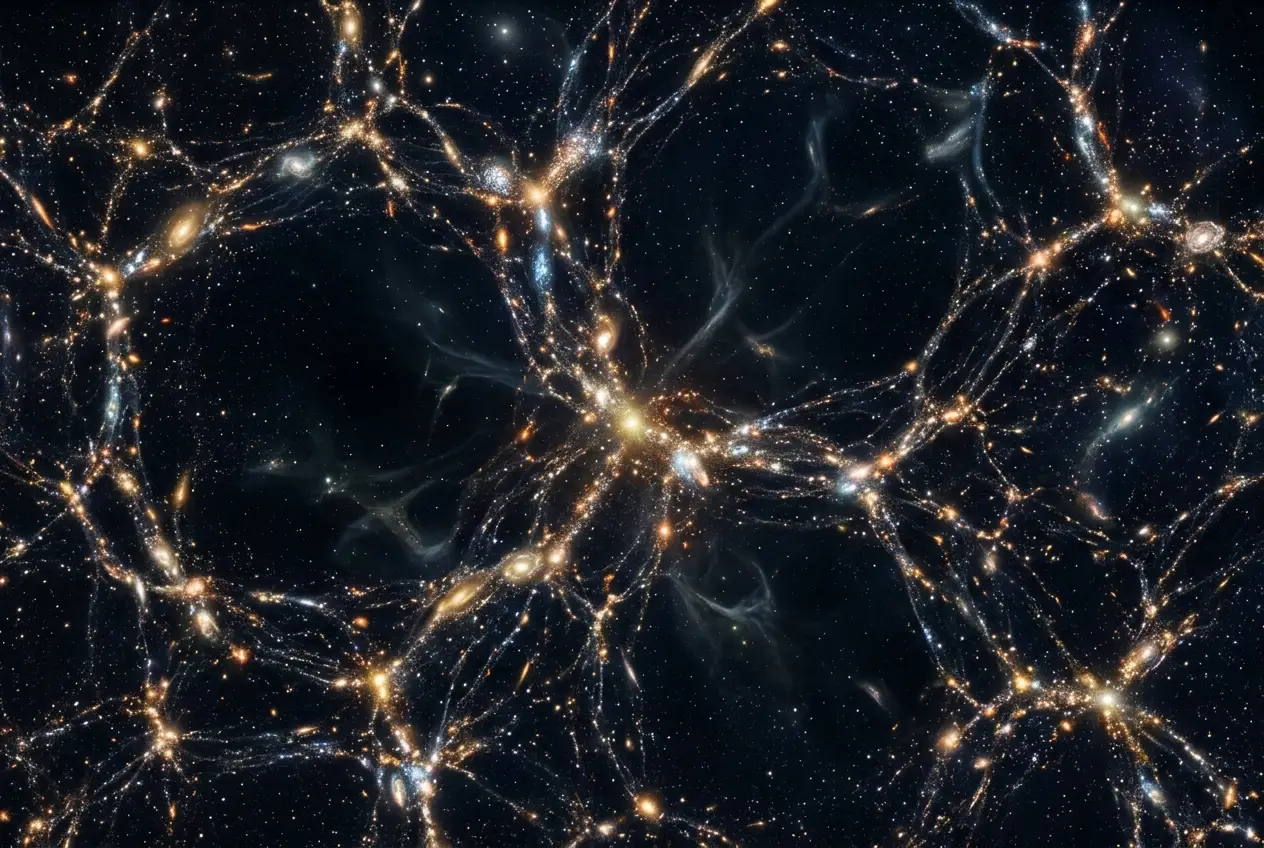
Imagine scaling up the universe, past our solar system, past our galaxy, and then beyond the local group, until individual galaxies look like mere specks of dust. You'd begin to see a mind-boggling structure emerge: the cosmic web. This web is a vast, sponge-like arrangement of matter, featuring dense knots of galaxy clusters, long filaments connecting them, and then, the colossal, gaping holes – the cosmic voids. These aren't just patches of darkness; they are the largest structures in the universe, stretching hundreds of millions of light-years across.
The Grand Architecture of the Universe: Filaments, Clusters, and Voids
The cosmic web is the fundamental architecture of the universe, shaped by gravity over billions of years since the Big Bang. Think of it like a giant, three-dimensional spiderweb. At the intersections of the web, gravity has pulled matter together, forming galaxy clusters – the densest known regions, teeming with thousands of galaxies. Connecting these clusters are filaments, long strands of galaxies and gas that act as cosmic superhighways, funneling matter towards the clusters. But between these threads and knots lie the cosmic voids, making up about 80% of the universe's volume.
It’s tempting to think of these voids as entirely empty. After all, "void" literally means emptiness. However, that’s not entirely accurate. While they are vastly emptier than the galactic filaments and clusters, they are not completely devoid of matter. They contain a sparse distribution of galaxies, gas, and an even more elusive component: dark matter. The average density inside a cosmic void can be as little as one-tenth the average density of the universe, making them the closest thing we have to a vacuum on a cosmic scale.
Why Do Voids Exist? The Echoes of the Early Universe
The existence of cosmic voids isn't a random occurrence; it's a direct consequence of the universe's initial conditions and the inexorable pull of gravity. Shortly after the Big Bang, the universe wasn't perfectly smooth. There were tiny quantum fluctuations – minuscule variations in density – that were amplified by cosmic inflation. These tiny ripples became the seeds from which all structure in the universe grew.
Over billions of years, gravity began to pull matter away from regions that were slightly less dense and towards regions that were slightly denser. It's like a cosmic game of tug-of-war where the denser areas always win. As matter coalesced into filaments and clusters, the regions from which it was drawn became progressively emptier, expanding to form the immense voids we observe today. This process is beautifully simulated in cosmological models, showing how the cosmic web evolved from a relatively uniform soup into the intricate structure we see. You can read more about this on Wikipedia's article on the Large-scale structure of the cosmos (opens in a new tab).
The Mystery Deepens: Are Voids Hiding Something More?
This brings us to the core question: beyond a sparse collection of ordinary matter and dark matter, could cosmic voids be hiding something else? Something unexpected, perhaps even unknown to our current physics? The sheer scale and relative isolation of these regions make them tantalizing candidates for anomalies.
One prominent theory revolves around dark energy, the mysterious force responsible for the accelerating expansion of the universe. Dark energy is thought to be uniformly distributed throughout space, but some researchers propose that its influence might be more complex within voids. Could voids act as "laboratories" for dark energy, where its properties are subtly different, leading to unexpected gravitational effects or even the manifestation of new particles?
Another fascinating idea concerns primordial black holes. These hypothetical black holes are thought to have formed in the very early universe, long before stars and galaxies. If they exist, and if they're small enough not to be easily detectable by gravitational lensing or X-ray emissions, they could be lurking in the voids. While current observational constraints limit their prevalence, the vastness of voids provides ample space for them to hide, contributing to the dark matter puzzle in an unexpected way.
The Enigma of "Void Galaxies"
Even the few galaxies found within voids present a mystery. These "void galaxies" are often older, smaller, and fainter than their counterparts in denser regions. They are like cosmic hermits, evolving in relative isolation, untouched by the frequent mergers and interactions that drive star formation and galactic evolution in clusters and filaments. Their existence raises questions: Did they form differently? Do they contain different proportions of dark matter or exotic particles? Studying them could offer unique insights into galaxy formation under minimal environmental influence.
"These void galaxies are like living fossils," notes Dr. Sarah Davies from the University of Western Australia, whose research focuses on galaxies in low-density environments. "They offer us a glimpse into how galaxies might have evolved in the early universe, before the cosmic web became so pronounced." These isolated galaxies provide a natural experiment, allowing us to disentangle the effects of environment from intrinsic galaxy properties.
The Search for the Unseen: How Do We Probe Voids?
Probing these vast, empty regions is an astronomical challenge. With so little light-emitting matter, observing voids directly is difficult. Instead, scientists use indirect methods:
- Galaxy Surveys: Large-scale galaxy surveys, like the Sloan Digital Sky Survey (SDSS), map the positions of millions of galaxies, allowing astronomers to statistically identify the boundaries and sizes of voids. The absence of galaxies in certain regions is precisely what defines a void.
- Cosmic Microwave Background (CMB): The CMB, the afterglow of the Big Bang, provides crucial clues. As CMB photons travel through voids, they experience a slight temperature shift (the Integrated Sachs-Wolfe effect) due to the gravitational potential of the void. This tiny shift can reveal information about dark energy and the void's structure.
- Weak Gravitational Lensing: The distortion of light from distant galaxies by the gravity of intervening matter, including dark matter, can be used to map the mass distribution within voids. Even though voids are underdense, they still contain dark matter, and its subtle gravitational pull can be detected. For more on this, check out the Wikipedia page on Gravitational Lensing (opens in a new tab).
Connecting Voids to Dark Matter and Other Anomalies
Cosmic voids are not just empty spaces; they are fundamental components of the universe's structure, and their properties are deeply intertwined with the mysteries of dark matter and dark energy. The expansion of voids is driven by dark energy, and their relative emptiness helps us understand where dark matter isn't, which in turn helps us infer where it is.
Could the anomalies in voids hint at something deeper? Perhaps a different distribution of dark matter particles, or even a localized variation in the laws of physics? Some exotic theories propose that these underdense regions might be places where phenomena like extra dimensions could be more prominent or detectable, as discussed in our previous article, "Decoding Reality: Does the Universe Hide Extra Dimensions?". The relative lack of 'noise' from ordinary matter makes voids a cleaner environment to search for subtle effects of new physics.
The Search Continues: What's Next for Void Astronomy?
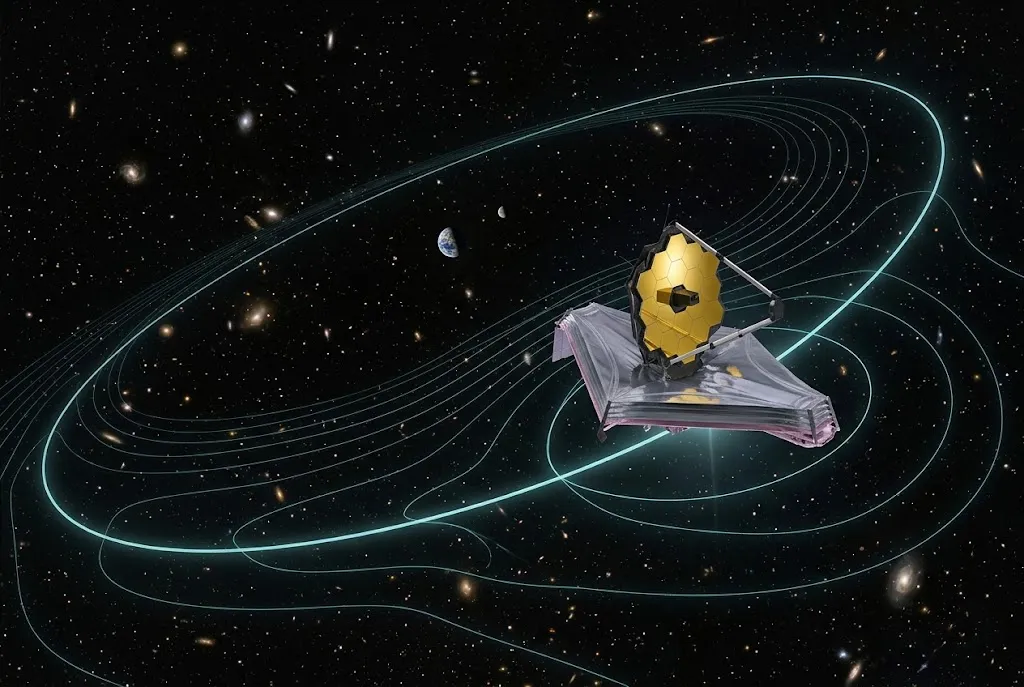
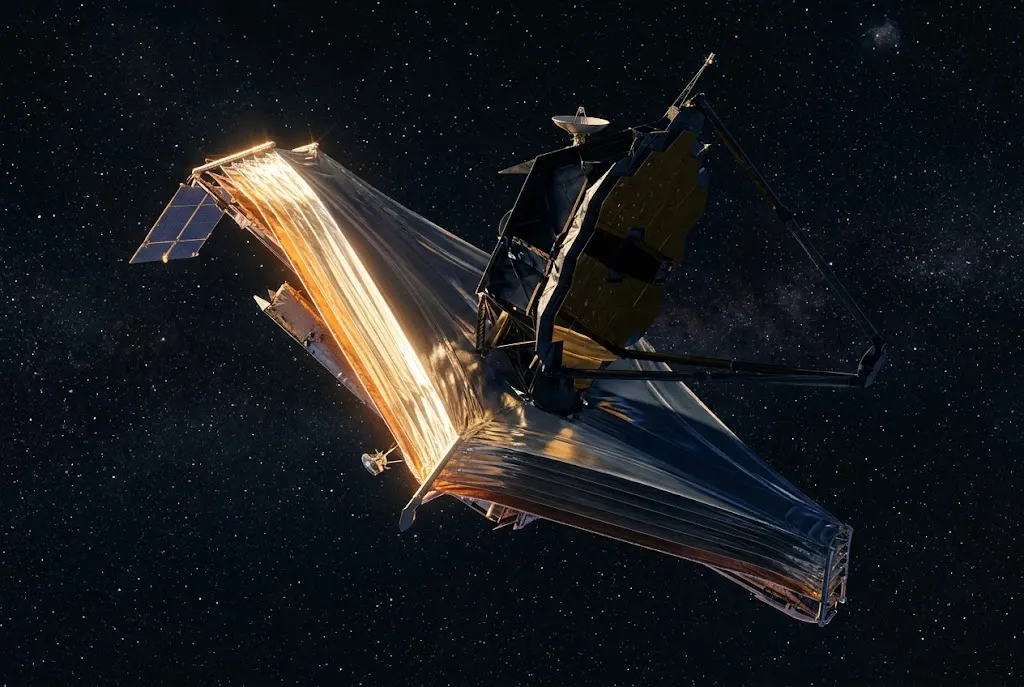
Future telescopes and surveys, such as the Nancy Grace Roman Space Telescope and the Euclid mission, are specifically designed to map the large-scale structure of the universe with unprecedented precision. These missions will delve deeper into the nature of cosmic voids, providing more detailed data on the distribution of galaxies and dark matter within them. They will allow us to test predictions about dark energy and potentially uncover unexpected phenomena that our current instruments can only hint at.
The study of cosmic voids is a frontier of cosmological research. These vast expanses of the universe are not merely empty gaps; they are dynamic, evolving regions that offer unique laboratories for understanding the fundamental forces and components of our cosmos. They remind us that even in the seemingly "empty" spaces, the universe holds profound secrets, waiting to be discovered. The idea that parallel universes might be leaving faint cosmic echoes could even have implications for understanding the boundaries and influences of these voids, as explored in "Are Parallel Universes Colliding? Decoding Cosmic Echoes".
So, the next time you gaze at the night sky, remember that between the glittering constellations, there are silent, colossal voids, perhaps harboring clues to the universe's deepest mysteries. What unseen structures might be lurking in those cosmic depths? Only time, and advanced astronomy, will tell. We continue to ask questions about the unseen, such as whether "Does Dark Matter Hide a Universe We Can't See?", and cosmic voids are a central piece of that puzzle.

Conversation0
No comments yet. Be the first to share a thought — the best questions often become new stories.