


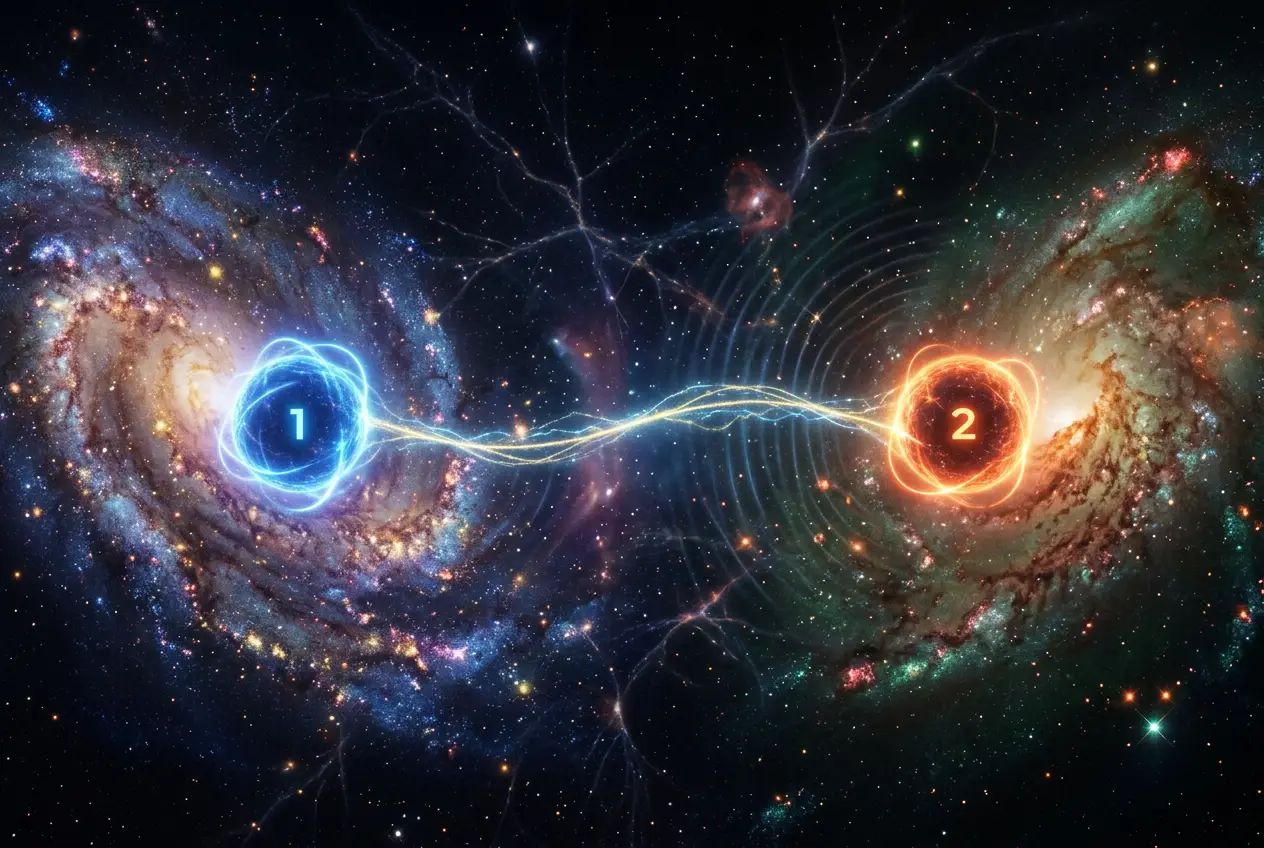
I remember the first time I truly grappled with the concept of quantum entanglement. It was like a sudden, dizzying peek behind the curtain of reality, revealing a universe far stranger and more interconnected than I had ever imagined. Albert Einstein himself famously called it "spooky action at a distance," a phenomenon so counter-intuitive it challenged the very foundations of his understanding of space and time. But what if this "spooky action" isn't just about distant particles influencing each other in our universe? What if it's a cosmic thread, subtly weaving together the fabric of not one, but many universes?
This is the mind-bending question we're diving into today: Does quantum entanglement connect parallel universes? It's a hypothesis that pushes the boundaries of theoretical physics, blending the bizarre world of quantum mechanics with the equally perplexing idea of a multiverse. So, buckle up, because we're about to explore the thrilling intersection of these two profound mysteries.
The Unsettling Nature of Quantum Entanglement
Let's start with the basics. What exactly is quantum entanglement? Imagine two particles, like a pair of electrons, that become "entangled." This means their fates are inextricably linked, no matter how far apart they are. If you measure a property of one particle – say, its spin – you instantly know the corresponding property of the other, even if it's light-years away. There's no communication happening between them in the classical sense; it's as if they share a single, unified quantum state.
This isn't just theoretical musing; it's a well-established phenomenon, repeatedly confirmed by experiments. From quantum computing to secure communication, entanglement is at the heart of many cutting-edge technologies. You can delve deeper into its applications, such as how it might be used in exotic forms of computation, in our previous post, Black Holes: Nature's Ultimate Quantum Computers?.
The truly mind-boggling part is the instantaneous nature of this connection. It appears to defy the cosmic speed limit – the speed of light – which is why it so troubled Einstein. Does information travel faster than light? Not necessarily. Quantum mechanics suggests that the properties of entangled particles aren't determined until they are measured. Before measurement, they exist in a state of superposition, a blend of all possible outcomes. The act of measuring one particle "collapses" its superposition into a definite state, and instantly, its entangled partner's state is also determined, no matter the distance. You can read more about quantum entanglement on Wikipedia: Quantum Entanglement (opens in a new tab).
The Multiverse Hypothesis: A Realm of Infinite Possibilities
Now, let's introduce the concept of parallel universes. The idea of a multiverse – a collection of countless universes, each potentially different from our own – might sound like science fiction, but it's a serious topic of discussion in theoretical physics. There are several multiverse theories, but perhaps the most relevant to our discussion is the Many-Worlds Interpretation (MWI) of quantum mechanics.
The MWI proposes that every time a quantum measurement is made, or every time a quantum event with multiple possible outcomes occurs, the universe "splits" or "branches" into new, parallel universes. In one universe, you observe outcome A; in another, an identical copy of you observes outcome B. All possible outcomes of a quantum event are realized, each in its own separate branch of reality. This elegantly solves the "measurement problem" in quantum mechanics by eliminating the need for a "collapse" of the wave function; instead, all possibilities simply unfold in different realities. It's a dizzying thought, but one that has gained traction among some prominent physicists. For a deeper dive into the Many-Worlds Interpretation, check out its Wikipedia page: Many-Worlds Interpretation (opens in a new tab).
Bridging Realities: The Entanglement-Multiverse Connection
So, if quantum entanglement means particles are intimately linked across vast distances in our universe, could it also mean they're linked across the "distances" between parallel universes?
This is where things get truly speculative, yet incredibly intriguing. Some theoretical physicists have explored the idea that entanglement could be the mechanism through which these parallel universes are not just separate, but subtly interconnected.
Consider the MWI again. When an entangled pair of particles is created, their quantum state is described by a shared wave function that exists in superposition. When a measurement is made, the MWI suggests that the universe branches. If you measure Particle A, and it shows "spin up," then in that branch of the universe, Particle B must instantly be "spin down." But in a parallel branch, where you measured Particle A and got "spin down," then Particle B would be "spin up."
The key insight is that the entanglement isn't broken by the branching. Instead, the entanglement itself persists across the branches. It's not just that two particles in this universe are correlated; it's that the correlation defines how the universes themselves split and remain connected in their quantum dance.
Some interpretations go even further, suggesting that entanglement isn't just a byproduct of the branching, but perhaps even a driver of it, or a way for information (or at least correlations) to persist across these separate realities. Could there be a "multiverse entanglement" where the very fabric of one universe is entangled with another, much like two particles?
I find this idea profoundly exciting. If true, it suggests a universe (or rather, a multiverse) that is far more interconnected than even the most daring science fiction narratives imagine. The "spooky action" might not just be confined to our cosmic neighborhood but could be echoing across the infinite expanse of the multiverse.
The Science vs. The Speculation
It's crucial to distinguish between what we know and what we hypothesize. Quantum entanglement is a verified phenomenon. The Many-Worlds Interpretation is a leading, though not universally accepted, theoretical framework for quantum mechanics. The idea that entanglement connects parallel universes is a further, highly speculative extension of these ideas.
Currently, there's no direct experimental evidence to support the existence of parallel universes, nor any way to detect entanglement between them. Our current technology and understanding are limited to observations within our own cosmic bubble. However, the elegance of the MWI in resolving quantum paradoxes makes it a compelling theory for many researchers.
Some physicists propose that if such connections exist, they would likely be incredibly subtle, perhaps manifesting as extremely faint correlations or echoes that are currently beyond our ability to measure. Others suggest that the very act of consciousness or observation might play a role in this branching process, an idea that, while fascinating, borders on the philosophical.
The pursuit of understanding gravity at a quantum level, and theories like string theory or loop quantum gravity, might one day offer new insights into the fundamental structure of spacetime and whether it allows for such inter-universal connections. We've previously explored other mind-bending connections in space, like the idea of Can Wormholes Really Connect Two Universes? Science vs Theory.
The Future of Exploration
While the direct connection between entanglement and parallel universes remains firmly in the realm of theoretical physics, ongoing research into quantum mechanics continues to unveil new wonders. Experiments pushing the limits of entanglement, trying to entangle larger and more complex systems, might indirectly shed light on the nature of reality itself.
Furthermore, advancements in quantum computing could provide theoretical tools to model extremely complex quantum systems, potentially offering insights into scenarios involving multiple universes. If we can build robust quantum computers, as discussed in our previous post, Why is Quantum Computer 1 Million Times Faster Than SuperComputers?, perhaps they could help us simulate the branching of realities.
The allure of this question – whether entanglement acts as a cosmic bridge – is undeniable. It taps into our deepest curiosities about existence, about what lies beyond our perceived reality. It reminds us that the universe, or perhaps the multiverse, is far grander and more mysterious than we can currently comprehend.
I, for one, am continuously captivated by these questions that sit at the edge of human knowledge. The journey to answer them is what drives science forward, pushing us to build better instruments, refine our theories, and dare to imagine possibilities that seem impossible today. And who knows, perhaps one day, the "spooky action" will reveal itself to be not just a quantum quirk, but the very mechanism that binds an infinite tapestry of realities.






Conversation0
No comments yet. Be the first to share a thought — the best questions often become new stories.