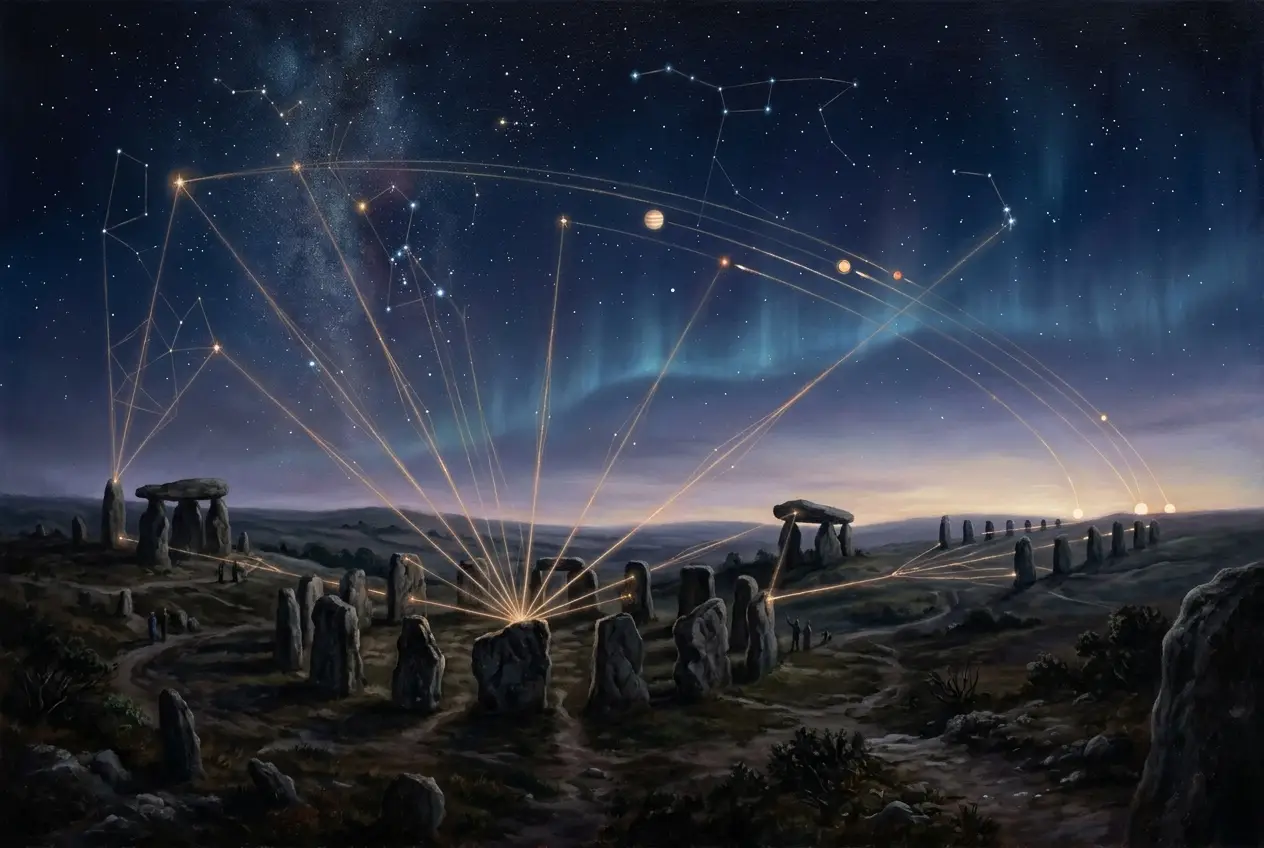
The night sky has always been humanity's oldest clock, calendar, and compass. But what if it was more than just a guide? What if, in their colossal stone circles and precisely aligned temples, our ancestors weren't just observing the cosmos, but actively *processing cosmic data* in a way that mirrored early computational systems? It’s a thought that might seem audacious, given the absence of silicon chips or electrical circuits, yet the evidence embedded in some of the world's most enigmatic ancient sites suggests a level of celestial understanding that goes far beyond simple stargazing.
I’ve often wondered about the true genius of these long-lost civilizations. We tend to frame them through the lens of their art or their social structures, sometimes overlooking their profound scientific and technological prowess. When I look at sites like Stonehenge or Chichen Itza, I see not just monuments, but sophisticated instruments—complex machines designed to interpret the rhythmic dance of the heavens. They didn't have screens or processors, but they had geometry, patience, and an incredible knack for observation.
### The Dawn of Cosmic Computation
Before the invention of the Antikythera Mechanism, which we've explored in another post on the blog, "[Antikythera: Was It Our First Analog Computer?](/blogs/antikythera-was-it-our-first-analog-computer-1343)," there were far grander, albeit less mechanical, "computers" at work. These weren't devices you could hold in your hand, but sprawling architectural complexes built to track the sun, moon, and stars with astounding precision. Their purpose wasn’t merely spiritual or ceremonial, although those elements were undoubtedly present. Many scholars now believe these sites served a highly practical function: predicting astronomical events crucial for agriculture, navigation, and even social order.
Imagine a farmer needing to know the precise timing of seasons for planting and harvesting, or a navigator needing to fix their position at sea. Accurate calendars were lifeblood, and the sky was the ultimate almanac. These ancient sites, through their deliberate alignments, acted as massive, static observatories. They could determine solstices, equinoxes, and even predict eclipses – all forms of "cosmic data processing" requiring intricate mathematical understanding and long-term observation.
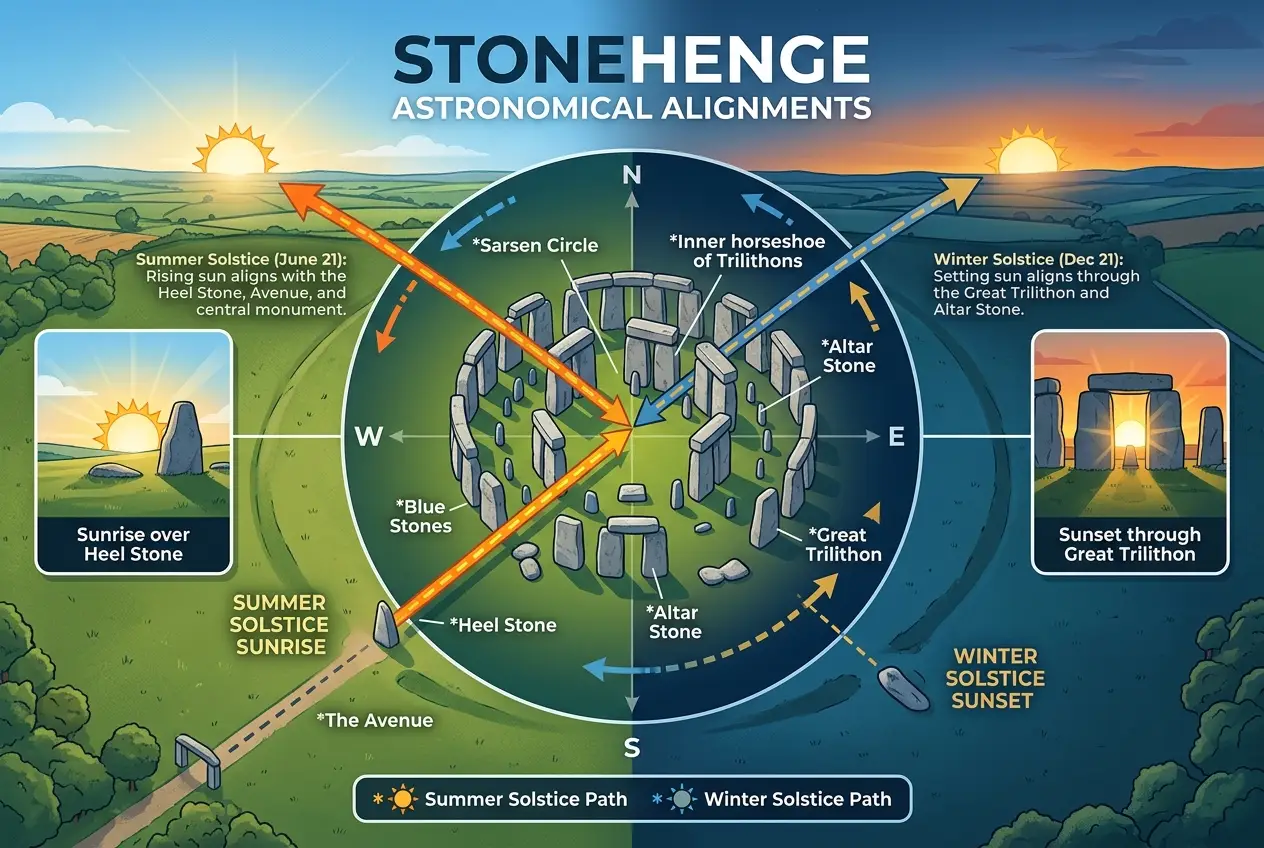
One of the most compelling examples of such a "cosmic data processor" is **Stonehenge** in England. While its exact purpose remains a mystery, its primary function as an astronomical observatory is widely accepted. The iconic Heel Stone, for instance, perfectly aligns with the rising sun on the summer solstice, a phenomenon that still draws crowds today. This isn't a coincidence; it's a deliberate design choice, reflecting a deep understanding of solar mechanics. But Stonehenge wasn’t just a simple calendar; its complex arrangement of stones may have allowed its builders to track lunar cycles as well, possibly even predicting eclipses. This level of prediction goes beyond mere observation and leans into what we might call algorithmic calculation using physical markers.
"The heavens declare the glory of God; the skies proclaim the work of his hands. Day after day they pour forth speech; night after night they display knowledge." — Psalm 19:1-2, highlighting humanity's ancient connection to celestial knowledge.
### Mesoamerican Marvels: Calendars and Cosmic Calculations
Across the Atlantic, civilizations like the Maya demonstrated an astonishing mastery of time and celestial mechanics. Their calendar systems, particularly the Long Count Calendar, were incredibly complex, tracking vast spans of time with remarkable accuracy. The city of **Chichen Itza** in Mexico, with its magnificent El Castillo pyramid, is another prime example of an ancient site designed to process cosmic data.
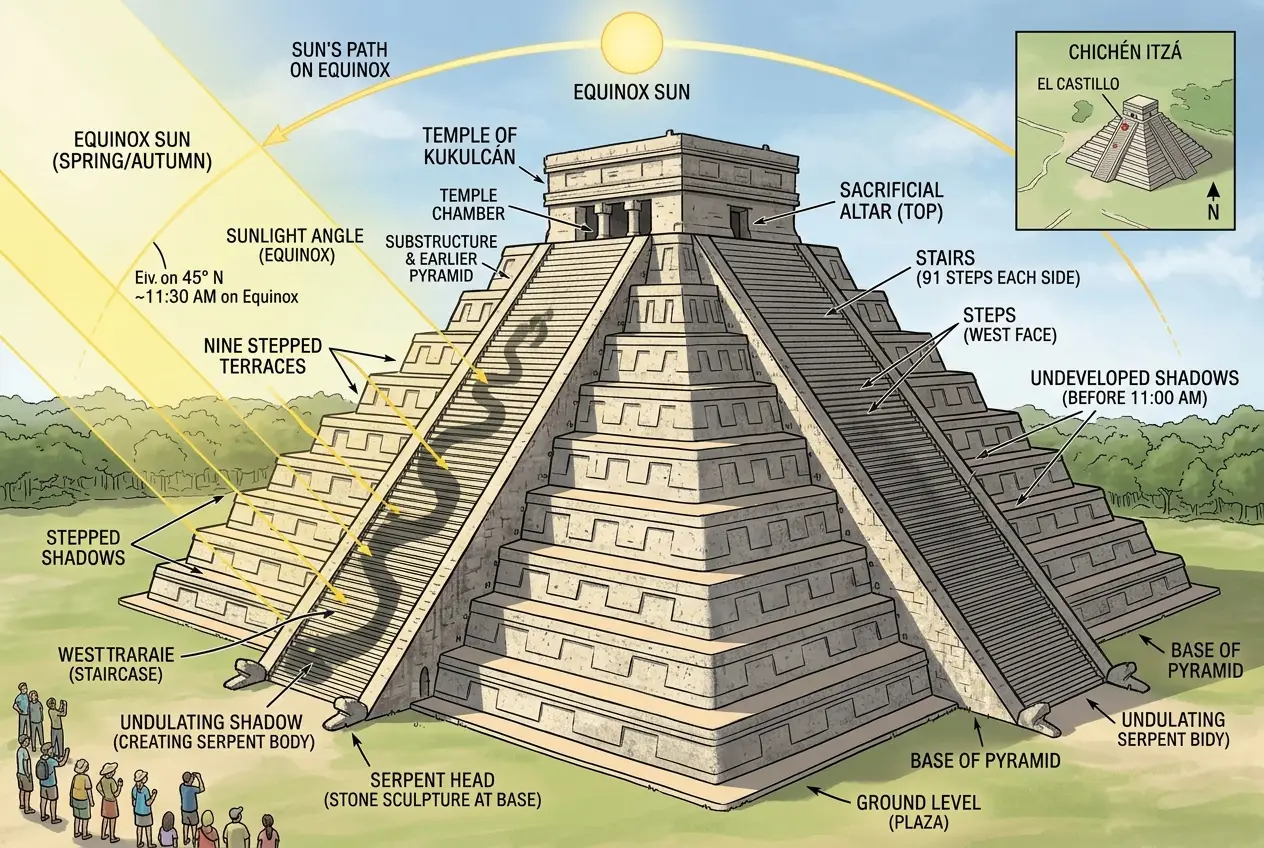
During the spring and autumn equinoxes, the setting sun casts a shadow down the side of El Castillo’s staircase, creating the illusion of a serpent (Kukulkan) slithering down to the earth. This intricate interplay of light and shadow is not just an architectural marvel but a precise astronomical indicator, signaling the change of seasons. The number of steps, platforms, and panels on the pyramid also correspond to calendar cycles, days in a year, and even Venusian periods, suggesting a complex, multi-layered "program" for tracking celestial events. The Maya used such observations not just for agricultural planning, but also for astrological divination and to schedule important rituals and political events. Learn more about the sophisticated Maya civilization on [Wikipedia's page on Maya astronomy](https://en.wikipedia.org/wiki/Maya_astronomy).
Could these alignments be mere happenstance? The sheer number of precisely aligned structures across various ancient cultures, coupled with their documented astronomical knowledge, argues strongly against it. These were deliberate constructions, meticulously planned over generations, to capture and interpret cosmic data.
### Navigating the Stars: The Polynesians' Living Computer
While not a fixed "site" in the traditional sense, the navigation system developed by ancient Polynesian voyagers represents an extraordinary form of "cosmic data processing" without physical computers. These master navigators crisscrossed vast expanses of the Pacific Ocean using an intricate mental map of stars, swells, and winds. They literally embodied a cosmic computer, memorizing hundreds of stars, their rising and setting points, and their relationships to islands.
Their "star compass" wasn't a physical instrument but a conceptual framework, a mnemonic device that allowed them to plot courses and maintain direction with astonishing accuracy. They also observed wave patterns, cloud formations, and the flight of birds—all subtle forms of environmental data that, when processed through their vast knowledge base, guided them to distant lands. This sophisticated form of wayfinding, as detailed on [Wikipedia's article on Polynesian navigation](https://en.wikipedia.org/wiki/Polynesian_navigation), highlights that "processing cosmic data" doesn't always require monumental architecture; sometimes, the "computer" is the human mind itself, exquisitely trained to read the subtle messages of the universe. For another look at how ancient cultures might have perceived the unseen, check out our piece on "[Did Ancient Cultures See Invisible Light?](/blogs/did-ancient-cultures-see-invisible-light-4845)".
### The Mechanism of Ancient Data Processing
How exactly did these ancient sites "process" data? It wasn't about crunching numbers with algorithms in the modern sense, but about creating an interactive, tangible model of the cosmos.
1. **Observation & Calibration:** Long-term, meticulous observation of celestial phenomena over generations. Priests, shamans, or astronomers meticulously recorded star positions, lunar phases, and solar paths.
2. **Architectural Encoding:** This observed data was then encoded into the physical structure of temples, observatories, and megaliths. Alignments, specific numbers of stones or steps, and unique light-and-shadow effects served as physical data points or indicators.
3. **Predictive Modeling:** By understanding these encoded patterns, ancient observers could then predict future events. For example, knowing that the sun aligns with a specific notch on the horizon on the summer solstice allowed them to mark that crucial turning point in the year with unwavering accuracy. This is a form of predictive modeling, albeit analogue.
4. **Cultural Integration:** The "outputs" of these cosmic computers—predictions of eclipses, seasons, or planetary movements—were then integrated into their cultural, religious, and political systems, reinforcing the power and knowledge of those who could "read" the sky.
Consider the role of the ancient Sumerians and Babylonians, who developed sophisticated astronomical tables and predictive models, crucial for their highly advanced understanding of planetary movements and eclipses. Their cuneiform tablets, essentially early spreadsheets of celestial data, allowed them to forecast astronomical events with impressive accuracy, long before the Greeks or Romans. The level of mathematical sophistication required for this is astounding, as explored in articles like [this Wikipedia entry on Babylonian astronomy](https://en.wikipedia.org/wiki/Babylonian_astronomy). They were, in essence, operating a form of "cosmic data processing center" using clay tablets as their storage and calculation medium. This makes me wonder, could these ancient systems have influenced later developments? Perhaps there's a link to how ancient cultures understood "unseen forces," a topic we explored in "[Unseen Forces: Did Tesla Discover Free Energy?](/blogs/unseen-forces-did-tesla-discover-free-energy-1748)".
### Beyond Practicality: The Cosmic Connection
Beyond the practical applications, the ability to process cosmic data through these sites also fostered a profound connection between humanity and the universe. It reinforced the idea of a structured, predictable cosmos, which likely had deep spiritual and philosophical implications. The builders of these sites saw the universe as an ordered system, and their "cosmic computers" were their way of understanding, participating in, and even harmonizing with that order.
This ancient quest to decipher the heavens resonates with our modern scientific endeavors. We use supercomputers and vast observatories to process cosmic data, from mapping the cosmic web to understanding black holes. While our tools are vastly different, the underlying curiosity and the desire to comprehend our place in the universe remain unchanged. The "cosmic computers" of antiquity, whether monumental stone structures or intricate mental maps, stand as a testament to humanity's enduring fascination with the stars and our innate drive to decode the universe's grand design.
In a world increasingly driven by digital computation, it's humbling to reflect on how our ancestors managed to extract such profound insights from the cosmos using only their intellect, their ingenuity, and the very ground beneath their feet. Perhaps their "cosmic data processors" weren't just about prediction, but about connecting humanity to the grand, eternal rhythm of the universe.
Verified Expert
Alex Rivers
A professional researcher since age twelve, I delve into mysteries and ignite curiosity by presenting an array of compelling possibilities. I will heighten your curiosity, but by the end, you will possess profound knowledge.
Leave a Reply
Comments (0)
No approved comments yet. Be the first to share your thoughts!
 Join Us

 Unknown Author



































Leave a Reply
Comments (0)