



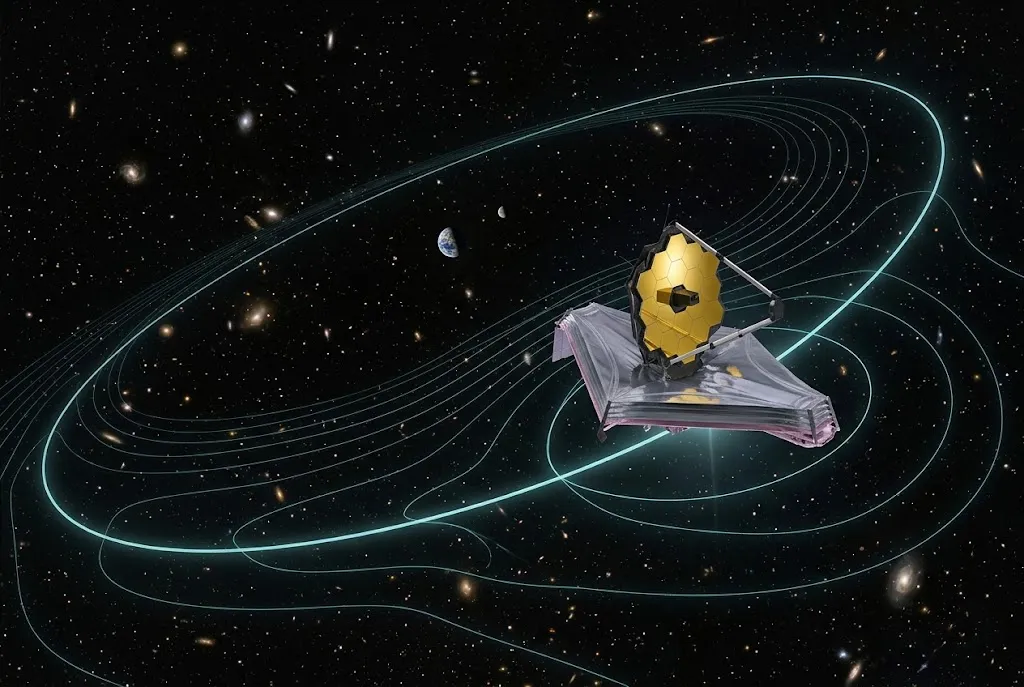
I often find myself looking up at the night sky, overwhelmed by the sheer scale of the universe. It’s a vast, ever-expanding canvas, and the greatest mystery painted across it is perhaps the very force driving that expansion: dark energy. For decades, scientists have grappled with this enigmatic entity, a cosmic anti-gravity pushing galaxies apart faster and faster. But what if this colossal, mysterious force, rather than just being a cosmological puzzle, held the key to our future among the stars? What if dark energy could become the ultimate fuel for interstellar — or even intergalactic — travel?
The concept sounds like something ripped straight from a science fiction novel, and honestly, that's what makes it so exciting. We're talking about harnessing the fundamental fabric of the cosmos to propel us beyond our wildest dreams. When I first encountered the idea, my mind immediately leaped to warp drives and starships zipping across light-years. But the reality, while still largely theoretical, is grounded in fascinating physics.
Understanding the Universe's Invisible Hand
Before we dive into propulsion, let's briefly touch on what dark energy is, or rather, what we think it is. Imagine the universe not as a static painting, but as an inflating balloon. Galaxies are dots on this balloon, and as it inflates, the dots move further apart. For a long time, cosmologists believed that gravity from all the matter in the universe would eventually slow this expansion down, perhaps even reversing it in a "Big Crunch."
However, in the late 1990s, observations of distant supernovae revealed something astonishing: the expansion of the universe isn't slowing down; it's accelerating. This groundbreaking discovery suggested the existence of an unknown force counteracting gravity on cosmic scales. Scientists dubbed this mysterious force "dark energy." It's thought to make up roughly 68% of the total energy density of the universe, dwarfing ordinary matter and dark matter. You can read more about this discovery and its implications on Wikipedia's Dark Energy page (opens in a new tab).
One leading theory for dark energy is that it's a property of space itself – vacuum energy. Einstein's theory of general relativity predicts that empty space can possess its own energy, and if this energy doesn't dilute as space expands, it would exert a constant outward pressure, causing the universe to accelerate its expansion. Another possibility is a new type of dynamic energy fluid or field, sometimes called "quintessence," that fills space but has negative pressure.
The Dream: Harnessing Cosmic Expansion
So, how does a force that expands the entire universe translate into propulsion for a spacecraft? This is where the theoretical physics gets really creative. The challenge is immense because dark energy is incredibly diffuse. It's not like a fuel we can bottle; it's woven into the very fabric of spacetime. However, the idea isn't to burn dark energy, but to manipulate spacetime itself using principles inspired by its effects.
One prominent concept is the Alcubierre warp drive, popularized by physicist Miguel Alcubierre. While not directly using dark energy, it offers a framework for thinking about spacetime manipulation. The warp drive proposes creating a "bubble" of spacetime around a spacecraft, contracting space in front of it and expanding space behind it. This would allow the craft to travel at superluminal speeds without violating the laws of physics locally, as the craft itself wouldn't be moving faster than light within its local bubble. It's the spacetime around it that's doing the bending.
The connection to dark energy lies in its fundamental characteristic: negative pressure. Dark energy effectively generates a repulsive gravitational force. If we could somehow create a localized region of spacetime with conditions similar to those generated by dark energy – a region of intensely negative pressure or energy density – we might be able to artificially generate a warp bubble. This would be a technological feat far beyond our current capabilities, requiring matter with exotic properties, such as negative mass or negative energy density, which are purely hypothetical at present. You can explore the theoretical physics of warp drives further on its Wikipedia page (opens in a new tab).
Beyond Warp Drives: Other Theoretical Approaches
While the warp drive is the most famous, other speculative concepts attempt to leverage the principles associated with dark energy:
1. Cosmic String Propulsion
Theoretically, cosmic strings are hypothetical one-dimensional topological defects in spacetime, remnants from the early universe. If they exist, they could possess immense energy density. Some speculative theories suggest that passing near or manipulating these strings could create localized spacetime distortions, offering another pathway for ultra-fast travel. Imagine a ship "surfing" a spacetime ripple generated by such a phenomenon.
2. Vacuum Energy Extraction
If dark energy is indeed vacuum energy, then theoretically, the vacuum of space itself contains an enormous amount of energy. The problem is that extracting usable energy from it on a practical scale is incredibly difficult, akin to trying to drain the ocean with a teacup, as the energy is diffuse and spread throughout space. However, advanced quantum field manipulation might someday allow for localized extraction, potentially leading to reactionless drives that don't need propellant. This would revolutionize space travel, freeing us from the tyranny of the rocket equation. For more on the challenges of vacuum energy, you might find discussions on quantum vacuum fluctuations relevant.
3. Manipulating Spacetime Curvature with Exotic Matter
The challenge for most advanced propulsion concepts, including warp drives, is the requirement for "exotic matter" – matter with properties like negative mass or energy density. If dark energy is a manifestation of such exotic properties on a cosmic scale, understanding its nature might reveal how to synthesize or manipulate similar conditions locally. This could involve harnessing quantum phenomena, perhaps even by studying how dark matter interacts or if there are connections to quantum computing's ability to manipulate fundamental states (see our previous blog: "Can Dark Matter Power Quantum Computers?" at /blogs/can-dark-matter-power-quantum-computers-6052).
The Hurdles: A Mountain of "What Ifs"
The biggest obstacle isn't just the engineering; it's the fundamental physics. We don't fully understand dark energy. It's an inference based on its observed effects. Trying to harness something we barely comprehend is like building a house without blueprints, just a vague idea of its function.
1. The Energy Requirements: Even if exotic matter were possible, the amount of energy required to create and sustain a warp bubble would be astronomical, potentially exceeding the energy of entire stars. 2. Theoretical Nature of Exotic Matter: We have no observational evidence or theoretical framework within the standard model of particle physics for the existence of matter with negative mass or energy. 3. The Causality Problem: Faster-than-light travel, even by bending spacetime, often raises questions about causality and the possibility of time travel paradoxes, which are highly problematic for modern physics. 4. Diffuseness of Dark Energy: Dark energy's low density means that in any given volume of space, there's very little of it. Concentrating it or manipulating its effects would be an unprecedented challenge.
Despite these colossal challenges, the mere contemplation of harnessing dark energy is a testament to humanity's boundless curiosity and ambition. It pushes the boundaries of scientific thought, driving us to explore the most profound mysteries of the cosmos. As we continue to develop our understanding of quantum mechanics and general relativity, perhaps some unforeseen breakthrough will illuminate a path forward. We've seen how advancements in materials science, like those explored in "Damascus Steel: Did Ancient Smiths Use Nanotech?" at /blogs/damascus-steel-did-ancient-smiths-use-nanotech-8000, can reveal surprising capabilities, even in ancient contexts. Imagine what future materials might enable!
Looking to the Future
While dark energy propulsion remains firmly in the realm of theoretical physics and science fiction, the pursuit of such audacious goals often leads to unexpected discoveries. The very act of trying to understand dark energy better could unlock other secrets of the universe, leading to breakthroughs in energy generation, materials science, or our fundamental understanding of spacetime itself. It reminds me of the bold visions of ancient civilizations, as discussed in "Were Ancient Megaliths Earth's First Global Network?" at /blogs/were-ancient-megaliths-earths-first-global-network-3626, hinting at advanced understanding that we're only now rediscovering through technology.
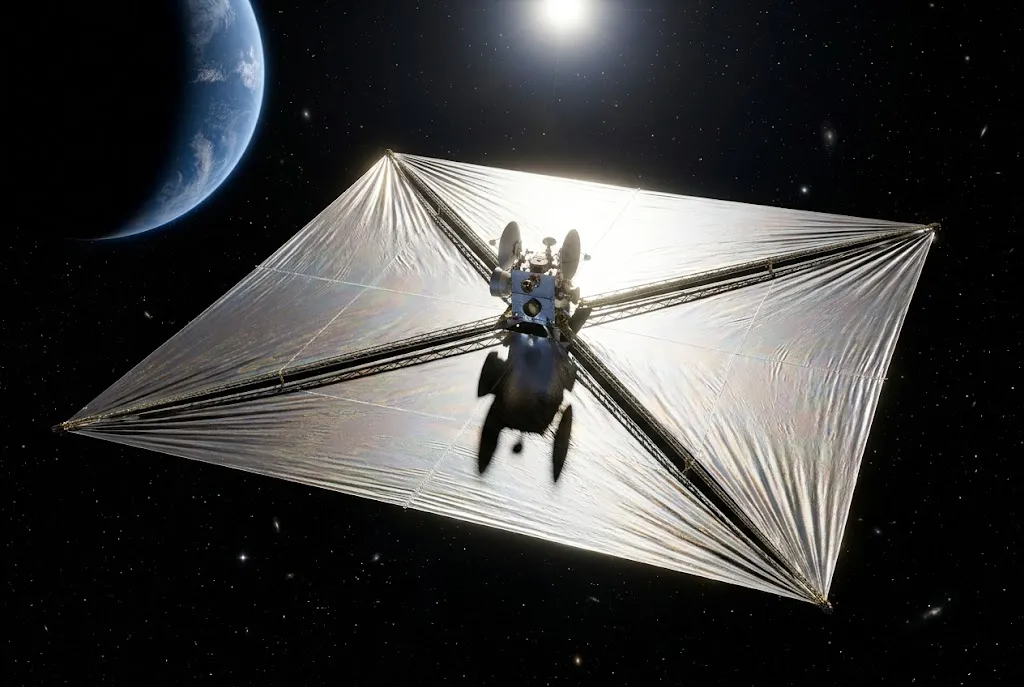
The ultimate question of whether we can ever truly harness dark energy for propulsion remains unanswered. It’s a profound mystery wrapped in a cosmic enigma. But I believe that the journey to find the answer is just as important as the answer itself, pushing our intelligence, our technology, and our collective dreams further into the vast unknown. Perhaps one day, a starship won't just sail through the cosmos, but will weave its path by manipulating the very energy that inflates the universe around it.
Conversation0
No comments yet. Be the first to share a thought — the best questions often become new stories.