The cosmos is an ocean of silence, punctuated by the occasional flash of a supernova or the distant hum of a galaxy. For centuries, we've gazed at the stars, wondering if anyone else is out there, and perhaps, more importantly, *how* we might ever communicate with them. Our current methods—radio waves, lasers—are bound by the speed of light, and the immense distances between star systems make even a single conversation span millennia. But what if the solution to interstellar communication isn't a faster signal, but an entirely different medium? What if the universe itself, in its most mysterious form, holds the key?
I've often found myself pondering this exact question, especially when I read about the baffling nature of dark matter. It’s a substance that makes up roughly 27% of our universe, yet we can’t see it, touch it, or directly detect it. It permeates everything, silently influencing galaxies, yet remains an enigma. This invisibility, this ghost-like presence, is precisely what sparked my curiosity: could this ubiquitous, non-interacting "dark" substance be the ultimate cosmic communication highway?
## Unpacking the Universe's Invisible Fabric: What is Dark Matter?
Before we delve into the fantastical idea of dark matter communication, let's ground ourselves in what we *think* we know about it. Dark matter isn't just empty space; it’s a distinct form of matter that doesn't absorb, reflect, or emit light, making it entirely invisible to telescopes. Its existence is inferred solely through its gravitational effects on visible matter, radiation, and the large-scale structure of the universe. Without it, galaxies wouldn't spin the way they do, and cosmic structures wouldn't hold together.
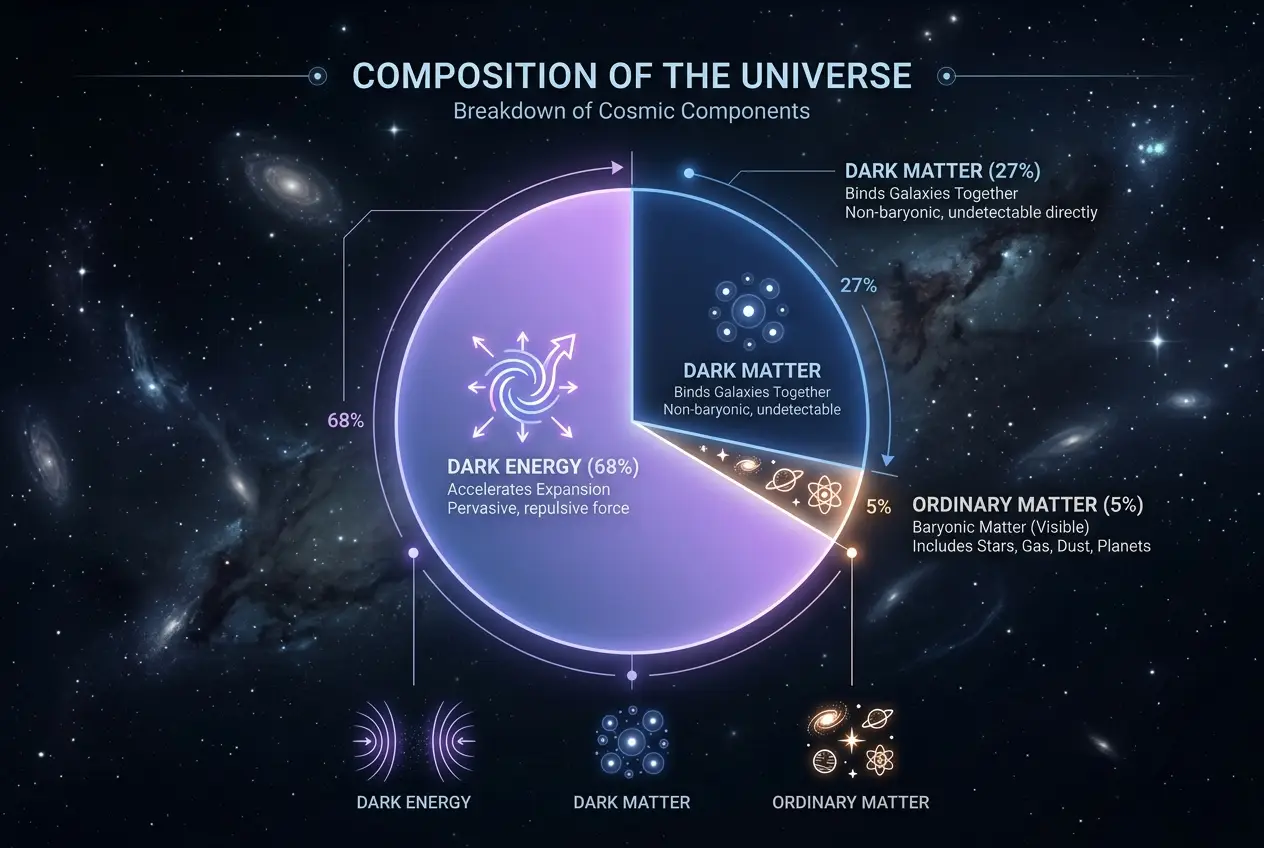
Scientists hypothesize that dark matter is composed of exotic particles that interact very weakly with the standard model particles we know. The leading candidates are **Weakly Interacting Massive Particles (WIMPs)** or even lighter particles like **Axions**. The "weakly interacting" part is crucial here. If dark matter particles truly didn't interact *at all* with normal matter except through gravity, then communication would be impossible. However, the possibility of extremely weak, non-gravitational interactions is where the door creaks open for this wild idea.
"The universe is full of mysteries," as renowned astrophysicist Neil deGrasse Tyson once remarked, "and dark matter is perhaps the biggest one." It's this profound mystery that compels us to explore unconventional possibilities.
## The Whispers of the Void: How Might Dark Matter Communication Work?
Imagine a communication system that isn't hampered by stars, planets, or cosmic dust. A signal that simply passes through everything, arriving at its destination unimpeded. This is the allure of dark matter communication. But how would one even begin to send a message through something we can't directly manipulate or detect?
### Modulating the Invisible
The core concept would involve somehow *modulating* a dark matter field or stream of particles. This is, admittedly, the most speculative part. If dark matter particles have even a tiny cross-section for interaction with known particles, we might theoretically be able to:
1. **Generate a Focused Beam:** Perhaps with incredibly powerful particle accelerators or novel energy sources, we could create localized, coherent fluctuations or even a 'beam' of dark matter particles. This beam wouldn't be like a light beam; it would be a stream of weakly interacting particles carrying information.
2. **Manipulate Dark Matter Fields:** Advanced civilizations might possess the technology to directly manipulate hypothetical dark matter fields, similar to how we manipulate electromagnetic fields to send radio waves. By creating specific perturbations or patterns within this field, information could be encoded.
The information itself would be embedded in these modulations – changes in intensity, frequency, phase, or even the quantum states of the dark matter particles. This is where theoretical physics steps far beyond our current technological grasp, but not necessarily beyond the laws of physics themselves. For a deeper dive into the theoretical framework of dark matter, the Wikipedia article on its composition and properties provides an excellent starting point: [Dark Matter on Wikipedia](https://en.wikipedia.org/wiki/Dark_matter).
### Listening to the Silence: Detecting Dark Matter Signals
Sending is only half the battle; detection is the other, equally daunting challenge. Our current dark matter detectors, like the XenonnT experiment, are designed to catch the incredibly rare instances where a dark matter particle *might* weakly interact with a normal atom, causing a tiny recoil. To detect a *modulated* signal, receivers would need to be:
* **Extraordinarily Sensitive:** Far beyond anything we have today, capable of distinguishing an artificial modulation from the constant background 'noise' of natural dark matter passing through.
* **Aimed and Tuned:** Just like a radio receiver, a dark matter receiver would need to be tuned to the specific type of modulation being used by the sender.
* **Massive and Shielded:** To enhance the chances of interaction and reduce interference from other particles, such detectors would likely be colossal, buried deep underground or even in space.
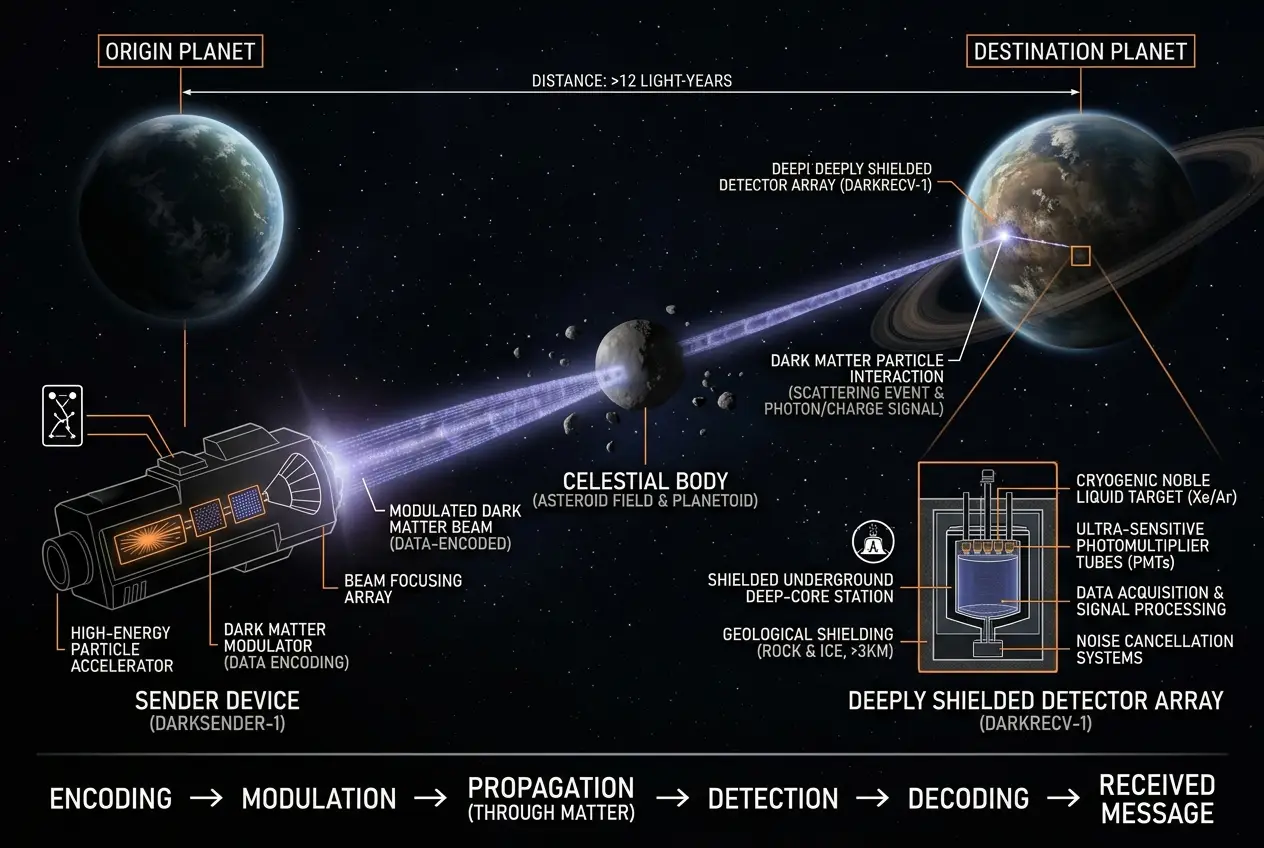
One of the fascinating aspects of such a system is its potential for incredible **stealth**. A dark matter signal would be virtually impossible to intercept by any civilization not explicitly looking for it with highly advanced, specialized equipment. This makes it a compelling, if distant, prospect for secure interstellar communication.
## The Hurdles: Why We're Not Texting Aliens with Dark Matter Yet
The concept is exhilarating, but the challenges are monumental.
### The Weak Interaction Problem
The defining characteristic of dark matter is its *weak* interaction. If it interacted strongly enough for us to easily manipulate and detect, we would have already found it. The very property that makes it an ideal medium for unhindered transmission also makes it incredibly difficult to engage with.
### Energy Demands
Generating a detectable, modulated dark matter signal would likely require energy levels far exceeding anything humanity can currently produce. We're talking about energies that could power entire planets for centuries, concentrated into a single, focused communication effort.
### Background Noise
The universe is awash with natural dark matter. Differentiating an artificial signal from the constant, random flux of ambient dark matter would be like trying to hear a whispered conversation during a rock concert, but without any instruments to filter the sound.
### Theoretical Gaps
Our understanding of dark matter is still in its infancy. We don't even know for sure what particles constitute it. Until we have a more concrete grasp of its fundamental nature, any ideas about manipulating it remain purely hypothetical.
## Dark Matter vs. Other Exotic Communication Ideas
When we talk about communicating across the cosmos, dark matter isn't the only exotic idea on the table.
### Neutrino Communication
Neutrinos are also weakly interacting particles, but we *can* detect and produce them. The concept of [neutrino communication](https://en.wikipedia.org/wiki/Neutrino_communication) involves sending messages through a beam of neutrinos. While more feasible than dark matter, neutrinos still interact, albeit weakly, meaning they can be absorbed or scattered. We've previously discussed if [neutrinos carry hidden cosmic messages](/blogs/do-neutrinos-carry-hidden-cosmic-messages-6956), exploring this very concept.
### Gravitational Wave Communication
Gravitational waves, ripples in spacetime, also pass through matter largely unimpeded. However, generating detectable gravitational waves for communication would require incredibly energetic events, like colliding black holes, far beyond any technology we can envision.
### Quantum Entanglement for Interstellar Communication
This is another fascinating avenue. Quantum entanglement suggests that two particles can become linked, sharing properties instantaneously, regardless of distance. If we could entangle particles and send one across vast distances, manipulating one could instantaneously affect the other, seemingly breaking the light-speed barrier for information transfer. We explored this in detail when considering if [quantum entanglement could fuel interstellar communication](/blogs/can-quantum-entanglement-fuel-interstellar-comm-5201). While not directly "sending" information in the classical sense, it represents a profound shift in thinking about cosmic messaging.
### The Universe as a Computer
Some speculative theories even propose that the universe itself functions like a giant computational system, with dark matter playing a role in its fundamental processing. If [empty space is a quantum computer](/blogs/is-empty-space-a-quantum-computer-9021), could dark matter be the cosmic bus for data transfer? This idea opens up even more mind-bending possibilities.
## The Long Road Ahead: From Theory to Reality
For now, dark matter communication remains firmly in the realm of science fiction and theoretical physics. Our primary goal is still to simply *detect* dark matter, to confirm its nature, and understand its properties. Experiments worldwide are tirelessly searching for those elusive interactions, hoping to catch a glimpse of this invisible universe.
The notion that dark matter might also be hiding a universe we can't see, or even be a medium for communication, adds another layer of intrigue. As discussed in our blog, [Does Dark Matter Hide a Universe We Can't See?](/blogs/does-dark-matter-hide-a-universe-we-cant-see-2793), the possibilities are truly astounding.
What this thought experiment highlights is the sheer breadth of undiscovered physics and unimaginable technologies that might lie in humanity's future, or perhaps already exist among advanced extraterrestrial civilizations. The very act of conceiving such ideas pushes the boundaries of our understanding, inspiring new research and guiding our efforts to unlock the universe's deepest secrets.
Even if direct dark matter communication remains forever beyond our grasp, the questions it raises lead us to a deeper appreciation for the profound, often hidden, mechanics of the cosmos. Who knows what other incredible uses we might find for dark matter once we finally understand its true nature?
Frequently Asked Questions
The primary advantage is that dark matter interacts extremely weakly with ordinary matter, allowing signals to pass through planets, stars, and nebulae without degradation or absorption, unlike electromagnetic waves.
No, current dark matter experiments are focused solely on detecting its presence and understanding its fundamental properties. Communication with dark matter remains a purely theoretical concept.
WIMPs (Weakly Interacting Massive Particles) and Axions are leading hypothetical candidates for dark matter particles. Their relevance to communication lies in their 'weak interaction' – if they interact even slightly with normal matter, it suggests a tiny window for manipulation and detection.
A dark matter signal would not be an electromagnetic wave. It would likely involve modulating a stream or field of dark matter particles themselves. Unlike radio waves, it wouldn't be affected by obstacles and would require entirely different generation and detection technologies.
While dark matter itself doesn't inherently imply faster-than-light travel, if its communication mechanism were tied to quantum entanglement, then information transfer *could* appear instantaneous. However, direct FTL messaging via dark matter is highly speculative and would challenge known physics.
Verified Expert
Alex Rivers
A professional researcher since age twelve, I delve into mysteries and ignite curiosity by presenting an array of compelling possibilities. I will heighten your curiosity, but by the end, you will possess profound knowledge.
Leave a Reply
Comments (0)
No approved comments yet. Be the first to share your thoughts!
 Join Us




 Unknown Author
































Leave a Reply
Comments (0)