


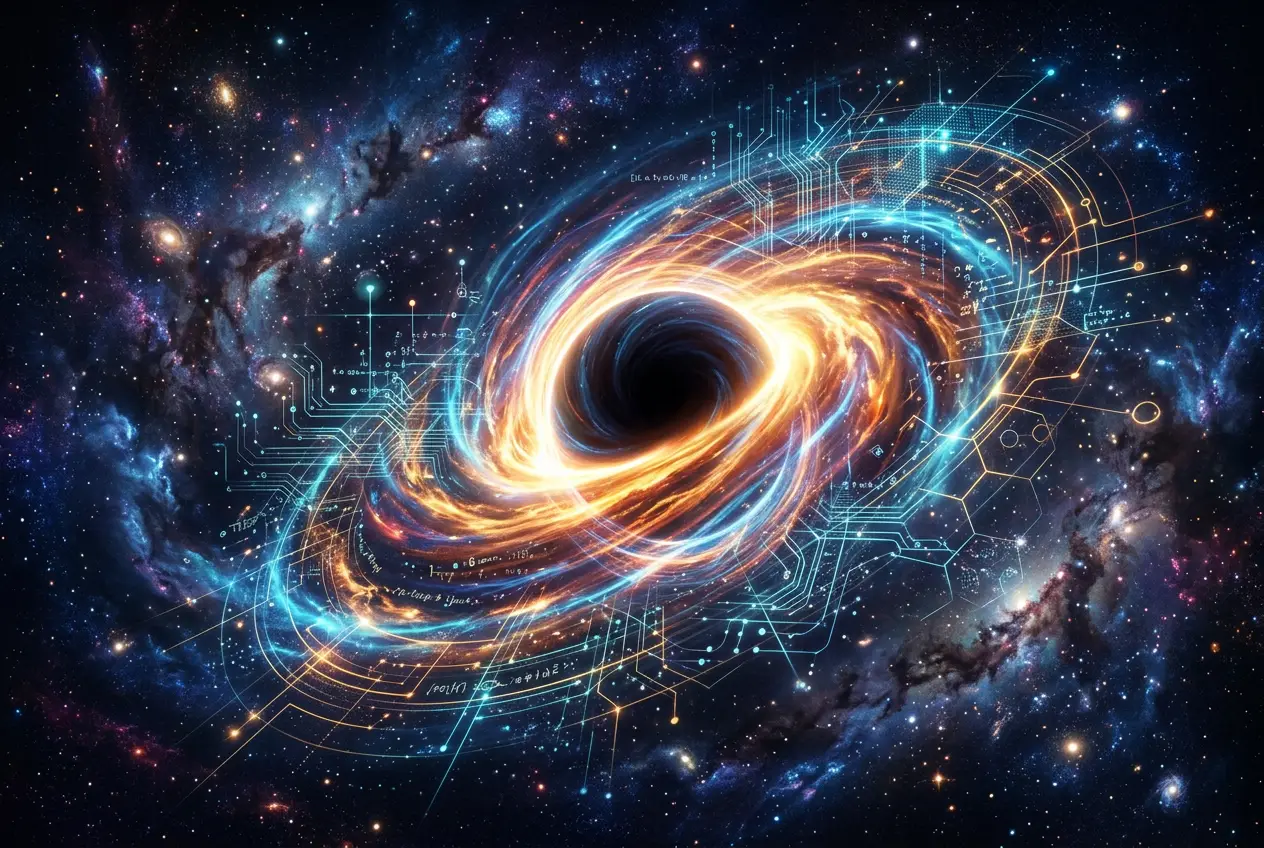
I remember staring up at the night sky as a child, utterly captivated by the countless pinpricks of light. Each one a star, a sun, a galaxy—a universe of unknowns. But even then, the concept of black holes held a special, terrifying allure. These cosmic behemoths, devouring light and warping space-time, seemed like the ultimate cosmic destroyers. Fast forward to today, and my perspective has shifted dramatically. What if these enigmatic voids aren't just cosmic vacuum cleaners, but something far more profound? What if, in their crushing gravitational embrace, they are actually performing calculations beyond our wildest dreams, acting as nature's ultimate quantum computers?
It’s a thought that sounds ripped from the pages of science fiction, yet a growing number of theoretical physicists are exploring this mind-bending possibility. The idea isn't that black holes are consciously "thinking" or running programs as we understand them, but rather that their fundamental physics might inherently perform processes analogous to quantum computation. This journey into the heart of a black hole, through the lens of quantum information theory, challenges everything we thought we knew about the universe's most extreme objects and the very fabric of reality itself.
The Black Hole Paradox: Information Lost, or Just Reorganized?
To understand how black holes could be cosmic computational engines, we first need to grapple with one of the most perplexing puzzles in modern physics: the black hole information paradox. Classical physics, governed by Einstein's theory of general relativity, paints black holes as simple, featureless objects defined only by their mass, charge, and angular momentum – famously dubbed "no-hair" theorems. Anything that falls in is gone forever, its information seemingly destroyed.
However, quantum mechanics, the theory governing the subatomic world, throws a wrench into this tidy picture. One of its cardinal rules is that information can never be truly destroyed, only transformed or redistributed. This fundamental conflict — information loss in black holes versus information conservation in quantum mechanics — has plagued physicists for decades.
Enter Stephen Hawking, who, in the 1970s, predicted that black holes aren't entirely black. They emit a faint thermal radiation, now known as Hawking radiation, due to quantum effects near the event horizon. This radiation slowly causes black holes to evaporate over trillions of years. If a black hole eventually evaporates completely, and if Hawking radiation is truly random and carries no information about what fell in, then the information paradox intensifies. Where does the information go? Does it simply vanish, violating quantum mechanics?
Quantum Computing: A Primer for Cosmic Scales
Before we dive deeper into the black hole-quantum computer connection, let’s quickly recap what makes quantum computing so revolutionary. Unlike classical computers that use bits (0s or 1s), quantum computers employ qubits. Qubits can exist in multiple states simultaneously (superposition) and become intrinsically linked through a phenomenon called quantum entanglement. This allows quantum computers to process vast amounts of information and explore multiple possibilities concurrently, offering exponential speedups for certain types of problems. (For a deeper dive into how quantum entanglement connects different realities, check out our article on /blog/does-quantum-entanglement-connect-parallel-universes-5363).
The power of quantum computing lies in manipulating these quantum states. Imagine trying to find the shortest route through a maze. A classical computer would try each path sequentially or systematically. A quantum computer, thanks to superposition, could potentially explore all paths simultaneously.
The Black Hole as a Qubit Processor: A Theoretical Framework
So, how do black holes fit into this? The connection primarily arises from two radical ideas:
- The Holographic Principle: This revolutionary concept suggests that the information content of a 3D volume of space can be encoded on a 2D surface – much like a hologram. For a black hole, this surface is its event horizon. The area of a black hole's event horizon is proportional to its entropy (a measure of disorder or information content), as described by the Bekenstein-Hawking entropy formula. This suggests that all the information about what falls into a black hole isn't destroyed but rather "smeared" across the event horizon. If information is stored on this 2D boundary, it could potentially be processed there.
- Quantum Information at the Event Horizon: Recent theories propose that the event horizon isn't a smooth, featureless boundary but a dynamic, highly complex region where quantum effects are profound. Some physicists suggest that the "bits" of information on the event horizon might actually behave like quantum bits, or qubits. The intricate quantum fluctuations near the horizon, constantly interacting and "processing" the infalling information, could represent a form of quantum computation.
One intriguing perspective comes from the idea of ER=EPR, a conjecture proposed by Leonard Susskind and Juan Maldacena. It posits a deep connection between entangled quantum particles (EPR pairs) and wormholes (ER bridges). If true, this means that the entanglement of particles near the event horizon could be directly linked to the very geometry of space-time, potentially forming a complex, interconnected network of quantum information. Could the gravitational dynamics themselves be performing quantum operations?
"The event horizon of a black hole is not just a boundary; it's a dynamic computational surface, processing information in ways we are only beginning to comprehend," argues theoretical physicist Dr. Eva Green in a recent seminar. This sentiment captures the essence of the ongoing research.
What Kind of "Computations" Could Black Holes Perform?
If black holes are indeed cosmic quantum computers, what problems might they be "solving"?
- Decoding the Universe's History: As matter and energy fall into a black hole, their information is encoded onto the event horizon. Over eons, a black hole could accumulate an immense dataset about the universe's past. The "computation" here might be the complex evolution and re-encoding of this information as the black hole grows and eventually evaporates.
- Simulating Gravity and Quantum Gravity: One of the holy grails of physics is a unified theory of quantum gravity. Black holes are unique laboratories where both general relativity and quantum mechanics play crucial roles. By studying their properties through the lens of quantum information, we might uncover new insights into how gravity works at the quantum level. Perhaps black holes are naturally simulating the very laws of physics that govern them.
- The Ultimate Random Number Generator: The apparent randomness of Hawking radiation could be an incredibly powerful source of true randomness, a valuable resource for secure communication and complex simulations. This, however, depends on whether the radiation carries any information, a point still debated.
- Beyond Our Comprehension: It's also possible that the "computations" performed by black holes are so fundamentally different from human-designed algorithms that we lack the conceptual framework to even describe them. They might be processing information about the structure of space-time, the nature of elementary particles, or even the fundamental laws of reality in ways we can only theorize.
Challenges and Future Directions
The idea of black holes as quantum computers is still highly speculative, built on the cutting edge of theoretical physics. There are significant challenges:
- Observational Evidence: How would one even begin to observe such computational processes? Black holes are notoriously difficult to study directly, and their quantum properties are even more elusive.
- The Nature of Information: The precise definition of "information" in a quantum gravitational context is still a matter of intense debate. Does it truly survive, and if so, in what form?
- Reconciling Theories: The biggest hurdle remains the reconciliation of general relativity and quantum mechanics. The quantum computer analogy is a powerful tool for exploring this intersection, but it doesn't solve the fundamental incompatibility itself.
Despite these challenges, this line of inquiry opens up fascinating new avenues. Researchers are using mathematical tools from quantum information theory to model the dynamics of black holes, searching for "signatures" of quantum computation. These theoretical explorations might even shed light on fundamental questions about the nature of reality, space, and time. Could the universe itself be a giant information processor, with black holes as its most powerful computational nodes?
| Feature | Classical Computers | Quantum Computers | Hypothetical Black Hole Computers |
|---|---|---|---|
| Basic Unit | Bits (0 or 1) | Qubits (0, 1, or superposition of both) | Planck-scale units on event horizon (Holographic?) |
| Processing Method | Boolean logic, sequential operations | Superposition, entanglement, quantum interference | Gravitational dynamics, quantum fluctuations |
| Speed Potential | Limited by transistor density & clock speed | Exponential speedup for specific problems | Potentially infinite or instantaneous for certain cosmic problems |
| Information Storage | Magnetic, optical, electrical states | Quantum states of particles (spin, polarization) | Information encoded on the event horizon (Bekenstein-Hawking Entropy) |
| Operational Environment | Silicon chips, controlled environments | Extremely cold, vacuum conditions, shielded | Extreme gravity, high energy density, space-time curvature |
| Known for | Data storage, traditional computation | Cryptography, drug discovery, complex simulations | Resolving cosmic paradoxes, simulating quantum gravity |
The Cosmic Computer: More Than Just a Metaphor?
The idea that black holes might be fundamental processors of information is more than just a captivating thought experiment. It represents a potential paradigm shift in our understanding of the cosmos, hinting that computation might be an intrinsic property of the universe at its most extreme scales. As we continue to build more powerful quantum computers here on Earth, they might, paradoxically, help us unravel the quantum secrets of the universe’s own 'supercomputers'.
Whether these cosmic enigmas truly "compute" in a way we can directly relate to our silicon-based machines remains to be seen. But the exploration pushes the boundaries of human knowledge, linking the most massive objects in the universe to the most fundamental laws of quantum information. It reminds us that the universe is a place of profound mystery, where the answers to our deepest questions might be hidden in plain sight, encoded in the very fabric of space-time itself. It makes me wonder what other secrets the cosmos holds, waiting for us to decode them, much like the possibility of ancient intelligence leaving behind cosmic messages (a concept we explored in /blog/the-cosmic-whisper-could-the-wow-signal-be-a-real-message-from-et-or-just-a-fluke-in-the-fabric-of-space-7898).
To dive deeper into the fascinating world of black holes and quantum theory, I recommend exploring resources like Wikipedia's entry on Black Hole Information Paradox (opens in a new tab) and articles on Quantum Gravity (opens in a new tab). For a more general overview of these cosmic giants, Wikipedia's page on Black Holes (opens in a new tab) is an excellent starting point. The exploration continues, and I, for one, am excited to see where it leads!




Conversation0
No comments yet. Be the first to share a thought — the best questions often become new stories.