


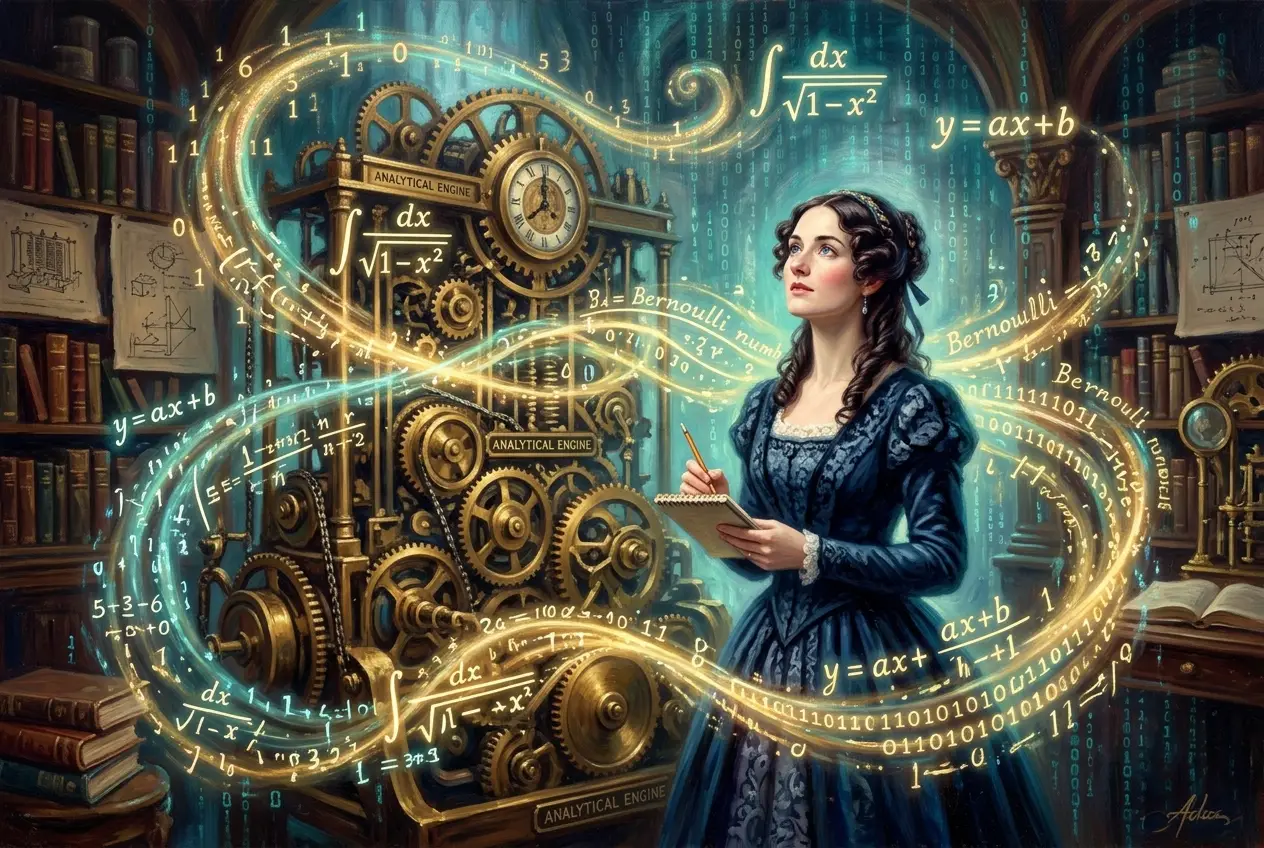
I remember a conversation I had once about the sheer audacity of vision. We were discussing the inventors and thinkers who didn't just see the next step, but leapt generations ahead, glimpsing a future almost unimaginable to their contemporaries. Few figures in history embody this leap quite like Ada Lovelace. In an age dominated by steam power and intricate clockwork, she didn't just observe a mechanical calculator; she envisioned the very bedrock of modern computing – the idea that machines could do more than just arithmetic. She saw the algorithms, the symbolic manipulation, the potential for a "poetical science" that could weave together logic and imagination. This isn't just a story about a brilliant mathematician; it's a deep dive into the mind of a woman who, in 1843, saw the digital age before electricity was even widely harnessed. This is going to be a very long blog, exploring the depths of her remarkable life, her revolutionary insights, and the enduring legacy she left on a world she helped to conceptualize.
The Enigmatic Visionary: A Glimpse of the Digital Dawn
Imagine a world devoid of computers, smartphones, and the internet. A world where "calculation" meant laborious manual arithmetic or the clunking gears of a specialized machine. Into this world, in the early 19th century, stepped Augusta Ada Byron, later Countess of Lovelace. Born into an era that barely conceived of automated processes beyond mechanical looms, she possessed a mind that soared beyond simple numbers. She saw patterns, relationships, and the abstract potential of symbolic logic. While her contemporary, Charles Babbage, meticulously engineered the hardware, Lovelace grasped the software – the instructions, the algorithms, the very language that would bring such a machine to life.
Her insights, penned in obscure footnotes to a translated article, lay dormant for decades, only to be rediscovered and celebrated as the foundational principles of computer programming. How did a woman born into Victorian aristocracy, constrained by the societal norms of her time, manage to achieve such a profound foresight? Her story is a tapestry woven with genius, privilege, struggle, and an unwavering intellectual curiosity that defied convention.
Born to Brilliance and Byron's Shadow: A Tumultuous Start
Ada Lovelace's life began under the dramatic shadow of one of English literature's most tempestuous figures: her father, Lord Byron. Born on December 10, 1815, Augusta Ada Byron was the only legitimate child of the renowned Romantic poet George Gordon Byron, 6th Baron Byron, and Anne Isabella Milbanke, Baroness Byron (affectionately known as "Annabella"). Their marriage was famously short-lived and turbulent. Just five weeks after Ada's birth, Lady Byron separated from Lord Byron, taking their infant daughter with her. Lord Byron himself left England forever a few months later, never to see his daughter again. He died when Ada was just eight years old.
Lady Byron, a highly intelligent and educated woman, was deeply scarred by her marriage to Byron. Fearing that Ada might inherit her father's perceived "poetical madness" and erratic temperament, she deliberately steered her daughter's education away from the arts and humanities, instead emphasizing a rigorous curriculum in science, logic, and mathematics. This decision, driven by a desire to counteract any Byronic tendencies, inadvertently forged the very analytical mind that would later become Ada's hallmark.
An Unconventional Upbringing for a Victorian Lady
Victorian society rarely encouraged intellectual pursuits for women, especially not in the "masculine" fields of mathematics and science. However, Lady Byron, with her own formidable intellect and social standing, ensured Ada received an education far superior to that of most young women of her era. From a young age, Ada was tutored by a series of governesses and private instructors. She showed an early aptitude for languages, music, and, crucially, numbers.
Her health, however, was often fragile. At the age of seven, she suffered from a paralyzing illness that kept her bedridden for nearly a year. Later, at fourteen, she contracted measles, which resulted in prolonged periods of illness and convalescence. These periods of isolation, while physically challenging, provided her with ample time for reading, reflection, and focused study, further cultivating her profound intellectual world.
A Mathematical Mind Blossoms: Mentors and Milestones
Ada's inherent aptitude for mathematics truly began to blossom in her teenage years. Her mother diligently sought out the best available tutors, leading Ada to connect with several influential figures who recognized and nurtured her burgeoning genius. One of the most significant was Mary Somerville, a Scottish polymath, astronomer, and mathematician, and one of the few prominent female scientists of her time. Somerville became a close friend and mentor, encouraging Ada's studies and introducing her to advanced mathematical concepts and the leading scientific minds of the day.
Early Explorations into Logic and Mechanics
Even as a young girl, Ada demonstrated a keen interest in mechanics and technology. She would meticulously study the diagrams of new inventions, and I read about how she once designed a theoretical flying machine, illustrating it with intricate sketches. This blend of abstract thought and practical application would become a defining characteristic of her later work.
Under Somerville's guidance, Ada delved deeper into the complexities of algebra, geometry, and calculus. She corresponded regularly with prominent mathematicians like Augustus De Morgan, a professor at University College London, who, despite initially expressing reservations about a woman's capacity for higher mathematics, was eventually impressed by Ada's intellect and understanding. De Morgan's letters provide a fascinating glimpse into her intellectual development, noting her extraordinary ability to grasp abstract principles and her "singular power of looking into the not-seen connection of things." This ability to perceive underlying structures and connections would prove crucial to her groundbreaking work.
Meeting the "Father of the Computer": Charles Babbage
The pivotal moment in Ada Lovelace's life, the one that would forever etch her name into the annals of technological history, occurred in June 1833. She was just 17 years old when she attended a soirée hosted by her mentor, Mary Somerville. It was there that she was introduced to Charles Babbage, a brilliant, eccentric, and perpetually frustrated mathematician, inventor, and mechanical engineer. Babbage was already renowned for his ambitious, albeit largely unfinished, project: the Difference Engine.
The Difference Engine: A Mechanical Calculator
The Difference Engine was a colossal, brass and steel machine designed to automatically calculate mathematical tables, such as logarithms and astronomical data, eliminating human error. When Babbage demonstrated a portion of his Difference Engine to the assembled guests, most were simply awestruck by its mechanical complexity. Ada, however, saw something more profound. She was captivated by its precision and the underlying logic of its operation. I imagine her eyes gleaming, not just at the gears and levers, but at the conceptual elegance of its design.
This initial encounter sparked an immediate intellectual connection between the young Ada and the much older Babbage. He was impressed by her quick understanding and enthusiastic grasp of his complex ideas, a stark contrast to the general public's often superficial interest. A friendship quickly blossomed, founded on their shared passion for mathematics and the potential of mechanical computation.
The Analytical Engine: A Machine Beyond its Time
While the Difference Engine was an impressive mechanical calculator, Babbage's mind had already moved on to a far more ambitious and revolutionary concept: the Analytical Engine. This machine, designed in the 1830s, was not merely an advanced calculator; it was, in essence, the conceptual blueprint for the first general-purpose computer.
Babbage's Radical Vision: Mill, Store, and Beyond
The Analytical Engine incorporated several key features that are fundamental to modern computers:
- The "Mill": This was the arithmetic logic unit (ALU), capable of performing basic arithmetic operations.
- The "Store": This functioned as the machine's memory, holding numbers and intermediate results.
- Input/Output: Data and instructions were to be fed into the machine via punched cards, a technology borrowed from Joseph Marie Jacquard's automated looms.
- Control Unit: A mechanism to sequence operations.
What made the Analytical Engine truly revolutionary was its programmability. Unlike the Difference Engine, which was designed for a specific set of calculations, the Analytical Engine could be instructed to perform any sequence of operations, making it a universal machine. It was this aspect, above all, that captured Ada Lovelace's imagination. She recognized that this machine was not just a number-cruncher, but a manipulator of symbols, capable of abstract thought.
Despite Babbage's tireless efforts and numerous designs, the Analytical Engine was never fully built during his lifetime, primarily due to financial constraints and the limitations of Victorian-era manufacturing. However, its theoretical design was decades, if not a century, ahead of its time.
Lovelace's Magnum Opus: Translating and Elaborating Menabrea's Sketch
The stage was set for Ada Lovelace's most significant contribution. In 1842, Luigi Federico Menabrea, an Italian mathematician and engineer, published a paper in French titled "Notions sur la machine analytique de Charles Babbage" (Elements of Charles Babbage's Analytical Machine). This paper, based on lectures Babbage had given in Turin, provided a concise description of the Analytical Engine's principles.
More Than a Translation: The Birth of the "Notes"
Babbage himself suggested that Ada translate Menabrea's paper into English. It was a task she readily accepted, driven by her deep understanding of the machine and her intellectual camaraderie with Babbage. However, her work quickly transcended a mere translation. She not only rendered Menabrea's text into English but also appended her own extensive "Notes" – a collection of seven detailed annotations that ultimately proved to be three times longer than the original article.
These "Notes," published in 1843 under the initials "A.A.L." (Augusta Ada Lovelace), were where her true genius shone. They went far beyond explaining Babbage's machine; they explored its profound theoretical implications, its potential, and its limitations with unparalleled clarity and foresight. I often think about the sheer intellectual horsepower it must have taken for her to articulate these concepts so eloquently in an age that had no reference point for them.
The First Computer Program: A Leap into the Abstract
Ada Lovelace's "Notes" are legendary primarily because they contain what is widely considered the world's first computer program – an algorithm designed specifically for Babbage's Analytical Engine to calculate a sequence of Bernoulli numbers. This was not merely a set of instructions for a single calculation, but a complex sequence of operations, demonstrating principles that are now fundamental to programming.
Deconstructing the Bernoulli Number Algorithm: A Glimpse into the First Code
In Note G of her paper, Lovelace meticulously detailed a step-by-step method for the Analytical Engine to compute Bernoulli numbers. This algorithm involved:
- Variables and Storage: How the machine would hold values.
- Operations: The sequence of additions, subtractions, multiplications, and divisions.
- Looping: The repetition of certain steps, a core concept in programming.
- Conditional Branching: The idea that the machine's actions could depend on intermediate results.
This was revolutionary because it moved beyond simple, linear calculations. It outlined a dynamic process where the machine's state changed based on its previous computations, a hallmark of modern programmable systems.
Table: Simplified Flow for Calculating Bernoulli Numbers (Lovelace's Concept)
| Step No. | Operation | Description |
|---|---|---|
| 1 | Initialize Variables | Set up starting values (e.g., n=1, B=1, etc.) |
| 2 | Check Loop Condition | Determine if further calculation is needed based on 'n' |
| 3 | Perform Calculation | Apply Bernoulli number formula, involving multiplication, division. |
| 4 | Store Intermediate | Save results in the "Store" (memory). |
| 5 | Update Variables | Increment 'n' or other control variables. |
| 6 | Repeat or Exit | Go back to Step 2 if condition met, or halt. |
You can read more about Bernoulli numbers on their Wikipedia page: Bernoulli number - Wikipedia (opens in a new tab).
Beyond Calculation: The Essence of Computation
Crucially, Lovelace understood the distinction between a machine that merely calculates and one that computes. A calculator executes fixed operations; a computer, as envisioned by Lovelace, could follow a program to perform a vast array of tasks. She articulated that the Analytical Engine "might act upon other things besides number, were objects found whose mutual fundamental relations could be expressed by those of the abstract science of operations, and which should be also susceptible of adaptations to the action of the operating notation and mechanism of the engine." This profound statement reveals her understanding that the machine could manipulate symbols, not just quantities.
Beyond Numbers: The Vision of a Universal Machine
This distinction, the idea that the Analytical Engine could process "other things besides number," is perhaps Lovelace's most breathtaking insight. While Babbage was primarily focused on automating mathematical tables, Lovelace saw a far broader potential. She imagined a machine that could:
- Compose complex pieces of music: By manipulating notes and harmonies according to algorithmic rules.
- Create intricate graphical patterns: By processing symbolic representations of visual elements.
- Generate scientific models and theories: By analyzing and synthesizing data.
The "Poetical Science" – Bridging Art and Algorithm
Lovelace referred to her approach as "poetical science." This wasn't merely a whimsical phrase; it encapsulated her belief in the symbiotic relationship between rigorous logic and imaginative creativity. She saw the machine as a tool to expand human intellect and artistic expression, not just to mechanize rote tasks. This vision aligns uncannily with modern applications of computing, from generative AI art to complex scientific simulations.
Her notes included the assertion that "the Analytical Engine has no pretensions whatever to originate anything. It can do whatever we know how to order it to perform." While this is often cited as a limitation (and indeed, a point of debate in AI consciousness discussions), it also underscores her understanding that the machine's power lay in its ability to execute intricate human-designed logic, opening up possibilities that human hands or minds could not achieve at scale.
The Interpreter: A Bridge Between Babbage's Design and Public Understanding
Lovelace's role extended beyond that of a mere programmer. She acted as a vital interpreter, bridging the gap between Babbage's complex engineering designs and the wider intellectual community. Babbage, for all his genius, was not always the most effective communicator of his own ideas. His designs were intricate, and his explanations could be dense.
Ada, with her elegant prose and clear logical exposition, translated these concepts into an understandable framework. Her "Notes" became the most comprehensive and articulate public description of the Analytical Engine available at the time. She didn't just understand the machine; she understood how to make others understand it, a crucial step in the diffusion of any groundbreaking technological concept. Their intellectual partnership, while often debated in terms of the exact extent of her independent invention versus Babbage's influence, was undeniably symbiotic. Babbage provided the raw mechanical genius; Lovelace provided the philosophical and algorithmic vision.
Personal Life, Struggles, and Ambitions
Away from the gears and algorithms, Ada Lovelace led a complex personal life, marked by both privilege and personal challenges. In 1835, she married William King, 8th Baron King, who was later created Earl of Lovelace. Through this marriage, she became Augusta Ada King, Countess of Lovelace. She bore three children: Byron (b. 1836), Anne Isabella (b. 1837), and Ralph Gordon (b. 1839).
Motherhood, Society, and Intellectual Pursuits
Despite her domestic responsibilities and the expectations placed upon a woman of her aristocratic standing, Ada continued her intellectual pursuits. Her husband, Lord Lovelace, was largely supportive of her scientific interests, allowing her to pursue her studies and correspond with leading thinkers. However, balancing her passions with her role as a wife and mother was undoubtedly a challenge, a struggle many brilliant women have faced throughout history.
Ada's ambition wasn't limited to theoretical mathematics. She also dabbled in practical applications and, famously, ventured into developing a mathematical system for betting on horse races. This endeavor, born from a desire to fund Babbage's Analytical Engine and perhaps driven by her own intellectual curiosity about probability, ultimately led to significant financial difficulties. This period highlights a more human, fallible side to her genius, demonstrating that even the most brilliant minds can face practical setbacks.
Gender and Genius in the Victorian Era
Ada Lovelace's achievements are all the more remarkable when viewed through the lens of Victorian society. For women, higher education and professional scientific careers were largely inaccessible. Expectations were centered around domesticity, motherhood, and social graces. That Ada not only pursued advanced mathematics but made such a groundbreaking conceptual leap stands as a testament to her extraordinary intellect and determination.
Navigating Societal Barriers
She navigated these societal barriers with the help of her privileged background and the support of key figures like her mother and Mary Somerville. Her status as a countess likely afforded her a degree of intellectual freedom and access to influential circles that would have been denied to women of lower social standing. Yet, even with these advantages, she still faced implicit biases. Augustus De Morgan's initial skepticism, despite his eventual admiration, is a clear example of the prevailing attitudes.
Lovelace's story is an inspiring example of a woman who defied the limitations of her era, demonstrating that intellectual capacity knows no gender. Her legacy continues to empower women in STEM fields today.
The Legacy Unfolding: Recognition in the 20th Century
Despite the profound insights contained within her "Notes," Ada Lovelace's work largely faded into obscurity after its publication. The Analytical Engine itself was never built, and the concepts she articulated were so far ahead of their time that few could fully appreciate their significance. For decades, her contributions remained a footnote in the history of mathematics, if remembered at all.
The Rediscovery and the Dawn of Electronic Computing
It wasn't until the mid-20th century, with the actual advent of electronic computers, that Lovelace's work began to receive the recognition it deserved. As engineers and scientists grappled with the fundamental principles of programming and machine logic, they looked back at Babbage's designs and, crucially, at Lovelace's "Notes."
One key figure in this rediscovery was B.V. Bowden, who republished her "Notes" in 1953 in his book "Faster Than Thought: A Symposium on Digital Computing Machines." This brought her work to a new generation of computer scientists, who were astonished by her foresight. They realized that Lovelace had articulated concepts like subroutines, looping, and conditional jumps decades before their practical implementation.
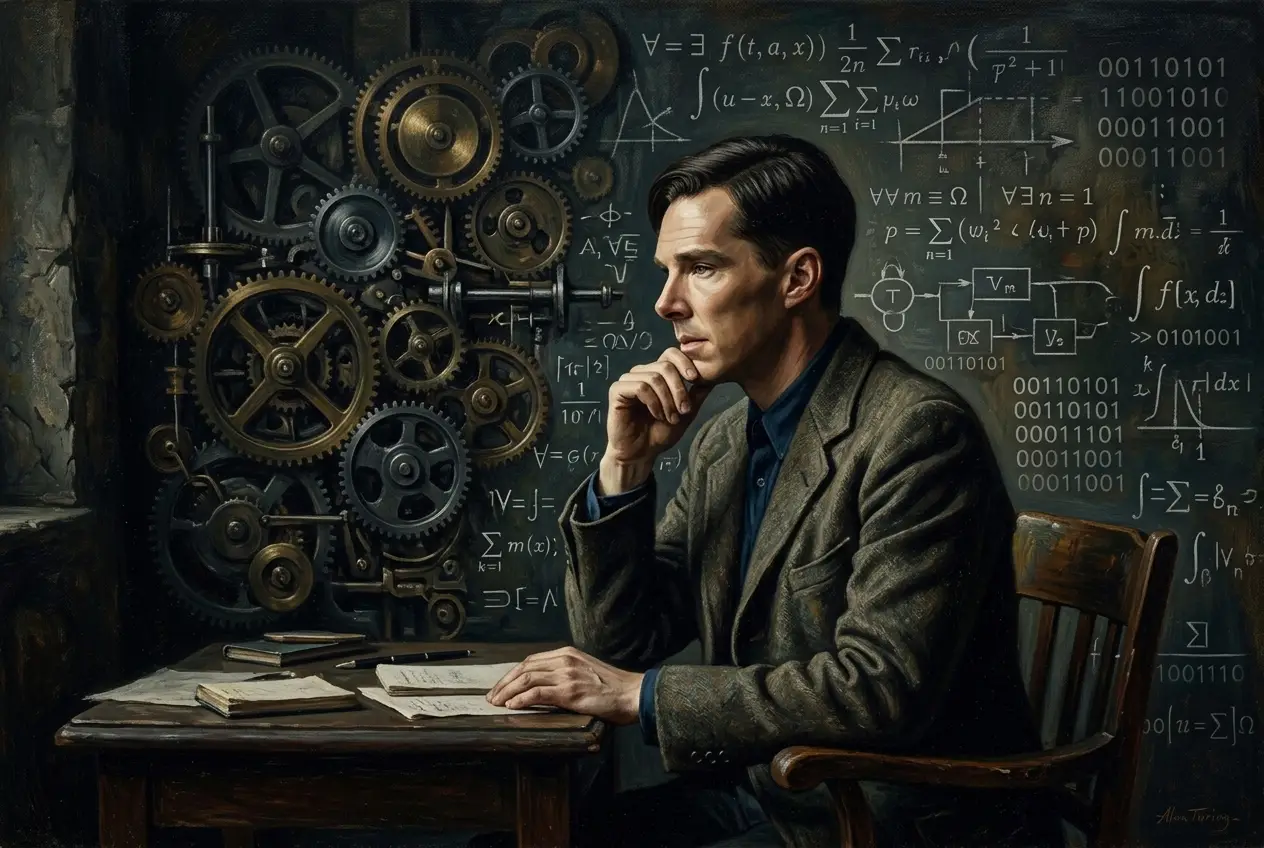
The work of pioneers like Alan Turing, who developed the theoretical foundations of modern computing, further highlighted the parallels with Lovelace's earlier conceptualizations of a universal machine. While Turing's work was independent, the underlying logical principles resonated with Lovelace's abstract vision. If you're curious about other foundational figures in computing, I highly recommend checking out our blog on Alan Turing: Alan Turing: The Enigma Who Wired Our Digital Future (opens in a new tab).
The Ada Programming Language: A Lasting Tribute
In a fitting tribute to her pioneering vision, a modern, high-level programming language was named "Ada" in her honor. This occurred in the late 1970s, when the United States Department of Defense initiated a project to develop a standardized, robust programming language for its embedded computer systems.
Designing for Reliability and Precision
The goal was to create a language that was highly reliable, efficient, and suitable for critical applications where errors could have severe consequences – systems like air traffic control, missile guidance, and space exploration. The development effort, led by a team at Honeywell Bull in France, resulted in a language that emphasized strong typing, modularity, and explicit concurrency.
In 1979, the language was officially named Ada. It was adopted as a military standard (MIL-STD-1815) in 1983, with the standard number 1815 chosen to commemorate Ada Lovelace's birth year. Ada became widely used in military, aerospace, and commercial applications requiring extreme reliability and safety. Its design principles, emphasizing clarity and error prevention, echo Lovelace's meticulous approach to logical structures. More information about the Ada programming language can be found here: Ada (programming language) - Wikipedia (opens in a new tab).
Impact on Modern Computing and AI
Ada Lovelace's influence extends far beyond a historical footnote or a namesake programming language. Her conceptual framework for software, her understanding of the abstract nature of computation, and her vision of a universal machine profoundly shaped the philosophy of computer science.
Foreshadowing Artificial Intelligence
Perhaps her most prescient insight was her understanding that machines could process more than just numbers. Her "Notes" contain the seeds of what we now call artificial intelligence. While she stated the Analytical Engine could not "originate anything" or "think," she opened the door to the idea of machines performing complex, symbol-manipulating tasks that mimic aspects of human intelligence. This foundational idea – that machines could follow algorithms to generate music, art, or even complex logical arguments – is a cornerstone of modern AI.
The debate about whether machines can "think" or "create" still rages today, echoing Lovelace's early discussions. Her assertion that machines perform what we order them to perform highlights the distinction between computation and true consciousness, a distinction still relevant in our conversations about advanced AI. For more on AI's creative potential, you might like our blog: Can AI Design Its Own Evolution? Decoding Future Machines (opens in a new tab).
Unanswered Questions and Enduring Myths
Like many historical figures whose work was rediscovered long after their time, Ada Lovelace is surrounded by certain myths and ongoing debates.
The Extent of Originality
One persistent question revolves around the exact extent of her independent invention versus Babbage's influence. While Babbage certainly laid the mechanical groundwork and developed the core concept of the Analytical Engine, it was Lovelace who meticulously detailed the algorithmic steps and articulated the broader philosophical implications of general-purpose computing. The consensus among historians of computing is that her contributions were genuinely original and visionary, extending Babbage's mechanical genius into the realm of abstract software principles.
The "Gambling System" and Financial Woes
Her involvement in a complex mathematical system for betting on horse races, which ultimately led to significant debt, is another aspect of her life that sometimes sparks curiosity. While it might seem a frivolous pursuit for a brilliant mind, it reflects her relentless desire to apply mathematical models to real-world problems and, for a time, her hope to fund Babbage's ambitious projects. It's a reminder that even profound intellects are human, with their own struggles and misjudgments.
A Modern Icon: Inspiring Future Generations
Today, Ada Lovelace is recognized globally as an icon for women in science, technology, engineering, and mathematics (STEM). Her story serves as a powerful reminder of the untapped potential that can be unleashed when societal barriers are challenged.
Ada Lovelace Day
Since 2009, "Ada Lovelace Day" has been celebrated annually on the second Tuesday of October. This international day of celebration aims to raise the profile of women in STEM by highlighting their achievements and inspiring more girls and women to pursue careers in these fields. It's a testament to her enduring legacy that she continues to be a symbol of innovation and intellectual courage.
Her relevance in the age of advanced AI, quantum computing, and complex algorithms is undeniable. Her initial leap from "numbers" to "symbols" underpins almost every digital interaction we have today. She challenged the prevailing notions of what machines could do, and in doing so, helped lay the intellectual foundation for our hyper-connected, technologically advanced world.
You can learn more about Ada Lovelace on her Wikipedia page: Ada Lovelace - Wikipedia (opens in a new tab). For a broader perspective on the history of computing, the Wikipedia page for the Analytical Engine is also excellent: Analytical Engine - Wikipedia (opens in a new tab).
Conclusion: The Enchantress of Numbers
Ada Lovelace, the "Enchantress of Numbers," as Charles Babbage himself called her, was a woman who lived a life as rich in intellect as it was in personal challenge. She stood at the precipice of a technological revolution, not merely observing it, but actively shaping its conceptual future. Her "Notes" on Babbage's Analytical Engine were far more than a translation; they were a manifesto for modern computing, articulating the profound idea that machines could process abstract symbols and follow algorithms to perform tasks limited only by human ingenuity.
Her vision of a "poetical science," where logic and imagination intertwine, remains incredibly relevant in an era grappling with the ethical and creative implications of artificial intelligence. Lovelace's legacy reminds us that true innovation often comes from seeing beyond the immediate, from grasping the abstract potential hidden within the tangible. She didn't just understand Babbage's machine; she saw the digital universe it could unleash. As we continue to push the boundaries of technology, we owe a debt of gratitude to the woman who, over a century and a half ago, helped code the very future we now inhabit.




Conversation0
No comments yet. Be the first to share a thought — the best questions often become new stories.