


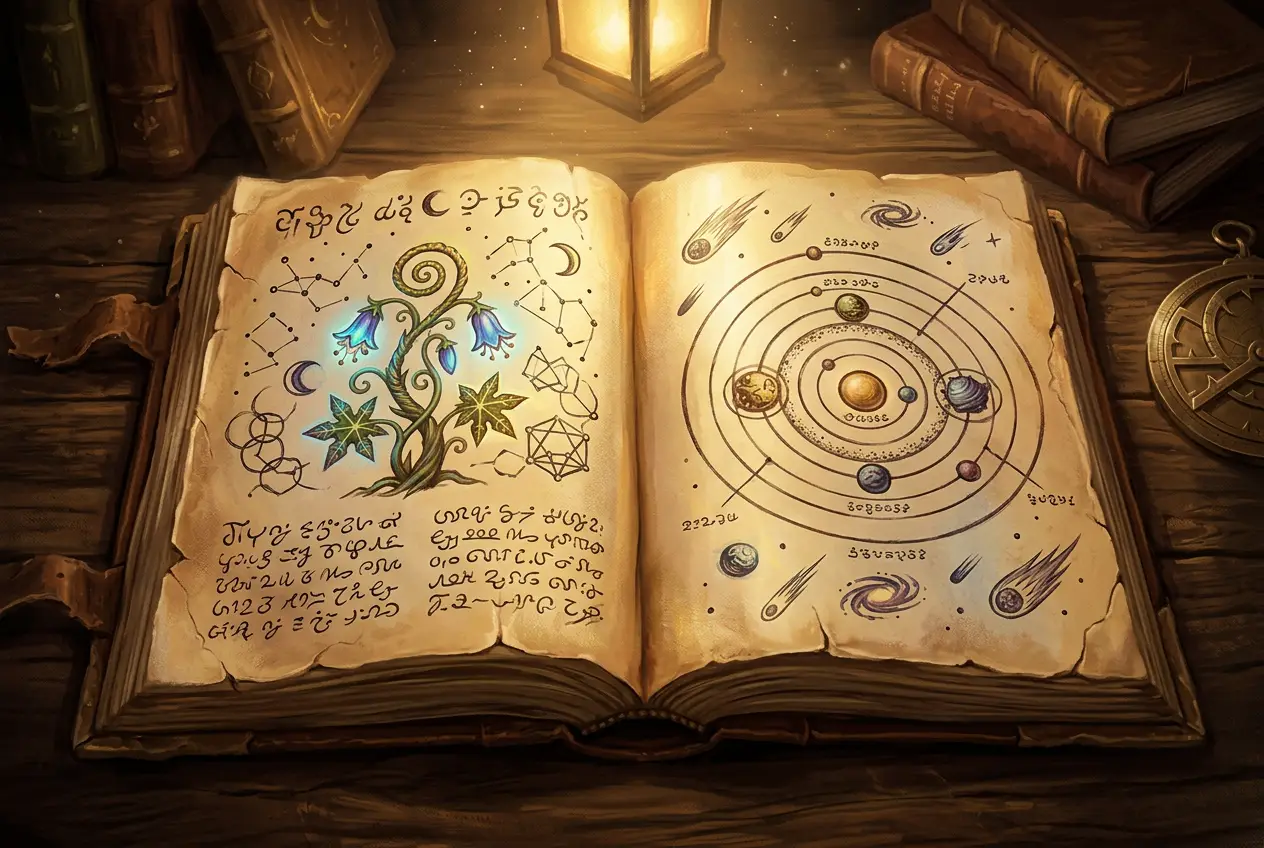
I remember the first time I stumbled upon images from the Voynich Manuscript. It wasn't a casual scroll through a history website; it felt more like peering into a forbidden library, a vault of forgotten knowledge. The pages were adorned with exquisite, yet utterly alien, illustrations of flora that defy botanical classification, astronomical charts unlike any known, and bizarre human-like figures engaged in mysterious rituals. But what truly held me captive was the text itself: thousands of elegant, flowing characters forming words and sentences, all completely indecipherable. No one, not cryptographers, linguists, or historians, has ever definitively cracked its code.
This isn't just an old book; it's arguably humanity's most enigmatic text, a silent challenge that has baffled the sharpest minds for centuries. Was it written by a forgotten genius, a medieval prankster, or perhaps, as some wild theories suggest, a visitor from another world, leaving behind a cosmic Rosetta Stone? Let’s dive deep into the layers of mystery surrounding the Voynich Manuscript and explore why it continues to ignite our curiosity.
The Manuscript's Strange Journey Through Time
The Voynich Manuscript isn't a new discovery. Its known history stretches back at least to the early 17th century, where it surfaced in the court of Emperor Rudolf II of Bohemia, a notorious collector of oddities and esoterica. Passed from hand to hand among European scholars and alchemists, it remained a puzzle, a beautiful but unyielding enigma. It finally landed in the hands of Wilfrid Voynich, a Polish book dealer, in 1912, who acquired it from a Jesuit college in Italy. He introduced it to the world, and thus, it bears his name.
The book itself is a small, unassuming tome, roughly 23.5 by 16 centimeters, composed of vellum pages. Its age has been determined through radiocarbon dating to be between 1404 and 1438 AD, placing it squarely in the European late medieval or early Renaissance period. This makes it an artifact of an era teeming with intellectual ferment, yet also ripe for mystification and secret knowledge. For further fascinating insights into ancient coding, you might be interested in how the Phaistos Disc: Ancient Data or Lost Code? similarly challenges our understanding.
A Language Without a Key: The Cryptographic Conundrum
At its core, the Voynich Manuscript is a cryptographic nightmare. Imagine receiving a letter, perfectly legible, grammatically structured, but written in characters you've never seen, forming words that don't exist in any dictionary. That's the Voynich. Its script features around 20-30 unique characters, some resembling Latin or Greek letters, others entirely unique.
Countless attempts have been made to decipher it, ranging from brute-force frequency analysis, common for breaking historical ciphers, to sophisticated computational linguistics. Yet, every single effort has failed. This isn't for lack of trying; some of the greatest minds in cryptology, including those who broke wartime codes during both World Wars, have dedicated years to the task.
Here's why it's so perplexing:
- Statistical Regularities: The text exhibits statistical patterns similar to natural languages. Words appear to follow certain distributions, lengths, and repetitions, suggesting it's not random gibberish. However, the distribution of letters is unusual.
- No Known Alphabet: The script does not correspond to any known alphabet or syllabary, making it impossible to substitute characters with known letters.
- Too Complex for Simple Ciphers: If it were a simple substitution cipher, frequency analysis would have cracked it decades ago. If it were a more complex polyalphabetic cipher (like the Vigenère cipher), modern computational power should have made headway.
- Potential Obfuscation: Some theorize it might be a steganographic text, where the real message is hidden within an innocuous cover text, or that it uses a highly complex code where only certain characters are meaningful.
This cryptographic deadlock fuels the theories: if it's not a known language or a standard cipher, what is it? It makes you wonder about other historical data encoding methods, like those discussed in Quipu: Did Inca Knots Encode Cosmic Data?.
The Illustrations: A Window to an Unknown World
Beyond the text, the illustrations are a major source of intrigue. They are meticulously drawn, full of vibrant colors and intricate details, and provide some clues (and more questions) about the manuscript's content. The manuscript is generally divided into several sections based on these illustrations:
- Herbal Section: Dominating the book, this section contains drawings of hundreds of plants. The problem? Most of these plants don't match any known species on Earth, or they appear to be composites of different plants. Are they fictional, extinct, or perhaps from another world?
- Astronomical Section: Features diagrams of celestial bodies, suns, moons, and stars, often arranged in intricate patterns that don't always align with medieval astronomy. Some diagrams include zodiacal symbols and what appear to be cosmological maps.
- Biological Section: Contains numerous small, naked female figures, often depicted in or around pools and intricate plumbing systems. These illustrations are perhaps the most unsettling and hard to interpret, suggesting bathing rituals, internal anatomy, or even astrological influences on the human body.
- Cosmological Section: Large, fold-out pages reveal complex diagrams and maps, some showing castle-like structures, others depicting circular forms that could be cities or cosmic arrangements.
- Pharmaceutical Section: Drawings of individual plant parts and what seem to be apothecaries' jars, hinting at medicinal recipes or botanical remedies.
- Recipes Section: Denser blocks of text with small, star-like symbols, possibly containing instructions or lists.
The bizarre nature of these illustrations, especially the unidentifiable plants, has led some to speculate that the author possessed knowledge far beyond their time, perhaps even knowledge from non-human sources. It makes us rethink what we consider "impossible artifacts," similar to the discussion in Impossible Artifacts: Clues to Lost Ancient Tech?.
Theories: From Hoax to Extraterrestrial Guidebook
Theories about the Voynich Manuscript are as diverse and captivating as its contents. They broadly fall into a few main categories:
The Hoax Theory
One of the most persistent theories is that the Voynich Manuscript is an elaborate hoax. This suggests that someone—perhaps a brilliant prankster or a con artist—created the book with no meaningful content, solely to defraud a wealthy collector. The high quality of the vellum and the detailed illustrations, however, make this a very costly and time-consuming prank. If it were a hoax, it would be arguably one of the most sophisticated in history. Some skeptics suggest the text is "gibberish" or glossolalia (speaking in tongues), perhaps written by someone with a mental illness. Yet, the statistical regularities of the text often challenge this idea.
Hidden Language or Code
This is the most scientifically favored approach. Many believe the manuscript is written in a lost or invented language, a complex cipher, or a micrographic script (tiny hidden symbols within symbols).
- Stenography/Steganography: The idea that the actual message is hidden within visible features, like specific patterns or variations in letter strokes.
- Artificial Language: A language invented from scratch, perhaps for a secret society or a philosophical experiment, much like later attempts at universal languages.
- Medical/Botanical Compendium: Despite the strange illustrations, it could be a highly specialized book on medieval medicine or botany, perhaps written by someone trying to protect their intellectual property with an unbreakable code.
Lost Knowledge and Ancient Wisdom
This theory posits that the manuscript contains genuine, profound knowledge that was either suppressed, forgotten, or simply too far ahead of its time. Could it be a treatise on alchemy, astronomy, or an unknown branch of science? The "herbal" section, in particular, suggests a deep but unconventional understanding of botany, possibly even predating modern classification systems.
The Extraterrestrial Connection: An Alien Rosetta Stone?
This is where the true "Curiosity Diaries" spirit shines. Given the unidentifiable plants, the unusual astronomical charts, and the utterly alien language, some have dared to ask: Could the Voynich Manuscript be a document of extraterrestrial origin or influence?
Imagine a scenario where:
- An ancient civilization had contact with non-human intelligence, and the manuscript is a record of that interaction or a piece of technology/knowledge shared.
- The plants are not from Earth, and the astronomical charts depict celestial bodies or phenomena unknown to medieval terrestrial astronomers.
- The language itself is not human, but an attempt by a human to record an alien script or a coded message for future generations who might develop the tools to understand it.
This theory, while speculative, gains traction precisely because all conventional explanations have failed. If it defies human understanding and human language, then perhaps its origins are not entirely human. It sparks the imagination, prompting us to consider the vastness of the cosmos and the possibility of other intelligences. What if, like the complex information possibly encoded in Did Prehistoric Art Code Cosmic Secrets?, this manuscript holds far greater secrets?
The Quest for Decipherment: Modern Approaches and Future Hopes
The digital age has brought new hope to the Voynich puzzle. With advanced computational tools, AI, and big data analysis, cryptographers are tackling the manuscript with unprecedented power.
- Statistical Analysis: Modern computer programs can meticulously analyze letter and word frequencies, patterns, and distributions far beyond what human cryptographers could do manually.
- Artificial Intelligence and Machine Learning: AI algorithms are being trained on vast corpora of historical languages and ciphers to look for patterns that might escape human detection. The hope is that AI could potentially identify a deep structure or a hidden linguistic link, perhaps even helping us to Can AI Unlock Ancient Lost Languages?.
- Linguistic Signatures: Researchers are looking for unique linguistic fingerprints. For instance, some studies suggest certain words consistently appear at the beginning of sections, or that there are patterns in word length similar to a natural language, just one we haven't encountered.
Despite these advancements, the Voynich remains unbroken. This continued resistance only deepens the mystery and reinforces its status as one of the world's greatest enduring anomalies.
My Thoughts: A Persistent Echo of Curiosity
I believe the Voynich Manuscript serves as a powerful reminder of humanity's endless curiosity and our relentless drive to decipher the unknown. Whether it's a clever medieval joke, a lost scientific text, or something truly extraordinary, its mere existence forces us to confront the limits of our knowledge.
Perhaps the true value of the Voynich isn't in its decipherment, but in its ability to spark our imagination, to make us question the boundaries of history, science, and even reality itself. It stands as a silent monument to what we don't know, a beautifully rendered challenge waiting for a mind, or perhaps a technology, capable of unlocking its secrets. Until then, it remains a tantalizing glimpse into an unknown mind, a forgotten world, or maybe, just maybe, an alien perspective.
The quest continues, and with every failed attempt, the mystery only deepens, ensuring the Voynich Manuscript will continue to be a source of wonder and speculation for generations to come.



Conversation0
No comments yet. Be the first to share a thought — the best questions often become new stories.