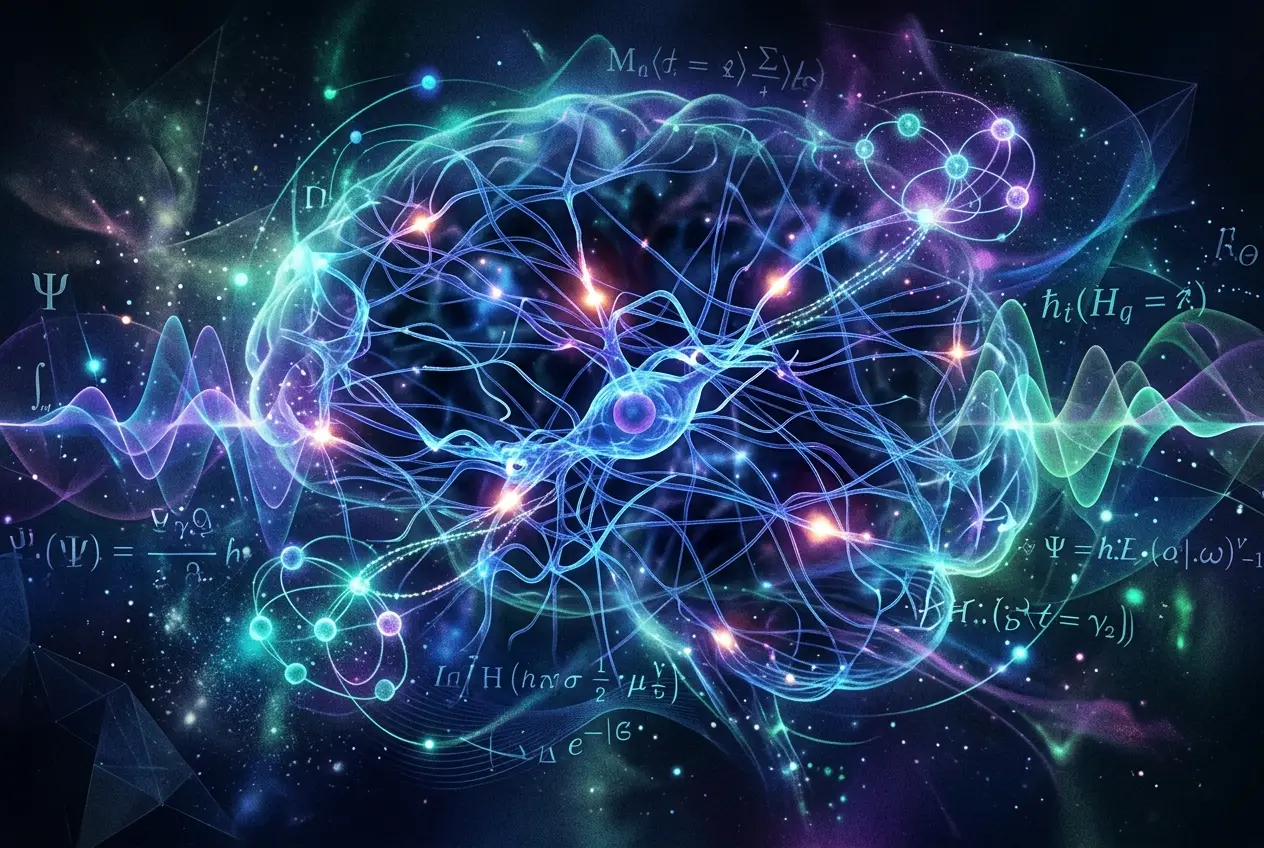
I often find myself pondering the deep questions of existence, like what truly makes us *us*. It's a feeling I'm sure many of you share – that undeniable sense of self, of subjective experience, the "I" that perceives the world. For centuries, philosophers and scientists have grappled with the mystery of consciousness: how does the seemingly mundane grey matter of our brains give rise to such a rich inner world of thoughts, emotions, and awareness? This is famously known as the "hard problem" of consciousness, and it's a puzzle that classical physics has largely failed to solve. But what if the answer isn't in the macroscopic, predictable world we observe every day, but in the bizarre, probabilistic realm of quantum mechanics?
Recently, I delved into the intriguing, often controversial, hypothesis that our consciousness might not just be an emergent property of classical neuronal activity, but deeply interwoven with quantum phenomena. It's a concept that pushes the boundaries of neuroscience, physics, and philosophy, suggesting that the very fabric of our subjective experience could be a quantum tapestry.
## The Enigma of Consciousness: More Than Just Neurons Firing?
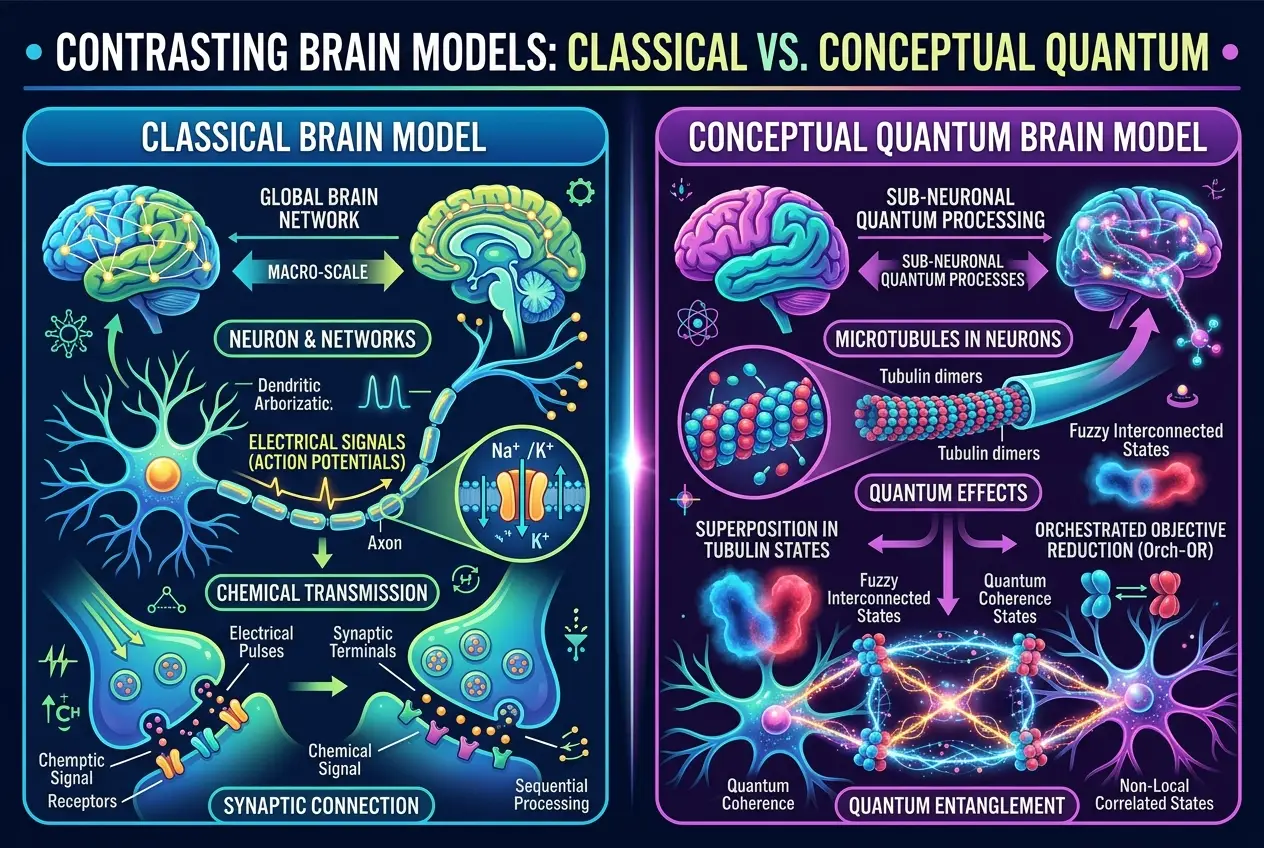
For decades, the dominant scientific view has been that consciousness arises from the complex interactions of billions of neurons firing in our brains. Electrical signals zip across synapses, forming intricate networks that process information, generate thoughts, and ultimately, create our perception of reality. While this model explains many aspects of brain function, from memory to motor control, it struggles to account for the qualitative "feel" of experience – why seeing the color red *feels* red, or why listening to music evokes specific emotions. This is the **"explanatory gap"** that many researchers find unsatisfying.
Think about it: if our brains are just incredibly complex computers running on classical physics, then theoretically, a sophisticated enough AI could perfectly simulate a human brain. But would that AI *feel* anything? Would it *be* conscious in the same way we are? This is where the classical model often hits a wall, prompting some to wonder if something more fundamental, more mysterious, is at play.
## Stepping into the Quantum Realm: A Different Kind of Reality
To understand how quantum mechanics might influence consciousness, we first need a basic grasp of what makes the quantum world so peculiar. Unlike the classical world, where objects have definite positions and momenta, quantum particles exist in states of **superposition**, meaning they can be in multiple states at once until measured. There's also **entanglement**, where two or more particles become linked, sharing the same fate regardless of distance – measure one, and you instantly know the state of the other. And then there's **quantum tunneling**, where a particle can pass through a barrier even if it doesn't have enough energy to go over it. These phenomena are not just theoretical curiosities; they are experimentally verified and form the basis of technologies like quantum computers and lasers.
"If quantum mechanics isn't astounding, you haven't understood it yet." - **Richard Feynman**. This quote perfectly encapsulates the paradigm shift required to consider quantum effects in biology, let alone consciousness. Traditionally, quantum effects were thought to be too fragile and short-lived to survive in the warm, wet, noisy environment of a living cell, including the brain. This belief was largely based on the phenomenon of **decoherence**, where quantum states quickly collapse due to interaction with their environment. However, recent discoveries in **quantum biology** have challenged this assumption.
For instance, quantum coherence has been observed in processes like photosynthesis, where light energy is efficiently harvested, and in the navigation systems of migratory birds, where subtle quantum effects help them sense Earth's magnetic field. If nature can harness quantum mechanics for such intricate biological processes, why not for something as complex as consciousness? You can learn more about quantum biology's fascinating implications on Wikipedia's [Quantum Biology page](https://en.wikipedia.org/wiki/Quantum_biology).
## Orchestrated Objective Reduction (Orch-OR): Penrose and Hameroff's Bold Hypothesis
The most prominent and detailed theory linking quantum mechanics to consciousness is the **Orchestrated Objective Reduction (Orch-OR)** model, proposed by physicist Roger Penrose and anesthesiologist Stuart Hameroff. Their theory suggests that consciousness arises from quantum computations performed in protein structures called **microtubules** within our neurons.
Microtubules are tiny, hollow cylinders found in the cytoskeleton of almost all eukaryotic cells. They play crucial roles in cell structure, transport, and division. Penrose and Hameroff theorize that these microtubules possess a unique crystalline lattice structure that allows for quantum coherence – a state where quantum effects like superposition and entanglement can persist for longer periods.
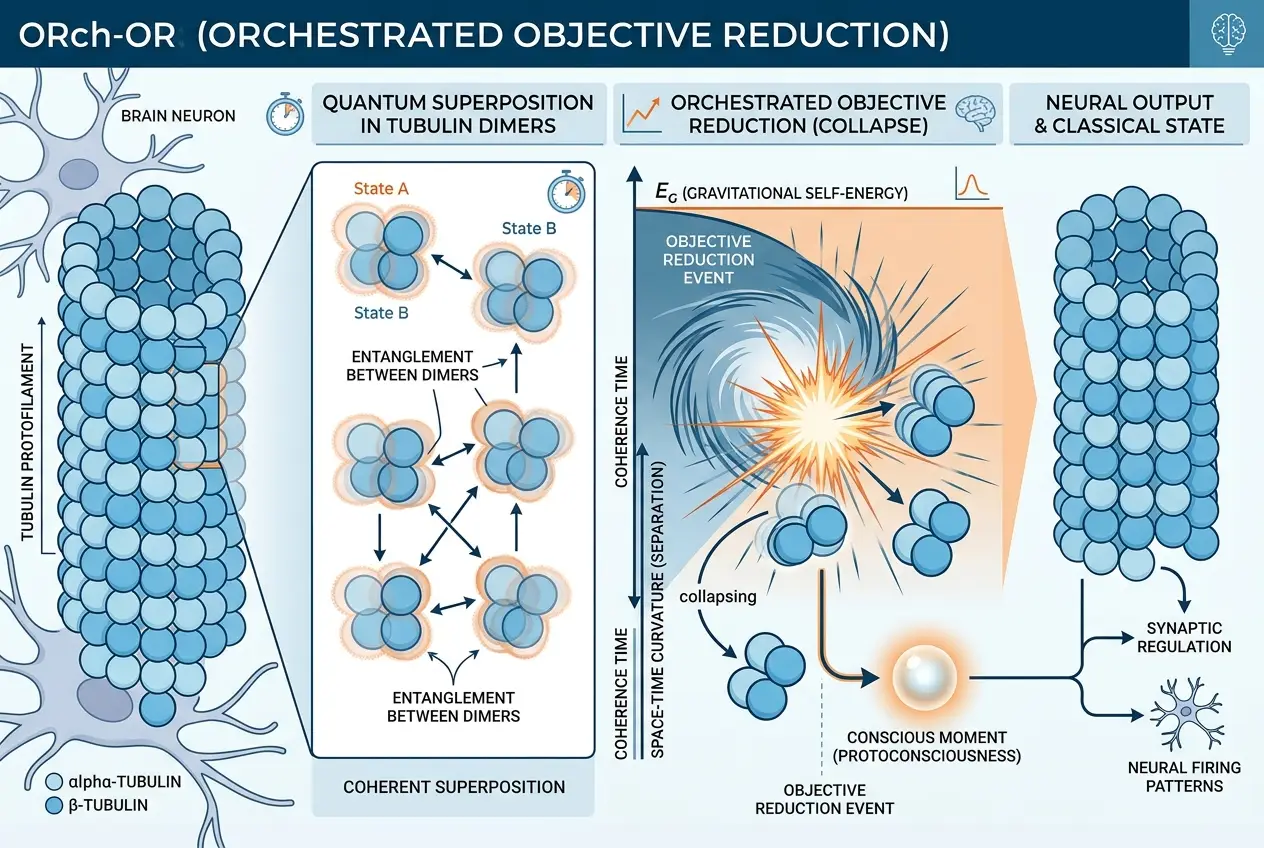
Here's a simplified breakdown of Orch-OR:
1. **Quantum Superposition in Microtubules:** They propose that tubulin proteins within microtubules can exist in a superposition of multiple conformational states simultaneously. These superpositions aren't just isolated events but extend across groups of tubulins.
2. **Orchestration and Entanglement:** These quantum superpositions become entangled, forming a collective quantum state across parts of the microtubule network. This "orchestration" is influenced by synaptic inputs and memory, guiding the quantum processes.
3. **Objective Reduction (OR):** Penrose's contribution, "objective reduction," suggests that spacetime itself has a fundamental "self-collapse" threshold. When a quantum superposition reaches this threshold of objective reality (a specific measure of mass-energy difference over time), it undergoes a spontaneous, non-computable collapse, choosing one definite classical state.
4. **Conscious Moments:** Each objective reduction event, according to Orch-OR, corresponds to a "moment of proto-consciousness." A sequence of these events, orchestrated within the brain's microtubules, gives rise to our continuous stream of consciousness.
This theory implies that consciousness isn't merely a classical computation but involves non-computable quantum processes, potentially explaining the subjective, irreducible nature of our inner experience. For a deeper dive, Wikipedia offers an extensive article on [Orchestrated Objective Reduction](https://en.wikipedia.org/wiki/Orchestrated_objective_reduction).
## The Skeptical Chorus: Debates and Criticisms
As you might imagine, a theory as radical as Orch-OR faces significant skepticism from the mainstream scientific community. The primary objection revolves around **decoherence**. Critics argue that the brain's warm, wet, and incredibly active environment would cause any delicate quantum states within microtubules to decohere almost instantaneously, long before they could contribute to consciousness. The timescale for neuronal activity is milliseconds, while quantum coherence in such an environment is typically thought to last picoseconds or femtoseconds.
Here are some common criticisms:
* **Environmental Noise:** The sheer thermal energy and chaotic interactions within the brain are seen as insurmountable obstacles for maintaining quantum coherence at biological scales.
* **Lack of Direct Evidence:** Despite its detailed nature, direct experimental evidence demonstrating quantum coherence in microtubules on the scales and durations required by Orch-OR is currently lacking.
* **Philosophical Objections:** Some philosophers argue that even if quantum effects are present, they don't necessarily bridge the explanatory gap of consciousness; they merely push the mystery into a different domain.
"There is no mechanism known to science whereby the brain’s microtubules could carry out quantum computation... The brain is too hot, wet, and noisy for anything other than very local, very brief quantum coherence to exist." – **Max Tegmark**, physicist, who performed calculations suggesting decoherence happens too quickly.
However, proponents of Orch-OR counter that microtubules might be specifically structured to shield quantum states from decoherence, or that the mechanisms of decoherence in biological systems are not fully understood. They point to the growing field of quantum biology as evidence that complex biological systems can indeed leverage quantum effects.
## Beyond Orch-OR: Other Quantum Consciousness Ideas
While Orch-OR is the most elaborated theory, it's not the only attempt to connect quantum mechanics and consciousness. Other ideas, though less developed, include:
* **Quantum Brain Dynamics:** Some theories suggest that the entire brain acts as a macroscopic quantum system, with quantum fields playing a role in information processing.
* **Consciousness as Information Collapse:** Inspired by the idea that observation collapses a quantum wave function, some propose that consciousness itself is intimately involved in this collapse process, perhaps even driving it.
* **Weak Quantum Effects:** Even if large-scale quantum coherence isn't happening, subtle quantum effects (like electron tunneling in enzymes or ion channels) could still amplify to influence neuronal firing patterns, subtly shaping our conscious experience. This is a less dramatic but perhaps more plausible scenario.
## The Future of the Mind: What if it's True?
If consciousness indeed has a quantum basis, the implications are profound.
1. **Redefining Intelligence:** Our understanding of artificial intelligence would shift dramatically. Building truly conscious AI might require more than just classical computing power; it might necessitate quantum hardware specifically designed to harness these phenomena. Could it be that our attempts at AGI are missing a fundamental quantum component? This is a discussion explored in our blog on whether AI can truly feel at [Can AI Truly Feel? Decoding Digital Empathy](https://curiositydiaries.com/blogs/can-ai-truly-feel-decoding-digital-empathy-8008).
2. **New Therapies and Insights:** Understanding the quantum underpinnings of consciousness could open doors to revolutionary treatments for neurological and psychological disorders. Imagine therapies that target quantum states within the brain.
3. **Fundamental Reality:** It could fundamentally alter our perception of reality itself, bridging the gap between mind and matter, and perhaps even offering new perspectives on phenomena like free will, intuition, and the nature of self.
4. **Interconnectedness:** If consciousness involves entangled states, it might suggest a deeper interconnectedness of minds or even with the universe's fabric, a concept often explored in our discussions on universal communication, such as in [Is the Universe a Giant Neural Network?](https://curiositydiaries.com/blogs/is-the-universe-a-giant-neural-network-2907).
The journey to unravel the mystery of consciousness is far from over. While the quantum hypothesis remains on the fringes of mainstream neuroscience, it represents a bold attempt to look beyond conventional explanations. As technology advances, allowing us to probe the brain at ever finer scales, we might one day find definitive answers. Until then, the possibility that our very awareness is woven from the strange, beautiful rules of the quantum realm continues to spark my curiosity and reminds me how much more there is to discover about ourselves and the universe.
## The Interplay of Quantum and Mind: A Summary Table
To summarize the key points and contrasting views:
| Feature | Classical View of Consciousness | Quantum View of Consciousness (e.g., Orch-OR) |
| :---------------- | :------------------------------------------------------- | :--------------------------------------------------------------------------- |
| **Basis** | Neuronal firing, synaptic plasticity, complex networks | Quantum coherence/superposition/entanglement in microtubules/sub-neuronal structures |
| **Mechanism** | Information processing via classical electrical/chemical signals | Non-computable objective reduction events, quantum computation |
| **Location** | Entire brain as a network | Microtubules within neurons, distributed across the brain |
| **Core Problem** | Explanatory gap for subjective experience (qualia) | Decoherence in warm, wet biological environment |
| **Implications** | Consciousness as emergent classical property | Consciousness as fundamental, non-computable quantum process |
The path forward will undoubtedly involve interdisciplinary collaboration, combining insights from physics, biology, neuroscience, and philosophy. The question of whether quantum effects influence our consciousness is not just an academic debate; it's a quest to understand the very essence of what it means to be alive and aware.
Frequently Asked Questions
The 'hard problem' refers to the difficulty of explaining how physical processes in the brain give rise to subjective experience, feelings, and sensations (qualia), as opposed to merely explaining brain function and behavior.
Orch-OR is a theory by Roger Penrose and Stuart Hameroff proposing that consciousness arises from quantum computations within microtubules inside neurons. These computations involve quantum superposition and entanglement, followed by 'objective reduction' events that create moments of proto-consciousness.
No, the quantum consciousness hypothesis, particularly Orch-OR, is highly controversial and not widely accepted by mainstream neuroscientists or physicists. The primary criticism is the rapid decoherence of quantum states in the warm, noisy environment of the brain.
Quantum biology is an emerging field studying the role of quantum phenomena in biological processes, like photosynthesis or bird navigation. It suggests that biological systems can leverage quantum effects, which some proponents of quantum consciousness theories use to argue that the brain might also maintain quantum coherence.
If consciousness has a quantum basis, it implies that classical AI might never achieve true consciousness. Building conscious AI could require quantum hardware designed to utilize quantum phenomena, potentially changing the future of artificial general intelligence.
Verified Expert
Alex Rivers
A professional researcher since age twelve, I delve into mysteries and ignite curiosity by presenting an array of compelling possibilities. I will heighten your curiosity, but by the end, you will possess profound knowledge.
Leave a Reply
Comments (0)
No approved comments yet. Be the first to share your thoughts!
 Join Us

 Unknown Author






















Leave a Reply
Comments (0)