I remember staring up at the night sky as a child, lost in the shimmering tapestry of stars, and wondering if anyone was looking back. It's a universal human curiosity, isn't it? That fundamental question: "Are we alone?" For decades, that question was largely confined to philosophy and science fiction. But today, with advanced telescopes like NASA's James Webb Space Telescope and its predecessors, we’re not just wondering; we’re actively searching, peering into the faint flickers of distant suns for answers.
One of our most powerful tools in this quest is the **transit method**. It's elegantly simple: when a planet passes in front of its host star from our perspective, it temporarily dims the star's light. By measuring these minute dips in brightness, astronomers can detect exoplanets, deduce their size, and even infer aspects of their atmospheres. We've discovered thousands of exoplanets this way, ranging from searing gas giants to rocky worlds that might just harbor life.
But what if these light curves, these cosmic fingerprints, sometimes tell a stranger story? What if some of these seemingly innocuous dimmings aren't just natural planetary transits, but something far more… deliberate? The idea that **exoplanet transits could hide alien technology** isn't a fringe conspiracy theory; it’s a valid, albeit highly speculative, avenue of scientific inquiry.
## The Dance of Shadows: How We Detect Exoplanets
Before we dive into the anomalies, let's briefly understand the standard procedure. The transit method relies on precise photometry, the measurement of light intensity. As a planet completes an orbit, it will, for a brief period, block a fraction of its star's light. The amount of light blocked, the duration of the transit, and the periodicity of these events give us critical information. A larger planet blocks more light, a slower orbit means longer intervals between transits, and so on.
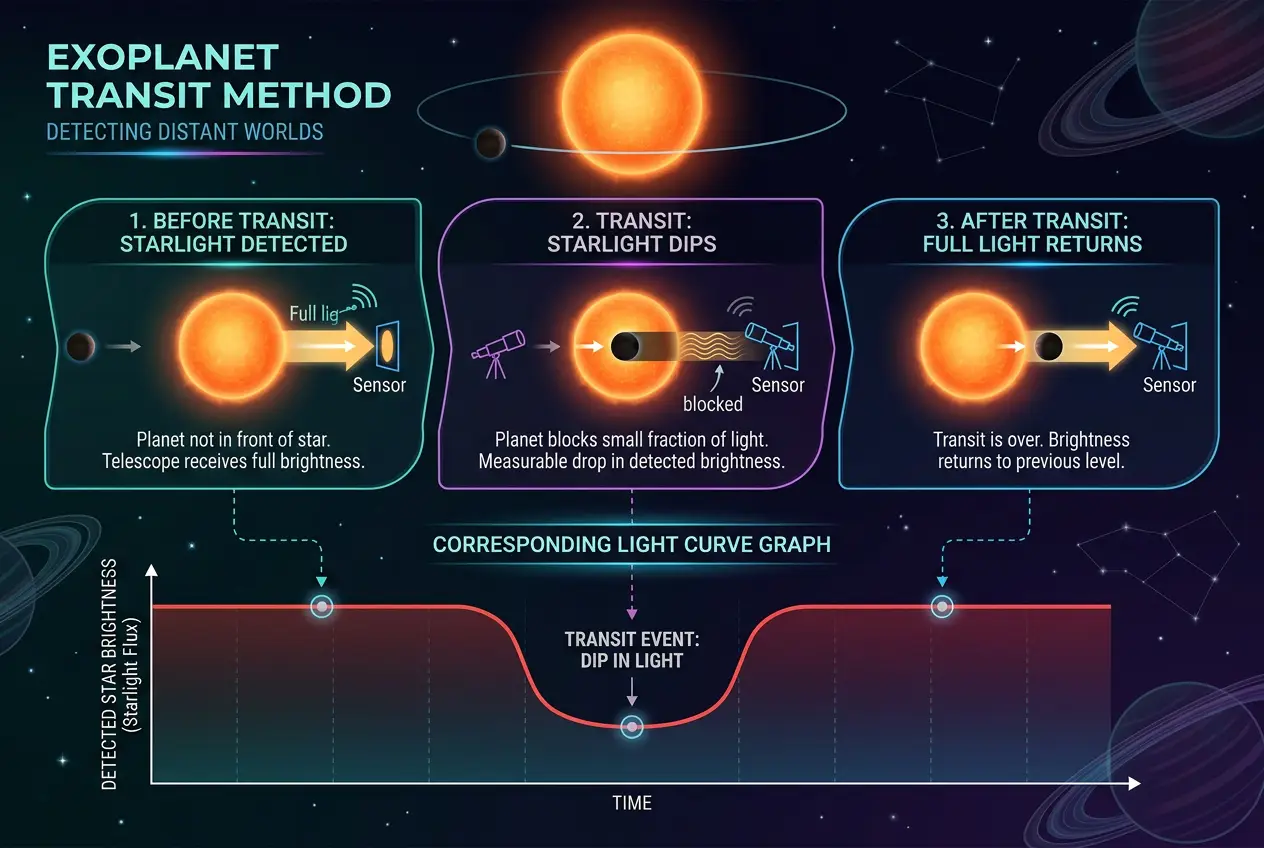
A typical transit looks like a U-shaped dip in a star's light curve. It's symmetrical, predictable, and repeatable. The depth of the dip tells us the size of the planet relative to the star, and the timing tells us its orbital period. For a deeper dive into how these celestial bodies are identified, you might want to check out our previous discussion on how [alien megastructures are researched](https://curiositydiaries.com/blogs/alien-megastructures-are-we-missing-cosmic-architects-6667).
## When the Universe Whispers: The Case of KIC 8462852
In 2015, a star named **KIC 8462852**, popularly known as **Tabby's Star** after astronomer Tabetha Boyajian, threw a cosmic curveball. Data from the Kepler Space Telescope showed extraordinary, inexplicable dimmings that went far beyond what a typical exoplanet could cause. Instead of the symmetrical, shallow dips we expect, KIC 8462852 exhibited irregular, deep, and prolonged drops in brightness, sometimes by as much as 22%, lasting for days or even weeks. And these events didn't follow any clear pattern or periodicity.
"It was so strange," Boyajian said in an interview with *The Atlantic*, "that at first, we thought there must be something wrong with the telescope or the data." But the data was solid. What could cause such a chaotic, colossal blockage of starlight?
### Natural Explanations (and their shortcomings)
Scientists immediately jumped to natural explanations:
* **Comet Swarms:** Perhaps a massive swarm of fragmented comets or asteroids was passing in front of the star. While plausible for some dimming, the sheer scale and irregularity required a truly unprecedented number of comets.
* **Dust Clouds:** Dust from a shattered planet or colliding objects could also obscure starlight. However, dust typically re-radiates heat in infrared wavelengths, which was largely absent from KIC 8462852's observations.
* **Stellar Activity:** Starspots, similar to sunspots, can cause dimming. But the dimming observed was too significant and irregular for known stellar phenomena.
Each natural hypothesis, while offering a piece of the puzzle, struggled to fully explain all observed anomalies without invoking highly improbable circumstances.
### The Technosignature Hypothesis: Dyson Spheres and Beyond
This is where the idea of **alien technology** enters the picture. The most popular technosignature invoked for KIC 8462852 was a **Dyson Sphere** or a Dyson Swarm. First theorized by physicist Freeman Dyson, these are hypothetical megastructures built by advanced civilizations to completely enclose a star and capture a significant portion of its energy output.
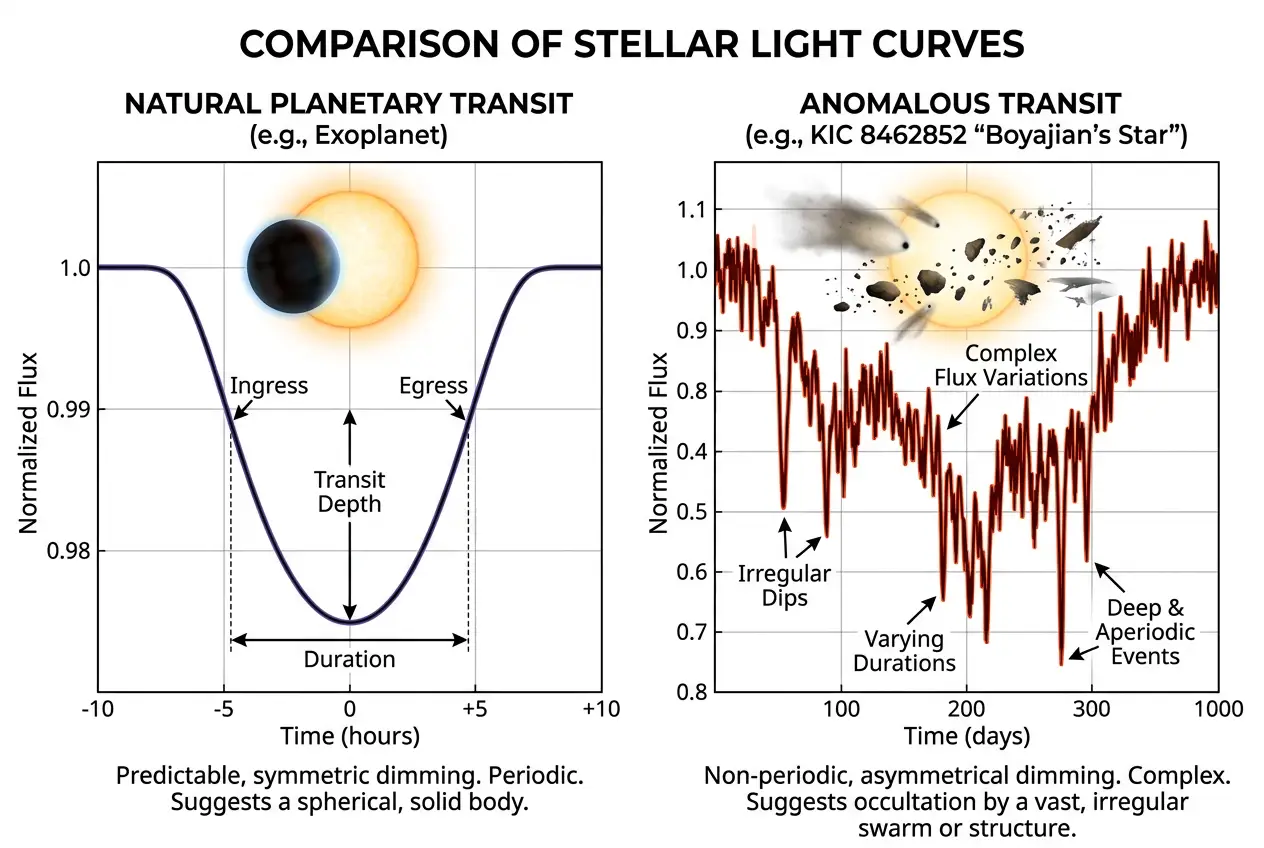
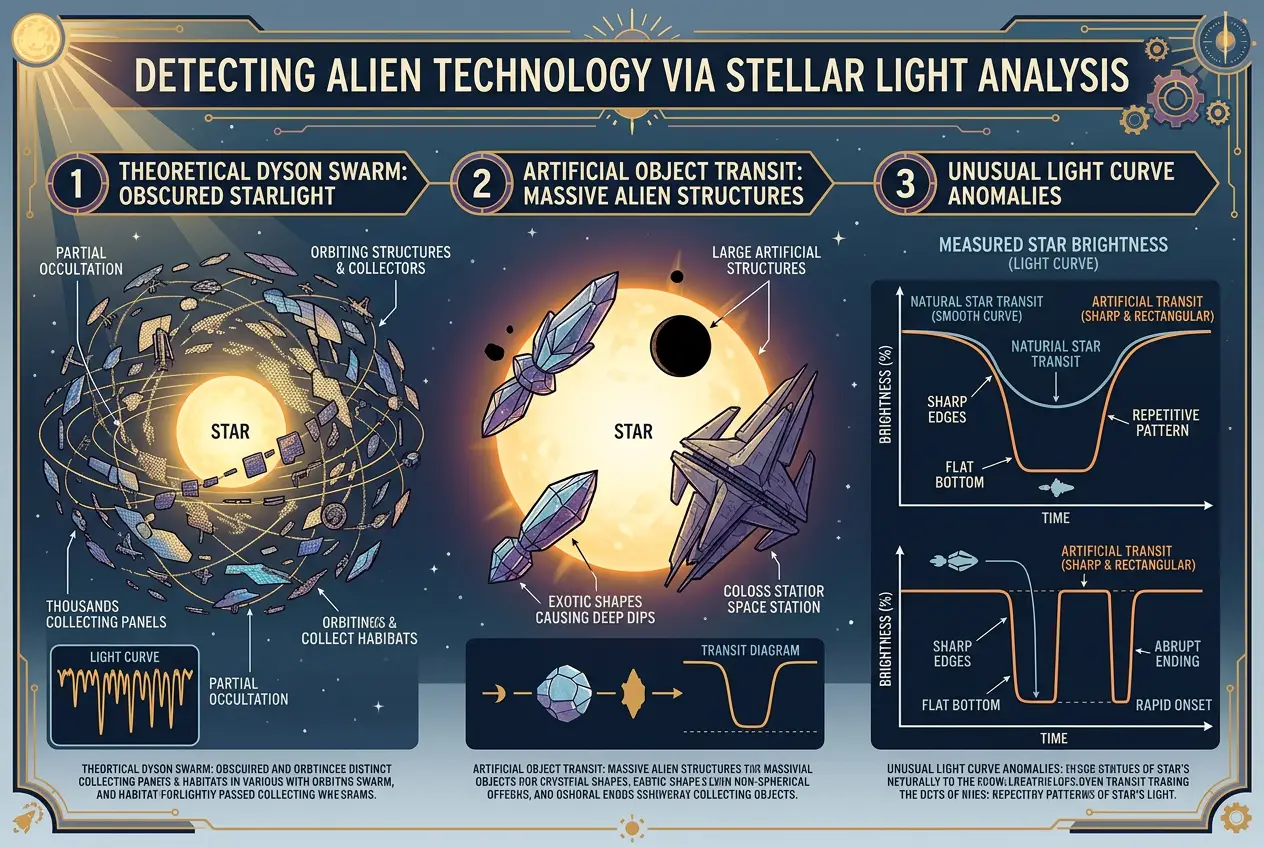
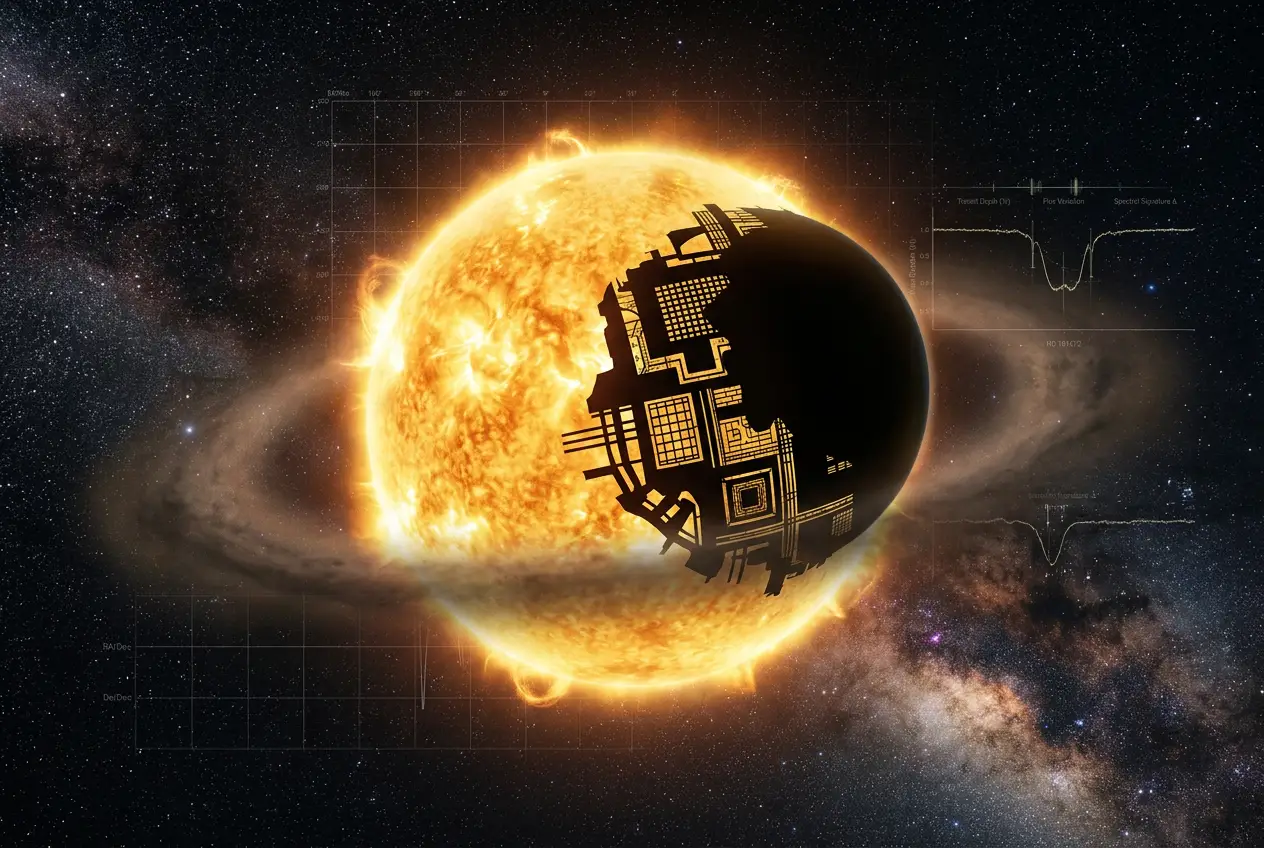
A complete Dyson Sphere would block nearly all light, making the star appear to vanish. However, a Dyson Swarm, a collection of orbiting habitats, solar collectors, or other engineered structures, could explain the erratic dimming. As these structures move around the star, they would block varying amounts of light, creating the observed chaotic dips. Such a vast undertaking would require an incredibly advanced civilization, a so-called "Type II" civilization on the Kardashev Scale, capable of harnessing the entire energy output of its star. More details on Dyson Spheres can be found on their [Wikipedia page](https://en.wikipedia.org/wiki/Dyson_sphere).
While later research and continued observations of KIC 8462852 largely leaned towards natural explanations involving dust, the initial mystery captivated the scientific community and the public alike. It highlighted how we might detect alien technology. As I consider these possibilities, I’m reminded of the intriguing debate around Oumuamua, another celestial visitor with peculiar characteristics. Could it have been [alien tech](https://curiositydiaries.com/blogs/is-oumuamua-alien-tech-deciphering-interstellar-visitors-5571)? The patterns of KIC 8462852, while now leaning towards dust, ignited the imagination about what we *could* find.
## What Would a "True" Alien Tech Transit Look Like?
If not a Dyson Swarm around Tabby's Star, what kind of signature would definitively point to alien engineering?
1. **Non-Natural Shapes/Arrangements:** Transiting objects that are clearly non-spherical (e.g., rectilinear, triangular) or arranged in complex, artificial patterns. Imagine a grid of solar panels or a massive space station.
2. **Unusual Speeds or Trajectories:** Objects moving at speeds or on paths inconsistent with natural orbital mechanics.
3. **Engineered Light Curves:** Light dips with perfectly flat bottoms, sharp edges, or stair-step patterns that couldn't be formed by spherical or even highly irregular natural bodies.
4. **Repeating, Complex Patterns:** A highly complex, non-periodic but clearly *repeating* pattern over long timescales, suggesting a programmed movement rather than random celestial mechanics.
5. **Multispectral Signatures:** The way the light is blocked across different wavelengths could also provide clues. Artificial materials might absorb or reflect light differently than natural dust or planets.
The challenge, of course, is that the universe is vast and capable of producing incredibly complex and unusual natural phenomena. Distinguishing a truly artificial signature from a rare cosmic fluke is incredibly difficult, demanding extraordinary evidence.
## The Role of SETI and Future Telescopes
The Search for Extraterrestrial Intelligence (SETI) has traditionally focused on radio signals, listening for deliberate broadcasts. However, optical SETI, which looks for laser flashes or other light-based communication, and technosignature searches like looking for Dyson Spheres, are gaining prominence. The Kepler mission and its successor, TESS (Transiting Exoplanet Survey Satellite), have provided a treasure trove of light curve data that continues to be analyzed for anomalies. You can find more about the SETI Institute's work on their [Wikipedia page](https://en.wikipedia.org/wiki/SETI).
Future telescopes, especially those with greater sensitivity and resolution like the planned Habitable Exoplanet Observatory (HabEx) or Large Ultraviolet Optical Infrared Surveyor (LUVOIR), will be even better equipped to detect subtle transit variations. Furthermore, the advent of **AI and machine learning** is revolutionizing our ability to analyze vast datasets and spot patterns that human eyes might miss. AI algorithms can be trained to look for specific technosignatures or even flag 'unusual' patterns for human review.
## The Grand Implications: If We Found It
Imagine for a moment that we *do* find an undeniable technosignature in a transit light curve. The implications would be profound, shaking the foundations of human understanding. It would confirm that we are not alone, reshape our place in the cosmos, and perhaps give us a glimpse into the potential ultimate destiny of technological civilizations.
But it would also open up a Pandora's Box of questions:
* How do we communicate with them?
* Are they benevolent, indifferent, or even hostile?
* What does their existence mean for our own technological progression?
* Could their "tech" be so advanced that we misinterpret it as natural phenomena, or vice versa?
The silence of the cosmos, often referred to as the Fermi Paradox, remains one of the universe's greatest enigmas. Finding alien technology in transit data would be a monumental step in addressing why [the universe is so quiet](https://curiositydiaries.com/blogs/why-is-the-universe-so-quiet-decoding-the-fermi-paradox-5418).
## Conclusion: The Cosmic Hunt Continues
The hunt for exoplanet transits that hide alien technology is a testament to humanity's boundless curiosity and our ever-advancing technological prowess. While no definitive evidence of alien megastructures or engineered objects has yet been found, the occasional cosmic anomaly like KIC 8462852 keeps the dream alive.
It reminds us that the universe is far more complex and surprising than we can possibly imagine. Every dip in starlight, every flicker, is a piece of a cosmic puzzle. And with each new telescope, each new algorithm, we get a little closer to deciphering the messages hidden in the light, perhaps eventually answering that age-old question that started it all.
Frequently Asked Questions
The primary method discussed is the transit method, where astronomers detect exoplanets by observing the temporary dimming of a star's light as a planet passes in front of it.
Tabby's Star exhibited irregular, deep, and prolonged dips in brightness, sometimes up to 22%, that were far more significant and chaotic than what could be explained by a typical planetary transit.
A Dyson Sphere or Swarm is a hypothetical megastructure built by an advanced civilization to enclose a star and capture its energy. A Dyson Swarm could cause the erratic, deep dimming observed in stars like Tabby's Star, suggesting an artificial origin.
Definitive signs would include non-natural shapes or arrangements of transiting objects, unusual speeds or trajectories inconsistent with natural orbits, engineered light curves with sharp edges or perfect flatness, or complex, repeating, non-periodic patterns over long timescales.
Future telescopes with greater sensitivity and resolution will enhance detection, while AI and machine learning are revolutionizing data analysis, enabling the identification of subtle patterns or anomalies that human observers might miss, thereby aiding in the search for technosignatures.
Verified Expert
Alex Rivers
A professional researcher since age twelve, I delve into mysteries and ignite curiosity by presenting an array of compelling possibilities. I will heighten your curiosity, but by the end, you will possess profound knowledge.
Leave a Reply
Comments (0)
No approved comments yet. Be the first to share your thoughts!
 Join Us
 Alex Rivers


















Leave a Reply
Comments (0)