


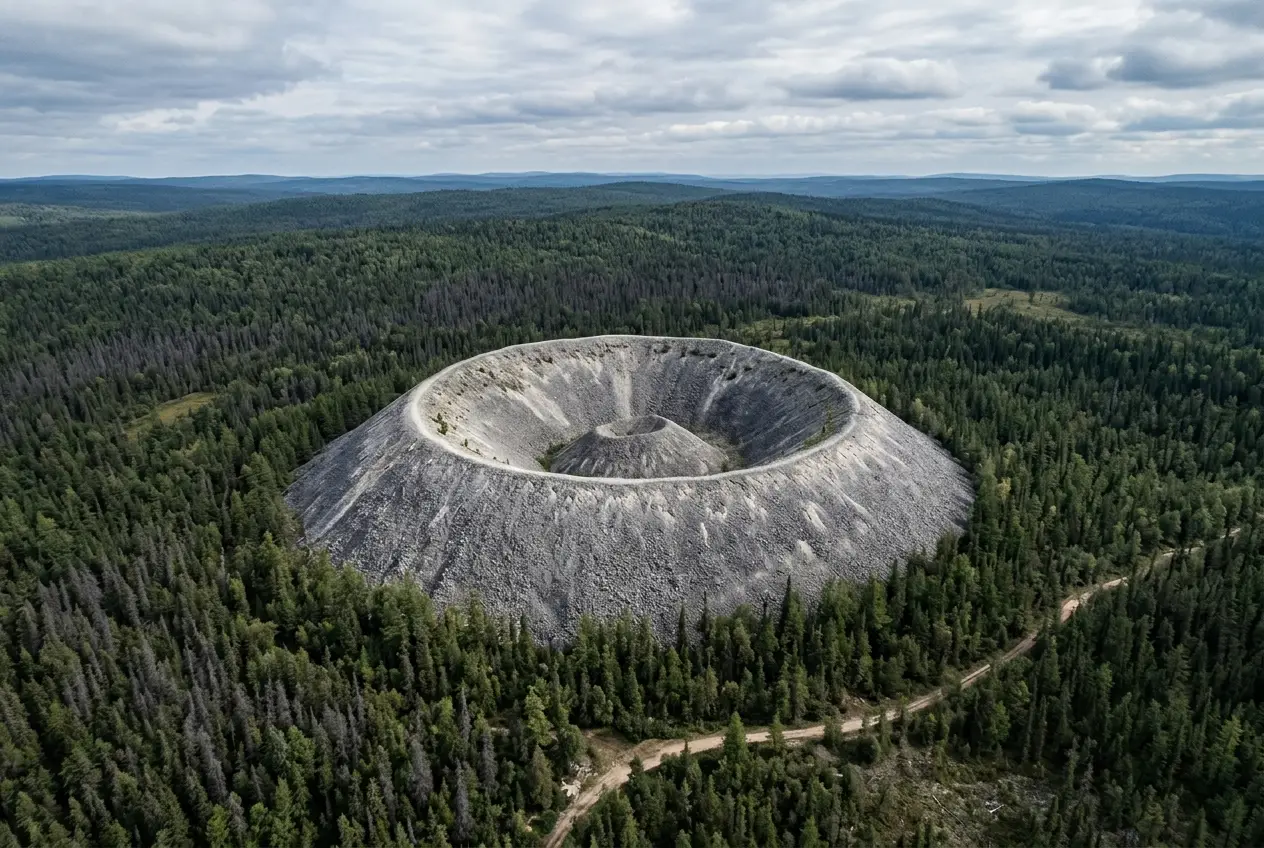
I've always been fascinated by Earth's hidden anomalies—places where geology seems to defy expectation, where nature has sculpted something so peculiar that it sparks endless questions. Recently, my curiosity led me deep into the heart of Siberia, to a place known locally as "The Nest of the Fiery Eagle" or, more formally, the Patom Crater. It's a colossal, perfectly conical mound rising from the dense taiga forest, a geological enigma that has puzzled scientists for over a century. Imagine stumbling upon something so alien in its appearance, so out of place, that it challenges every conventional explanation. That’s the Patom Crater for you.
When I first saw images of it, I couldn't help but wonder: what forces could have created such a structure? Is it a forgotten volcanic vent, a meteorite impact site, or something far more unusual, something that hints at geological processes we don't fully understand, or perhaps even something beyond our understanding? The mystery isn't just in its form, but in the profound silence it holds, guarding secrets beneath layers of rock and folklore.
The Enigmatic Discovery and Form
The Patom Crater wasn't officially "discovered" until 1949 by geologist Vadim Kolpakov, who was mapping the region. What he found was unlike anything seen before: a giant, perfect cone, roughly 80 meters (260 feet) high and 180 meters (590 feet) in diameter at its base, with a distinctive ring-shaped ridge and a raised central dome. It looks uncannily like a giant molehill or a miniature volcano, but it’s neither. The local Yakut people have known about it for generations, avoiding it due to widespread superstitious beliefs that it's a place of evil, where animals refuse to graze and people fall ill.
Kolpakov initially believed it might be an ancient volcano, but the region is not known for volcanic activity. Subsequent investigations quickly ruled out typical volcanic origins. The material forming the crater is primarily broken limestone blocks, not volcanic rock. The sheer scale and symmetry of the Patom Crater are astounding, especially considering its remote location in the Irkutsk region of Siberia, far from any major geological fault lines or seismic zones that might explain such a dramatic uplift.
Unpacking the Scientific Theories
For decades, scientists have grappled with the Patom Crater's origins, proposing several hypotheses, each with its own set of strengths and weaknesses.
1. The Meteorite Impact Theory
This is often the go-to explanation for large, circular geological features. A meteorite striking the Earth could certainly create a crater. However, the Patom Crater lacks many tell-tale signs of an impact event. There's no clear evidence of shock metamorphism in the rocks, no specific meteoritic fragments, and its raised central dome and layered structure are atypical for impact craters, which usually feature a more bowl-like depression. While some theories suggest a "cryptovolcanic" explosion triggered by a meteorite deep underground, direct evidence remains elusive. One of the closest comparison would be craters like the Barringer Crater, but the Patom Crater's internal structure deviates significantly.
2. The Cryovolcanic or Gas Vent Hypothesis
Another theory posits that the crater could be a result of cryovolcanism, a phenomenon where volatiles like water, ammonia, or methane erupt, forming ice volcanoes. This is common on icy moons in the outer solar system, but highly improbable on Earth, especially given the temperate (though cold) climate of Siberia. A more plausible variation is a massive gas emission or explosion from deep within the Earth. Imagine a colossal bubble of methane or hydrogen sulfide, trapped under immense pressure, suddenly erupting through the overlying rock. This could potentially explain the inverted cone shape and the uplifted central dome. However, finding such an enormous, concentrated gas pocket and explaining its sudden, catastrophic release remains a challenge. The crater's composition of broken limestone further complicates this, as it doesn't align with simple gas expulsion.
3. Geodynamic Processes and Diapirism
Perhaps the most favored scientific explanation currently involves geodynamic processes, specifically diapirism. This occurs when a less dense material (like mud, salt, or magma) pushes upwards through denser overlying rock. In the case of Patom Crater, some geologists suggest that a diapir of deep-seated rock or a gas-rich magma chamber slowly pushed upwards over a very long period, eventually breaking through the surface. The uplifted central dome could be the exposed top of this diapir, and the surrounding ridge the result of the rock being pushed aside and folded. This theory aligns better with the presence of fractured limestone and the slow, sustained pressure required to form such a massive, symmetrical structure. It implies a long, drawn-out process rather than a sudden, violent event. You can read more about diapirism on Wikipedia to understand the underlying geological mechanics: Diapir - Wikipedia (opens in a new tab).
Local Legends and Anomalous Readings
Beyond the scientific debates, the Patom Crater is steeped in local folklore. The Yakut people refer to it as "The Fire Eagle's Nest," believing it to be a cursed place where strange things happen. There are tales of people feeling unwell, experiencing fear, or even disappearing near the crater. While often dismissed as superstition, these stories add another layer of intrigue.
Intriguingly, early expeditions reported some peculiar findings. Trees in the immediate vicinity of the crater seemed to be growing at an accelerated rate, similar to those found near the Chernobyl disaster zone. While later studies haven't consistently replicated these exact growth anomalies, the initial reports sparked theories about unusual radiation or geothermal activity. Moreover, some researchers have noted magnetic anomalies around the crater, suggesting the presence of unusual mineral deposits or geological structures deep beneath the surface. Such anomalies sometimes pique our interest in whether Earth's unseen forces might be at play, a topic we've explored previously regarding how Earth's invisible shields guard unseen secrets.
One of the most perplexing aspects is the lack of a definitive age for the crater. Initial estimates placed it at around 250 years old, based on tree growth, but this has been highly debated. If it is relatively young, the speed and scale of its formation are even more astonishing, requiring an exceptionally powerful and rapid geological event. If it's much older, then the slow-push diapirism theory gains more traction.
What if it’s an Unseen Energy Source?
The "unknown forces" mentioned in our title naturally lead to a more speculative, yet captivating, question: Could the Patom Crater be a manifestation of some deep, unseen energy source or geological process that we are only beginning to comprehend? The magnetic anomalies, the peculiar tree growth reports, and the sheer uniqueness of the structure itself make one wonder if it's tapping into something profound.
Perhaps it's a "breathing" geological entity, slowly expanding and contracting due to internal pressures, or a vent for deep-earth gases that are still active, but on a scale and in a manner unfamiliar to us. Some might even entertain connections to ideas of planetary resonance, a concept that touches upon how planets emit secret frequencies. While there's no concrete scientific evidence to support such claims directly for Patom Crater, the allure of the unknown often drives further research.
The Patom Crater serves as a powerful reminder of how much we still have to learn about our own planet. It stands as a silent monument to geological forces that can sculpt landscapes in ways we find hard to categorize. Its mysteries are a beacon for future scientific inquiry, drawing us deeper into the Earth's hidden mechanisms. Could it be a place where Earth's fields hold lost memories, or simply a fascinating, yet explainable, geological anomaly? Only continued, rigorous research will tell.
In conclusion, the Patom Crater is more than just a peculiar hill in Siberia; it’s a living geological puzzle that continues to challenge our understanding of Earth’s dynamic processes. While the exact "unknown forces" remain elusive, the ongoing quest to unravel its secrets promises to shed light on our planet's hidden depths and the incredible phenomena that shape it. The allure of the unknown, in this case, isn't a call to baseless speculation, but an invitation to deeper scientific exploration.





Conversation0
No comments yet. Be the first to share a thought — the best questions often become new stories.