


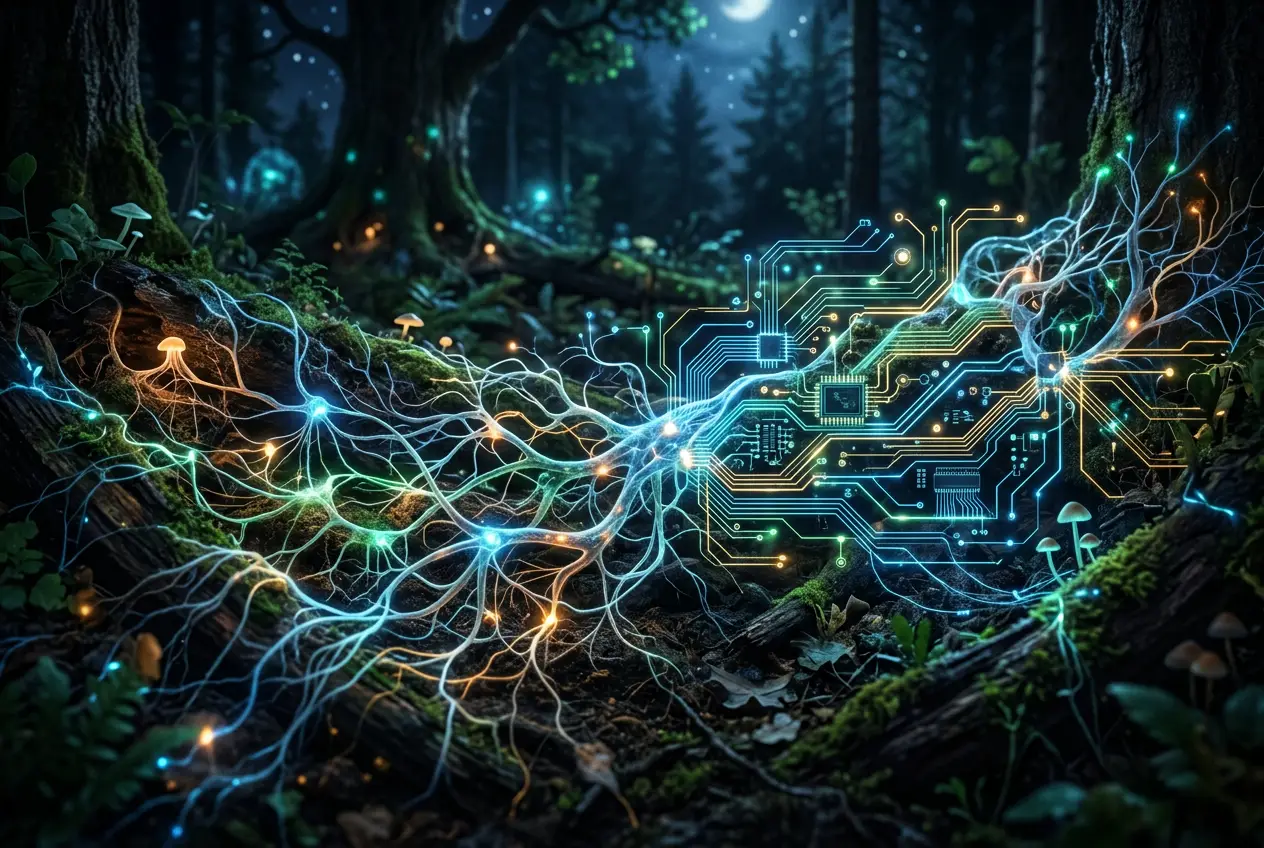
I remember the first time someone suggested that fungi, those unassuming decomposers we often overlook, could hold the key to the next generation of computing. My initial reaction was a raised eyebrow, followed quickly by a spark of genuine curiosity. We’re used to thinking about computers in terms of silicon chips, binary code, and the relentless march of Moore’s Law. But what if the ultimate processor isn't something forged in a high-tech cleanroom, but something grown in the damp earth, a biological network that rivals the complexity of our own brains?
This isn't a scene from a science fiction novel, though it certainly feels like one. Scientists are seriously exploring the potential of mycelium – the intricate root-like structure of fungi – as a natural, living computing substrate. Imagine a computer that heals itself, grows, learns, and perhaps even thinks, all while being biodegradable and energy-efficient. It sounds too good to be true, but the more I delve into it, the more plausible it seems.
The Unseen Architects: Understanding Mycelial Networks
Before we dive into fungal supercomputers, let's appreciate the silent, sprawling genius beneath our feet. Mycelium is the vegetative part of a fungus, a vast, branching network of filamentous hyphae. It's often compared to an underground internet, connecting trees, plants, and microorganisms across entire ecosystems. Through this network, fungi exchange nutrients, water, and even chemical signals, acting as nature's ultimate recyclers and communicators.
Think about the sheer scale: a single cubic inch of soil can contain miles of hyphae. These networks are not static; they are constantly growing, adapting, and restructuring in response to their environment. This dynamic, interconnected nature is what first caught the eye of researchers looking for alternatives to traditional silicon-based computing.
Why Biology for Computation? The Silicon Ceiling
For decades, silicon has been the undisputed king of computing. Its ability to create tiny, fast switches (transistors) has driven an exponential increase in processing power. However, we're hitting fundamental limits. Miniaturization is becoming incredibly challenging, heat dissipation is a major problem, and the energy consumption of massive data centers is skyrocketing. This "silicon ceiling" has spurred the search for radically different computing paradigms.
This is where biology, specifically mycelial networks, enters the picture. Unlike rigid, pre-programmed silicon, biological systems are inherently parallel, self-organizing, and remarkably fault-tolerant. They process information not through discrete on/off switches, but through complex, analogue interactions, much like a brain. Mycelium, in particular, exhibits properties that make it an exciting candidate for what's known as neuromorphic computing, which seeks to mimic the structure and function of the human brain.
Fungus as a Processor: How Could It Work?
The idea is breathtakingly simple, yet profoundly complex. Imagine the hyphae as wires and the branching points as nodes. Information could be encoded as electrical impulses, chemical signals, or even changes in growth patterns. As these signals propagate through the mycelial network, they interact, merge, and diverge, performing computational operations.
One leading pioneer in this field is Professor Andrew Adamatzky from the University of the West of England. He and his team have conducted fascinating experiments demonstrating that fungal networks can process information, solve mazes, and even mimic logic gates. In one study, they fed oat flakes (as nutrients) to different parts of a Physarum polycephalum (a slime mold, not strictly a fungus, but often studied for similar network properties) and observed how it grew and optimized its network to connect the food sources efficiently, a process that can be modeled as a computation.
"Mycelial networks provide a vast, distributed, and adaptive substrate for unconventional computation," Adamatzky stated in one of his research papers. This adaptability is key. Unlike a fixed silicon chip, a fungal computer could literally reconfigure its connections, grow new pathways, and optimize its structure in real-time, learning from experience.
Beyond Logic Gates: The Promise of Mycelial Intelligence
While basic logic gates are a crucial first step, the real excitement lies in more advanced capabilities. Think about the way a forest's mycelial network allows trees to share resources and communicate about threats. This collective intelligence, distributed across a vast biological network, could be a blueprint for a new kind of computing.
Imagine a network that learns to recognize patterns, adapt to new inputs, and even predict outcomes, all without the need for traditional programming. This isn't just about speed; it's about a fundamentally different way of processing information, one that is more organic, resilient, and potentially more powerful for certain types of tasks, especially those involving complex, ambiguous data where traditional algorithms struggle.
Researchers envision applications in areas like:
- Environmental Monitoring: Self-growing sensors that detect pollutants and communicate information through their network.
- Decentralized AI: Autonomous, distributed computing systems that don't rely on central servers.
- Bioremediation: Fungal networks designed to break down toxins while simultaneously performing computations related to their environment.
- Novel Materials: Growing "smart" materials with embedded computational capabilities.
This takes us to an interesting parallel with other emergent computing fields. Just as scientists are exploring the potential of living crystals as computing's next frontier, mycelial computing represents another exciting venture into leveraging the inherent properties of matter and life for information processing.
Challenges and the Road Ahead
Of course, the path from scientific curiosity to practical application is fraught with challenges. Controlling the growth and behavior of living organisms for precise computation is immensely difficult. How do you reliably input data and extract output from a dynamic, growing network? How do you ensure stability and prevent unpredictable biological responses?
- Standardization: Establishing common protocols for fungal computation.
- Scalability: Moving from laboratory experiments to larger, more complex systems.
- Interfacing: Developing robust ways to connect biological computers with traditional electronic systems.
- Predictability: Ensuring the results of computations are consistent and reliable.
Despite these hurdles, the research is gaining momentum. The sheer elegance of using biology itself to compute, and the potential to unlock entirely new forms of intelligence, makes this a compelling frontier. It also offers a fresh perspective on how biological systems might communicate, much like how forests hidden network allows trees to talk digitally.
We're moving beyond the simple silicon chip, looking at everything from quantum mechanics to the very fabric of life for our next computing breakthroughs. The contrast between our current understanding of computation and the potential of biological systems is vast. While quantum computers are mind-bogglingly faster than supercomputers by leveraging quantum phenomena, mycelial computing offers a different kind of leap—one into the realm of truly adaptive, self-organizing, and sustainable intelligence.
As we continue to push the boundaries of AI, we might find that the ultimate answer isn't in perfecting artificial neural networks on silicon, but in harnessing the original, natural neural networks that have existed for eons. The idea that humble fungi could be our partners in designing the computers of tomorrow is a testament to the endless wonders that nature holds, waiting for us to discover and, perhaps, learn to collaborate with. It reminds me how much there is yet to discover about biological intelligence, echoing questions like can AI dream, deciphering digital imagination.
The journey to building a functional mycelial computer is just beginning, but the implications are profound. It's a vision of computing that is not just powerful, but also harmonious with the natural world, paving the way for a truly sustainable technological future.




Conversation0
No comments yet. Be the first to share a thought — the best questions often become new stories.