The scent of liquid nitrogen hung in the air, a crisp, cold breath that always seemed to precede a moment of wonder in my old physics lab. I remember watching, captivated, as a tiny, metallic puck, chilled to near absolute zero, effortlessly levitated above a powerful magnet. This wasn't magic, of course, but the **Meissner effect**, a cornerstone of superconductivity where magnetic fields are expelled from the superconductor's interior. It’s a phenomenon that has always made me wonder: if superconductors can so dramatically push away magnetic fields, could they, in some esoteric way, interact with other fundamental forces – perhaps even gravity?
It’s a thought that sounds like science fiction, the kind of concept that fuels dreams of anti-gravity devices and warp drives. Yet, within the fringes of theoretical physics and the intense curiosity of researchers, the question of whether superconductors might offer a glimpse into manipulating spacetime, or at least creating a "mini-gravity" effect, persists. The idea is far from mainstream, but it touches upon some of the deepest mysteries of the universe, bridging the quantum world of superconductors with the grand tapestry of general relativity.
## The Quantum Ballet of Superconductors
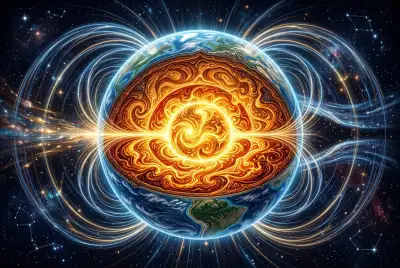
To understand this intriguing proposition, we first need to grasp what superconductors truly are. They are materials that, when cooled below a critical temperature, exhibit two remarkable properties: **zero electrical resistance** and the **expulsion of magnetic fields** (the Meissner effect). This expulsion isn't just a passive shielding; it's an active dynamic process. When a superconductor is placed in a magnetic field, currents are induced on its surface that perfectly counteract the external field, pushing it out. This is what causes those dramatic levitation demonstrations, a testament to the powerful quantum forces at play.
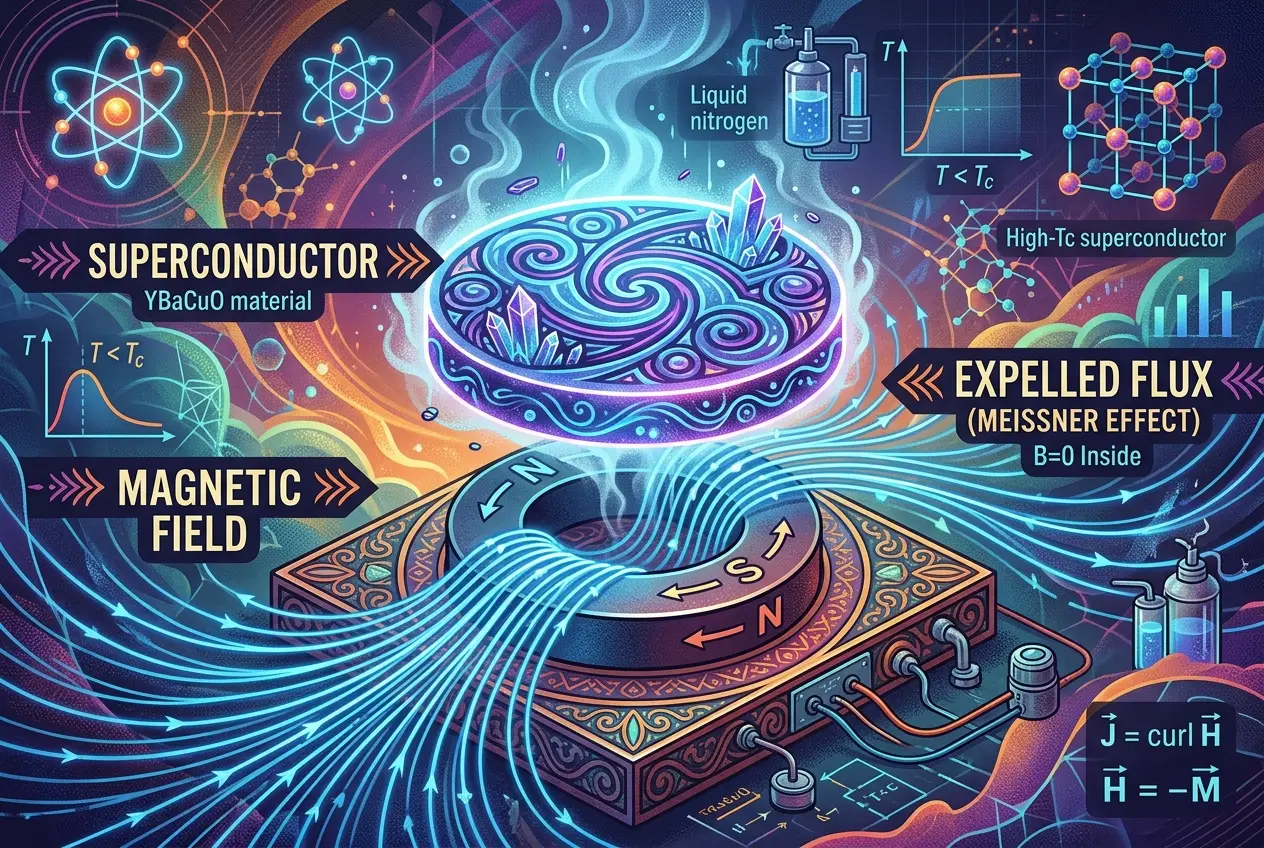
At a fundamental level, superconductivity arises from quantum mechanics. Electrons, normally fiercely individual, pair up into "Cooper pairs" and move through the material without resistance. This collective, coherent quantum state is what gives superconductors their unique properties. It's a macroscopic quantum phenomenon, meaning quantum effects are observable on a scale much larger than individual atoms. For a deeper dive into these fascinating materials, Wikipedia offers an excellent overview of [superconductivity](https://en.wikipedia.org/wiki/Superconductivity).
## Gravity's Enigmatic Dance Partner: Spacetime
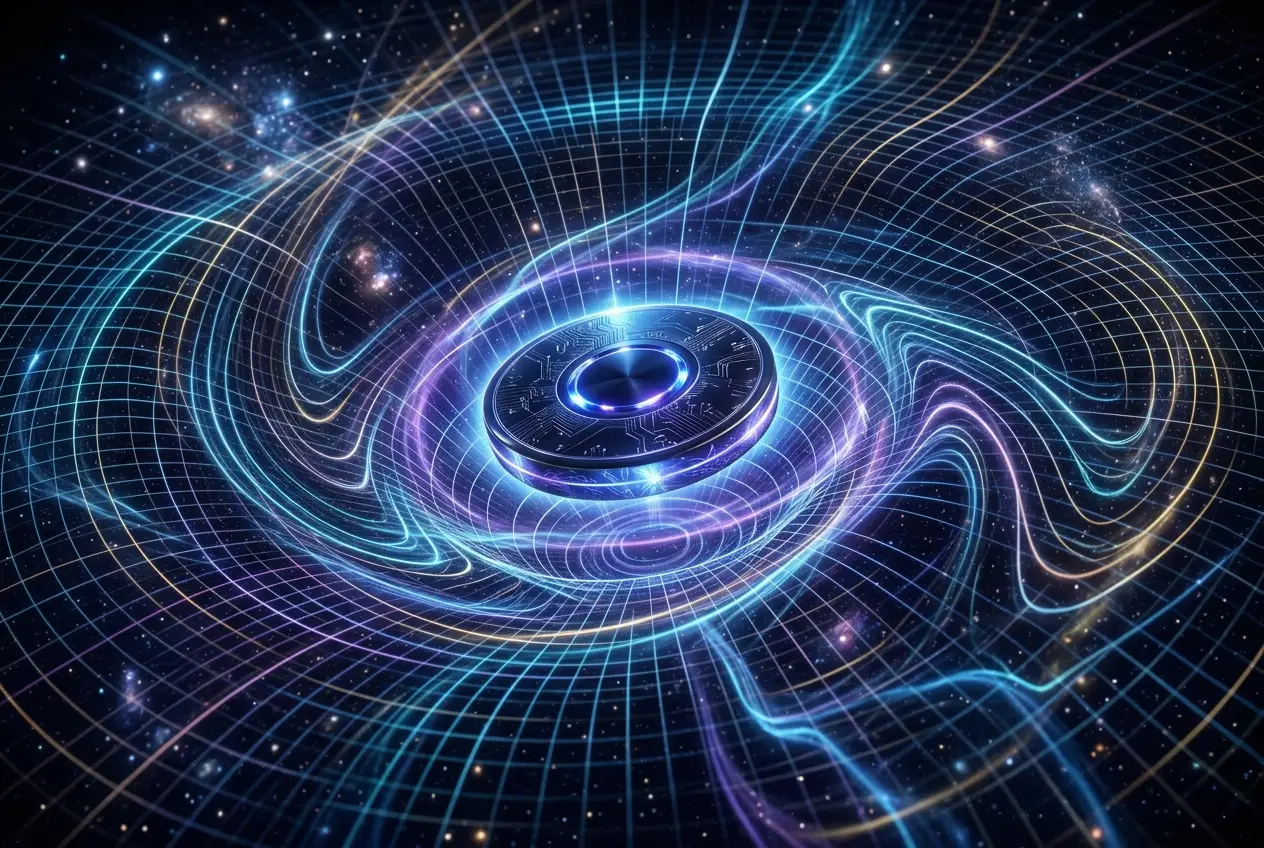
Now, let's turn our attention to gravity. In Einstein's theory of general relativity, gravity isn't a force pulling objects together, but rather a **manifestation of the curvature of spacetime** caused by mass and energy. Massive objects, like planets and stars, warp the fabric of spacetime around them, and what we perceive as gravity is simply objects following the shortest path through this curved geometry. It's a beautiful, elegant, and incredibly successful theory that has passed every experimental test with flying colors.
But gravity also holds many secrets. It's the weakest of the four fundamental forces, yet it dictates the large-scale structure of the universe. Unlike electromagnetism, which we can shield and manipulate with ease, gravity remains stubbornly impervious to our attempts at control. We can't simply "block" gravity or create an "anti-gravity" field with conventional means. Or can we?
## The Unseen Connection: Linking Meissner and Gravity
The idea of a link between superconductivity and gravity isn't new, though it has seen its share of controversy and skepticism. Early theories, particularly in the mid-20th century, explored the possibility of "gravitomagnetic" effects within superconductors. Gravitomagnetism is an analogy to electromagnetism, where moving masses (or energy currents) create gravitational fields, much like moving charges create magnetic fields. This is a legitimate prediction of general relativity, known as the **Lense-Thirring effect** or frame-dragging, where rotating massive objects "drag" spacetime around them. You can read more about it on [Wikipedia's page for gravitomagnetism](https://en.wikipedia.org/wiki/Gravitomagnetism).
Some researchers have theorized that the collective quantum behavior of Cooper pairs within a superconductor might interact with spacetime in a novel way, potentially leading to a weak gravitomagnetic field or even a subtle alteration of local spacetime curvature. The argument often stems from the idea that the Meissner effect involves a dramatic interaction with the electromagnetic field, and given that electromagnetism and gravity are both fundamental forces, perhaps there's an analogous interaction waiting to be discovered.
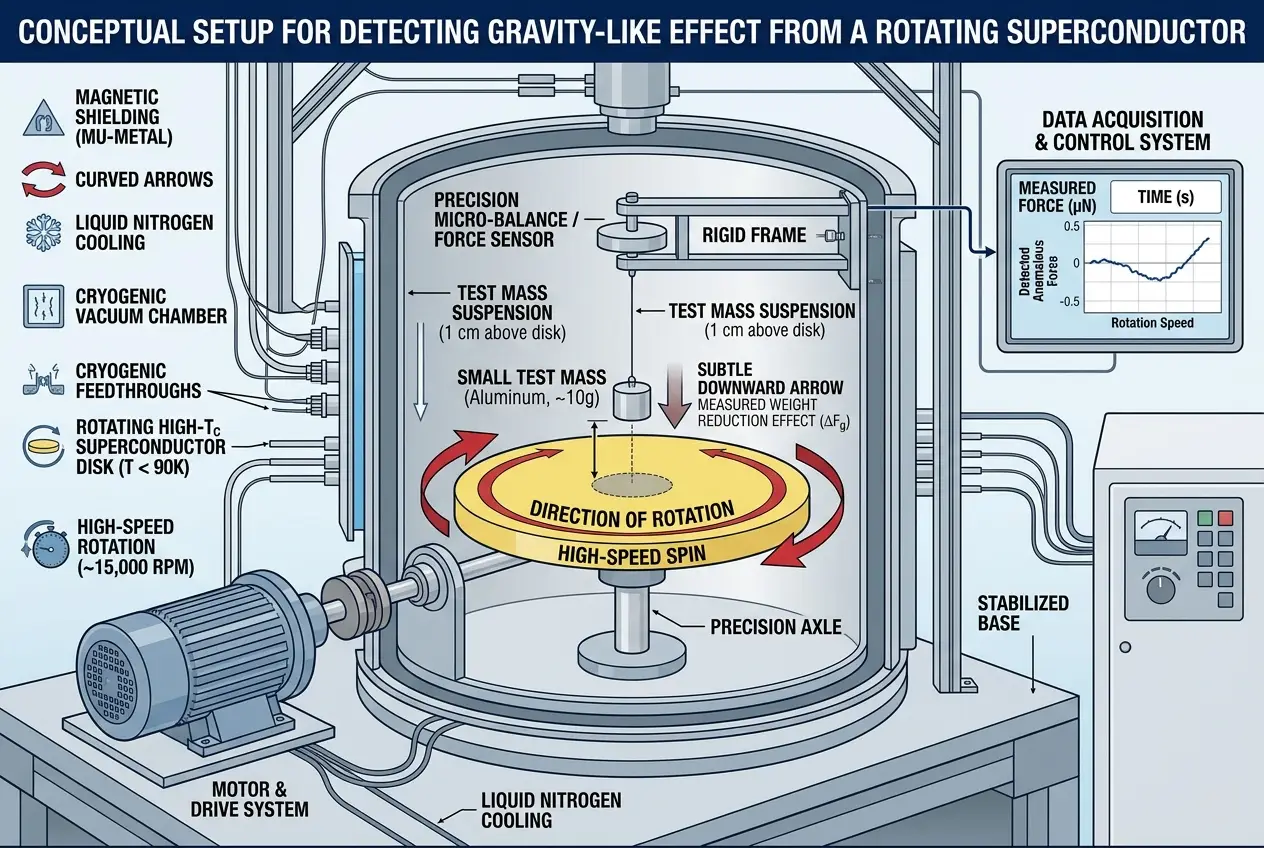
One of the most notable (and controversial) claims in this area came from **Evgeny Podkletnov** in the 1990s, who reported observing a slight weight reduction above a rotating superconducting disk. These experiments, often referred to as "gravity shielding" or "gravity modification" effects, have been met with intense scrutiny. Despite attempts by other research groups to replicate his findings, they have largely remained unconfirmed or have been attributed to experimental errors. The scientific consensus currently holds that there is no verified experimental evidence of superconductors producing measurable "gravity-like" effects beyond the extremely weak gravitomagnetic effects predicted by general relativity for any rotating mass.
## Why the Persistent Fascination?
Despite the lack of concrete evidence, the idea remains captivating for several reasons:
1. **Fundamental Physics Frontier**: Linking quantum mechanics (superconductivity) with general relativity (gravity) is the holy grail of modern physics. Any genuine connection would represent a monumental breakthrough towards a unified theory of everything.
2. **Technological Implications**: Imagine if we could, even subtly, manipulate gravity. This could revolutionize space travel, leading to propulsion systems that don't rely on expelling propellant, or even localized gravity generators for advanced material processing.
3. **The Allure of the Unknown**: Superconductivity itself is a weird, wonderful quantum phenomenon. It defies classical intuition. Is it possible there are more layers to its quantum weirdness that we haven't yet uncovered, particularly in its interaction with the very fabric of reality?
Researchers continue to explore this space, albeit with extreme caution and rigor. Most current mainstream efforts focus on precision measurements of known general relativistic effects, like the Lense-Thirring effect, rather than seeking exotic new interactions. For example, some look for subtle interactions between supercurrents and gravitational fields, or attempt to refine the theoretical framework that would allow such interactions to exist.
## Future Prospects and The "What If"
While the dream of superconductor-powered anti-gravity remains largely in the realm of science fiction, the scientific process thrives on asking bold questions and meticulously testing even the most audacious hypotheses. The journey to understand extreme phenomena like the Meissner effect often uncovers unexpected insights, even if they don't directly lead to dramatic breakthroughs in gravity manipulation.
Perhaps a new generation of **high-temperature superconductors**, or even exotic quantum materials yet to be discovered, could exhibit properties that bring us closer to this elusive link. Or maybe, our current understanding of spacetime is simply too incomplete to fully grasp such interactions.
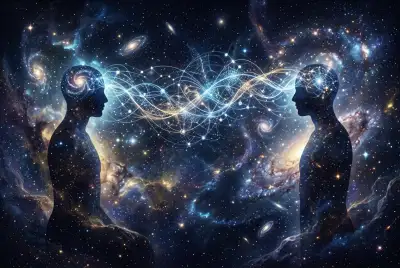
The question, "Do superconductors warp spacetime?" forces us to confront the boundaries of our current knowledge and pushes us to explore the vast, uncharted territories where quantum mechanics meets cosmology. It reminds me of the profound mysteries we still grapple with, like whether [our brains are quantum field generators](blogs/are-our-brains-quantum-field-generators-7406) or if [quantum entanglement could connect minds](blogs/can-quantum-entanglement-connect-minds-9125). Even if the answer today is a resounding "no" for significant, measurable effects, the pursuit of such questions is where true scientific discovery often begins. The universe, after all, has a habit of surprising us.
**References:**
* [Superconductivity on Wikipedia](https://en.wikipedia.org/wiki/Superconductivity)
* [Meissner Effect on Wikipedia](https://en.wikipedia.org/wiki/Meissner_effect)
* [Gravitomagnetism on Wikipedia](https://en.wikipedia.org/wiki/Gravitomagnetism)
* [Lense–Thirring effect on Wikipedia](https://en.wikipedia.org/wiki/Lense%E2%80%93Thirring_effect)
Frequently Asked Questions
The Meissner effect is a phenomenon where a superconductor actively expels all magnetic fields from its interior when it's cooled below a critical temperature. This expulsion is what causes superconducting materials to levitate above magnets.
General relativity, Einstein's theory of gravity, describes gravity not as a force, but as a curvature of spacetime caused by the presence of mass and energy. Objects then follow paths along this curved spacetime.
No, current mainstream scientific consensus, based on numerous experiments, has not confirmed any measurable spacetime warping or gravity modification effects produced by superconductors beyond the extremely weak gravitomagnetic effects predicted by general relativity for any rotating mass.
Gravitomagnetism is a term used to describe the gravitational analogue to magnetism in general relativity. It predicts that moving masses (or energy currents) can generate gravitational fields similar to how moving electric charges generate magnetic fields, leading to effects like frame-dragging.
Linking quantum mechanics (which describes the very small) and general relativity (which describes the very large) is challenging because they operate on fundamentally different principles and scales, and a unified theory that reconciles them, such as quantum gravity, has yet to be fully developed.
Verified Expert
Alex Rivers
A professional researcher since age twelve, I delve into mysteries and ignite curiosity by presenting an array of compelling possibilities. I will heighten your curiosity, but by the end, you will possess profound knowledge.
Leave a Reply
Comments (0)
No approved comments yet. Be the first to share your thoughts!
 Join Us
 Unknown Author














Leave a Reply
Comments (0)