



I recently stumbled upon a documentary about cutting-edge materials science, specifically on self-healing polymers and alloys. The idea that a material could repair itself, patching up microscopic cracks before they become catastrophic failures, fascinated me. We’re talking about polymers that can mend cuts or metals that can recover from fatigue. It feels like something out of a futuristic sci-fi novel. But then, a thought sparked in my mind: Could our ancestors, perhaps through forgotten knowledge or serendipitous discovery, have stumbled upon similar principles, creating materials that seemed almost "alive" in their resilience?
This question led me down a rabbit hole, exploring the fascinating intersection of historical tech, metallurgy, and perplexing anomalies. We often think of ancient civilizations as primitive, yet archaeological discoveries continually challenge this notion, revealing sophisticated engineering and enigmatic artifacts. What if some of these "lost arts" included advanced material science that allowed metals to exhibit properties we're only now beginning to understand and replicate?
The Whispers of Legendary Metals: More Than Myth?
Throughout history, countless cultures have woven tales of extraordinary metals possessing almost magical properties. From the mythical Orichalcum of Atlantis, described by Plato as a gleaming red metal, to the famed Damascus steel that was legendary for its sharpness, flexibility, and seemingly indestructible nature. While Orichalcum remains purely in the realm of myth, Damascus steel offers a tangible starting point for our investigation into ancient self-healing or, at least, remarkably resilient metals.
Imagine a warrior wielding a sword so robust it could cut through lesser blades without chipping, or one that bent in battle only to spring back to its original form. These aren't just romantic notions; historical accounts and metallurgical studies have confirmed the superior quality of certain ancient steels. The question isn't if they were exceptional, but how and to what extent their properties mimicked modern "self-healing" concepts.
Damascus Steel: A Glimpse into Ancient Material Science
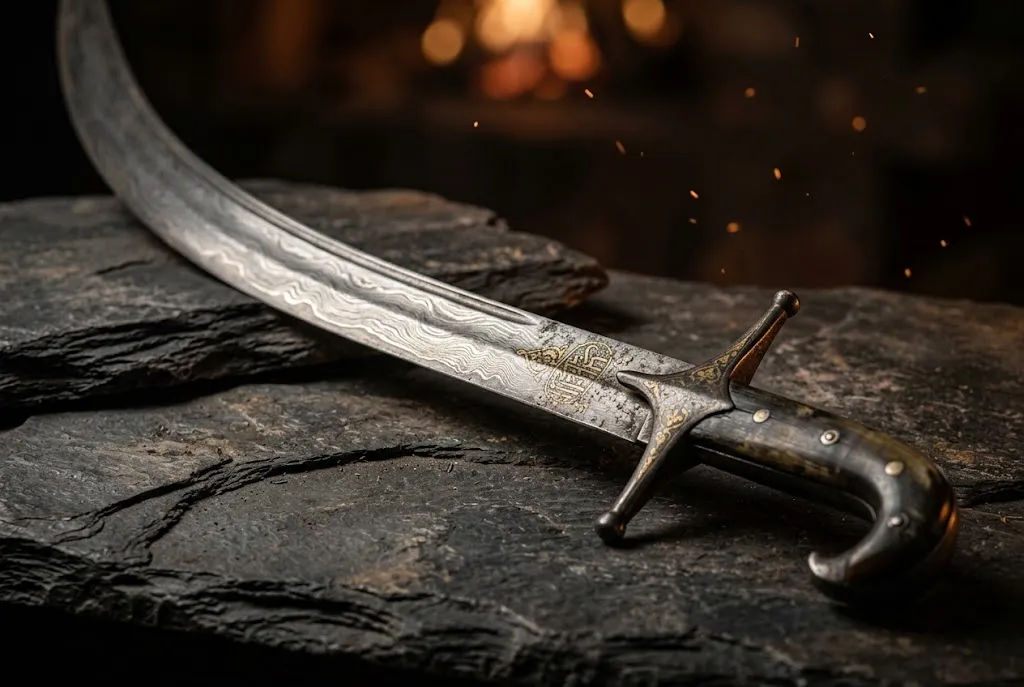
Perhaps the most famous example of a mysterious ancient metal is Damascus steel. Produced in the Near East from roughly 300 BC to 1700 AD, blades made from this steel were renowned for their distinctive watery ripple pattern (called wootz) and their legendary strength, sharpness, and flexibility. For centuries, the exact method of its creation was lost, becoming one of history's great metallurgical puzzles. Modern scientists have spent decades trying to reverse-engineer its secrets.
What makes Damascus steel so relevant to our discussion of "self-healing"? The answer lies in its unique microstructure. Studies, particularly those by Peter Paufler and his team at Dresden University of Technology, revealed that genuine Damascus steel contained carbon nanotubes and cementite nanowires. These incredible structures, normally associated with 21st-century nanotechnology, were seemingly present in ancient blades. You can read more about this fascinating discovery on Wikipedia's page about Damascus steel (opens in a new tab).
How Carbon Nanotubes Could Impart Resilience:
- Exceptional Strength and Toughness: Carbon nanotubes are among the strongest and stiffest materials known. Their presence within the steel matrix would significantly enhance the blade's overall strength without sacrificing flexibility.
- Crack Resistance: The network of nanotubes and carbide particles could act as a barrier to micro-crack propagation. Instead of a crack running unimpeded through the metal, it might be deflected, blunted, or even arrested by these structures. This isn't true self-healing, where material regenerates, but it's a form of damage tolerance that prevents small defects from becoming catastrophic failures.
- Fatigue Resistance: Metals often fail due to repeated stress, a process called fatigue. If the nanostructures could dissipate stress or prevent the formation of fatigue cracks, the metal would effectively last longer and resist wear in a way that might have seemed magical to observers.
While it's unlikely ancient Damascus steel truly "healed" in the biological sense of growing new material, its unique composition could have given it an extraordinary capacity to resist damage and maintain structural integrity. This level of resilience and durability could easily have been interpreted as a mystical property of self-renewal by people unfamiliar with its underlying science. It’s akin to how we might perceive an advanced alloy today that never seems to corrode or break – it simply defies our common understanding of material decay.
The Art of Ancient Metallurgy: Empirical Science
Ancient smiths weren't performing scientific experiments in labs, but they were master empirical scientists. Through generations of trial and error, observation, and meticulous craftsmanship, they perfected techniques. The process of creating Wootz steel (the raw material for Damascus blades) involved specific iron ores, unique charcoal from certain plants (which introduced vanadium and other trace elements), and a slow cooling process known as crucible melting. The forging process itself, including precise temperature control and repeated folding, was crucial for distributing the carbon nanotubes and carbides evenly.
This highlights a recurring theme in historical mysteries – how advanced technologies might have arisen from practical, hands-on knowledge rather than theoretical science. Like the Romans' "immortal concrete" that seems to heal with seawater (you can learn more about that here: Immortal Concrete: Did Romans Master Lost Tech?), these were not accidental discoveries but the result of deliberate, albeit empirically derived, processes.
Perhaps other ancient cultures also developed unique metallurgical processes that lent their metals similar advantages. Imagine the tales of unbreakable armor or tools that lasted for millennia. While some stories are undoubtedly exaggerated, the core idea of exceptionally durable materials isn't far-fetched.
Modern Parallels: Self-Healing in the 21st Century
Today, the quest for self-healing materials is a vibrant field of research. Scientists are developing:
- Self-Healing Polymers: These materials often incorporate microcapsules containing healing agents that rupture upon damage, filling and mending cracks.
- Self-Healing Coatings: Applied to various surfaces, these coatings can repair scratches and prolong the life of structures.
- Self-Healing Metals and Composites: Though more challenging, researchers are exploring metallic alloys and composites that can recover from fatigue damage or even micro-cracks through mechanisms like shape memory effects or embedded healing agents. You can find more comprehensive information on self-healing materials on Wikipedia (opens in a new tab).
The parallels, while not exact, are thought-provoking. If modern science is striving to create materials that minimize the impact of damage and extend lifespan, it’s not unreasonable to consider that some ancient techniques achieved a primitive form of this. The "healing" might have been subtle: a blade that maintained its edge longer, an axe head that resisted fracturing after repeated blows, or a piece of armor that could withstand numerous impacts without total failure. These properties, from a pre-scientific perspective, would indeed seem miraculous.
The Enduring Allure of Lost Knowledge
The question "Did Ancient Metals Have Self-Healing Powers?" remains a captivating one. While we don't have definitive proof of metals truly regenerating themselves, the evidence from artifacts like Damascus steel suggests a profound, empirical understanding of material science that allowed ancient smiths to create metals with extraordinary properties – properties that pushed the boundaries of what was thought possible for their time.
The pursuit of lost knowledge is not merely an academic exercise; it offers practical insights. Modern metallurgists continue to study ancient artifacts, hoping to uncover forgotten principles that could inform the next generation of advanced materials. Just as the intricate structures of ancient blades hint at nanotechnological principles, so too might other ancient technologies hold secrets yet to be fully deciphered. Perhaps the answers to some of our most complex material challenges lie hidden in the annals of history, waiting for us to rediscover them. It makes you wonder what else our ancestors knew that we've forgotten, doesn't it?
Conclusion
The idea of ancient self-healing metals blurs the line between myth and advanced historical technology. While not 'healing' in the biological sense, the incredible resilience and damage tolerance of materials like Damascus steel, achieved through sophisticated, empirically derived metallurgical processes, undoubtedly contributed to their legendary status. As we continue to delve into the secrets of the past, we might find that our ancestors were far more technologically savvy than we often give them credit for, mastering arts that still spark our curiosity and inspire modern innovation.



Conversation1
Hello