The cosmos is a vast, bewildering place, full of wonders that stretch the limits of our understanding. For centuries, humanity has gazed upwards, charting stars, mapping constellations, and slowly, painstakingly piecing together the grand tapestry of the universe. Yet, even with our most advanced telescopes and sophisticated models, some mysteries persist, defying easy explanation and hinting at forces far beyond our immediate grasp.
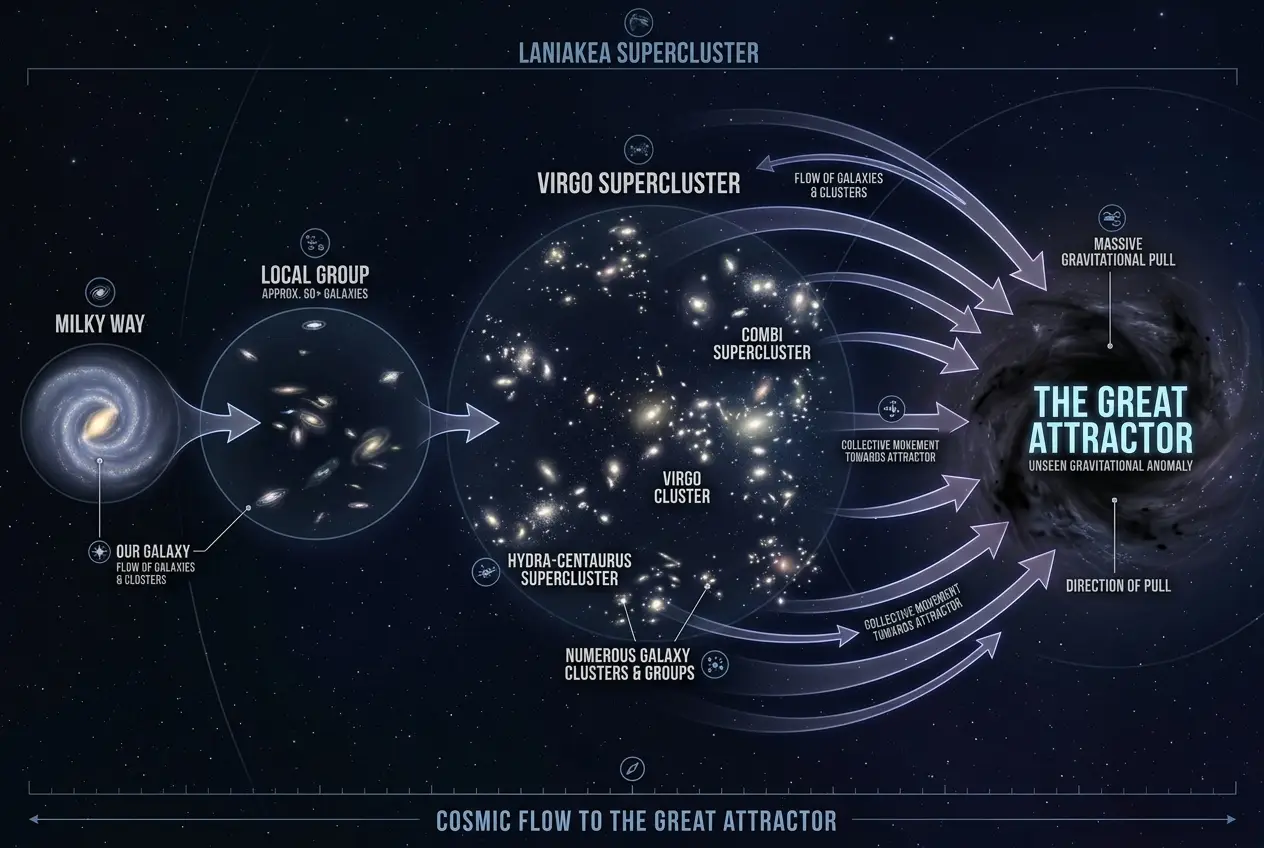
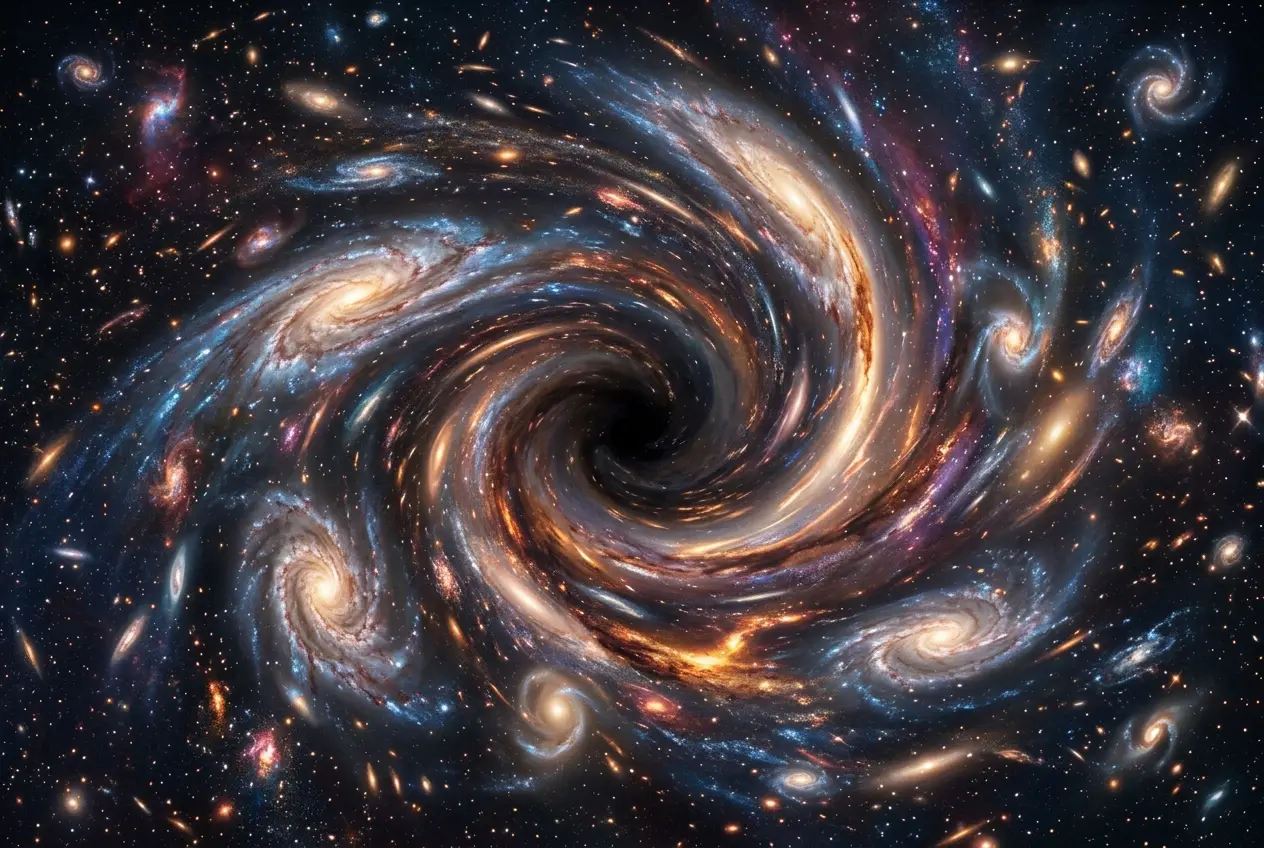
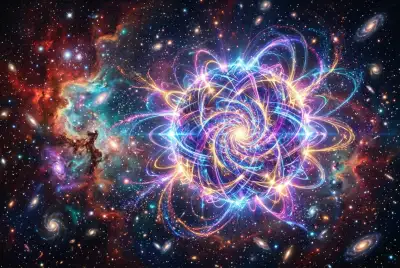
One such enigma is a gravitational anomaly so colossal that it's tugging not just our Milky Way, but hundreds of thousands of other galaxies towards it. Imagine an invisible cosmic magnet, silently exerting its immense will across billions of light-years, drawing entire galactic superclusters into its embrace. This isn't science fiction; it's a real, observed phenomenon that astrophysicists call **The Great Attractor**.
## Unveiling a Cosmic Enigma
The story of the Great Attractor began, as many astronomical discoveries do, with a slight deviation. In the 1970s and 80s, astronomers noticed that the Milky Way and its neighbouring galaxies weren't moving exactly as predicted by the expansion of the universe. Instead of simply flowing outwards with the cosmic tide, they appeared to be experiencing an additional, powerful gravitational pull, almost as if they were falling towards something unseen.
This observed velocity, known as peculiar velocity, was a critical clue. Our local group of galaxies, including the Andromeda galaxy, is moving towards a specific region of space at roughly 600 kilometers per second (about 1.3 million miles per hour). This is a staggering speed, indicative of an immense mass concentration.
For a long time, the source of this pull remained elusive, shrouded behind what astronomers call the **"Zone of Avoidance"**. This region of the sky is obscured by the dust and gas in our own Milky Way galaxy, making it incredibly difficult to observe what lies beyond using visible light telescopes. It’s like trying to see a distant city through a dense fog – our own galactic fog blocks the view.
## The Search Through the Zone of Avoidance
Overcoming the Zone of Avoidance required ingenuity and different observational techniques. Astronomers turned to technologies that could penetrate the obscuring galactic dust, such as X-ray and radio telescopes. These instruments allowed them to peer through the veil, revealing hidden structures and providing crucial data about the distribution of matter in the universe.
The breakthrough came with extensive surveys using infrared radiation, which can largely bypass dust clouds. Missions like the **Infrared Astronomical Satellite (IRAS)** and later, the **Cosmic Background Explorer (COBE)**, helped map the sky in ways previously impossible. These surveys began to reveal massive clusters of galaxies in the direction of the mysterious pull.
What they found was not a single, giant black hole or an exotic cosmic object, but rather a vast, diffuse concentration of matter: the **Norma Cluster** and several other superclusters. These structures, located roughly 150 to 250 million light-years away in the direction of the constellations Triangulum Australe and Norma, are immensely massive, comprising thousands of galaxies. Their collective gravitational force is indeed powerful enough to explain the observed peculiar velocities.
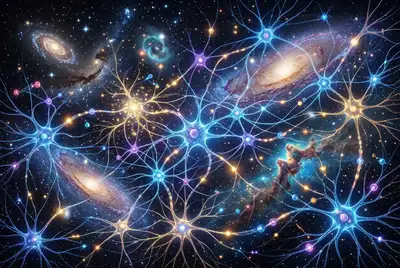
However, the Great Attractor isn't just one cluster; it's a more complex, extended structure. It's part of an even larger cosmic web, a filamentary structure of galaxies, gas, and dark matter that permeates the universe. Think of it as a vast, invisible cosmic river, with our galaxy, and thousands of others, flowing downstream.
## The Role of Dark Matter
When we talk about cosmic gravity on such immense scales, we cannot ignore **dark matter**. We still can't directly observe dark matter, but its gravitational effects are undeniable. Scientists estimate that dark matter makes up about 27% of the universe's total mass-energy content, far outweighing the ordinary matter (baryonic matter) that forms stars, planets, and us. Without dark matter, the gravitational pull attributed to the Great Attractor simply wouldn't be strong enough.
The Great Attractor, therefore, is not just a collection of visible galaxies. It's an enormous region where both visible matter and a significant concentration of invisible dark matter have accumulated. This immense reservoir of mass acts as a gravitational well, drawing in everything within its sphere of influence. Understanding its full extent requires mapping not just the luminous galaxies but inferring the distribution of dark matter through its gravitational lensing effects and galactic motions. For a deeper dive into the universe's invisible components, you might want to read our article on whether [Dark Matter hides a universe we can't see](https://curiositydiaries.com/blogs/does-dark-matter-hide-a-universe-we-cant-see-2793).
## Our Place in the Cosmic Flow
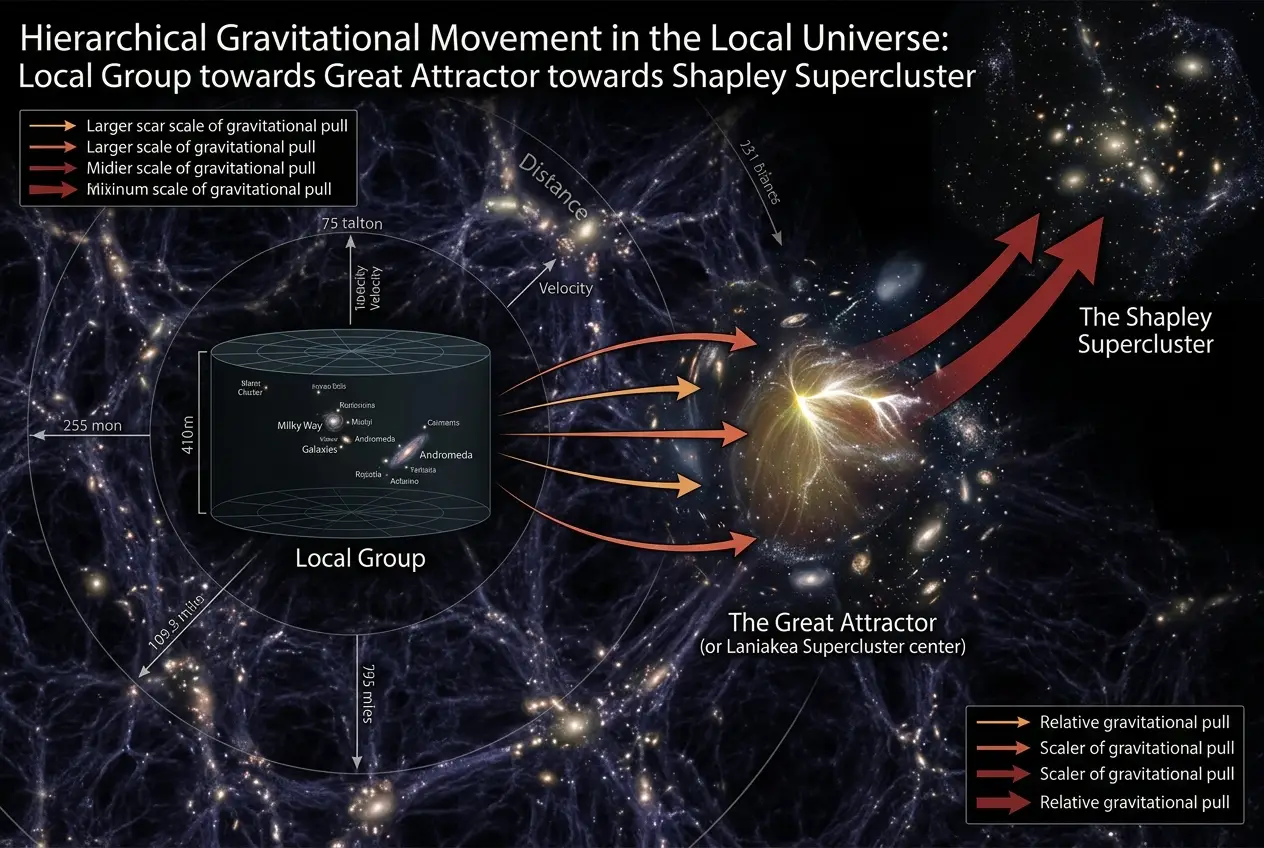
The Great Attractor isn't the final destination of our cosmic journey. Recent research, particularly from projects like the **Dark Energy Survey (DES)** and the **Hubble Space Telescope**, has revealed that the Great Attractor itself is being pulled towards an even larger, more distant structure: the **Shapley Supercluster**.
The Shapley Supercluster, located about 650 million light-years away, is the most massive known concentration of galaxies in our nearby universe. It’s so massive that it forms the gravitational center of a vast region of space, with the Great Attractor playing a subordinate role. So, while we are falling towards the Great Attractor, the Great Attractor is simultaneously falling towards Shapley. It's a cosmic cascade of gravitational dominance!
This nested hierarchy of gravitational pulls gives us a profound perspective on our place in the universe. We are not static, nor are we merely expanding outwards. We are part of an intricate cosmic dance, constantly moving, constantly falling towards larger and larger gravitational wells.
## What Does This Mean for the Future?
Does this mean our galaxy will eventually collide with the Great Attractor or the Shapley Supercluster? In a way, yes, but not in any way that poses an immediate threat to life on Earth. The scales of time and distance in the cosmos are immense. Our Milky Way is already on a collision course with the Andromeda galaxy, a process that will take billions of years to unfold. The eventual "fall" towards the Great Attractor and then Shapley will be a much slower, grander gravitational dance spanning tens of billions of years.
Moreover, the universe is also expanding, and this expansion is accelerating due to **dark energy**. This means that while local gravitational forces like the Great Attractor and Shapley Supercluster dominate on smaller scales, the overall expansion of space will eventually win out on the largest scales. Galaxies that are sufficiently far apart will eventually be stretched away from each other faster than gravity can pull them together.
"The ultimate fate of our local group, and indeed the entire universe, is a delicate balance between the relentless tug of gravity and the accelerating push of dark energy," notes Dr. Katie Mack, a theoretical astrophysicist, in her popular science book "The End of Everything (Astrophysically Speaking)". She elaborates on how the universe's expansion could eventually isolate galaxies, making us truly alone in a vast, dark cosmos.
Understanding these vast gravitational flows helps us map the large-scale structure of the universe, providing crucial data for cosmological models. It allows us to test our theories of gravity, dark matter, and dark energy, pushing the boundaries of what we know about the fundamental forces shaping reality. If you're fascinated by how cosmic phenomena can influence our technology, you might also find our discussion on [how cosmic rays secretly glitch our tech](https://curiositydiaries.com/blogs/do-cosmic-rays-secretly-glitch-our-tech-3330) quite intriguing.
## Current Research and Future Prospects
The study of the Great Attractor and other large-scale structures continues to be a vibrant field of astrophysical research. New telescopes, both ground-based and space-based, are constantly providing more detailed maps of the universe. For instance, projects like the **Square Kilometre Array (SKA)**, currently under construction, promise unprecedented sensitivity in mapping hydrogen gas across vast cosmic distances, which will help unveil the distribution of both visible and dark matter with incredible precision. You can learn more about the SKA project on its official Wikipedia page: [Square Kilometre Array - Wikipedia](https://en.wikipedia.org/wiki/Square_Kilometre_Array).
Furthermore, gravitational wave observatories like **LIGO** and **Virgo**, while primarily focused on black hole and neutron star mergers, are also contributing to our understanding of the universe's large-scale structure by probing the most massive cosmic events. The synergy between different observational techniques—from visible light to radio waves to gravitational waves—is essential for painting a complete picture of these colossal cosmic forces. The European Space Agency's (ESA) Gaia mission is also precisely mapping billions of stars in our galaxy, providing crucial data for understanding the Milky Way's movement within this larger cosmic flow. More details on the Gaia mission can be found here: [Gaia (spacecraft) - Wikipedia](https://en.wikipedia.org/wiki/Gaia_(spacecraft)).
Another fascinating avenue of research involves using observations of the **Cosmic Microwave Background (CMB)**, the faint afterglow of the Big Bang. Tiny fluctuations in the CMB can reveal the primordial seeds from which these massive structures, like the Great Attractor, eventually grew. Understanding the "cold spots" and "hot spots" in the CMB can give us clues about the initial distribution of matter and energy that ultimately led to the formation of the cosmic web we observe today. For an in-depth explanation of CMB, check out its Wikipedia entry: [Cosmic Microwave Background - Wikipedia](https://en.wikipedia.org/wiki/Cosmic_Microwave_Background).
## Conclusion
The Great Attractor stands as a powerful testament to the universe's profound mysteries and the relentless forces that shape its evolution. It reminds us that we are part of an incredibly dynamic and interconnected cosmos, constantly moving, constantly under the influence of unseen gravitational giants. As technology advances, allowing us to see further and with greater clarity, we continue to unravel these cosmic enigmas, gaining a deeper appreciation for the grand, intricate dance that defines our universe. Our journey through the cosmos is far from over, and with each new discovery, the universe only grows more wonderfully complex and awe-inspiring.
Frequently Asked Questions
No, the Great Attractor is not a single black hole. It's a vast, diffuse region of space containing an enormous concentration of mass, including several massive galaxy clusters (like the Norma Cluster) and a significant amount of dark matter. Its gravitational pull comes from this collective mass, not a single point source like a black hole.
The Great Attractor was discovered indirectly by observing its gravitational effects. Astronomers noticed that our galaxy and others were moving faster and in a specific direction that couldn't be explained by the universe's expansion alone. This 'peculiar velocity' indicated an unseen source of gravity. Later, advanced telescopes using infrared and X-ray light, which can penetrate galactic dust, revealed massive galaxy clusters in that direction.
While our galaxy is indeed being pulled towards the Great Attractor, a direct collision in the traditional sense is not expected for billions of years, if ever. The universe's expansion, driven by dark energy, works against these gravitational pulls on large scales. Instead of a head-on collision, our galaxy will likely become a part of the larger supercluster structure in a very distant future, undergoing a slow, gravitational merging over cosmic timescales.
The 'Zone of Avoidance' is a region of the sky heavily obscured by the dust, gas, and stars within our own Milky Way galaxy. This makes it extremely difficult to observe distant galaxies and structures behind it using traditional optical telescopes. For a long time, the Great Attractor's location was hidden within this zone, making its identification challenging. Overcoming this observational barrier with infrared and radio telescopes was crucial to mapping the mass concentrations that constitute the Great Attractor.
Dark matter plays a crucial role in the Great Attractor's immense gravitational pull. While visible galaxies contribute some mass, the observed gravitational effect is far stronger than what ordinary matter alone could produce. Scientists believe that a significant portion of the Great Attractor's mass is composed of dark matter, an invisible substance that interacts only through gravity, but whose presence is essential to explain the movements of galaxies on such large scales.
Verified Expert
Alex Rivers
A professional researcher since age twelve, I delve into mysteries and ignite curiosity by presenting an array of compelling possibilities. I will heighten your curiosity, but by the end, you will possess profound knowledge.
Leave a Reply
Comments (0)
No approved comments yet. Be the first to share your thoughts!
 Join Us
 Unknown Author























Leave a Reply
Comments (0)