


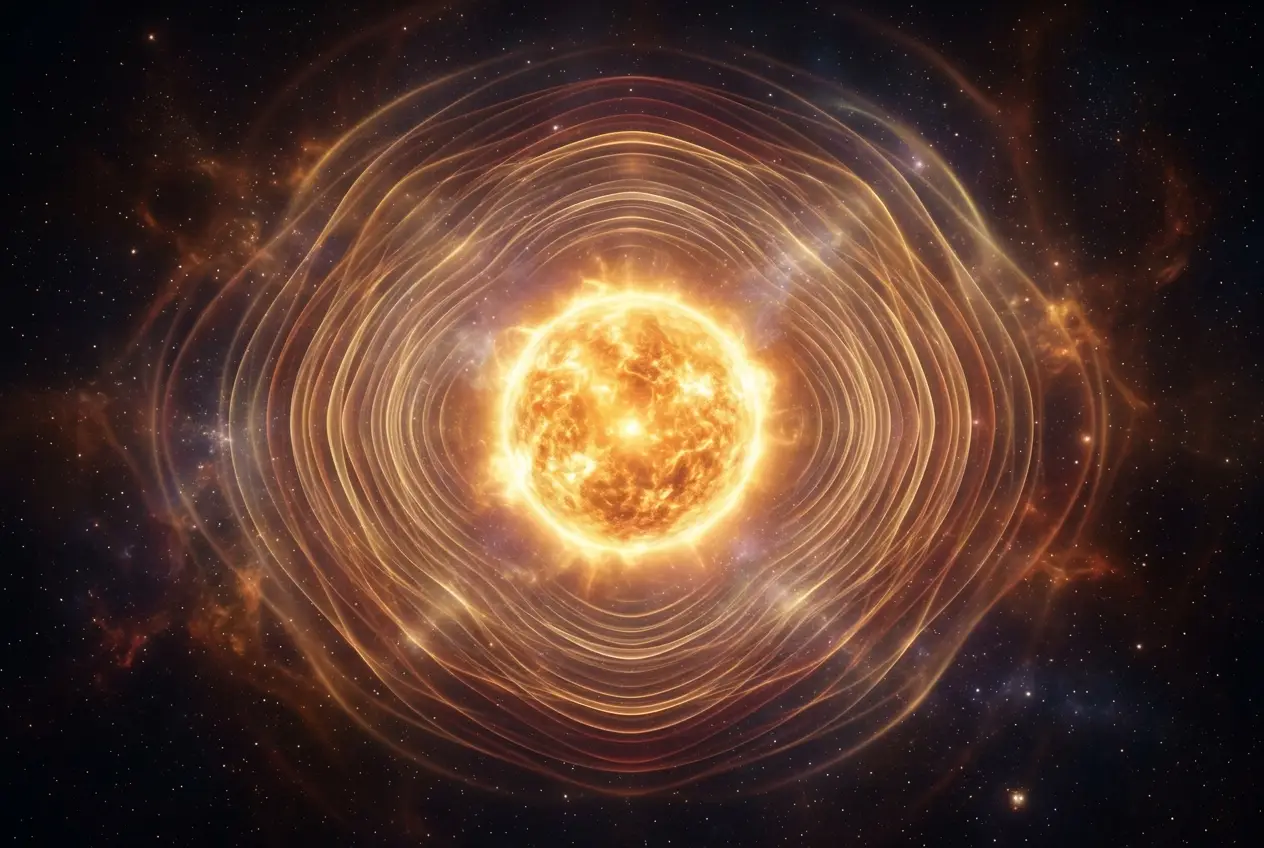
I often find myself gazing at the night sky, a vast canvas of cosmic wonders, and pondering the unseen forces and unheard melodies that govern our universe. We observe stars, galaxies, and nebulae with powerful telescopes, but what if some of the most profound secrets are not visual, but vibrational? What if our very own Sun, the life-giver of our solar system, is constantly singing a song, a deep hum that carries information we’re only just beginning to decipher? It sounds like science fiction, a cosmic symphony, yet the reality is that the Sun does hum, and its vibrations might be telling us stories far more complex than we ever imagined.
For decades, scientists have studied the Sun's oscillations, a field known as helioseismology. Much like seismologists study earthquakes to understand Earth's interior, helioseismologists analyze the Sun's surface vibrations to peer deep inside our star. These sound waves, too low in frequency for human ears to detect, reverberate through the Sun's plasma, carrying clues about its temperature, density, composition, and even its internal movements. But could this solar hum be more than just an internal diagnostic tool? Could it be a medium for cosmic messages, a fundamental whisper from the heart of our star that holds secrets about its past, its future, or even its connection to the wider cosmos? I believe the potential is immense.
The Sun's Deep Resonance: More Than Just a Stellar Belly Rumbling
Imagine the Sun not just as a burning ball of gas, but as a colossal, living bell, constantly ringing. These "sunquakes" generate millions of different acoustic waves that travel through the Sun, reflecting off its core and surface. When these waves reach the surface, they create tiny ripples – movements of plasma – that scientists can observe. The patterns of these ripples are like a cosmic Morse code, a detailed map of the Sun's inner workings.
Helioseismology has revolutionized our understanding of the Sun. Before its advent, our knowledge of the Sun's interior was largely theoretical. Now, we have direct observational evidence of things like the Sun's rotation rate at different depths, the structure of its convection zone, and even the presence of sub-surface jet streams. We've learned that the Sun is not a uniform sphere but a dynamic, swirling maelstrom of activity. You can learn more about this fascinating science on its Wikipedia page (opens in a new tab).
But here’s where the curiosity truly sparks: if these vibrations are so rich in internal data, could they also be influenced by external cosmic phenomena? What if distant gravitational ripples, passing through our solar system, leave an imprint on the Sun’s hum? Or could the Sun's hum itself be generating subtle ripples in spacetime, communicating with other celestial bodies in ways we haven't yet conceived?
Decoding the Unheard: From Solar Flares to Gravitational Waves
The Sun is a dynamic entity, constantly undergoing massive explosions like solar flares and coronal mass ejections. These energetic events are known to impact Earth, potentially causing geomagnetic storms that can disrupt satellites, power grids, and communication systems. (For more on these effects, read our blog on could solar storms ignite digital chaos?). I often wonder if the Sun's internal hum acts as a precursor, a subtle change in its symphony that precedes these dramatic outbursts. Some research already suggests that changes in solar oscillations can predict solar flares hours before they occur, acting as a natural early warning system.
Consider the concept of neutrinos, those elusive, nearly massless particles that stream from the Sun’s core, passing through matter as if it weren't there. The Sun emits trillions of neutrinos every second, and their properties and oscillations carry information about the nuclear fusion processes within the Sun. Could the solar hum, in some mysterious way, be entangled with the quantum dance of neutrinos? While it sounds far-fetched, the universe often reveals connections where we least expect them. The study of solar oscillation (opens in a new tab) continues to reveal new layers of complexity.
Moreover, the detection of gravitational waves by experiments like LIGO has opened a new window into the universe. These ripples in spacetime, generated by colossal cosmic events like merging black holes, stretch and compress everything in their path. If a powerful gravitational wave were to pass through our solar system, even subtly, could it momentarily alter the Sun's internal structure enough to change its hum? Imagine if our Sun’s vibrations could become a natural gravitational wave detector, offering a continuous, subtle readout of cosmic cataclysms far beyond our direct observation. This would be a profound leap in our ability to sense the universe’s most extreme phenomena. The idea of cosmic ripples is also explored in our piece, do gravity waves warp time?.
The Search for a Stellar Language
What if the Sun’s hum isn't just a byproduct of its internal physics, but a form of communication? This might sound like pure speculation, but consider the possibility. Every star in the universe has its own unique set of oscillations, its own "stellar song." These stellar vibrations are influenced by a star's mass, age, composition, and internal dynamics. If we could develop sufficiently advanced sensors and analytical tools, could we differentiate between the "normal" hum and anomalies that suggest external influences or even intentional patterns?
Think about how pulsars emit highly regular radio waves, acting like cosmic lighthouses or clocks. (Our blog, pulsars: can these cosmic clocks guide future explorers? delves deeper into this). While the Sun's hum isn't a direct radio signal, the information encoded within its complex wave patterns could, theoretically, be far richer. Could changes in the hum indicate the presence of exotic matter, unseen planets, or even the subtle gravitational tug of a distant, massive object?
The challenge lies in filtering out the Sun's natural chaos from any potential "signal." Our Sun is a turbulent, energetic beast, and its hum is a cacophony of overlapping frequencies. It's like trying to hear a specific melody in a raging storm. However, with advancements in artificial intelligence and machine learning, coupled with ever more sensitive observational techniques, the seemingly impossible might become plausible. Imagine AI algorithms trained to detect minute, non-random deviations in the Sun's hum – patterns that don't fit the standard model of solar physics. These could be the first clues to a deeper, more profound cosmic interaction. For example, fast radio bursts represent another type of mysterious cosmic signal we are still trying to understand.
Future Tech: Listening to the Cosmos's Deepest Notes
The exploration of the Sun’s hum as a potential cosmic information highway is still largely in its infancy, driven by curiosity and theoretical physics. However, the trajectory of scientific discovery often begins with such bold questions. Future missions, perhaps even dedicated helioseismology observatories in space, could provide unprecedented data accuracy, allowing us to build more detailed "sonograms" of our star.
The applications of such knowledge are mind-boggling. If we could reliably interpret anomalies in the Sun's hum:
- Advanced Space Weather Prediction: Greater lead times for predicting solar flares and coronal mass ejections, protecting our technology and astronauts.
- Early Warning for Cosmic Events: Detecting passing gravitational waves or the approach of unknown celestial objects long before they are optically visible.
- Unveiling Dark Matter Interactions: Subtle influences on the Sun's interior might be detectable through helioseismology, offering a new way to study elusive dark matter.
- A New Form of Cosmic Archaeology: The hum might contain residual "echoes" from the Sun's formation, or even its passage through different regions of the galaxy.
One of the most exciting theoretical possibilities is the potential to detect signatures of neutrino oscillations – the phenomenon where neutrinos change type – not just directly, but also through their subtle gravitational effects on the Sun’s acoustic waves. The intricate dance of these particles, constantly shape-shifting, could be influencing the very fabric of our star's vibrations. More on neutrinos can be found on Wikipedia (opens in a new tab).
Conclusion: The Sun's Unending Song
The Sun's hum is far more than just background noise; it is a complex, data-rich phenomenon that continues to challenge and inspire scientists. While the idea of deciphering cosmic messages from these stellar vibrations might still reside on the fringes of current scientific capability, the history of science is replete with examples of what was once considered impossible becoming reality. As our technology advances, and our understanding of physics deepens, I believe we are moving closer to a future where we can truly listen to the Sun’s song, not just as a natural marvel, but as a potential conduit to the universe's most profound secrets. The Sun is singing, and we are finally learning to listen.

Conversation0
No comments yet. Be the first to share a thought — the best questions often become new stories.