


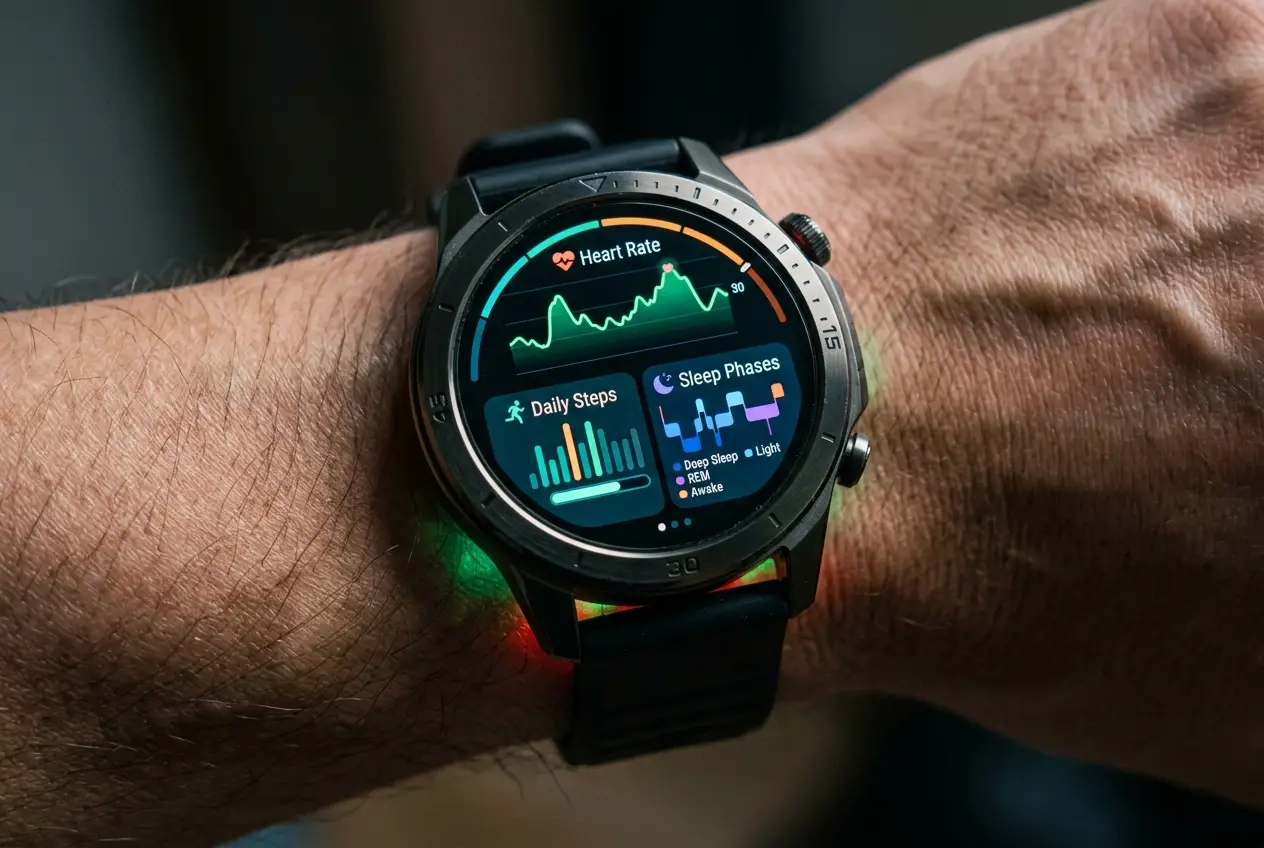
I remember the first time I strapped on a smartwatch. It felt like a piece of the future on my wrist – sleek, responsive, and promising a glimpse into my own biology. Little did I know, this seemingly simple gadget was a marvel of miniaturized engineering, constantly peering into my body, collecting data, and trying to decipher the secrets of my well-being. But how exactly does this tiny device achieve such a feat? Is it truly "seeing" our health, or merely making educated guesses?
It’s a question many of us ponder as we glance at our daily step counts or receive an alert about an unusual heart rhythm. The truth lies in a sophisticated symphony of miniature sensors, clever algorithms, and a dash of artificial intelligence that together transform raw biological signals into actionable insights. Let's pull back the curtain and unravel the incredible technology that makes your smartwatch an indispensable health companion.
The Heartbeat Whisperer: Photoplethysmography (PPG)
One of the most fundamental features of any smartwatch is its ability to measure your heart rate. If you've ever flipped your watch over, you've probably noticed a flashing green light. This isn't just for show; it's the core of how your watch monitors your pulse using a technique called Photoplethysmography (PPG).
How It Works: The green LED lights emit light onto your skin. Blood, being red, absorbs green light more effectively than other colors. When your heart beats, blood flow to your wrist momentarily increases, leading to more green light absorption. As your heart relaxes, blood flow decreases, and less green light is absorbed. Tiny photodetectors on the watch back measure these fluctuations in absorbed light. These minute changes are then translated into a pulse wave, which the watch's internal processor uses to calculate your heart rate.
Real-Life Connection: This ingenious method is why your watch glows green when it measures your heart rate. It's also why accuracy can sometimes be affected by factors like skin tone, tattoos, or excessive movement. Darker skin tones or tattoos might absorb more light, requiring the watch to work harder to get a clear signal, which can sometimes lead to slightly varied readings. To learn more about how light interacts with technology, you might find our blog on how touchscreens sense your finger fascinating, as it also delves into sensor technology: How Do Touchscreens Really Sense Your Finger? (opens in a new tab).
You can find more detailed information about Photoplethysmography on Wikipedia (opens in a new tab).
The Movement Maestro: Accelerometer and Gyroscope
Beyond your heartbeat, your smartwatch is a diligent observer of your movements. Every step you take, every gesture you make, every time you fall – these are often detected by a powerful duo: the accelerometer and the gyroscope.
How They Work:
- Accelerometer: This sensor measures non-gravitational acceleration. In simpler terms, it detects linear motion along three axes (X, Y, Z). When you take a step, your wrist moves up and down, side to side, and forward and backward. The accelerometer picks up these distinct patterns of acceleration.
- Gyroscope: Complementing the accelerometer, the gyroscope measures angular velocity or rotational motion. If you swing your arm, turn your wrist, or even just rotate your body, the gyroscope quantifies these rotational changes.
Together, these sensors provide a comprehensive picture of your motion. Algorithms process the combined data to distinguish between walking, running, cycling, or even just sitting still. They are crucial for features like step counting, distance tracking, calorie estimation, and even sophisticated fall detection systems that can alert emergency contacts.
Real-Life Connection: This powerful sensor combo is why your watch knows if you're walking, running, or even just fidgeting. It also explains why some fitness trackers can sometimes be "tricked" by repetitive arm movements that aren't actual steps, highlighting the importance of proper algorithms to filter out noise.
For a deeper dive into accelerometers, check out their Wikipedia page (opens in a new tab). Gyroscopes also have extensive information on Wikipedia (opens in a new tab).
The Sleep Detective: Unpacking Your Rest
Your smartwatch isn't just awake when you are; it's also quietly observing you as you sleep. By combining data from the PPG sensor and the accelerometer/gyroscope, smartwatches attempt to decipher your sleep cycles.
How It Works: During sleep, your heart rate fluctuates (often dropping during deep sleep and increasing during REM), and your body moves differently in various sleep stages. The accelerometer detects your movements – tossing, turning, or stillness. The PPG sensor monitors your heart rate variability. Sophisticated algorithms analyze these patterns, inferring whether you are in light sleep, deep sleep, or the dream-rich REM stage.
Real-Life Connection: While incredibly insightful for tracking trends, it's important to remember that consumer smartwatches aren't medical-grade sleep labs. They infer sleep stages based on movement and heart rate, which is why their accuracy, while good for general tracking, cannot definitively diagnose sleep disorders like clinical polysomnography can.
Beyond the Basics: ECG and SpO2 (Advanced Sensors)
Many modern smartwatches go beyond basic heart rate and movement, incorporating advanced sensors to offer deeper health insights.
Electrocardiogram (ECG)
Some smartwatches include an ECG (Electrocardiogram) function. Unlike the continuous heart rate monitoring which uses PPG, an ECG measures the electrical signals of your heart directly.
How It Works: By placing a finger on the watch's crown or a specific sensor, the smartwatch completes a circuit across your body. It then records the electrical impulses that cause your heart to beat. These electrical waves are unique and can reveal much about your heart's rhythm. The primary use for smartwatch ECGs is to detect signs of Atrial Fibrillation (AFib), an irregular heart rhythm that can increase the risk of stroke.
SpO2 (Blood Oxygen Saturation)
Another increasingly common sensor is the SpO2 (Blood Oxygen Saturation) monitor. This measures the percentage of oxygen-carrying hemoglobin in your red blood cells.
How It Works: Similar to PPG, SpO2 sensors use light, but typically both red and infrared light. Oxygenated blood absorbs more infrared light and reflects more red light, while deoxygenated blood does the opposite. By shining these lights through your skin and measuring the amount reflected back, the watch can calculate your blood oxygen levels.
Real-Life Connection: These advanced sensors are why some smartwatches can alert you to potential atrial fibrillation or dangerously low blood oxygen levels, offering an early warning system for serious conditions. For instance, consistent low SpO2 readings during sleep could indicate conditions like sleep apnea.
You can learn more about Electrocardiography on its Wikipedia page (opens in a new tab) and Pulse Oximetry (SpO2) on its Wikipedia page (opens in a new tab).
The Brain of the Operation: AI and Algorithms
Raw sensor data is just noise without intelligence to interpret it. This is where sophisticated algorithms and Artificial Intelligence (AI) come into play. The tiny computer inside your smartwatch is constantly crunching numbers, looking for patterns, and making sense of the influx of data.
How It Works:
- Signal Processing: The initial data from sensors is often noisy. Algorithms filter out irrelevant signals and enhance the clear ones.
- Pattern Recognition: Machine learning models are trained on vast datasets of human activity and biological signals. These models learn to recognize specific patterns, such as the distinct accelerometer signature of a running stride versus a brisk walk, or the subtle heart rate changes indicative of different sleep stages.
- Personalization: Your smartwatch's AI continuously learns your unique physiological patterns and activity levels. This is why it often gets better at identifying your activities and providing more accurate calorie burn estimates over time, adapting to your individual nuances.
Real-Life Connection: The AI in your watch isn't just a generic program; it’s designed to understand you. This continuous learning is why your watch becomes more effective at giving you personalized insights, making its recommendations and alerts increasingly relevant. To delve deeper into how AI learns and evolves, you might be interested in our blog about how AI mimics cosmic evolution: Does AI Mimic Cosmic Evolution? (opens in a new tab).
The Big Picture: Insights, Not Diagnoses
The convergence of these miniature sensors and powerful AI creates a remarkable tool for personal health awareness. Your smartwatch provides invaluable insights into your activity levels, cardiovascular health, and sleep patterns, empowering you to make healthier lifestyle choices.
However, it's crucial to understand their limitations. Smartwatches are consumer devices designed for wellness and fitness tracking, not medical diagnostics. While they can detect anomalies and provide early warnings, they are not a substitute for professional medical advice. Always consult a healthcare professional for any health concerns or before making significant changes to your health regimen based on smartwatch data.
The journey of the smartwatch from a simple time-telling device to a sophisticated health monitor is a testament to the relentless pace of technological innovation. It's a tiny window into the complex world within us, constantly pushing the boundaries of what's possible on our wrists.




Conversation0
No comments yet. Be the first to share a thought — the best questions often become new stories.