


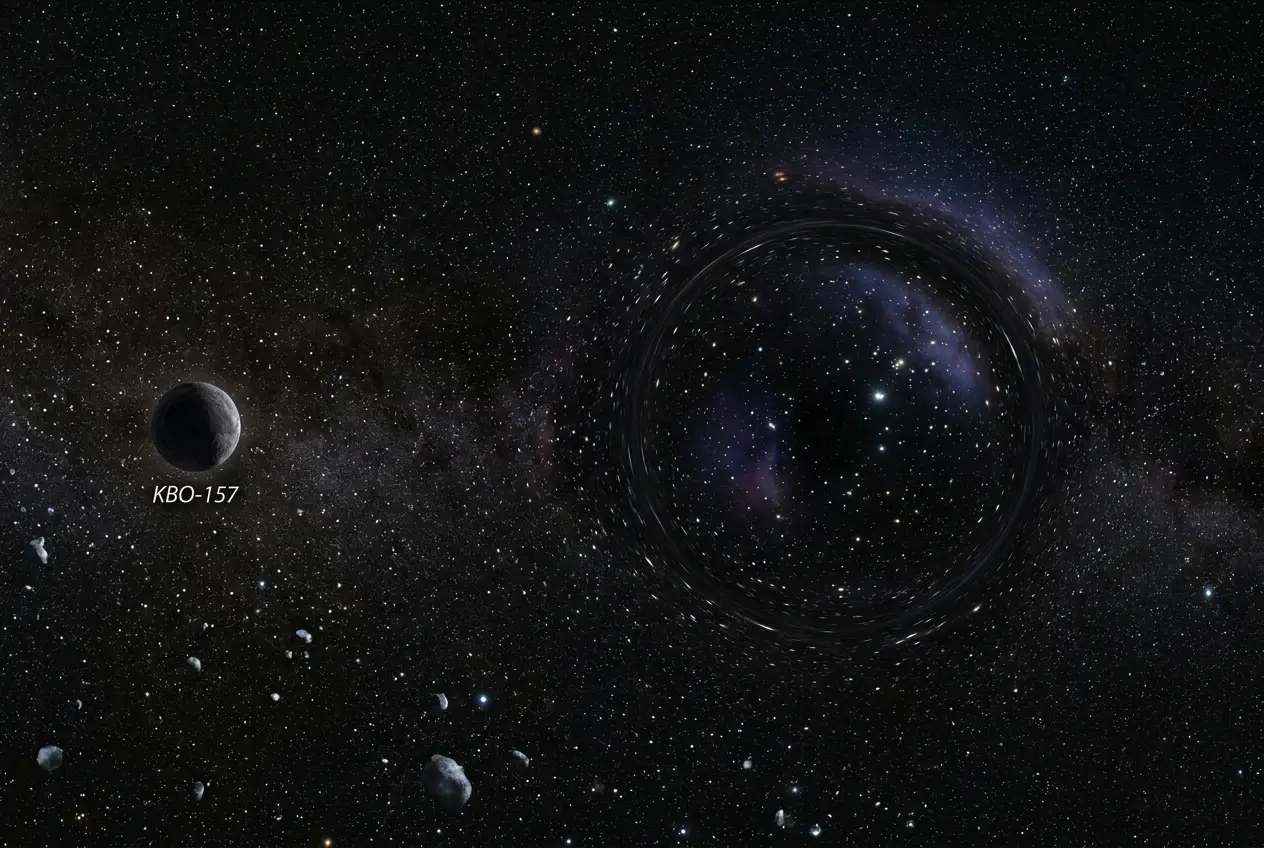
I remember staring up at the night sky as a child, utterly convinced there were endless mysteries lurking just beyond the reach of our telescopes. That sense of wonder hasn't faded; in fact, it's only grown stronger as I delve into the cutting-edge theories of modern astrophysics. Recently, a theory has been making waves that is so mind-bending, it feels straight out of a sci-fi novel: what if the elusive Planet Nine isn't a planet at all, but something far stranger—a primordial black hole?
For years, astronomers have observed peculiar orbital patterns in the distant Kuiper Belt, a region of icy bodies beyond Neptune. These distant objects seem to be shepherded by an unseen gravitational force, leading to the hypothesis of a massive, undiscovered planet – the fabled Planet Nine. But a growing number of scientists are now daring to ask: what if this isn't just a bigger, colder version of Earth or Neptune, but a relic from the universe’s earliest moments, a tiny, ancient black hole? It's a question that completely redefines our search for cosmic neighbors and could unveil a new type of dark matter.
The Mystery of Planet Nine: Gravitational Clues in the Cold Void
The story begins not with a direct sighting, but with a cosmic whisper. In 2016, astronomers Konstantin Batygin and Mike Brown at Caltech presented compelling evidence for the existence of a ninth major planet in our solar system. Their observations focused on the anomalous orbits of several extreme trans-Neptunian objects (ETNOs), bodies whose elongated paths are tilted in an odd, synchronized way. Imagine a fleet of tiny boats in a massive, swirling ocean, all inexplicably circling a hidden vortex. That’s essentially what we’re seeing in the outer solar system.
These ETNOs exhibit a gravitational clustering that defies random chance. Their orbits are not only highly elliptical but also tend to point in the same direction, and their planes are tilted similarly. The probability of this occurring naturally without an external influence is astonishingly low, somewhere around 0.007%. This statistical anomaly strongly suggests the presence of a massive perturbing body – something around 5 to 10 times the mass of Earth – pulling these distant icy worlds into alignment. For a deeper dive into unusual cosmic behaviors, you might find our article on if strange radio bursts signal alien tech equally fascinating.
Traditional searches for Planet Nine have focused on finding a large, icy gas giant using infrared telescopes. However, after years of searching, direct detection has remained elusive. This lack of a clear sighting, despite the strong gravitational evidence, has opened the door for more exotic explanations.
Enter the Primordial Black Hole: A Universe's Leftover
This is where the idea of a primordial black hole (PBH) comes into play. Unlike the stellar-mass black holes formed from the collapse of massive stars, primordial black holes are theorized to have formed in the early universe, mere moments after the Big Bang, from density fluctuations in the primordial plasma. They could range in size from microscopic to thousands of times the mass of our Sun. A PBH with a mass 5 to 10 times that of Earth would be incredibly compact, perhaps only a few centimeters in diameter – smaller than a bowling ball!
Think about that for a moment: a super-dense, invisible object, a cosmic bullet, silently orbiting our Sun at its outermost reaches. Its tiny size makes it incredibly difficult to detect using conventional optical or infrared telescopes, which are designed to spot planets by their reflected light or emitted heat. A PBH would emit almost no light, nor would it reflect much. Its presence would be known only through its gravitational effects. This is where the challenge—and the thrill—lies.
The concept of primordial black holes isn't new. It was first explored by Stephen Hawking and Bernard Carr in the early 1970s. These ancient cosmic remnants are also considered potential candidates for dark matter, the mysterious substance that makes up about 27% of the universe but doesn't interact with light. If Planet Nine truly is a PBH, it would not only solve a solar system mystery but also offer the first direct evidence of a new class of dark matter. To learn more about the universe's unseen components, check out our exploration of whether dark matter is a cosmic communication network.
How Do We Find an Invisible Neighbor?
So, if we can't see it, how do we prove it's there? Scientists are proposing ingenious methods to hunt for this elusive gravitational anomaly:
-
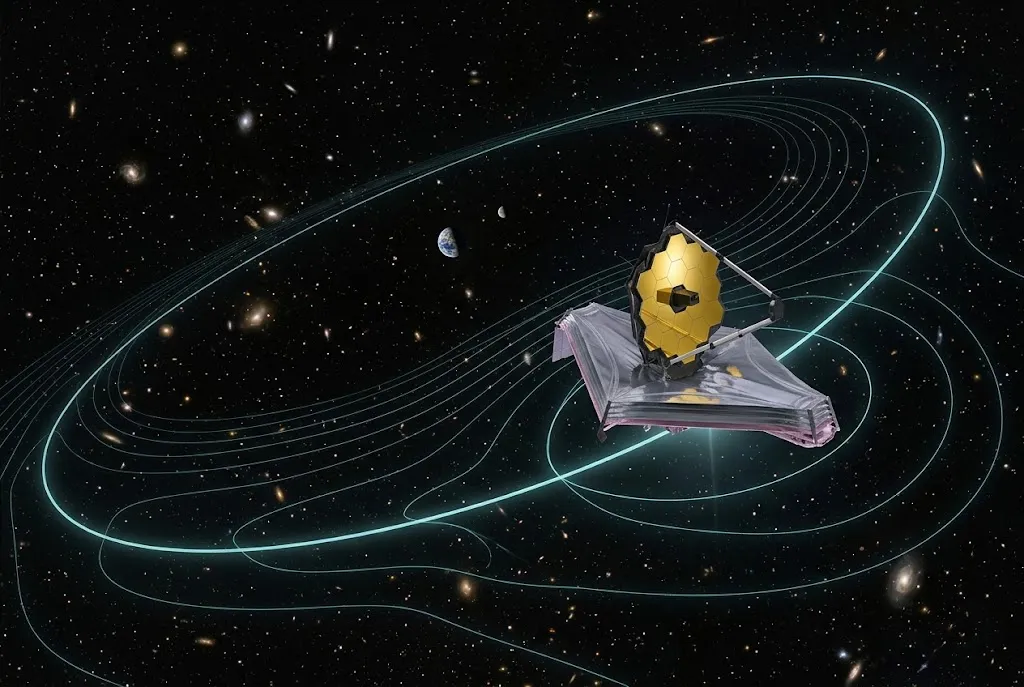
Gravitational Microlensing: This is the most promising method. When a compact, massive object (like a PBH) passes in front of a more distant star, its gravity can bend and magnify the star's light. This creates a temporary brightening of the background star, a phenomenon called microlensing. Telescopes like the Vera C. Rubin Observatory (formerly LSST), currently under construction, are designed to survey vast swathes of the sky repeatedly, making them ideal for catching these fleeting microlensing events. If Planet Nine is a PBH, we might see microlensing events as it passes in front of the millions of stars in the galactic plane. This could also offer insights into the properties of black holes as nature's ultimate quantum computers.
-
Accretion Flares: While a PBH in the cold, sparse outer solar system wouldn't have much gas and dust to feed on, it might occasionally accrete stray matter, such as small asteroids or comets. As this matter falls into the black hole, it would heat up and emit X-rays or gamma rays, creating a detectable flare. However, such events would likely be rare and difficult to predict.
-
Anomalous Heating of Kuiper Belt Objects: A PBH would still generate tidal forces, and if it has a small, icy moon, it could cause internal friction and heating. Detecting such a heated moon could indirectly point to the presence of a PBH. However, finding such a tiny moon would be incredibly challenging.
"The idea that Planet Nine could be a primordial black hole is compelling because it provides a single explanation for both the gravitational evidence and the difficulty of direct detection," says Dr. James Scholtz, one of the proponents of the PBH hypothesis. "It moves beyond merely speculating about a new planet to exploring a fundamental aspect of cosmic history."
The Stakes Are High: Redefining Our Solar System and Beyond
If Planet Nine turns out to be a primordial black hole, the implications would be enormous.
- Our Solar System's Identity: It would force us to rethink the very definition of a "solar system." Instead of just planets, asteroids, and comets, we might have a tiny black hole as a permanent resident. This would be a groundbreaking discovery, altering textbooks and expanding our understanding of stellar neighborhoods.
- Dark Matter Unveiled: Finding a PBH in our own backyard would be direct evidence for a form of dark matter that has eluded us for decades. It could provide crucial clues to the nature of this mysterious cosmic component, shedding light on the early universe and galactic evolution. This would be a massive leap in our understanding of the universe, possibly as significant as realizing the universe itself might be a hologram.
- New Cosmic Hunting Grounds: It would open up entirely new avenues for searching for other PBHs throughout the galaxy, potentially revealing a hidden population of these ancient objects that contribute significantly to the universe's mass budget.
The search for Planet Nine, whether it’s a massive planet or a primordial black hole, is a testament to humanity’s enduring curiosity and our relentless pursuit of knowledge. It’s a journey into the unknown, driven by subtle gravitational clues and powered by ever-advancing technology. It's a reminder that even in our own cosmic backyard, the universe still holds incredible secrets, waiting to be unearthed by diligent observation and bold scientific theories.
I, for one, can't wait to see what the next generation of telescopes reveals. The possibility that we might soon discover a piece of the early universe, a relic from the Big Bang, orbiting our very own Sun, is an idea that fills me with profound awe.
Conclusion: A Tiny Door to a Vast Universe
The theory that Planet Nine could be a primordial black hole isn't just a quirky idea; it's a serious scientific hypothesis being investigated by leading astronomers. It challenges our preconceived notions about what makes up a solar system and pushes the boundaries of our search for dark matter. Whether it's a giant icy planet or a miniature black hole, one thing is certain: the outer reaches of our solar system are far more mysterious and exciting than we ever imagined. The hunt is on, and the potential discoveries could redefine our place in the cosmos.
References:
Conversation0
No comments yet. Be the first to share a thought — the best questions often become new stories.