I remember the first time I truly pondered the vastness of the universe. Not just the seemingly endless stretch of stars and galaxies, but the very *stuff* everything is made of. We learn in school about atoms, then protons, neutrons, electrons, and eventually, quarks. But what if the journey into the infinitely small doesn't end there? What if, at the very bedrock of existence, we find not particles, but tiny, vibrating threads—strings that hum a cosmic symphony, composing all of reality?
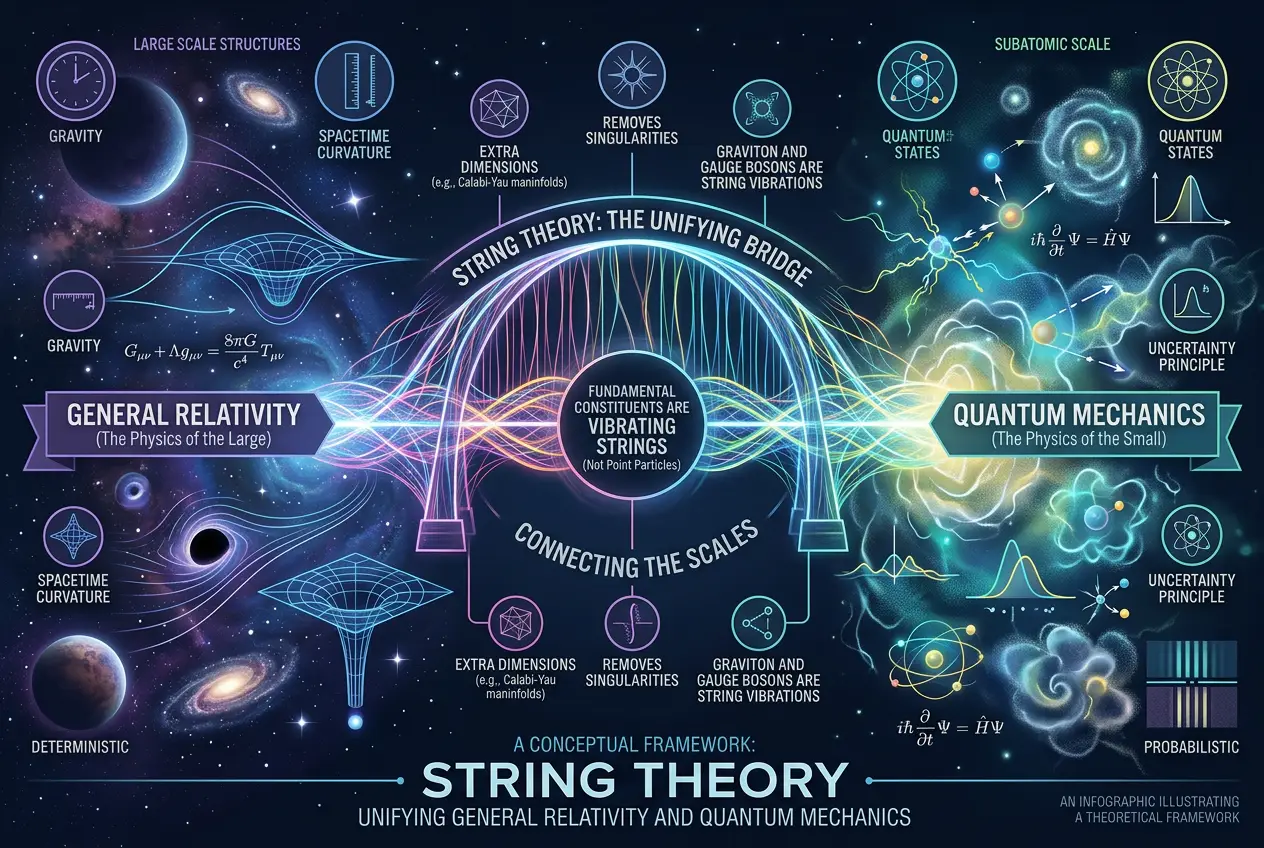
This isn't the premise of a science fiction novel; it's the audacious, mind-bending idea at the heart of **String Theory**. For decades, theoretical physicists have been grappling with the universe's most profound mysteries, particularly the gaping chasm between our two most successful, yet incompatible, theories: Albert Einstein’s **General Relativity**, which describes gravity and the large-scale structure of the cosmos, and **Quantum Mechanics**, which governs the subatomic world. They work beautifully in their respective domains, but try to combine them, and the math breaks down, leading to infinities and paradoxes. String Theory emerges as a leading candidate to bridge this divide, proposing a radical re-imagining of reality itself.
### The Problem with Point Particles: A Cosmic Collision
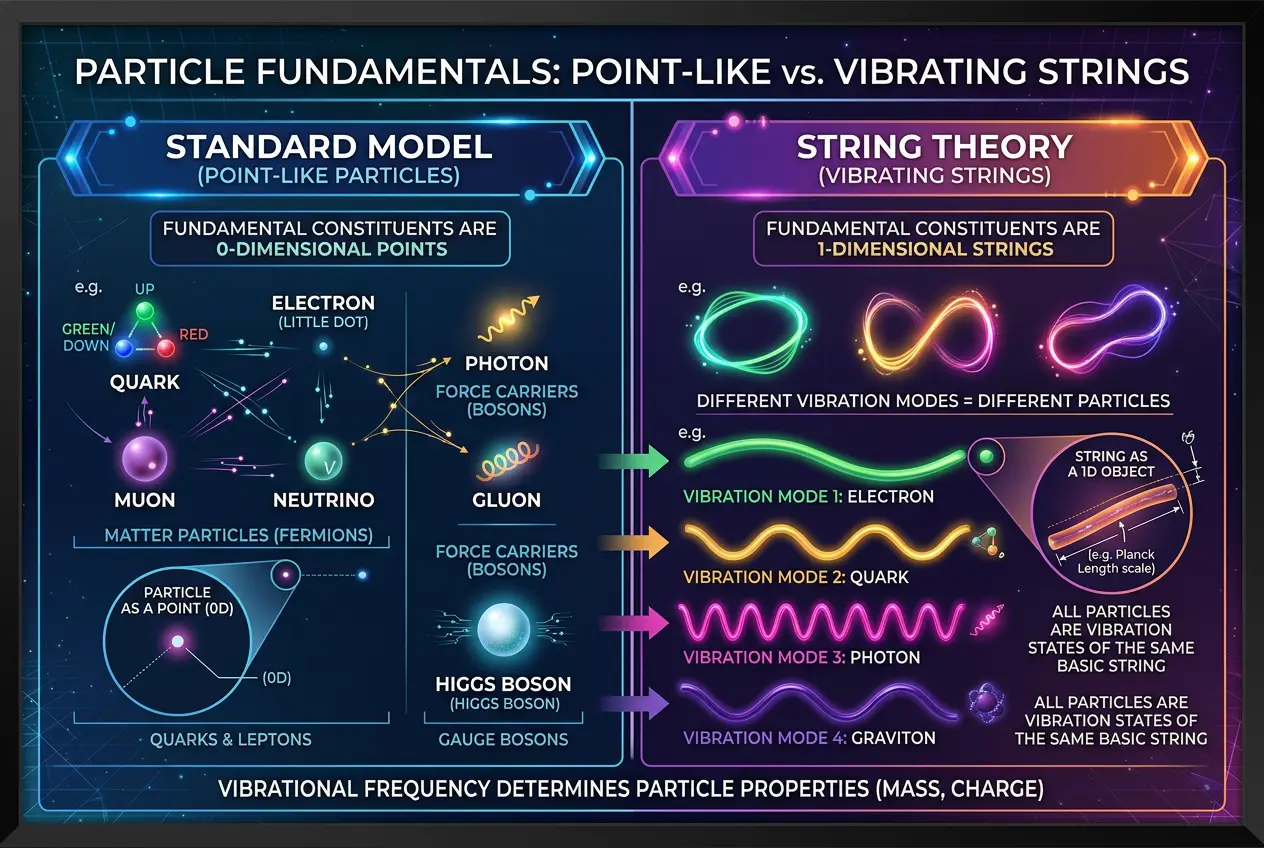
To understand why String Theory is so revolutionary, we first need to look at the standard model of particle physics. This model posits that the fundamental constituents of matter are point-like particles—meaning they have no spatial extent. Electrons, quarks, neutrinos, and the force-carrying bosons (like photons) are all considered infinitesimally small points. This works wonderfully for explaining three of the four fundamental forces: the strong, weak, and electromagnetic forces.
However, when you try to incorporate gravity, described by General Relativity, into this point-particle framework at the quantum level, chaos ensues. Calculations attempting to describe quantum gravity predict infinite values for energies and probabilities, which are nonsensical in physics. It's like trying to fit a square peg in a round hole, only the hole keeps shrinking to nothingness. This is where the elegance of String Theory begins to shine.
### Enter the Strings: A Universe of Vibrations
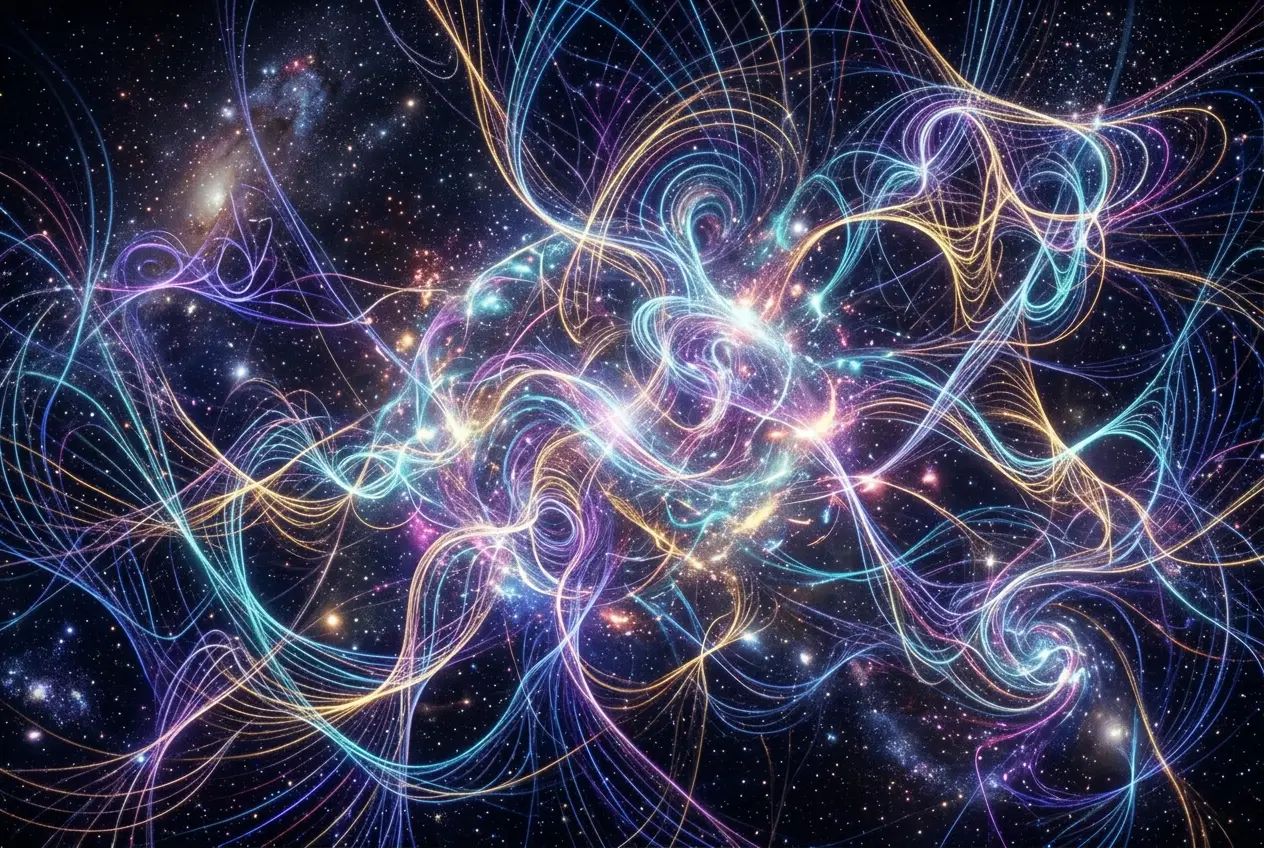
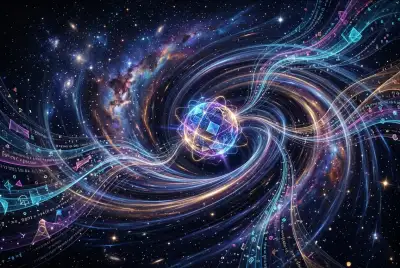
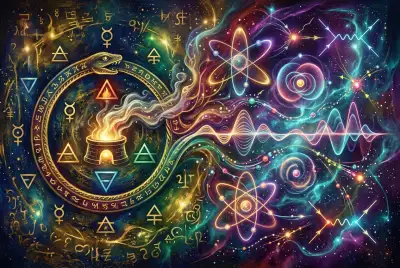
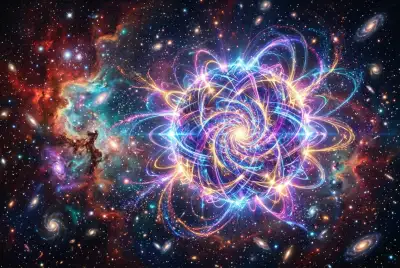
Instead of zero-dimensional point particles, String Theory proposes that the fundamental building blocks of the universe are one-dimensional, tiny, vibrating strings of energy. Imagine a violin string. Depending on how it vibrates, it produces different musical notes. In String Theory, these different vibrational patterns of a string correspond to different fundamental particles. One vibration might be an electron, another a quark, yet another a photon. Crucially, one particular vibration mode corresponds to the **graviton**, the hypothetical quantum particle that mediates the force of gravity.
This simple, yet profound, shift from points to strings is key. Unlike point particles, strings have a tiny, but non-zero, length (thought to be around 10-35 meters, the Planck length, which is unimaginably small). This tiny extension "smears out" the gravitational force at extremely small distances, preventing the infinities that plague point-particle theories of quantum gravity. Suddenly, the impossible becomes mathematically possible.
"The elegant simplicity of String Theory, where all particles are merely different vibrations of a single type of fundamental string, holds an undeniable allure for physicists seeking a unified description of reality," notes Leonard Susskind, one of the theory's pioneers, in his various lectures and writings.
### The Multidimensional Universe: More Than Meets the Eye
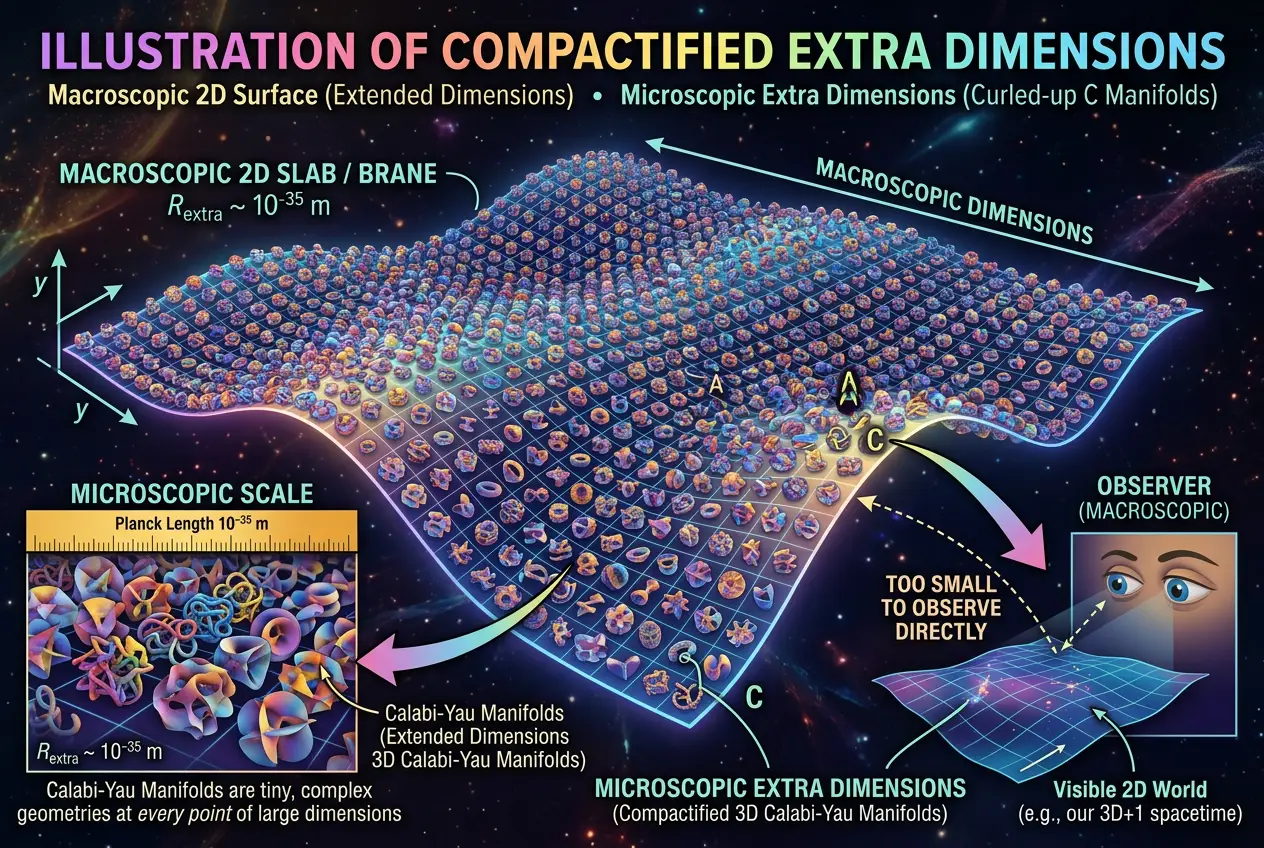
One of the most mind-bending aspects of String Theory is its requirement for extra spatial dimensions. While we perceive our universe as having three spatial dimensions (up/down, left/right, forward/back) and one time dimension, String Theory typically requires **ten or eleven dimensions** for its mathematical consistency.
Where are these extra dimensions? Why don't we see them? The prevailing idea is that these extra dimensions are "compactified" or "curled up" into incredibly small shapes, far too small for us to perceive. Imagine a garden hose from a distance—it looks like a one-dimensional line. But up close, you see it has a second, curled-up dimension (its circumference). Similarly, these extra dimensions are thought to be curled up on themselves at the Planck scale. The specific geometry of these curled-up dimensions, known as **Calabi-Yau manifolds** for some versions of the theory, determines the fundamental constants and properties of our universe, including the types of particles and forces we observe. This concept radically changes our understanding of space itself, suggesting that what we perceive as empty space might be intricately folded and teeming with hidden complexities.
To delve deeper into how we might perceive other realities, you might be interested in exploring our previous article: [Beyond Our Universe: What Types of Multiverses Exist?](/blogs/beyond-our-universe-what-types-of-multiverses-exist-1922).
### Unifying the Forces: Gravity's Grand Entrance
The holy grail of modern physics is a "Theory of Everything" (TOE) that unifies all four fundamental forces of nature: gravity, electromagnetism, and the strong and weak nuclear forces. String Theory offers a tantalizing pathway to this unification.
In the Standard Model, gravity remains stubbornly separate. But as I mentioned, String Theory naturally incorporates the graviton as a particular vibrational mode of a closed string. This means that, unlike other quantum field theories, String Theory *requires* gravity rather than struggling to include it. It treats all particles, including the graviton, as manifestations of the same fundamental entity, oscillating at different frequencies within a higher-dimensional spacetime.
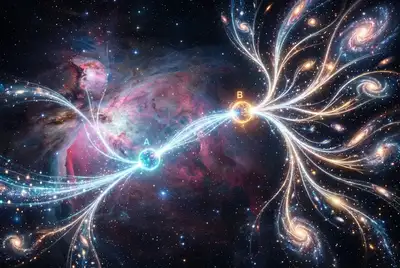
This ability to unify gravity with quantum mechanics is its most compelling feature. It suggests a universe where all interactions, from the smallest subatomic dance to the largest galactic collision, are governed by the same underlying cosmic laws—the vibrations of these fundamental strings. This is a truly profound shift in perspective. As physicists continue to explore the implications, they find remarkable connections. For example, some aspects of String Theory connect to phenomena like quantum entanglement, a peculiar quantum mechanical effect where particles become linked regardless of distance. For more on this, you can check out: [How Does Quantum Entanglement Defy Space-Time?](/blogs/how-does-quantum-entanglement-defy-space-time-5424).
### Supersymmetry and M-Theory: Expanding the String Family
To make String Theory work, it often requires **supersymmetry**, a theoretical principle that posits every fundamental particle has a "superpartner." For every boson (force carrier), there's a fermion (matter particle), and vice-versa. For example, the electron's superpartner would be a "selectron," and the photon's a "photino." While no superpartners have been discovered yet, experiments at the Large Hadron Collider (LHC) continue to search for evidence of them, which would provide strong support for String Theory.
Over time, physicists realized there wasn't just *one* String Theory, but five consistent versions. This led to the development of **M-theory** in the mid-1990s, which unified these five string theories and an eleventh-dimensional theory called supergravity into a single, overarching framework. M-theory is even more complex, often described as an 11-dimensional theory that includes not just 1-dimensional strings, but also higher-dimensional objects called **branes** (membranes). Our entire universe, with its three spatial dimensions, could potentially be a "3-brane" floating within a higher-dimensional bulk. This also opens doors to concepts like parallel universes existing on other branes, which you can read more about here: [Is Our Reality a Digital Simulation? Decoding the Universe's Code](/blogs/is-our-reality-a-digital-simulation-decoding-the-universes-code-9313).
### The Grand Challenge: Lack of Experimental Evidence
Despite its mathematical elegance and potential, String Theory faces a monumental challenge: the lack of direct experimental evidence. The energy scales required to probe these tiny strings or detect extra dimensions are astronomically high, far beyond the capabilities of current or foreseeable particle accelerators. The Planck length is so small that it’s like comparing the size of an atom to the entire observable universe.
This lack of testability has led to significant debate within the physics community. Critics argue that a theory without empirical verification risks becoming purely philosophical, rather than scientific. However, proponents point out that the theory makes several indirect predictions that could be tested, such as the existence of supersymmetry, primordial gravitational waves from the Big Bang, or even subtle gravitational effects from extra dimensions. Scientists are always seeking new ways to probe the universe's most hidden aspects, even exploring if dark matter could be related to these exotic phenomena, as discussed in: [Does Dark Matter Hide a Universe We Can't See?](/blogs/does-dark-matter-hide-a-universe-we-cant-see-2793).
### A Symphony of Possibilities
If String Theory proves to be correct, the implications are profound. Our universe wouldn't just be a collection of particles, but a vibrant, interwoven tapestry of vibrating strings in a higher-dimensional space. It could explain fundamental constants, shed light on the nature of black holes, and perhaps even reveal the origins of the Big Bang itself. It suggests a universe far richer and more complex than we currently imagine, one where fundamental reality is a cosmic symphony.
While experimental verification remains elusive, the quest to understand the universe at its most fundamental level continues. String Theory, with its breathtaking vision of a cosmos built from shimmering, vibrating strands, offers one of the most compelling and beautiful answers to the universe's ultimate secret code.
### The Future of the Cosmic Code
The journey into the universe's deepest secrets is far from over. Whether String Theory ultimately proves to be the "Theory of Everything" or a crucial stepping stone towards it, its influence on theoretical physics is undeniable. It has pushed our understanding of spacetime, gravity, and the very definition of matter to new frontiers, forcing us to ask questions about dimensions and reality that were once confined to the realm of science fiction. The search for the universe's secret code, vibrating through the fabric of existence, continues to inspire and challenge the brightest minds, promising a future where the cosmos reveals even more of its astonishing mysteries.
**External Sources:**
* [String Theory - Wikipedia](https://en.wikipedia.org/wiki/String_theory)
* [General Relativity - Wikipedia](https://en.wikipedia.org/wiki/General_relativity)
* [Quantum Mechanics - Wikipedia](https://en.wikipedia.org/wiki/Quantum_mechanics)
* [Calabi-Yau manifold - Wikipedia](https://en.wikipedia.org/wiki/Calabi%E2%80%93Yau_manifold)
* [M-theory - Wikipedia](https://en.wikipedia.org/wiki/M-theory)
Frequently Asked Questions
String Theory proposes that the fundamental constituents of the universe are not point-like particles, but rather tiny, one-dimensional vibrating strings of energy. Different vibrational patterns of these strings correspond to different particles, including the graviton.
By replacing point particles with extended strings, String Theory 'smears out' interactions at extremely small distances, preventing the infinities that arise when trying to combine General Relativity (gravity) with Quantum Mechanics in point-particle theories. This allows for a consistent description of quantum gravity.
For its mathematical consistency, String Theory typically requires ten or eleven dimensions. We don't perceive these extra dimensions because they are thought to be 'compactified' or 'curled up' into incredibly small shapes, making them undetectable at our current energy scales.
M-theory is a unifying framework that emerged in the mid-1990s, bringing together five consistent versions of String Theory and an 11-dimensional supergravity theory. It suggests a broader picture that includes not just strings, but also higher-dimensional objects called 'branes'.
The primary challenge is the lack of direct experimental evidence. The energy scales required to directly observe these tiny strings or extra dimensions are far beyond current technological capabilities, making direct verification extremely difficult.
If true, String Theory would offer a 'Theory of Everything,' unifying all fundamental forces and particles. It could explain fundamental constants, the nature of black holes, the origins of the universe, and suggest a universe with hidden dimensions and potentially multiverses.
Verified Expert
Alex Rivers
A professional researcher since age twelve, I delve into mysteries and ignite curiosity by presenting an array of compelling possibilities. I will heighten your curiosity, but by the end, you will possess profound knowledge.
Leave a Reply
Comments (0)
No approved comments yet. Be the first to share your thoughts!
 Join Us

 Alex Rivers

















Leave a Reply
Comments (0)