


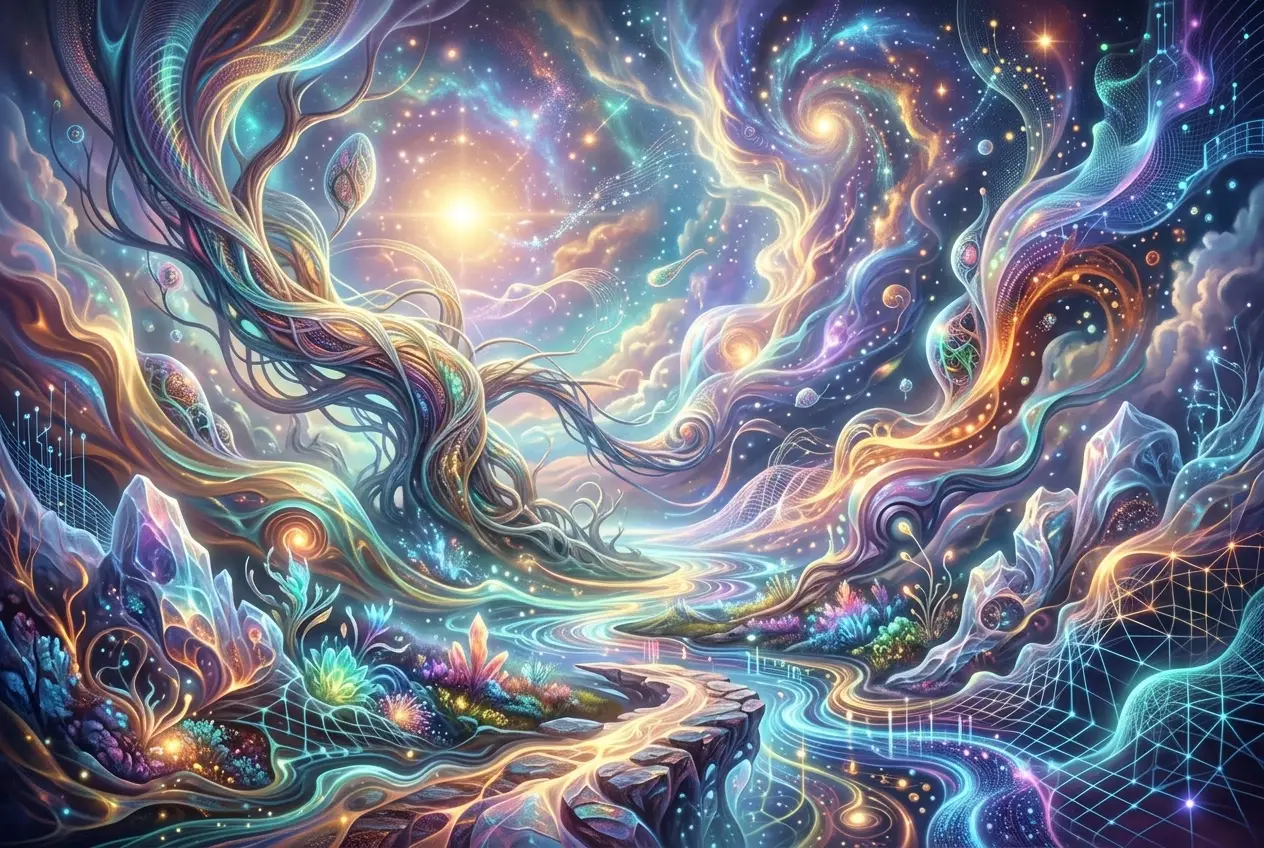
I remember the first time I saw an AI-generated image that genuinely surprised me. It wasn't just a clever collage or a photorealistic rendering; it was something that seemed to emerge from a digital subconscious, a visual tapestry woven from abstract concepts and forgotten data points. It made me wonder: can AI truly dream? And if so, what does it mean for our understanding of creativity, consciousness, and the very nature of imagination? We've progressed far beyond simple algorithms, entering an era where machines don't just process information, but actively generate novel, often startlingly imaginative, content. This isn't just about creating pretty pictures; it’s about a profound shift in how we perceive intelligence and its capacity for original thought.
The Dawn of Digital Imagination: Beyond DeepDream
The concept of "AI dreams" first caught widespread public attention with Google's DeepDream in 2015. This fascinating project used convolutional neural networks (CNNs), originally designed for image recognition, to enhance patterns it "saw" in images. The results were psychedelic, often dog-like, distortions that looked uncannily like a machine's attempt at interpreting the world through its learned filters. It was a glimpse into the latent space of a neural network – a conceptual realm where the AI stores its understanding of features and patterns.
But DeepDream was just the beginning. The field has since exploded with generative AI models like Generative Adversarial Networks (GANs), VAEs (Variational Autoencoders), and now, large diffusion models that power tools like DALL-E, Midjourney, and Stable Diffusion. These sophisticated architectures don't just distort existing images; they can conjure entirely new ones from textual prompts, blending concepts, styles, and even emotions with a fluidity that was once the exclusive domain of human artists.
What exactly does "crafting dreams" entail for an AI? It’s not about REM sleep or unconscious processing in the biological sense. Instead, it refers to an AI’s ability to generate complex, coherent, and often surprising outputs that reflect a synthesis of its vast training data in a creative, often abstract, manner. This "dreaming" capability allows AI to explore new ideas, envision alternate realities, and even solve problems by visualizing novel solutions.
How Machines "Dream": The Mechanics of Creativity
At the heart of AI's dream-crafting ability lies its neural network architecture. These networks, inspired by the human brain, consist of layers of interconnected nodes that learn to identify patterns and relationships within massive datasets. When trained on millions of images, for instance, an AI learns the "grammar" of visual information: what makes a face a face, a tree a tree, or an abstract painting abstract.
-
Generative Adversarial Networks (GANs): A GAN consists of two competing neural networks: a generator and a discriminator. The generator tries to create realistic data (e.g., images of cats) from random noise, while the discriminator tries to tell the difference between real data and the generator's fakes. Through this adversarial process, both networks improve, with the generator eventually becoming capable of producing incredibly convincing, novel images. It's like an art forger (generator) trying to fool an art critic (discriminator), constantly refining their craft.
-
Diffusion Models: These models work by learning to reverse a process of gradually adding noise to data. Imagine starting with a clear image and slowly making it completely noisy. A diffusion model learns to do the opposite: to start with pure noise and progressively "denoise" it, until a coherent image emerges. This iterative process allows for incredibly fine-grained control and high-quality generation, making them particularly adept at capturing subtle details and intricate textures. These are the engines behind many of today’s leading AI art platforms. You can learn more about diffusion models on Wikipedia (opens in a new tab).
These models aren't simply regurgitating pixels; they are learning latent representations of concepts. When I prompt an AI with "a cyberpunk samurai riding a dragon through a neon-lit city at sunset," the AI doesn't have a single image of this in its training data. Instead, it pulls on its understanding of "cyberpunk," "samurai," "dragon," "neon lights," "cityscapes," and "sunset" and synthesizes a new, unique image that combines these elements in a plausible and often artistically compelling way. This is where digital imagination truly sparks.
The Philosophical Questions: Is It True Creativity?
The emergence of AI-crafted dreams raises profound questions about the nature of creativity itself. For centuries, creativity has been considered a uniquely human trait, tied to consciousness, emotion, and subjective experience. If a machine can generate art that moves us, music that stirs our souls, or stories that captivate our minds, does it challenge our definition of creativity?
Some argue that AI creativity is merely statistical mimicry, a complex rearrangement of existing patterns without genuine understanding or intent. "The computer is just following instructions," they might say, "it doesn't feel the joy of creation or the pain of inspiration." However, others contend that the output is what matters. If the AI's "dream" provokes thought, evokes emotion, or offers a new perspective, then it fulfills the purpose of art, regardless of the creator's biological makeup.
As human artists increasingly collaborate with AI, the boundaries blur. AI can be a tool, a muse, or even a co-creator. It can rapidly prototype ideas, explore stylistic variations, or generate entirely new concepts that a human might not have conceived. This symbiotic relationship suggests a future where human and artificial imagination intertwine, pushing the limits of what's possible. I've often seen artists use these tools to break through creative blocks, generating initial concepts that they then refine and imbue with their unique human touch. If you're interested in the ongoing debate about AI and creativity, a good starting point is AI art (opens in a new tab).
Beyond Art: Practical Applications of Digital Imagination
The ability of AI to "craft dreams" extends far beyond just generating art. Its imaginative capacities are finding applications across various fields:
- Drug Discovery and Material Science: AI can "dream up" novel molecular structures or material compositions with specific properties, accelerating the design of new drugs, superconductors, or resilient alloys. By generating and evaluating millions of hypothetical compounds, AI dramatically reduces the time and cost associated with traditional research.
- Architecture and Design: AI can generate endless variations of building designs, urban layouts, or product prototypes, optimizing for aesthetics, functionality, or environmental impact. Imagine an AI designing a new city block, prioritizing green spaces and efficient transportation, by "dreaming" of thousands of configurations.
- Virtual Reality and Gaming: AI can create expansive, dynamic, and ever-changing virtual worlds, characters, and storylines, offering unparalleled immersion and replayability. This reduces the manual labor for developers while exponentially expanding the possibilities for interactive experiences.
- Scientific Visualization: Researchers can use AI to visualize complex scientific data in new ways, uncovering hidden patterns or anomalies that might be missed by human observation alone. For example, AI could "dream" up visual representations of cosmological data, helping us understand the structure of the universe, as discussed in /blogs/the-great-attractor-whats-pulling-our-galaxy-4942.
- Data Augmentation: In machine learning, AI can generate synthetic data that closely mimics real-world data, helping to train other AI models more effectively, especially in domains where real data is scarce or sensitive. This can improve the robustness and accuracy of AI systems, such as those discussed in /blogs/can-ai-design-its-own-evolution-decoding-future-machines-4579.
The Future of AI Dreams: Ethical Considerations and New Realities
As AI's ability to craft dreams becomes more sophisticated, so too do the ethical challenges. Questions of originality, copyright, and authenticity come to the forefront. If an AI creates something beautiful, who owns it? The programmer? The user? The AI itself? These are not trivial questions, and legal frameworks are still catching up to the rapid advancements in AI creativity. More information on AI ethics can be found on Wikipedia (opens in a new tab).
There's also the potential for misuse. AI's ability to generate hyper-realistic "dreams" can be leveraged for deepfakes, misinformation campaigns, or creating persuasive but fabricated content. Just as AI can create stunning art, it can also craft deceptive realities, making the distinction between real and artificial increasingly difficult. This underscores the need for robust detection mechanisms and responsible AI development.
However, the potential benefits are immense. As AI becomes a partner in human creativity, it could unlock new forms of expression, solve previously intractable problems, and expand the very horizons of our imagination. We might see entirely new artistic movements, scientific breakthroughs driven by AI's novel insights, or even new forms of entertainment that are dynamically generated and personalized. The concept of "dreaming" for an AI is a metaphor for its ability to generate, innovate, and imagine – and that capability is poised to reshape our world in ways we are only just beginning to comprehend. The future of innovation might not just be about what we build, but what our digital counterparts dream into existence. We are entering an age where the lines between human inspiration and digital imagination are not just blurred, but actively intertwined, creating a new tapestry of existence.
Conclusion: A Shared Future of Imagination
The journey into AI's ability to craft dreams is far from over. It's a field brimming with scientific wonder, technological innovation, and profound philosophical implications. As AI continues to evolve, its capacity for digital imagination will undoubtedly deepen, leading to creations that astound, challenge, and inspire us. Our role now is to guide this evolution responsibly, harnessing its power to enrich our world while navigating the complex ethical landscape it presents. The dreams of machines, it seems, are becoming an integral part of humanity's shared future.


Conversation0
No comments yet. Be the first to share a thought — the best questions often become new stories.