


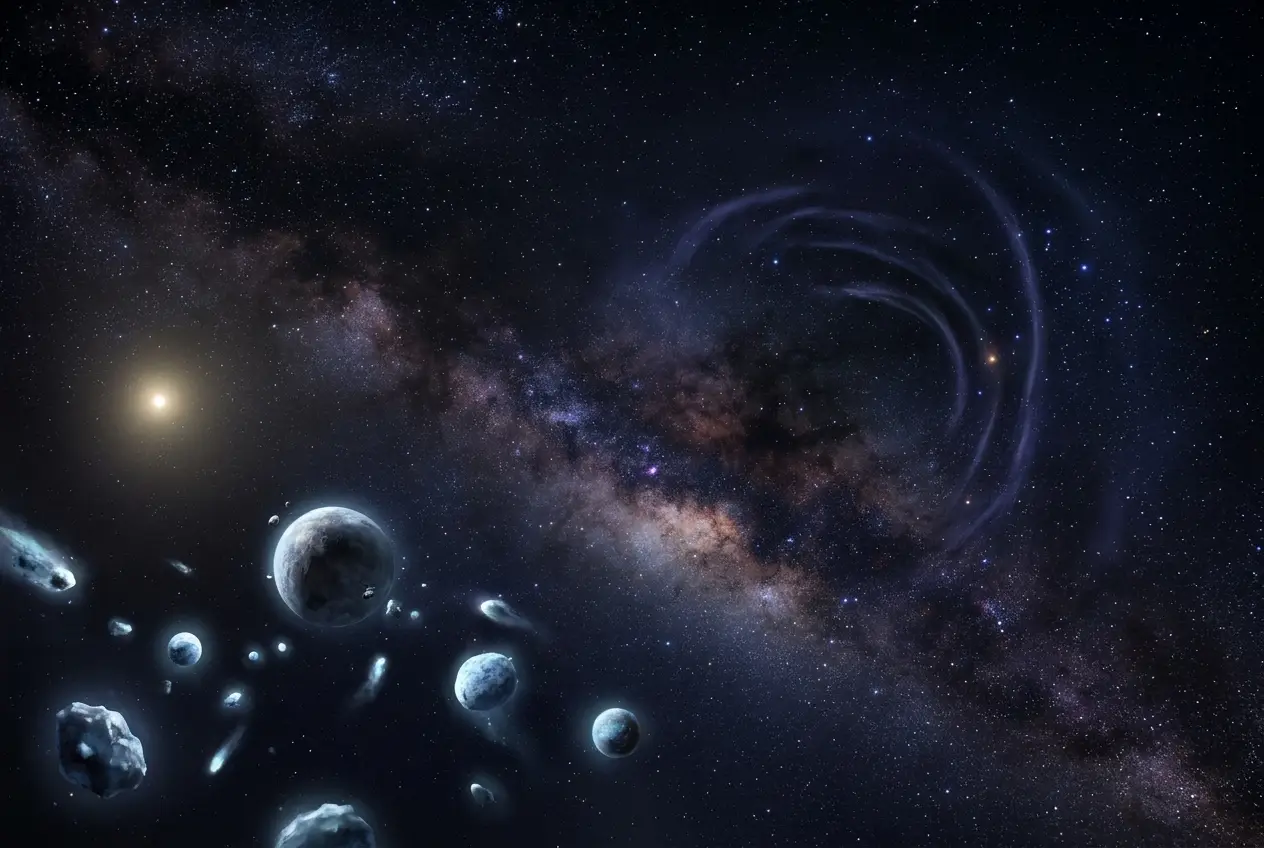
The night sky has always been a canvas for our deepest curiosities. For centuries, we believed our solar system was a tidy arrangement of eight (or sometimes nine, depending on Pluto's mood) planets, revolving around our sun. But what if, beyond the familiar, something profoundly stranger lurks? I've been fascinated by the persistent whispers of a potential "Planet Nine," a massive, unseen world whose gravitational pull seems to be subtly herding distant icy objects in the Kuiper Belt. However, a newer, even more mind-bending theory has emerged from the fringes of astrophysics: what if Planet Nine isn't a planet at all, but a primordial black hole?
This isn't a plot from a sci-fi movie; it’s a serious debate among astronomers. The idea shifts our perception of what could be hiding in our cosmic backyard from a giant ice ball to something far more exotic and fundamental. It's a journey into the intersection of cosmic mechanics, particle physics, and pure speculative wonder, grounded in observable anomalies.
The Case for Planet Nine: Gravitational Nudges
For years, astronomers have observed peculiar orbital patterns among a cluster of extreme trans-Neptunian objects (eTNOs) in the far reaches of our solar system. These small, icy bodies, located beyond Neptune and extending into the scattered disc, exhibit orbits that appear to be clustered and tilted in an unusual way. This alignment is highly improbable to occur randomly. The mathematical odds are stacked against it, suggesting an unseen gravitational influence is shepherding them.
In 2016, Caltech astronomers Konstantin Batygin and Mike Brown formally proposed the existence of "Planet Nine" – a hypothetical giant planet, roughly 5 to 10 times the mass of Earth, orbiting the Sun far beyond Neptune, with an orbital period possibly lasting 10,000 to 20,000 years. Its existence would neatly explain the observed clustering of eTNO orbits. You can delve deeper into the initial hypotheses surrounding this elusive body on Wikipedia's Planet Nine page (opens in a new tab). The search for this massive gas giant has since become one of the most exciting endeavors in planetary science, consuming countless hours of telescope time. Yet, despite years of searching, Planet Nine remains stubbornly elusive. No direct observation has confirmed its presence.
Why So Hard to Find?
The reason for its elusiveness isn't necessarily a flaw in the theory. If Planet Nine exists, it would be incredibly faint due to its immense distance from the Sun. It would reflect very little sunlight and emit only residual heat, making it a dim target for even our most powerful telescopes. Imagine trying to spot a bowling ball in a dimly lit stadium that's millions of miles away – that's essentially the challenge. This lack of direct observation opens the door to alternative, more radical explanations.
Enter the Primordial Black Hole Hypothesis
This is where things get truly wild. In 2019, a group of physicists, including James Unwin and Jakub Scholtz, proposed that the gravitational effects attributed to Planet Nine might instead be caused by a primordial black hole (PBH). A primordial black hole is a hypothetical type of black hole that formed in the early universe, just moments after the Big Bang, rather than from the collapse of a massive star. For a deeper understanding of these fascinating objects, I recommend checking out Wikipedia's article on Primordial Black Holes (opens in a new tab).
The idea might sound outlandish – a black hole in our own solar system? But hear me out. If Planet Nine is indeed 5 to 10 times the mass of Earth, a black hole of that mass would be incredibly small, perhaps only a few centimeters across. Such an object would be virtually impossible to detect directly through traditional astronomical methods. It wouldn't reflect light, and its gravitational pull would be localized, making it a cosmic needle in a haystack.
| Feature | Hypothetical Planet Nine | Hypothetical Primordial Black Hole |
|---|---|---|
| Mass (approx.) | 5-10 Earth masses | 5-10 Earth masses |
| Size | Several Earth diameters | Few centimeters in diameter |
| Formation | Accretion in solar nebula | Early universe fluctuations |
| Visibility | Very faint, reflects sunlight/emits heat | Invisible (no reflected light, minimal Hawking radiation) |
| Detection Difficulty | Extremely difficult due to distance/faintness | Nearly impossible due to small size/invisibility |
| Gravitational Influence | Explains eTNO clustering | Also explains eTNO clustering |
| Dark Matter Connection | None directly | Could be a candidate for dark matter |
Why a PBH Makes Sense (and doesn't)
One of the intriguing aspects of this theory is its potential connection to dark matter. Primordial black holes are one of the proposed candidates for what makes up dark matter – the mysterious substance that accounts for about 27% of the universe's mass but doesn't interact with light. If Planet Nine were a PBH, it would not only solve the orbital clustering mystery but also potentially offer a local detection of dark matter. This makes the concept particularly appealing to theoretical physicists.
However, the PBH hypothesis isn't without its challenges. While it explains the gravitational effects, it also requires us to accept the idea that one of these ancient cosmic relics is casually orbiting our Sun. The probability of such a capture event, while not zero, is quite low. Furthermore, the exact distribution and frequency of PBHs in the universe are still unknown, making it hard to predict how many might be floating around.
The search for Planet Nine is a captivating scientific endeavor, pushing the boundaries of what we know about our cosmic neighborhood. It resonates with the thrill of discovery, much like our ongoing efforts to understand other cosmic enigmas, as discussed in "Why is the Universe so Quiet? Decoding the Fermi Paradox" (/blogs/why-is-the-universe-so-quiet-decoding-the-fermi-paradox-5418).
Hunting the Invisible: New Detection Methods
If Planet Nine is a primordial black hole, how could we possibly find it? Standard optical telescopes won't work. Scientists are proposing alternative detection strategies, leveraging the unique properties of black holes:
-
Microlensing Surveys: A PBH would warp spacetime around it. If it passes in front of a distant star, its gravity could temporarily magnify and brighten the star's light – a phenomenon called gravitational microlensing. While challenging, extensive surveys like those used to find exoplanets could theoretically spot these transient events. For more on how this cosmic phenomenon works, see Wikipedia's page on Gravitational Lensing (opens in a new tab).
-
Gamma Ray Bursts: Some theories suggest that dark matter particles might annihilate or decay as they interact with a PBH, producing detectable gamma-ray signals. While a single, isolated PBH might not generate strong enough signals to be easily found, future gamma-ray observatories might be sensitive enough.
-
Accretion Flares: If the PBH passes through a cloud of gas or dust (like the Oort Cloud, described further on Wikipedia's Oort Cloud page (opens in a new tab)), it could accrete this material. As matter spirals into a black hole, it heats up and emits X-rays or radio waves. These "accretion flares" could be a tell-tale sign of its presence.
"The possibility that a black hole is orbiting the sun, whether it's primordial or not, changes everything we think we know about our solar system," says astronomer Elena Petrova. "It's a testament to the fact that the universe continues to surprise us."
The implications of finding a primordial black hole in our own solar system would be monumental. It would be the first concrete evidence of a PBH, offering direct insights into the early universe and the nature of dark matter. It would also remind us that even our "home" cosmic environment might harbor secrets more profound than we ever imagined. The vastness of space holds so many unanswered questions, and sometimes the answers are closer than we think, hidden in plain sight, much like the potential dangers from space discussed in "Could Cosmic Rays Alter Our DNA? Unpacking Space Radiation" (/blogs/could-cosmic-rays-alter-our-dna-unpacking-space-radiation-8657).
The Future of the Search
The hunt for Planet Nine continues, and with it, the debate between a giant planet and a primordial black hole. Upcoming telescopes, such as the Vera C. Rubin Observatory, will conduct unprecedented wide-field surveys that could potentially spot either candidate. Their deep, wide-area observations are exactly what's needed to find faint, slow-moving objects in the outer solar system.
Whether it's a rocky super-Earth or a tiny, ancient black hole, the existence of Planet Nine, in any form, underscores the dynamism and mystery of our solar system. I find it exhilarating to think that there might be something so fundamental and alien right on our doorstep, waiting to be discovered. This ongoing scientific quest highlights our relentless pursuit of knowledge, constantly refining our understanding of the universe, and occasionally challenging the very fabric of our scientific assumptions. The universe, I believe, has an endless capacity for surprise, and objects like these prove that there are still countless cosmic secrets to uncover, perhaps even rogue black holes lurking in our own galaxy, a topic explored in "Do Rogue Black Holes Threaten Our Galaxy?" (/blogs/do-rogue-black-holes-threaten-our-galaxy-6767).
In the end, what we discover about Planet Nine might be less about the object itself and more about how much we still have to learn. It’s a powerful reminder that our understanding of the cosmos is always evolving, always pushing us to ask bigger, bolder questions.

Conversation0
No comments yet. Be the first to share a thought — the best questions often become new stories.