


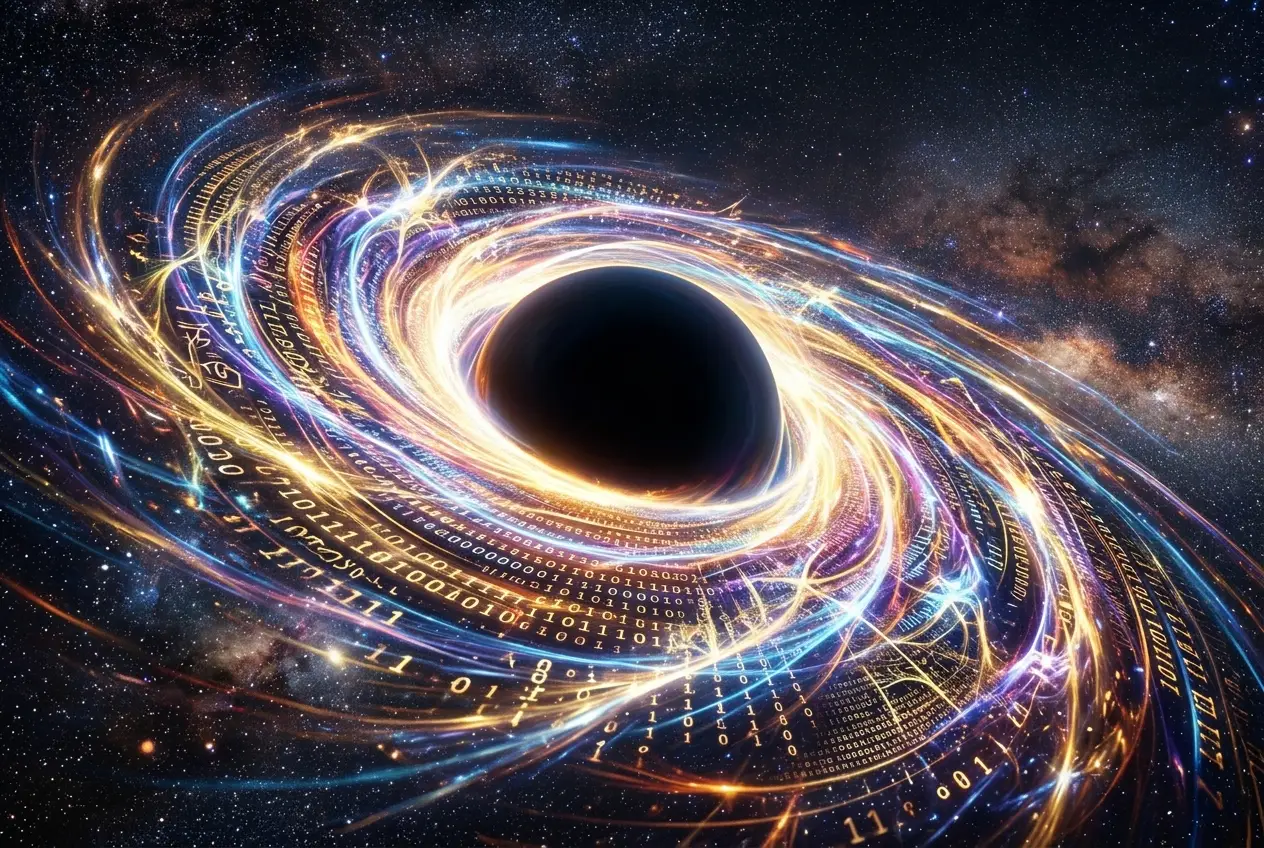
I often find myself contemplating the vastness of the cosmos, a place where the ordinary rules of physics twist into mind-bending anomalies. It’s a realm where stars die in spectacular fashion, where galaxies collide, and where the most enigmatic objects—black holes—challenge our deepest understanding of reality. We typically imagine black holes as cosmic destroyers, gravitational behemoths that swallow everything, including light, never to release it. But what if this isn't the full story? What if, instead of mere oblivion, these cosmic leviathans are the universe's ultimate, most secure data vaults, diligently preserving every scrap of information that falls into their clutches?
It’s a thought that truly excites me, one that makes me reconsider everything I thought I knew about cosmic destruction. Imagine a library of Alexandria, not consumed by flames, but absorbing every book, scroll, and whispered secret, only to encode it perfectly on its outer surface, waiting for a future generation to decipher. This isn't a fantasy; it's a concept deeply rooted in cutting-edge theoretical physics, revolving around one of the most profound paradoxes of the 20th century: the black hole information paradox.
The Cosmic Conundrum: Information Lost or Found?
For decades, the prevailing view of black holes, largely shaped by Albert Einstein's general relativity, depicted them as regions where spacetime becomes infinitely dense, and anything crossing the event horizon—the point of no return—is gone forever. Classical physics told us that information about the matter that fell in would simply cease to exist, compressed into an unrecoverable singularity. I remember thinking this made perfect sense. If nothing can escape, how could any record of what entered persist?
However, the advent of quantum mechanics introduced a radical, unwavering principle: information cannot be destroyed. This isn't just about data on a hard drive; it's a fundamental tenet of quantum theory known as unitarity. Every physical process, no matter how chaotic, must preserve the total amount of quantum information. If you burn a book, the information isn't lost; it’s merely scrambled into the ashes, smoke, and heat, theoretically recoverable if you could precisely track every particle. This inviolable law clashed spectacularly with the black hole paradigm.
The conflict reached its peak with the work of Stephen Hawking. In the 1970s, Hawking discovered that black holes aren't entirely black. Due to quantum effects near the event horizon, they emit a faint thermal radiation, now known as Hawking radiation, and slowly evaporate over unfathomably long timescales. The critical issue was that this radiation appeared to be purely random, carrying no discernible information about what had fallen into the black hole. If a black hole eventually evaporates completely, and the Hawking radiation contains no information, then where did all the information about the stars, planets, and even people it swallowed go? It seemed to vanish, a direct violation of quantum mechanics.
The Event Horizon: Universe's Ultimate Storage Drive?
The black hole information paradox ignited one of the fiercest debates in theoretical physics, involving titans like Stephen Hawking, Leonard Susskind, and Gerard 't Hooft. The resolution, though still debated, points to an extraordinary possibility: the information isn't destroyed; it's encoded on the event horizon itself. This idea is encapsulated in the Holographic Principle.
Think of a hologram: a 3D image encoded on a 2D surface. The holographic principle, when applied to black holes, suggests that all the information about the 3D objects that fall into a black hole is somehow encoded on the 2D surface of its event horizon. This boundary, which once seemed like a one-way gate to oblivion, transforms into a cosmic memory bank.
I found this concept utterly mind-blowing the first time I encountered it. It implies that our universe, or at least certain regions of it, might operate like a giant hologram, where the information of a volume is somehow projected from its boundary. For black holes, the event horizon’s surface area is directly proportional to its entropy—a measure of its internal disorder or, crucially, its information content. This suggests that the event horizon acts like a cosmic hard drive, its surface 'pixels' storing the quantum states of everything that has ever crossed it. For more details on this fascinating concept, you can explore the Holographic Principle on Wikipedia (opens in a new tab).
What does this mean for the information paradox? It suggests that as a black hole evaporates via Hawking radiation, the radiation is not entirely random. Instead, it's subtly entangled with the information encoded on the event horizon, carrying it away, albeit in an incredibly scrambled form. So, the information isn't lost; it's slowly radiated back into the universe, like a cosmic data stream gradually decrypting itself over eons. It's an astonishing feat of cosmic engineering, far beyond any digital archive we can currently conceive.
Scrambling and Retrieving Cosmic Data
To be clear, "storing information" in a black hole isn't like saving a file to a USB stick. The information is utterly scrambled, encoded in such a way that it would be practically impossible to retrieve in a coherent form. It’s like throwing a meticulously organized library into a gigantic cosmic blender. The atoms and their quantum states are all still there, but their original arrangement—the meaningful "data"—is transformed into a chaotic, highly entangled mess.
The challenge of retrieval is immense. Imagine trying to reconstruct a novel by meticulously analyzing the smoke and ashes from its burning pages, tracking every molecule. For a black hole, this task would require a quantum computer of unimaginable power, capable of processing the quantum state of every emitted particle of Hawking radiation and unraveling the complex entanglement. It’s a task that likely transcends the capabilities of any civilization, now or in the far future. However, the theoretical possibility that information is preserved is what truly matters for the consistency of physics.
This preservation of information has profound implications. If information is indeed conserved, it suggests a universe that is far more interconnected and deterministic at a fundamental level than we might imagine. It challenges our intuitive notions of destruction and finality, hinting that perhaps nothing truly vanishes, but merely transforms into a new, incredibly complex quantum state. This conservation could even link to theories about the universe as a vast information-processing system, echoing ideas I've explored about whether the universe is a giant neural network.
The Future of the Paradox and Quantum Gravity
The black hole information paradox isn't fully resolved. Debates continue, particularly concerning the "firewall paradox," a more recent challenge to the idea of information conservation that suggested a violent, scorching "firewall" at the event horizon. This has spurred further research into various quantum gravity theories, such as string theory and loop quantum gravity, which aim to reconcile general relativity with quantum mechanics.
These theories offer different perspectives on the ultimate fate of information. Some propose that black holes might be "fuzzballs" without a distinct event horizon, or that information escapes through tiny quantum wormholes. Whatever the ultimate resolution, the black hole information paradox has been a powerful engine driving our understanding of the universe's most extreme environments and the fundamental laws that govern them. It forces us to confront the very nature of reality, space, time, and information itself.
When I ponder this, I can't help but feel a deep sense of wonder. The universe, in its intricate design, seems to have built-in mechanisms for preserving its own history, even within its most destructive phenomena. It makes me question if black holes could be more than just cosmic storage units; perhaps they are also involved in cosmic computation, a concept touched upon in our article exploring if black holes are nature's ultimate quantum computers.
The journey to understand black holes, initiated by profound thinkers like Stephen Hawking (whose contributions are detailed further on Wikipedia (opens in a new tab)), continues to unravel the universe's deepest secrets. It reminds me that even in the darkest corners of space, there is information, complexity, and a constant redefinition of what we perceive as possible. Perhaps the next big breakthrough will not only tell us how black holes store information, but also what universe-spanning secrets they are holding onto. And who knows, maybe insights from this paradox will even shed light on concepts like decoding reality through hidden dimensions, further expanding our cosmic perspective.
Conversation0
No comments yet. Be the first to share a thought — the best questions often become new stories.