


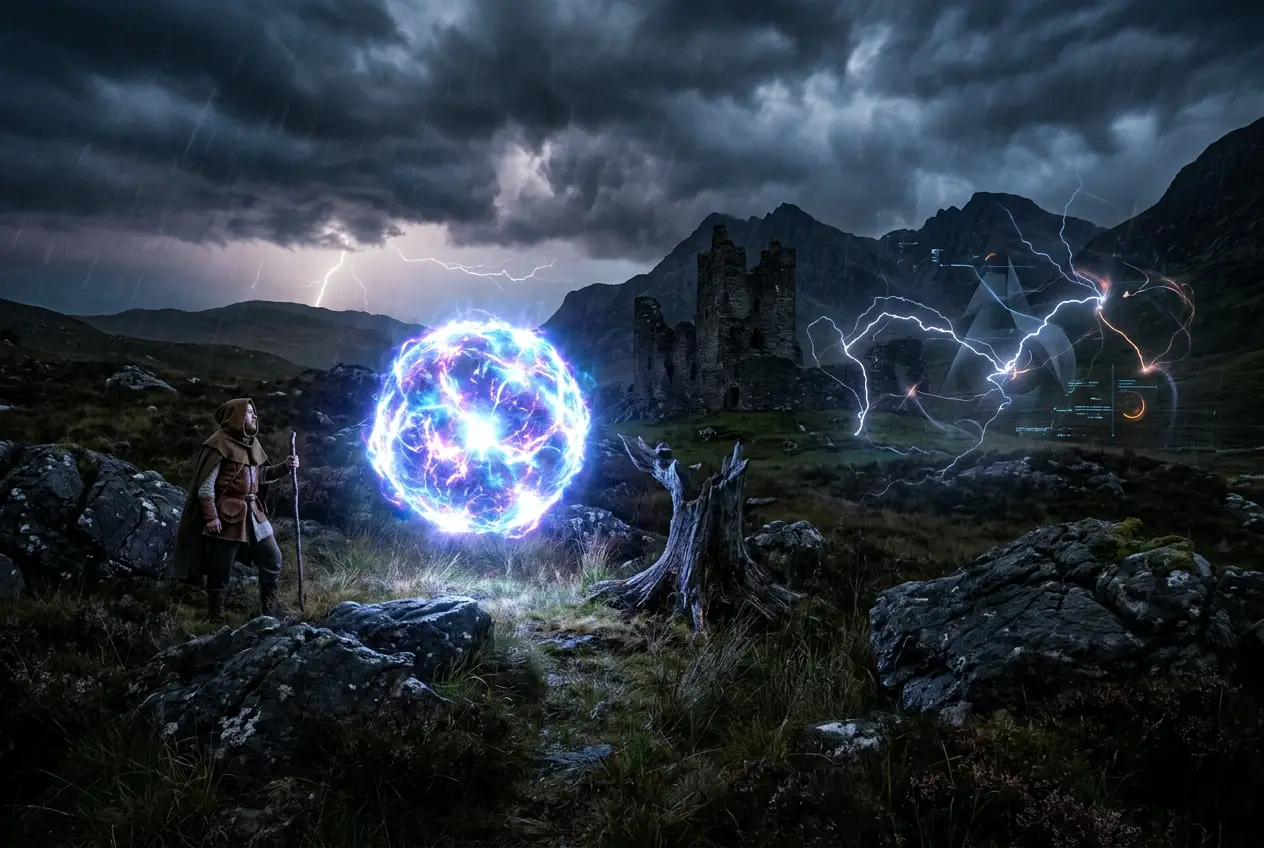
Imagine a silent, glowing orb, perhaps the size of a grapefruit or even a basketball, drifting slowly through the air, sometimes crackling, sometimes humming, before vanishing as mysteriously as it appeared. I'm talking about ball lightning, a phenomenon that has fascinated humanity for centuries, appearing in folklore, historical accounts, and even modern scientific journals, yet remains one of nature's most elusive puzzles. Is it merely an exotic manifestation of electricity, a unique form of plasma, or did our ancestors perhaps glimpse something more profound, perhaps even "ancient powers" at play?
Recently, I was reading an old mariner's tale about a glowing sphere that rolled across a ship's deck during a thunderstorm, singeing the wood before disappearing into the sea. Such stories aren't just confined to the annals of naval history; they echo through countless cultures, suggesting a phenomenon that has consistently captivated and confounded observers across millennia. What exactly is this fiery sphere, and why does it defy easy explanation?
Echoes Through History: When Ancients Met the Orb
From ancient Greek philosophers like Aristotle, who noted peculiar atmospheric lights, to medieval monks documenting strange luminous balls, humanity has long been aware of these airborne specters. Historical accounts are replete with descriptions of fiery globes that emerge during thunderstorms, sometimes passing through walls or even inside buildings, only to dissipate without a trace or with a soft pop.
Consider the puzzling event in Widecombe-in-the-Moor, Devon, in 1638. During a severe thunderstorm, a "great ball of fire" reportedly entered a church, killing several people and causing significant damage, melting metal and tearing apart stone. Was this ball lightning? Many believe so. Such dramatic occurrences cemented ball lightning's place in folklore, often attributed to supernatural forces, divine wrath, or mischievous spirits. For cultures lacking modern scientific understanding, these glowing orbs might have been seen as manifestations of raw, untamed energy – true "ancient powers" that hinted at forces beyond human comprehension. For further reading on historical accounts, you can refer to the Wikipedia article on Ball Lightning (opens in a new tab).
I find it particularly intriguing how these accounts often describe similar characteristics: the spherical shape, the luminescence, the varying sizes, and the unpredictable movements. This consistency across disparate cultures and timelines suggests a common underlying natural phenomenon, rather than mere myth.
The Science of the Enigma: Unpacking the "Cosmic Plasma"
Modern science, equipped with advanced physics and observational tools, has attempted to demystify ball lightning, yet it remains largely unexplained. The term "cosmic plasma" in our title hints at one of the leading contenders for its explanation: that ball lightning is a form of atmospheric plasma – an ionized gas containing electrons and ions, capable of conducting electricity and emitting light. However, creating a stable, long-lasting plasma sphere in open air at ambient pressure is incredibly difficult, making ball lightning a significant challenge for physicists.
Several prominent theories attempt to explain this phenomenon:
-
Silicon Vapor Hypothesis: Proposed by researchers like John Abrahamson and James Dinniss, this theory suggests that when lightning strikes the ground, it vaporizes silicon dioxide (silica) from soil or sand. This silicon vapor then mixes with carbon and oxygen to form nanoparticles that oxidize slowly, releasing energy and light, creating a glowing sphere. The slow oxidation process could explain the longer lifespan of some ball lightning observations. This idea gained traction after a 2012 event where Chinese scientists observing a thunderstorm captured the spectrum of ball lightning, which showed silicon, iron, and calcium.
-
Microwave Cavity Theory: Developed by Russian physicist Peter Kapitsa, this theory posits that ball lightning is formed by standing electromagnetic waves (microwaves) trapped within a region of ionized air. The energy from these waves sustains the plasma, creating a self-contained luminous sphere. The surrounding atmosphere acts like a waveguide, trapping the microwaves and preventing them from dissipating quickly.
-
Chemical Explanations: Some theories suggest that ball lightning might be a result of unusual chemical reactions occurring in the atmosphere during a lightning strike. For instance, the formation of ozone and nitrogen oxides could lead to energetic reactions that produce light and heat. Other variations involve combustion of aerosols or other atmospheric trace elements.
-
Optical Illusions or Neurological Phenomena: While less popular for explaining tangible interactions like burning or structural damage, some skeptics propose that certain sightings could be retinal afterimages or even mild epileptic seizures induced by intense lightning flashes, causing individuals to perceive a floating orb. However, this fails to account for observations by multiple witnesses or the physical effects.
I find the silicon vapor hypothesis particularly compelling because it offers a tangible mechanism for the orb's creation and sustenance, tying it directly to the ground strike of conventional lightning. Yet, none of these theories fully explain all observed characteristics, such as the ability to pass through glass or metal without apparent interaction, or its sometimes silent, sometimes noisy nature.
The mystery of ball lightning highlights how much we still have to learn about atmospheric physics and unseen forces at play during powerful electrical phenomena. This isn't too dissimilar from the strange lights of the Hessdalen Valley, an unexplained luminous phenomenon that has baffled scientists and locals alike, suggesting that our understanding of atmospheric plasma and energy could be more limited than we think. You can read more about it here: Hessdalen Lights: A Glimpse of Unknown Plasma Tech?
Modern Observations & Lab Attempts
Despite being rare, ball lightning has been observed by pilots, scientists, and ordinary citizens, with some recent observations even captured on video or high-speed cameras. These modern documentations provide invaluable data, even if they're not frequent enough to settle the debate. For example, the 2012 Chinese observation, mentioned earlier, used spectrometers to analyze the light emitted by ball lightning, confirming the presence of elements like silicon and iron.
Lab experiments have tried to recreate ball lightning by generating high-energy electrical discharges through various materials. Scientists have managed to produce small, short-lived glowing plasma spheres, often using silicon wafers or other materials, but these artificial creations typically last only fractions of a second and don't fully replicate the stable, free-floating, and sometimes long-lived nature reported in natural sightings. The challenge lies in sustaining the plasma sphere for extended periods without an external energy source, and ensuring it matches the density and temperature of observed ball lightning.
The difficulty in replicating and studying ball lightning reminds me of how challenging it is to understand other giant electrical discharges and complex energy grids that seem to naturally occur on Earth. For insights into these grand phenomena, you might enjoy reading: Giant Electrical Discharges: Earth's Hidden Power Grid?
Ancient Wisdom vs. Modern Science
Could there be a connection between the "ancient powers" interpretations and our modern scientific theories? Perhaps not in a mystical sense, but rather in the profound awe and careful observation that ancient peoples applied to natural phenomena. While they lacked the language of plasma physics or nanoparticle chemistry, their detailed accounts (like the mariner's tale or the church incident) provided valuable qualitative data that modern science can now try to explain.
I often wonder if certain natural anomalies, which we are only now beginning to understand through advanced scientific instruments, were simply accepted as part of the natural world by our ancestors, influencing their cosmologies and technological curiosities. We’ve explored similar ideas, for instance, when questioning if unseen forces did sound energy build ancient megaliths (/blogs/unseen-forces-did-sound-energy-build-ancient-megaliths-7946). This perspective suggests that while ancient civilizations didn't build "cosmic computers" to predict ball lightning, their keen observation of such events undoubtedly shaped their understanding of the world and the powerful energies within it.
The Unanswered Questions and Future Directions
Despite centuries of observation and decades of scientific inquiry, ball lightning remains largely a mystery. We still don't fully understand:
- Its exact formation mechanism: Is it primarily a plasma phenomenon, a chemical reaction, or a complex interplay?
- Its stability and longevity: How can it maintain its spherical shape and luminescence for seconds or even minutes in open air?
- Its interaction with matter: Why does it sometimes pass through objects harmlessly, while other times it causes significant damage?
- Its energy source: What powers the sphere for its duration?
Future research will likely involve more high-speed camera observations, spectroscopic analysis, and dedicated laboratory experiments to try and replicate the conditions under which ball lightning forms naturally. Perhaps a breakthrough will come from a surprising interdisciplinary approach, combining atmospheric science, plasma physics, and materials science.
Conclusion: A Glowing Reminder of Nature's Mysteries
Ball lightning stands as a testament to the fact that even in our technologically advanced age, nature still holds profound secrets. Whether viewed as an "ancient power" by our ancestors or as a complex "cosmic plasma" by modern scientists, its elusive nature sparks our curiosity and challenges the boundaries of our current understanding. I believe that its continued mystery serves as a powerful reminder of the vast, unexplored wonders of our own planet, urging us to keep observing, questioning, and pushing the frontiers of knowledge. The quest to understand this glowing orb is a journey into the very heart of nature's most captivating anomalies.


Conversation0
No comments yet. Be the first to share a thought — the best questions often become new stories.