


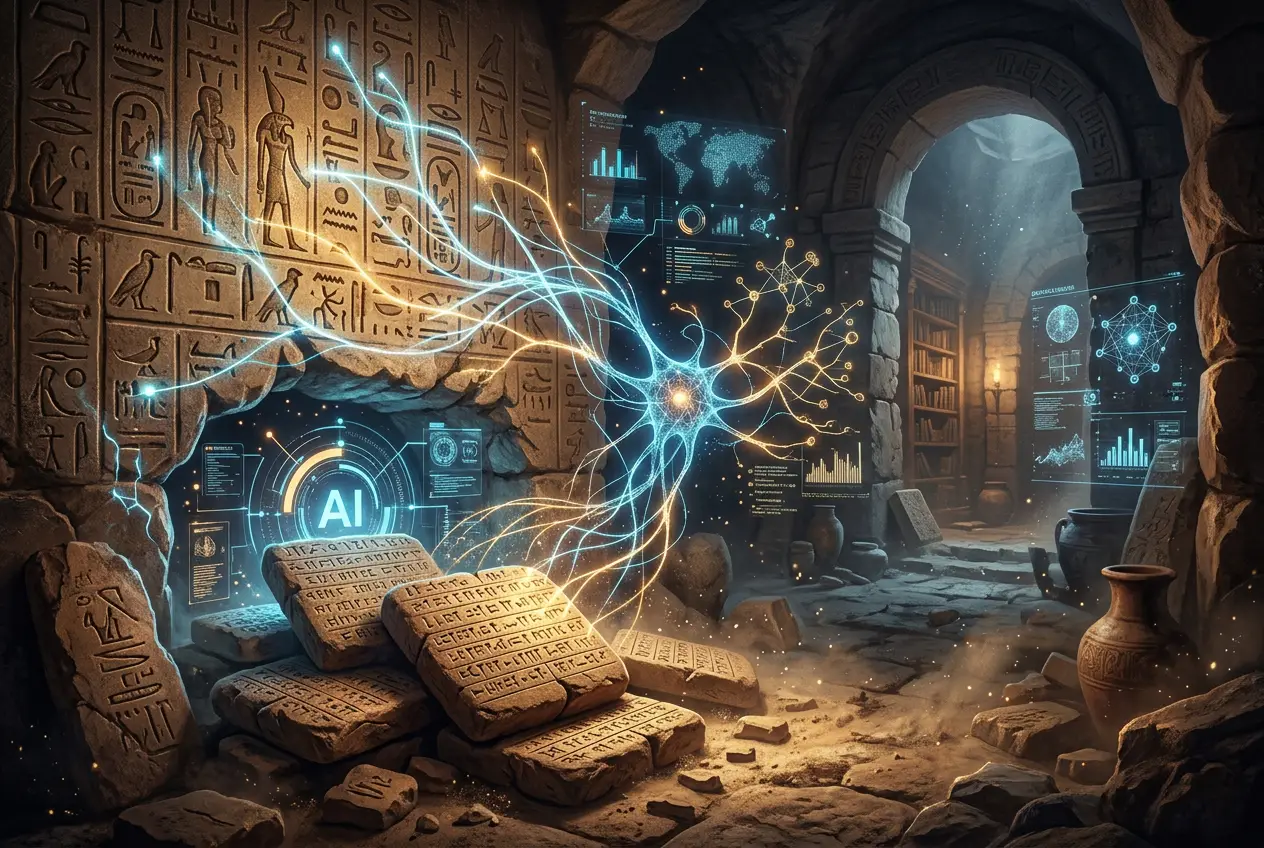
I’ve always been fascinated by the whispers of the past, especially those hidden in undeciphered scripts. Imagine holding a key to a vault of knowledge, a direct line to the thoughts and stories of civilizations long gone, yet being unable to turn it. This is the enduring mystery of lost languages—scripts that hold the wisdom, history, and everyday lives of ancient peoples, but remain stubbornly silent. For centuries, brilliant minds have grappled with these linguistic puzzles, often spending entire lifetimes on a single inscription. But what if the next great decipherment isn’t the work of a lone human scholar, but a collaboration with something far more powerful? What if Artificial Intelligence holds the key to unlocking these ancient lost languages?
Recently, I’ve been diving deep into the burgeoning field of AI in historical linguistics, and what I've found is truly astounding. The idea isn't just science fiction anymore; it’s a rapidly developing area where machine learning algorithms are being trained to spot patterns, predict grammar, and even infer meaning from texts that have stumped humans for generations. It feels like we're on the cusp of a new era, where digital minds might finally let ancient voices speak again.
The Silent Centuries: Why Some Languages Remain Lost
Before we delve into AI’s role, let’s understand why some languages remain lost in the first place. The challenges are formidable. Often, we lack a bilingual text, like the Rosetta Stone, which provided the key to Egyptian hieroglyphs by presenting the same decree in three scripts, including ancient Greek, which was understood. Without such a "crib," decipherers are left trying to break a code with no direct reference.
Furthermore, we might not know the language family, the grammatical structure, or even the direction of writing. Imagine trying to read English if you didn't know it was read left-to-right, didn't recognize any of its letters, and had no idea if it was related to, say, Chinese or Swahili. This is the magnitude of the challenge for scripts like Linear A from Minoan Crete or the Indus script from the Harappan civilization. These scripts are not just code-breaking exercises; they require a deep understanding of the underlying linguistic system and cultural context.
Historically, decipherment has been a painstaking, inductive process. Scholars examine every available inscription, looking for recurring symbols, attempting to infer word breaks, and comparing them to known languages from the same region or period. It’s a monumental task, combining linguistics, history, archaeology, and often, sheer intuition.
Enter AI: Pattern Recognition on Steroids
This is where Artificial Intelligence steps in. At its core, AI excels at pattern recognition. It can process vast amounts of data at speeds and scales impossible for humans. For lost languages, this means analyzing every known inscription, identifying recurring symbols, detecting potential grammatical structures, and even cross-referencing these patterns with other known languages or linguistic families.
Think of it like this: human decipherers are brilliant detectives, but they can only process a finite number of clues at a time. An AI, particularly one utilizing deep learning techniques, can sift through millions of data points simultaneously, identifying subtle correlations that might escape even the most observant human eye.
One of the foundational principles AI employs is statistical analysis. For instance, certain symbols or sequences of symbols might appear more frequently at the beginning or end of what are inferred to be words. Some languages follow specific word orders (subject-verb-object, for example). AI can learn these statistical regularities, even if the underlying language is unknown.
For instance, a team at MIT developed an AI system that successfully deciphered a lost language by identifying its linguistic family and the direction of writing. Their algorithm leveraged a crucial principle: languages tend to maintain consistent word order. If two languages share a common ancestor, their word orders are more likely to be similar. This seemingly simple rule, when applied across thousands of words and phrases by an AI, can be incredibly powerful for breaking down linguistic barriers. You can read more about this on Wikipedia's article on decipherment (opens in a new tab).
Case Studies: AI's Early Victories and Bold Attempts
While a complete, groundbreaking decipherment of a major lost language purely by AI is yet to be announced, there have been significant advancements and promising attempts:
- Ugaritic to Hebrew: Researchers have successfully used AI to translate Ugaritic, an ancient Semitic language, into Hebrew with remarkable accuracy. While Ugaritic is not "lost" in the same way as Linear A, this project demonstrated AI's ability to learn and apply rules across closely related languages. The algorithms identified root words and morphological patterns common to both, showcasing AI's potential in comparative linguistics.
- Linear B: While Linear B was famously deciphered by Michael Ventris (a human!) in the 1950s, modern AI models have been applied to its corpus. These projects serve as valuable benchmarks, training AI to "re-decipher" known languages, thereby refining their algorithms for truly unknown scripts. This process helps us understand how AI might approach a language with no known relatives.
- The Voynich Manuscript: This infamous text, filled with strange illustrations and an undeciphered script, has long been the holy grail for codebreakers. While no AI has definitively cracked it, various research groups have applied machine learning to analyze its statistical properties, word distributions, and potential linguistic structure. Some AI-driven analyses have suggested it might be a cipher of an existing language, or even a sophisticated hoax. For more on this enigmatic text, check out our blog post on the topic: Voynich Manuscript: Secret Code or Ancient AI?.
- Ancient Greek Dialects: Another area where AI shows promise is in distinguishing between subtle dialects of ancient languages where context might be limited. By analyzing stylistic differences, lexical variations, and grammatical nuances, AI can help classify texts and provide insights into linguistic evolution.
The Role of Human-AI Collaboration
It's important to clarify that AI isn't replacing human scholars; it's augmenting them. The most successful approaches involve a human-in-the-loop system. AI can sift through data, propose hypotheses, and highlight patterns, but human linguists provide the intuition, cultural context, and nuanced understanding that machines currently lack.
Consider the example of the Rosetta Stone. While it provided a direct translation, the full decipherment still required years of dedicated human effort. AI could potentially accelerate the initial matching phase, but understanding the nuances of ancient Egyptian culture and religion embedded in the hieroglyphs requires human expertise. As I've explored in other contexts, like how AI can dream and decipher digital imagination, AI's true power lies in its ability to process information on a scale we cannot, opening new avenues for human insight.
The Road Ahead: Challenges and Ethical Considerations
Despite the promising advancements, significant challenges remain.
- Data Scarcity: Many lost languages have very few surviving inscriptions. AI models, especially deep learning ones, thrive on vast datasets. Limited data means less for the AI to learn from, making accurate decipherment harder.
- No "Ground Truth": When a language is truly lost, there’s no known translation to verify the AI's output. How do we know if the AI is correct, or merely generating plausible-sounding nonsense? This necessitates robust validation methods, often involving historical and archaeological cross-referencing.
- Contextual Understanding: Language is deeply intertwined with culture. AI can identify word patterns, but understanding the poetic, metaphorical, or religious meanings embedded in ancient texts often requires a level of contextual awareness that current AI struggles with. For instance, knowing that a specific symbol represents a god or a ritual is not something easily inferred from syntax alone.
Moreover, there are ethical considerations. If AI "deciphers" a text, who verifies its accuracy? What if a false decipherment gains widespread acceptance, fundamentally altering our understanding of an ancient culture? This underscores the need for stringent validation and continued human oversight. The history of scholarship is replete with examples of mistaken decipherments that took decades to correct.
A Future Where Ancient Voices Echo Anew
The journey to unlock ancient lost languages is far from over, but the advent of Artificial Intelligence has injected a powerful new tool into the decipherer's arsenal. From recognizing common linguistic structures to analyzing statistical regularities, AI can perform tasks that would take humans centuries, if not millennia. It’s not about machines replacing scholars, but about creating a synergistic partnership, where the computational power of AI enhances the wisdom and intuition of human expertise.
I truly believe we are entering a golden age of historical discovery, driven by technology. Imagine a world where the Linear A tablets finally reveal the secrets of the Minoans, or the Indus script opens a window into the mysterious Harappan civilization. AI won't just translate words; it will help us reconstruct entire worldviews, recover forgotten histories, and perhaps, even help us understand the very origins of human communication. This prospect, to me, is one of the most exciting frontiers in modern technology and historical research. It's a reminder that sometimes, the future’s most profound revelations lie hidden in the distant past.
As we continue to develop more sophisticated AI, the question isn't whether AI can unlock these secrets, but how quickly and completely it will help us restore the voices of our ancestors. The future of understanding the past is digital, and I, for one, am incredibly excited to hear what these ancient voices have to say.





Conversation0
No comments yet. Be the first to share a thought — the best questions often become new stories.