


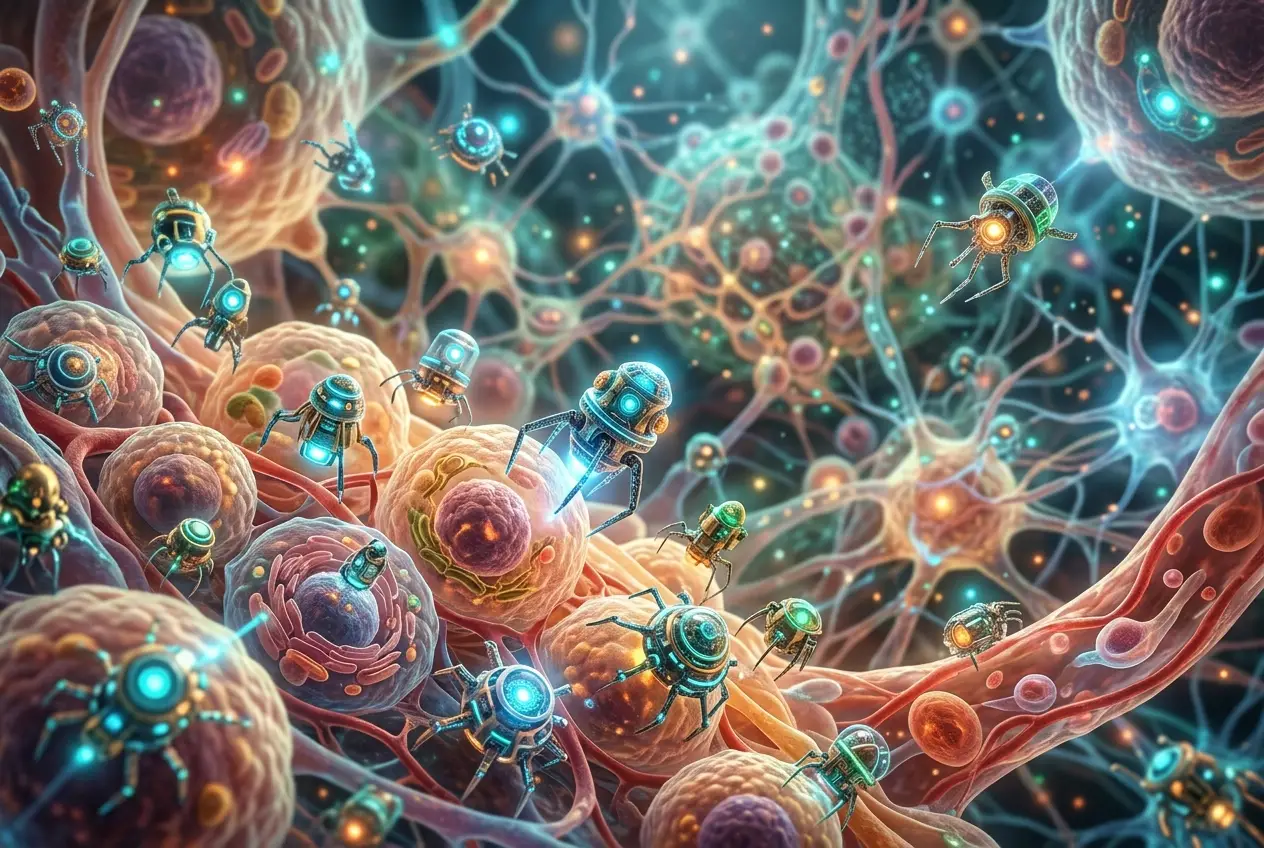
I’ve always been captivated by the potential of miniature technology, especially when it intertwines with something as profoundly complex as the human body. Recently, I found myself diving deep into the realm of nanobots—those almost mythical microscopic machines that promise to revolutionize medicine. It feels like something straight out of a science fiction novel, yet the scientific community is making astounding progress. Could these tiny robots truly become our internal repair crew, fixing illnesses from the inside out?
The idea of microscopic machines navigating our bloodstream, battling diseases at a cellular level, is both exhilarating and a little unsettling. But as I explored the research, I realized we're not just talking about distant future dreams; we’re talking about groundbreaking innovations happening right now. This isn't just about bigger, better pills; it's about a paradigm shift in how we approach health, healing, and even human longevity.
The Microscopic Revolution: What Exactly Are Nanobots?
At their core, nanobots are machines on the nanoscale, typically ranging from 1 to 100 nanometers. To put that into perspective, a single human hair is about 80,000 to 100,000 nanometers thick. We're talking about devices so small they can interact directly with individual cells, proteins, and even DNA. The field of nanotechnology, which includes nanobots, is essentially engineering at the atomic and molecular level. It’s like being able to tinker with the very building blocks of life and matter.
These aren't just passive particles; we're envisioning sophisticated microscopic robots capable of performing specific tasks. Some might be simple drug delivery systems, while others could be complex autonomous entities performing intricate surgical procedures. The beauty of nanobots lies in their precision. Unlike conventional treatments that often affect healthy tissues alongside diseased ones, nanobots promise targeted interventions with unprecedented accuracy.
The Promise of Precision Medicine: How Nanobots Could Heal
Imagine a future where a cancer diagnosis doesn't lead to debilitating chemotherapy, but a swift, localized attack by a swarm of nanobots. Or perhaps, a heart attack could be averted by nanobots clearing arterial blockages before they become critical. These aren't just hopeful musings; they're the driving force behind extensive research.
Targeted Drug Delivery
One of the most immediate and promising applications of nanobots is targeted drug delivery. Currently, many powerful drugs, especially chemotherapy agents, spread throughout the body, causing severe side effects. Nanobots could be engineered to encapsulate these drugs and release them only at the site of cancerous cells or infected tissues. This precision would drastically reduce side effects and increase treatment efficacy. Researchers are exploring various materials, from gold nanoparticles to biocompatible polymers, to create these intelligent delivery systems. For a deeper dive into how such microscopic entities can interact with biological systems, you might find our blog on living cells as supercomputers fascinating.
Cellular Repair and Regeneration
This is where the idea of "repairing our bodies from within" truly shines. Nanobots could potentially be programmed to:
- Repair damaged cells: Imagine nanobots identifying and mending compromised cell membranes or organelles.
- Remove harmful agents: They could seek out and destroy bacteria, viruses, or even rogue proteins responsible for neurodegenerative diseases like Alzheimer's.
- Assist in tissue regeneration: By delivering growth factors or scaffolding materials directly to injured sites, nanobots could accelerate wound healing or help regenerate damaged organs.
- Gene editing: Nanobots could potentially deliver gene-editing tools like CRISPR-Cas9 with unparalleled accuracy to specific cells, correcting genetic defects that cause hereditary diseases. The journey into advanced biotechnologies like this truly makes me wonder about the future of human biology.
Early Disease Detection
Beyond treatment, nanobots hold immense potential for early disease detection. Circulating within the body, they could act as microscopic sentinels, detecting the earliest biomarkers of cancer, infections, or other conditions long before symptoms appear. This proactive approach could drastically improve prognosis for many illnesses. Think of it as an internal, continuous diagnostic system, far more sensitive than any blood test we have today.
Challenges on the Path to the Nanobot Future
While the promise is extraordinary, the challenges are equally daunting. I'm always reminded that scientific breakthroughs, especially those impacting human health, require rigorous testing and ethical consideration.
Biocompatibility and Immune Response
The most significant hurdle is ensuring that nanobots are biocompatible—meaning they don't trigger a harmful immune response from the body. Our immune system is designed to detect and destroy foreign invaders, and nanobots, no matter how beneficial, are foreign entities. Researchers are exploring various surface coatings and materials to make nanobots "invisible" to the immune system. Finding the right balance between functionality and biological acceptance is critical.
Navigation and Power
How do these tiny machines know where to go? And how do they power themselves? Precise navigation within the complex vascular network of the human body is a monumental task. Researchers are experimenting with external magnetic fields, biochemical gradients, and even self-propelling mechanisms (like bacterial flagella or chemical reactions) to guide nanobots. Power sources are also a challenge, with options ranging from biological fuels (like glucose) to external energy sources or even internal energy harvesting. Learn more about the complex interfaces between living systems and technology in discussions around brain-computer interfaces.
Control and Programming
The sheer complexity of programming and controlling billions of nanobots simultaneously within a dynamic biological environment is mind-boggling. Advanced artificial intelligence (AI) will likely play a crucial role, allowing nanobots to operate autonomously, make real-time decisions, and adapt to changing conditions. This makes me consider how much we already rely on advanced algorithms, as seen in topics like AI predicting scientific leaps.
According to a report by Grand View Research, "The global nanomedicine market size was valued at USD 138.8 billion in 2021 and is expected to grow at a compound annual growth rate (CAGR) of 10.3% from 2022 to 2030." This indicates a massive investment and confidence in the future of medical nanotechnology, even with the hurdles. (Source: Wikipedia on Nanomedicine (opens in a new tab))
Safety and Ethics
Beyond the technical challenges, profound ethical questions arise. What are the long-term effects of nanobots remaining in the body? Who controls these powerful microscopic agents? What are the implications for human enhancement and the very definition of being human? These are questions that society, not just scientists, must grapple with as the technology progresses. As I often think when considering radical tech, the social and ethical dimensions are just as complex as the scientific ones.
The Road Ahead: From Lab to Life
Despite the formidable obstacles, the progress in nanobot research is accelerating. Scientists are developing proof-of-concept nanobots that can:
- Swim through bodily fluids using miniature propellers.
- Detect cancer cells by binding to specific biomarkers.
- Deliver tiny payloads of drugs or gene-editing tools.
The journey from a laboratory prototype to a clinically approved medical treatment is long and arduous, involving years of preclinical testing, clinical trials, and regulatory approvals. However, the potential rewards—a future free from many of today's most devastating diseases—are immense.
Nobel laureate Richard Feynman, in his visionary 1959 speech "There's Plenty of Room at the Bottom," famously said, "The principles of physics, as far as I can see, do not speak against the possibility of maneuvering things atom by atom." This foundational idea continues to inspire generations of scientists and engineers to push the boundaries of what's possible at the smallest scales. (Source: Wikipedia on There's Plenty of Room at the Bottom (opens in a new tab))
While we might not have swarms of autonomous repair bots flowing through our veins tomorrow, the foundational work is being laid. Nanobots are not merely a futuristic fantasy; they represent a tangible, evolving frontier in medicine. The vision of our bodies being repaired, protected, and enhanced from within is becoming less a dream and more a scientific inevitability. This microscopic revolution could very well redefine health, extending not just our lifespan, but the quality of our years. It’s an exciting, slightly nerve-wracking, but ultimately hopeful prospect that keeps me glued to every new discovery.
For more on how tiny technologies could reshape our world, consider exploring the concept of smart dust and a digital skin for our planet, another fascinating example of engineering at small scales.


Conversation0
No comments yet. Be the first to share a thought — the best questions often become new stories.